Locker Estate Management UK: Managing Locker Assets, Access, Lifecycle and Performance
May 14, 2026
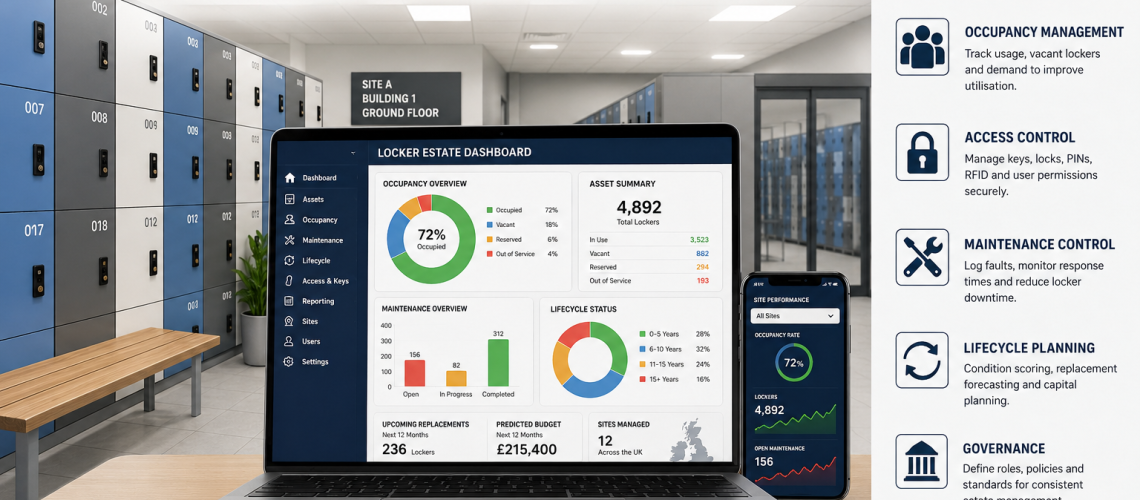
Locker estate management is the organisation-wide process used to keep an existing locker estate visible, controlled, serviceable and aligned with current user and operational requirements throughout its working life.
It connects the physical locker estate with asset records, condition, allocation, occupancy, access systems, maintenance, intervention status, performance, governance and replacement planning. The purpose is not to duplicate every specialist process. It is to make sure each process works from consistent information and has a clear owner, status and next action.
Locker Estate Management coordinates the whole physical estate. The Asset Register records what exists. Estate Audit verifies condition. Parts & Servicing diagnoses faults and routes corrective work. Refurbishment and Replacement Planning deliver approved interventions.
For planning a new locker installation or redesigning a room, use Locker Planning UK. For faults, component repair and initial intervention routing, use Locker Parts & Servicing. Approved refurbishment and replacement work then move into their dedicated project guides.
A well-managed locker estate should answer four questions: what exists, where is it, what state is it in, and which process owns the next action?
Quick Answer: What Is Locker Estate Management?
Locker estate management is the coordinated control of a defined population of lockers across one or more sites. It gives facilities and estates teams an overall view of physical assets, location, condition, usable capacity, maintenance status, intervention position, responsibilities and future investment requirements.
| Estate area | Main question | Detailed owner |
|---|---|---|
| Asset visibility | What lockers exist and where are they? | Locker Asset Register |
| Physical condition | What condition is the estate in? | Locker Estate Audit |
| User allocation | Who is assigned or entitled to use storage? | Locker Management Systems |
| Occupancy | How much usable capacity is actually being used? | Occupancy Management |
| Access technology | How are lockers opened? | Access Control Systems |
| Access authority | Who may approve, reset or override access? | Access Permissions & Governance |
| Maintenance | What faults and work orders are open? | CAFM Integration |
| Intervention status | Is the next action routine repair, refurbishment, replacement or monitoring? | Parts & Servicing / Estate Audit |
| Replacement | Which approved renewal projects need funding and delivery? | Replacement Planning |
| Multi-site coordination | How should several locations operate consistently? | Multi-Site Estate Management |
What This Locker Estate Management Guide Owns
This guide owns the estate-wide coordination layer. It explains how the physical locker estate is controlled, how specialist records connect, how responsibilities are divided and how management information is converted into practical action.
- Overall locker-estate ownership and coordination.
- Common asset and location hierarchy.
- Estate-wide terminology and minimum information standards.
- Visibility of physical condition and usable capacity.
- Connection between asset records, maintenance and intervention status.
- Estate-level governance, responsibilities and escalation.
- Estate-level KPIs and performance oversight.
- Recurring-fault and maintenance-risk visibility.
- Prioritisation of management attention.
- Coordination of refurbishment and replacement pipelines.
- Consistency across several sites.
- Control of estate standards and approved exceptions.
Detailed operating processes remain with their specialist owners. This page does not recreate occupancy methodology, individual asset-register fields, CAFM configuration, access-control selection, fault diagnosis, refurbishment delivery or replacement-project delivery.
Treat Lockers as Operational Infrastructure
In larger organisations, lockers are not simply individual storage products. They form part of the wider operational infrastructure of a building or estate because their location, capacity, access method, maintenance and availability affect how people use changing rooms, workplaces, schools, healthcare sites and industrial facilities.
Locker estate management brings these infrastructure layers together without replacing the specialist processes that own them. Physical assets, user allocation, occupancy, access control, maintenance and intervention decisions should remain distinct, but they should use compatible records and common estate definitions.
| Infrastructure layer | Estate-management requirement | Specialist owner |
|---|---|---|
| Physical lockers | Know what exists, where it is and its current status | Locker Asset Register |
| Capacity | Separate installed, usable and unavailable capacity | Occupancy Management |
| User allocation | Know how lockers are assigned and returned to availability | Locker Management |
| Access | Keep the principal lock or access family visible | Access Control |
| Maintenance | Connect faults and repairs to the physical asset | CAFM Integration |
| Intervention | Keep repair, refurbishment and replacement status visible | Parts & Servicing, Refurbishment and Replacement Planning |
This infrastructure view is especially useful where lockers affect staff flow, changing facilities, school circulation, shift working, PPE storage or shared workplace capacity. The exact locker product can vary by environment, but the management framework should remain coherent.
What Counts as a Locker Estate?
A locker estate is more than a collection of metal or laminate cabinets. It is the complete managed population of lockers, compartments, locks, locations, records and supporting processes within a defined organisation or site.
- Locker banks and individual compartments.
- Locker type, material, size and configuration.
- Locks and access-system families.
- Asset numbers and locker numbering.
- Site, building, floor, department and room locations.
- Allocation model.
- Occupancy and availability status.
- Physical condition.
- Maintenance status.
- Current intervention status.
- Replacement or refurbishment status.
- Approved local exceptions.
A small workplace might have one changing room containing several locker banks. A national employer, academy trust, healthcare organisation or council may have thousands of lockers spread across multiple sites. The same principles apply, but the level of formal control should remain proportionate to the size and complexity of the estate.
Build a Clear Locker Estate Hierarchy
Locker estate management becomes unreliable when different records use different location names, asset references or definitions. Establish a hierarchy that can be used consistently across asset records, inspections, maintenance, occupancy reporting and replacement planning.
| Hierarchy level | Example | Purpose |
|---|---|---|
| Organisation | Company, trust, council or NHS organisation | Defines the overall estate |
| Region / division | Operating region or business unit | Supports portfolio management |
| Site | School, hospital, depot or office | Identifies the principal location |
| Building / floor | Main building or first floor | Improves location accuracy |
| Room / area | Changing room, corridor or department | Locates the locker operationally |
| Locker bank | Bank A12 | Connects maintenance and condition records |
| Compartment | Locker 042 | Supports allocation and access where needed |
The detailed asset fields belong in Locker Asset Register UK. Estate management owns the requirement that connected records and systems use the same hierarchy consistently.
Maintain One Reliable Physical Asset Record
The organisation should have one recognised source for core physical locker information. Avoid uncontrolled spreadsheets, maintenance systems and local lists that each describe the same assets differently.
- Stable locker or bank identifier.
- Site and precise location.
- Manufacturer or product range where known.
- Material and locker configuration.
- Compartment quantity.
- Lock family.
- Numbering reference.
- Current service status.
- Current condition status.
- Last physical verification date.
- Current repair, refurbishment or replacement status.
Use Locker Asset Register UK for the detailed structure and fields of the asset record.
Keep Physical Condition Visible
Knowing that a locker exists is not enough. Estates teams also need sufficient current evidence to identify deteriorating assets and areas requiring intervention.
- Door and frame condition.
- Hinge operation and alignment.
- Lock operation.
- Corrosion or moisture damage.
- Loose or unstable units.
- Missing shelves, hooks or fittings.
- Damaged numbering or identification.
- Suitability for current belongings.
- Cleaning and maintenance access.
- Accessibility issues requiring planning review.
Where existing records cannot be trusted, carry out a physical verification using Locker Estate Audit UK.
Separate Condition Evidence From Intervention Status
A condition problem is evidence, not automatically a replacement decision. A failed lock may need a simple repair. Repeated faults, widespread wear, unsuitable retained lockers or structural deterioration may justify a larger intervention.
| Estate evidence | Typical next route |
|---|---|
| Minor isolated defect | Parts or servicing |
| Repeated similar faults | Investigate cause and review the wider bank |
| Several worn components but sound structure | Refurbishment review |
| Condition unclear across a wider estate | Estate audit |
| Structural deterioration or unsuitable retained estate | Replacement planning once renewal is approved |
| Replacement already approved | Move into project delivery |
Estate Management should keep the status visible, but the detailed technical work remains with the specialist process. Use Locker Parts & Servicing for fault diagnosis, Locker Estate Audit for broader physical evidence, Locker Refurbishment for approved renewal of retained assets and Locker Replacement Planning for approved replacement projects.
Use Recurring Faults as an Early Warning Signal
Repeated problems can reveal deterioration before complete failure occurs. Estate management should therefore make recurring faults visible rather than treating every repair as an isolated event.
- Repeated lock failures on the same locker or lock family.
- Increasing hinge or door-alignment problems.
- Corrosion recurring in the same environment.
- Increasing maintenance visits.
- Repeated unavailable capacity.
- Replacement parts becoming difficult or uneconomical to source.
- Repeated temporary repairs.
- Increasing downtime before return to service.
These signals do not automatically mean replacement is required. They indicate that the affected assets need review through Parts & Servicing and, where the issue is wider than isolated faults, Estate Audit.
Keep Allocation and Occupancy Separate
Locker allocation and locker occupancy are related but different. A locker can be allocated to an individual yet rarely used. A shared locker can serve several people without permanent assignment. A damaged locker may still exist physically while being unavailable for normal use.
| Measure | Meaning |
|---|---|
| Physical capacity | Total installed compartments |
| Usable capacity | Compartments currently fit and available for permitted use |
| Assigned | A user or group has been allocated the locker |
| Occupied / used | The locker is being used under the local occupancy definition |
| Vacant | Usable capacity not presently allocated or occupied |
| Unavailable | Installed capacity temporarily or permanently removed from normal use |
Use Locker Management Systems UK for user allocation and administration. Use Locker Occupancy Management Systems UK for occupancy, vacancy and utilisation methodology.
Keep Lock and Access Information Visible
Lock type affects maintenance, key control, override arrangements, replacement parts and future upgrades. The estate record should therefore make the principal locking system visible without becoming the operational access database.
- Keyed cam lock.
- Padlock hasp.
- Mechanical combination lock.
- Coin or token lock.
- Electronic keypad lock.
- RFID or credential-based lock.
- Smart or centrally managed access system.
- Known master-key or override family where relevant.
Where the locking method itself needs review, use Locker Access Control Systems UK. For administrator authority, resets, overrides and revocation, use Locker Access Permissions & Governance UK.
Connect Locker Maintenance to the Correct Asset
Fault and repair information becomes far more useful when every maintenance event can be connected to the correct locker bank, compartment, lock or component.
- Asset or locker-bank reference.
- Fault category.
- Date reported.
- Operational impact.
- Action taken.
- Parts used.
- Date returned to service.
- Repeat-fault indicator.
- Intervention-review flag where appropriate.
For asset-to-work-order integration, source-of-truth rules and facilities-management systems, use Locker CAFM Integration UK.
Use CAFM Without Creating a Second Locker Estate
CAFM or IWMS software can be useful for inspections, maintenance, QR asset access, work orders and reporting, but it should not create a conflicting parallel set of locker definitions.
- Decide which system owns the master asset identifier.
- Define which system owns location data.
- Define which status fields are exchanged.
- Use controlled terminology consistently.
- Avoid manually retyping the same information into several systems where reliable integration is available.
- Define what happens when lockers are moved, replaced or decommissioned.
- Validate imported and synchronised records.
Keep Intervention Status Visible Across the Estate
The estate-management view should show where assets sit in the repair and renewal pipeline without creating a competing technical decision process.
| Status | Estate meaning |
|---|---|
| Normal service | No action beyond routine operation and maintenance |
| Monitor | Issue recorded but no immediate intervention is approved |
| Repair required | Defined fault requires corrective work |
| Refurbishment review | Coordinated renewal may be more appropriate than repeated isolated repairs |
| Approved refurbishment | Asset has entered a defined refurbishment programme |
| Replacement review | Condition or suitability evidence indicates renewal should be assessed |
| Approved replacement | Asset has entered a planned replacement programme |
| Decommissioned | Asset is no longer part of active usable capacity |
The technical evidence behind these statuses belongs with Parts & Servicing, Estate Audit, Refurbishment and Replacement Planning. Estate Management keeps the status and next owner visible.
Define Locker Estate Governance and Responsibility
A significant locker estate needs clear organisational ownership. This does not mean one person performs every task. It means the organisation knows who is accountable for the overall estate, who maintains standards and records, who may approve exceptions and where unresolved issues must escalate.
Estate governance controls the locker estate as an operational asset. Access governance controls authority over opening, resetting, overriding and administering locker access.
For privileged access roles, resets, overrides, credential administration and revocation, use Locker Access Permissions & Governance UK.
Name a Locker Estate Owner
Every managed locker estate should have a clearly identifiable organisational owner, even where day-to-day work is divided between several teams or locations.
- Facilities management.
- Estates.
- Workplace services.
- School or academy-trust administration.
- Healthcare estates.
- Site operations.
- Property or physical-asset management.
The job title matters less than making accountability visible. Other teams should know who owns the locker-estate framework and where unresolved estate-level issues should go.
Define Locker Estate Governance Roles
| Role | Typical responsibility |
|---|---|
| Estate owner | Overall accountability for the locker-estate framework |
| Standards owner | Maintains approved estate terminology and minimum requirements |
| Asset-data owner | Maintains required physical record fields, identifiers and data-quality rules |
| Local site owner | Applies the agreed framework locally and escalates exceptions |
| Maintenance owner | Owns fault workflow, repairs and return to service |
| Intervention owner | Coordinates repair, refurbishment and replacement-review routing |
| Exception approver | Approves justified departures from estate standards |
| Reporting owner | Ensures estate KPIs and exceptions reach the appropriate management audience |
| Assurance reviewer | Checks whether agreed estate-management controls are being followed |
One person may hold several responsibilities in a small organisation. A large estate may divide them between facilities, maintenance, asset-data, procurement and local site teams.
Set Minimum Locker Estate Standards
- Every locker bank or managed asset should have a stable identifier.
- Sites should use the agreed location hierarchy.
- Required physical asset fields should be defined.
- Faults should use common categories where cross-estate reporting is required.
- Physical condition should use the approved audit framework.
- Intervention status should use the approved repair, refurbishment and replacement terminology.
- Estate KPIs should use documented definitions and denominators.
- Approved locker and lock families should be used where standardisation provides practical benefit.
- Material local exceptions should be recorded.
- Unresolved significant issues should have a defined escalation route.
The objective is consistent management and evidence, not forcing every site to use identical locker products.
Control Changes to Estate Standards
Organisation-wide standards should not change informally because one site buys a different locker range, uses a different lock family or starts using different terminology.
- Approved locker families.
- Approved lock or access families.
- Asset-identification structure.
- Minimum asset-data fields.
- Location hierarchy.
- Condition terminology.
- Intervention statuses.
- Fault categories.
- KPI definitions and reporting rules.
- Escalation thresholds.
Define which role can approve changes to each standard and record material changes so historic reports can still be interpreted correctly.
Control Local Exceptions Without Forcing Uniformity
Some locations have legitimate reasons to depart from the normal estate standard. Wet areas, specialist PPE storage, charging requirements, accessibility needs or an established local access system can justify a different solution.
The objective is therefore controlled variation rather than eliminating every exception.
| Exception field | Purpose |
|---|---|
| Standard affected | Identifies which normal estate rule is being varied |
| Reason | Explains the operational requirement |
| Alternative | Records the proposed local solution |
| Impact | Records maintenance, cost, compatibility or support implications |
| Approver | Shows who authorised the variation |
| Review date | Shows when the exception should be reconsidered where appropriate |
Approved variation should remain visible so future maintenance, refurbishment and replacement decisions do not accidentally treat it as uncontrolled drift.
Define Estate Escalation Routes
| Issue | Typical escalation route |
|---|---|
| Routine local fault | Local facilities / maintenance |
| Repeated component problem | Maintenance / Parts & Servicing |
| Cross-site recurring problem | Central estate owner |
| Asset-data quality problem | Asset-data owner / estate owner |
| Overdue physical verification | Local owner / Estate Audit owner |
| Estate-standard exception | Standards or exception approver |
| Material access-authority concern | Access Permissions & Governance |
| Replacement-review issue | Estate owner with Parts & Servicing / Estate Audit evidence |
| Approved capital requirement | Estate, finance or appropriate approving group |
| Unresolved material estate issue | Senior estate owner or appropriate management body |
The specialist process identifies and manages the immediate problem. Estate management ensures unresolved issues remain visible and reach the correct level of authority.
Record Material Estate Decisions
- Decision reference.
- Date.
- Issue considered.
- Evidence used.
- Decision made.
- Approving role.
- Conditions attached to approval.
- Next action.
- Review date where appropriate.
Examples include approving a local locker exception, changing an estate-wide lock family, accepting a refurbishment programme or approving replacement for progression into procurement.
Check That the Estate Framework Is Being Followed
Estate assurance is different from a physical locker audit. Locker Estate Audit UK verifies physical assets and condition. Estate assurance checks whether the management framework itself is operating as intended.
- Is there still a named estate owner?
- Are minimum asset records being maintained?
- Are approved terminology and status definitions being used?
- Are local exceptions recorded?
- Are unresolved actions visible?
- Are escalation routes being used?
- Are estate KPI definitions applied consistently?
- Are repair, refurbishment and replacement decisions reaching the estate record?
- Are decommissioned assets removed from active capacity?
- Are approved standards still suitable for current operations?
Review Governance When the Estate Changes
- New sites or acquisitions.
- Major changes in user population.
- Move from keyed to electronic access.
- Introduction of shared or hot lockers.
- New CAFM, workplace or smart-locker software.
- Major refurbishment or replacement programmes.
- Recurring exceptions showing that the existing standard no longer fits.
- Changes in organisational ownership.
- Repeated data-quality or reporting problems.
Standardise the Framework, Not Every Locker
Estate standardisation should reduce avoidable complexity without forcing unsuitable uniformity across different buildings, users and environments.
- Use common asset and location identifiers.
- Use common condition, availability and intervention terminology.
- Use approved locker and lock families where that simplifies parts support and administration.
- Use common fault categories and escalation routes.
- Use common minimum record fields.
- Define which local variations require approval.
- Retain different materials, dimensions or access systems where the operational requirement justifies them.
The goal is consistency of management, evidence and terminology, not identical locker products regardless of context.
Locker Estate KPIs Worth Monitoring
Locker estate KPIs should help facilities and estates teams identify change, exceptions and emerging problems. They should support management decisions without becoming a second occupancy, maintenance, audit, fault-diagnosis or replacement-planning system.
A locker KPI is only useful when its definition, denominator, reporting period and data source are consistent. Raw totals can be useful operationally, but they are often misleading when comparing different sites, periods or locker populations.
Define Each KPI Before You Report It
| KPI element | What should be defined |
|---|---|
| Purpose | The management question, risk or decision the KPI supports |
| Scope | Which sites, locker banks, compartments, faults or jobs are included |
| Numerator | The quantity, event, time or cost being counted |
| Denominator | The population, time or activity against which it is measured |
| Reporting period | Snapshot date, week, month, quarter, year or other defined period |
| Data source | The authoritative system or record supplying the evidence |
| Owner | The role responsible for reviewing and following up the KPI |
| Baseline | The measured starting performance |
| Target | The locally justified intended performance level |
| Threshold | The point at which review or escalation is triggered |
If the formula, denominator, scope or source changes, record the change. Do not silently continue a trend line as though the measurement remained identical.
Core Locker Estate KPIs
| KPI | What it shows | Typical source |
|---|---|---|
| Usable capacity | How much installed capacity is currently available for normal use | Occupancy / estate records |
| Unavailable capacity | How much installed capacity has been removed from normal use | Occupancy / maintenance |
| Occupancy or utilisation | How much usable capacity is actually being used | Occupancy Management |
| Fault rate | Frequency of reported faults relative to estate size | CAFM / maintenance |
| Repeat-fault rate | How frequently problems recur on affected assets | CAFM / maintenance |
| Lock failure rate | Reliability of locks and access components | CAFM / access records |
| Downtime | How long locker capacity remains unavailable | CAFM / maintenance |
| Maintenance response time | How quickly reported faults receive a defined response | CAFM |
| Resolution time | How long it takes to restore normal service | CAFM |
| Maintenance backlog | Outstanding maintenance demand | CAFM |
| Inspection completion | Whether planned physical verification is taking place | Estate Audit |
| Asset-record completeness | Whether required physical asset information is available | Asset Register |
| Replacement-review exposure | How much of the estate has formally entered replacement review | Estate Management supported by condition and servicing evidence |
| Overdue actions | Whether agreed management actions are being completed | Estate / CAFM records |
Useful Locker KPI Formulas
| Measure | Example calculation |
|---|---|
| Usable capacity | Total physical compartments – unavailable compartments |
| Unavailable capacity rate | Unavailable compartments ÷ total physical compartments × 100 |
| Fault rate per 100 lockers | Faults during period ÷ in-scope locker population × 100 |
| Lock failure rate per 100 compartments | Lock failures during period ÷ in-scope lock-equipped compartments × 100 |
| Repeat-fault rate | Assets with a defined repeat fault ÷ assets with at least one fault × 100 |
| Inspection completion | Completed scheduled inspections ÷ scheduled inspections × 100 |
| Asset-record completeness | Assets with all required fields complete ÷ assets in scope × 100 |
| Overdue action rate | Overdue applicable actions ÷ open applicable actions × 100 |
| Replacement-review exposure | Assets in replacement review ÷ in-scope assets × 100 |
Always state the reporting period with rate-based measures. For example, faults per 100 usable lockers per month is clearer than simply reporting a fault rate.
Detailed occupancy calculations belong in Locker Occupancy Management Systems UK. Replacement-review status should be supported by Parts & Servicing and Estate Audit evidence, while Estate Management keeps that status visible across the portfolio.
Keep Response Time, Resolution Time and Downtime Separate
| Metric | Starts | Ends |
|---|---|---|
| Response time | Fault report received | Acknowledgement or attendance according to the local definition |
| Resolution time | Fault report received | Locker returned to normal service |
| Repair working time | Repair work starts | Repair work ends |
| Downtime | Locker becomes unavailable | Locker returns to usable service |
A quick response can still be followed by long downtime where a specialist component or replacement part is required.
Baseline, Target and Threshold Are Different
| Term | Meaning |
|---|---|
| Baseline | Measured starting performance |
| Target | Locally intended performance level |
| Threshold | Defined point that triggers review or escalation |
There is no universal locker-estate target for occupancy, downtime, fault rate, repair cost or response time that suits every school, workplace, healthcare site, leisure facility or industrial estate.
A local KPI target should not be presented as a UK industry benchmark unless a genuine external benchmark exists and uses a compatible definition and calculation method.
- Define the measure. Fix the formula, scope and data source.
- Measure a baseline. Understand current performance.
- Identify the operational need. Decide what needs improvement.
- Set a local target. Base it on operational consequence and practicality.
- Define escalation. Decide what threshold requires investigation or action.
- Keep the method stable. Record any material change to the denominator or source.
Avoid Common KPI Denominator Traps
- Locker unit vs compartment: one six-door locker unit is not the same denominator as six compartments.
- Physical vs usable: decide whether unavailable compartments remain in the population.
- Installed vs in-scope: use a documented rule for exclusions.
- Average vs end-of-period population: the estate may change during the reporting period.
- Jobs vs assets: several work orders can relate to one locker.
- Users vs allocations: one user may hold several allocations and shared lockers may serve several people.
- Calendar time vs scheduled service time: closures can distort downtime calculations.
- Locker unit vs compartment cost: use one basis consistently.
Show the Quality of the Evidence
A precise percentage should not imply precise evidence when the underlying records are incomplete. Where data quality varies, report the limitation alongside the KPI.
- Percentage of assets with required fields complete.
- Percentage of sites reporting for the full period.
- Number of unmatched maintenance records.
- Assets missing location or lock-family information.
- Extent of physical audit coverage.
- Date of last physical verification where relevant.
- Whether the definition or source system changed during the period.
Use Leading, Lagging and Context Indicators
| Indicator type | Examples | What it tells you |
|---|---|---|
| Leading | Inspection completion, data completeness, overdue actions | Whether management controls are being carried out |
| Lagging | Fault rate, downtime, repeat repairs, maintenance cost | What has already happened |
| Context | Usable capacity, occupancy, environment | The conditions in which performance occurs |
Avoid Locker Estate Vanity Metrics
- Total lockers owned without condition or usability context.
- Total faults without estate size or reporting period.
- Average occupancy without peak-demand context.
- Total maintenance spend without a defined scope or denominator.
- Number of inspections without knowing whether findings were resolved.
- Number of dashboards produced without evidence that they support decisions.
Prefer a smaller set of stable measures that answer known management questions.
Report for Decisions, Not Data Volume
Senior locker-estate reporting should answer practical management questions rather than reproduce every field in an asset database or every individual maintenance ticket.
| Management question | Useful evidence |
|---|---|
| Is usable capacity under pressure? | Usable capacity, unavailable capacity and occupancy |
| Are reliability problems increasing? | Fault rate, repeat faults and downtime |
| Is maintenance restoring service effectively? | Response time, resolution time and backlog |
| Can estate data be trusted? | Asset-record completeness and audit coverage |
| Which assets require intervention attention? | Recurring faults, condition, supportability and current intervention status |
| Which projects may require investment? | Replacement-review exposure and approved replacement pipeline |
Prioritise Locker Estate Attention
Locker Estate Management should prioritise the management queue. It should not create a second technical repair or replacement score that competes with Estate Audit, Parts & Servicing or the approved project processes.
- Significant unavailable capacity affecting operations.
- High concentrations of open or recurring faults.
- Poor asset-data quality preventing reliable decisions.
- Sites with overdue physical verification.
- Approved repair or refurbishment actions not yet delivered.
- Replacement projects waiting for funding or procurement.
- Problems affecting a common locker or lock family across several sites.
- Unresolved estate-standard exceptions.
- Decommissioned assets still appearing in active capacity figures.
Manage Multi-Site Locker Estates Consistently
Multi-site organisations need common definitions before meaningful comparison, reporting or central planning is possible. Standardisation should focus on management structure and terminology rather than forcing identical locker products into unsuitable environments.
- Common site and asset hierarchy.
- Common minimum record fields.
- Common condition terminology.
- Common availability and intervention statuses.
- Common fault categories.
- Approved locker and lock families where useful.
- Defined local and central ownership.
- Controlled local exceptions.
- Consistent escalation routes.
- Common KPI definitions where sites are compared.
Separate Central and Local Responsibilities
| Central responsibility | Local responsibility |
|---|---|
| Define minimum estate standards | Apply approved standards locally |
| Maintain common terminology | Use terminology consistently |
| Approve material exceptions | Request and record justified variations |
| Define estate KPI rules | Provide reliable local source data |
| Define escalation routes | Escalate unresolved issues appropriately |
| Coordinate standard locker or lock families where useful | Maintain local assets within the approved framework |
| Review cross-site patterns | Investigate and correct local issues |
For detailed portfolio coordination, site ownership and cross-site implementation, use Multi-Site Locker Estate Management UK.
Maintain a Locker Replacement Pipeline
Estate management should make future renewal requirements visible without assuming every locker has a fixed replacement age.
- Assets under observation.
- Repairs awaiting completion.
- Refurbishment candidates.
- Replacement-review candidates.
- Approved replacement projects.
- Projects waiting for budget or programme coordination.
- Assets scheduled for relocation or decommissioning.
Use Locker Parts & Servicing and Locker Estate Audit to support intervention decisions, Locker Refurbishment UK for approved renewal of retained assets and Locker Replacement Planning UK once replacement has been approved.
Connect Budgeting to Estate Evidence
A locker estate becomes easier to budget when maintenance and replacement requirements are visible before they become emergencies. Estate management should connect approved evidence to the organisation’s normal budgeting and project-planning process.
- Routine maintenance demand.
- Known specialist parts or lock-support requirements.
- Planned refurbishment programmes.
- Approved replacement projects.
- Building projects that affect lockers.
- Expansion or capacity projects.
- Access-system migration or standardisation.
- Decommissioning and relocation work.
A Practical Locker Estate Management Workflow
- Define the estate scope. Decide which sites, buildings and locker populations are included.
- Assign ownership. Name the estate owner and local responsibilities.
- Establish the hierarchy. Use stable location and asset references.
- Create or clean the asset register. Ensure physical assets can be identified consistently.
- Verify unreliable records. Audit the physical estate where needed.
- Record condition. Make physical deterioration visible.
- Connect allocation and occupancy context. Understand how capacity is being operated.
- Connect access information. Record the principal lock or access family.
- Connect maintenance evidence. Link faults and repairs to assets.
- Record intervention status. Keep repair, refurbishment and replacement outcomes visible.
- Define estate KPIs. Use stable definitions, denominators and reporting periods.
- Set governance and escalation. Define standards, responsibilities and exceptions.
- Coordinate sites. Standardise terminology where portfolio comparison is required.
- Maintain the replacement pipeline. Route approved actions into projects.
- Report exceptions and decisions. Focus management attention where action is required.
- Decommission correctly. Remove retired assets from active records and capacity.
What to Review at a Locker Estate Meeting
A regular locker-estate review should focus on exceptions and decisions rather than re-reading every operational record.
- Changes in estate size or location.
- Sites with incomplete or unreliable asset information.
- Significant unavailable capacity.
- Recurring faults or increasing maintenance backlog.
- Audits requiring follow-up.
- Assets moved into refurbishment or replacement review.
- Outstanding estate standards or local exceptions.
- Multi-site issues affecting common locker or lock families.
- KPI changes requiring investigation.
- Replacement projects requiring budget or procurement decisions.
- Decommissioned assets still appearing in active records.
Locker Estate Management for Schools and Education
Schools and academy trusts may need to coordinate pupil lockers, staff lockers and changing-room storage across different buildings, year groups and sites.
- Use consistent building, area and locker numbering.
- Check abandoned or damaged lockers at suitable points in the school year.
- Separate lost keys from failed locks.
- Record condition before holiday maintenance programmes.
- Identify locker banks that no longer suit current pupil storage requirements.
- Coordinate standards across academy-trust sites while allowing justified local differences.
For product selection and education-specific requirements, use School Lockers UK.
Locker Estate Management for NHS and Healthcare Sites
Healthcare organisations may need to coordinate staff lockers across hospitals, departments, changing areas and community sites with different shifts and operational requirements.
- Maintain clear site and department references.
- Separate installed capacity from usable capacity.
- Track condition in high-use changing areas.
- Keep principal lock families visible.
- Monitor recurring maintenance problems.
- Maintain refurbishment and replacement status.
- Record justified local exceptions.
For healthcare changing-room requirements, use NHS & Healthcare Changing Room Planning UK.
Locker Estate Management for Workplaces and Industrial Sites
Workplace locker requirements can change as teams, shifts, PPE requirements and working patterns change. Estate management should distinguish between physical asset problems and allocation problems before new lockers are purchased.
- Track physical and usable capacity separately.
- Record PPE or equipment requirements where they affect locker suitability.
- Keep lock-family and replacement-part information visible.
- Compare recurring faults by location or locker family.
- Review underused capacity before expanding the estate.
- Send structurally sound but outdated lockers into lifecycle review rather than automatically replacing them.
For workplace-specific selection and storage requirements, use Workplace Lockers UK.
Common Locker Estate Management Mistakes
- Treating Estate Management as Parts & Servicing. Estate Management coordinates the estate; Lifecycle decides physical intervention.
- Maintaining several conflicting asset lists. Establish one recognised physical asset record.
- Using installed locker count as usable capacity. Unavailable lockers need to remain visible.
- Treating allocation as occupancy. Assigned does not necessarily mean used.
- Recording maintenance without asset references. Repair history then becomes difficult to analyse.
- Ignoring repeat faults. Recurrence can reveal wider deterioration.
- Replacing by age alone. Condition, suitability, parts support and maintenance history provide stronger evidence.
- Comparing sites that use different definitions. Standardise terminology first.
- Leaving decommissioned lockers active in records. This distorts capacity and reporting.
- Overloading the asset register with user data. Keep personal allocation and credential information in the appropriate system.
- Creating KPIs without stable denominators. Comparisons then become unreliable.
- Presenting local KPI targets as UK standards. Use documented local baselines and targets.
- Building dashboards before correcting source data. Reporting cannot repair poor records.
- Forcing identical lockers across every location. Standardise the management framework, not unsuitable products.
- Allowing local exceptions without approval or records. Controlled variation is different from uncontrolled drift.
- Failing to name an estate owner. Exceptions then have no clear escalation route.
- Confusing estate governance with access governance. Authority to reset, override or revoke access belongs in Access Permissions & Governance.
Locker Estate Management Checklist
- Is the scope of the locker estate defined?
- Is there a named estate owner?
- Are central and local responsibilities clear?
- Are sites, buildings, rooms and locker banks identified consistently?
- Does each asset have a stable reference?
- Has the physical estate been reasonably verified?
- Is current condition visible?
- Are physical capacity, usable capacity, allocation and occupancy kept separate?
- Is the principal lock or access family recorded?
- Can faults and repairs be traced to the correct asset?
- Are repeat faults visible?
- Are intervention statuses visible?
- Are decommissioned assets removed from active capacity?
- Are estate KPI definitions documented?
- Are KPI denominators and reporting periods stable?
- Are local KPI targets clearly distinguished from external benchmarks?
- Are multi-site definitions consistent where comparison is required?
- Are estate standards controlled?
- Are approved exceptions recorded?
- Are escalation routes defined?
- Are material estate decisions traceable?
- Is there a visible refurbishment and replacement pipeline?
- Does CAFM use compatible asset identifiers?
- Are new or replacement lockers added to the asset record at handover?
Related Locker Estate Management Guides
- Locker Asset Register UK – physical asset IDs, locations and stable record fields.
- Locker Estate Audit UK – physical verification and condition assessment.
- Locker Management Systems UK – user allocation, reassignment and operational administration.
- Locker Occupancy Management Systems UK – occupancy, vacancy and utilisation.
- Locker Access Control Systems UK – key, PIN, RFID and digital access methods.
- Locker Access Permissions & Governance UK – administrator roles, resets, overrides and revocation.
- Locker CAFM Integration UK – maintenance workflows and FM-system integration.
- Locker Parts & Servicing Guide – monitor, repair, refurbish, replace and decommission decisions.
- Multi-Site Locker Estate Management UK – coordination across several locations.
- Locker Replacement Planning UK – approved renewal projects, procurement and phasing.
- Locker Planning UK – new-project capacity, layout and installation planning.
Locker Estate Management UK FAQs
What is locker estate management?
Locker estate management is the coordinated control of a defined physical locker estate, including asset visibility, condition, capacity, maintenance, intervention status, responsibilities, performance and future replacement planning.
Why should lockers be treated as operational infrastructure?
In larger organisations, lockers affect capacity, access, staff or pupil flow, maintenance and changing-room or workplace operation. Treating them as part of the wider operational estate helps connect physical assets with maintenance, occupancy, access and intervention decisions.
What is the difference between locker estate management and locker lifecycle management?
Estate management coordinates the whole physical locker estate. Lifecycle management is narrower and decides whether individual assets or locker banks should remain in service, be monitored, repaired, refurbished, replaced or decommissioned.
What is the difference between estate governance and access governance?
Estate governance controls organisational ownership, standards, exceptions and escalation for the physical locker estate. Access governance controls authority to reset locks, issue or revoke credentials, use overrides and administer privileged access.
Is a locker asset register the same as locker estate management?
No. The asset register records what physical locker assets exist and their stable identifying information. Estate management uses that record together with condition, maintenance, occupancy, lifecycle and governance information to manage the wider estate.
What locker estate KPIs should be monitored?
Useful estate-level measures can include usable capacity, unavailable capacity, occupancy or utilisation, fault rate, repeat faults, lock failure rate, maintenance response time, resolution time, downtime, audit completion, asset-data completeness and replacement-review exposure.
Is there a standard target for locker KPIs?
No universal target suits every locker estate. Targets should normally be based on a reliable local baseline, operational requirement and consequence of failure unless a genuine external benchmark with a compatible calculation method exists.
Should lockers be replaced at a fixed age?
No universal fixed age applies. Condition, suitability, environment, usage, maintenance history, parts availability and operational requirements provide better evidence for refurbishment or replacement decisions.
Do you need CAFM software to manage a locker estate?
No. Smaller estates can be managed with controlled records, clear ownership and consistent processes. CAFM or IWMS integration can become useful where locker assets need to connect with wider maintenance, helpdesk, inspection or reporting systems.
How should a multi-site locker estate be managed?
Use consistent asset hierarchies, minimum information fields, condition terminology, intervention statuses, fault categories, KPI rules and approval processes across sites while allowing justified differences in locker products and local operating requirements.
What should happen when lockers are removed from service?
Update the physical asset record, close or transfer maintenance records, remove obsolete allocation references and ensure the lockers no longer appear as active usable capacity at their previous location.
Summary
Locker Estate Management is the umbrella process that keeps the physical locker estate, asset records, condition, capacity, access, maintenance, intervention status, performance, governance and replacement planning connected.
Its purpose is not to recreate the specialist processes beneath it. It should provide one coherent estate view, establish ownership and standards, expose exceptions, measure performance consistently and make sure every identified problem has a clear route to audit, maintenance, lifecycle review, refurbishment or replacement.
For physical intervention decisions, use Locker Parts & Servicing Guide. For approved renewal projects, use Locker Replacement Planning UK. Where replacement changes quantity, locker dimensions or room layout, return to Locker Planning UK.
For new or replacement lockers, compare the approved requirement with the current commercial locker ranges or contact Total Locker Service with the site, quantity, user requirements, existing locker details and any estate-standardisation objectives.
Discover more from Blog Total Locker Service
Subscribe to get the latest posts sent to your email.