RFID Locker Systems UK: Cards, Wristbands, Smart Access and Audit Control
May 11, 2026
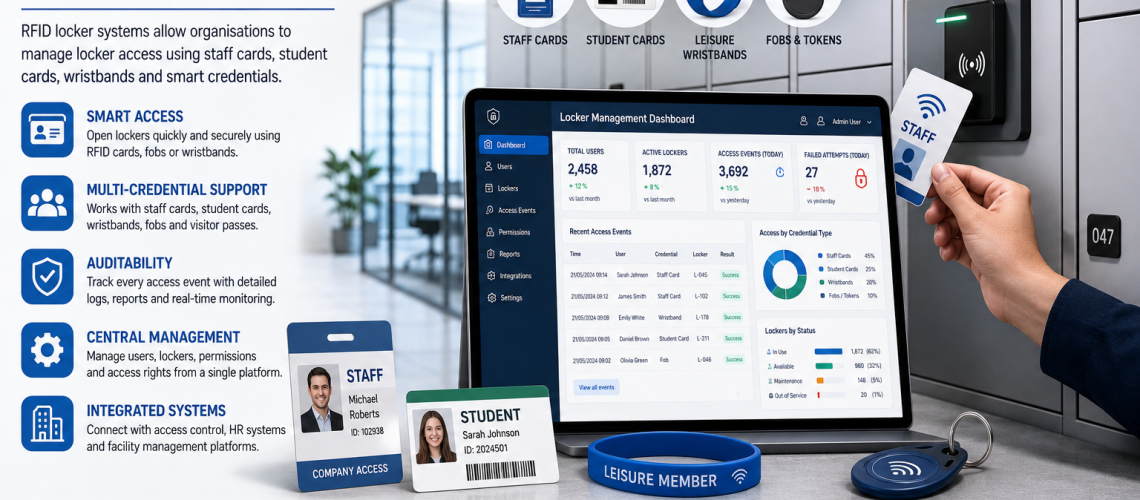
RFID locker systems allow users to access lockers with contactless credentials such as staff cards, student cards, leisure wristbands, fobs or access tokens. They help organisations reduce key management problems, improve auditability and connect locker access into wider digital access control systems.
RFID lockers are increasingly used in schools, universities, workplaces, gyms, leisure centres, healthcare buildings and hybrid offices. They are especially useful where many users need fast, managed and traceable locker access.
This guide explains how RFID locker systems work, where they are used, what credentials they support, and how they connect with smart locker software, audit trails and locker access governance.
What Is an RFID Locker System?
An RFID locker system uses radio-frequency identification to open, assign or manage lockers without a traditional key.
Instead of inserting a key, the user presents a contactless credential to the locker lock, reader or control point.
- Staff ID cards
- Student cards
- Gym membership cards
- Leisure wristbands
- RFID fobs
- Visitor cards
- Contractor passes
- Mobile-linked credentials where supported
The system checks whether the credential has permission to open the locker. If access is approved, the lock releases. RFID locker systems sit between traditional keyed locker systems and fully integrated smart locker systems.
Why RFID Locker Systems Matter
RFID lockers solve several common locker-management problems. They reduce reliance on physical keys and improve how locker access is issued, changed and reviewed.
- Reduces lost key issues
- Limits unmanaged duplicate keys
- Speeds up locker allocation
- Reduces manual sign-out records
- Improves user convenience
- Supports temporary access
- Improves central management
- Strengthens access accountability
- Supports audit trails where connected systems are used
For organisations moving away from physical keys, RFID is often the first practical digital transition step.
How RFID Locker Access Works
RFID locker access usually follows a simple process.
- A user receives an RFID credential.
- The credential is assigned to a locker or access group.
- The user presents the credential to the lock or reader.
- The system checks the permission.
- The locker opens if the credential is valid.
- The access event may be logged, depending on the system.
Some RFID lockers work as standalone locks. Others connect to central software for reporting, user control and audit visibility.
RFID Locker Credentials
RFID locker systems can support several credential types depending on the lock, reader and software platform.
| Credential Type | Common Use | Main Benefit |
|---|---|---|
| Staff card | Workplaces, NHS, offices | Uses existing ID infrastructure |
| Student card | Schools, colleges, universities | Simplifies student allocation |
| Wristband | Gyms, leisure centres, pools | Suitable for wet areas |
| Fob | Industrial sites and staff areas | Durable and easy to issue |
| Visitor card | Offices and public facilities | Supports temporary access |
| Contractor pass | Workplaces and estates teams | Controls short-term permissions |
The strongest systems connect locker credentials with wider access permissions, audit procedures and facilities management workflows.
Staff Card Locker Systems
Staff card locker systems allow employees to use existing workplace ID cards for locker access.
This is useful in offices, factories, NHS facilities, universities, distribution centres and hybrid workplaces.
- Reduces the need for separate locker keys
- Supports department-based access
- Works well with staff onboarding
- Can support hot lockers and day-use lockers
- Can connect locker access with wider building-access policy
Staff card integration helps lockers become part of wider workplace access governance rather than a separate maintenance task.
Student Card Locker Systems
Student card locker systems are used in schools, colleges and universities where learners already carry ID or access cards.
- Student locker allocation
- Year-group access
- Term-based permissions
- Library and sports facility lockers
- Boarding house storage
- Temporary locker reassignment
- Safeguarding-related access reviews
RFID student lockers can reduce lost key problems and simplify term-end access removal.
Leisure Wristband Locker Systems
RFID wristband locker systems are common in gyms, leisure centres, swimming pools and spas.
- Wearable for changing rooms
- Suitable for wet areas
- Easy to issue at reception
- Useful for shared-use lockers
- Convenient for users who do not want to carry keys
- Can connect with membership or turnstile systems
Leisure wristband systems are valuable for public-access environments with high user turnover.
RFID Locker Systems for Hybrid Offices
Hybrid offices often need flexible locker allocation. Staff may not use the same desk or locker every day.
- Day-use lockers
- Assigned personal lockers
- Team-based locker banks
- Temporary access
- Hot-locker systems
- Staff card integration
- Central locker management
This helps facilities teams manage lockers efficiently while supporting modern working patterns.
RFID Locker Systems in Healthcare
Healthcare environments may use RFID locker systems for staff changing rooms, secure staff storage and department-based access.
- Shift-based access
- Staff-only locker areas
- Temporary worker access
- Department permission groups
- Supervisor override records
- Controlled access to sensitive areas
- Audit trail visibility
For NHS and healthcare estates, RFID systems can improve accountability while reducing physical key handling.
RFID Locker Systems in Industrial Sites
Industrial environments often need durable and controlled locker access for staff, PPE, tools and restricted-area storage.
- PPE lockers
- Shift-worker lockers
- Contractor access
- Restricted-area lockers
- High-wear staff changing rooms
- Tool and equipment storage
- Supervisor override procedures
RFID fobs or cards can be easier to manage than large key sets in high-turnover environments.
RFID Locker Systems and Audit Trails
Auditability is one of the major advantages of connected RFID locker systems.
Depending on the system, audit trails may record:
- User identity
- Credential used
- Locker opened
- Access time
- Failed access attempts
- Override events
- Temporary access periods
- Credential revocation
- Administrator changes
This makes RFID systems valuable for organisations that need stronger locker accountability. For deeper audit procedures, see the dedicated guide to locker access audit systems.
RFID Locker Systems and Access Governance
RFID lockers should not be treated as separate hardware only. They should be governed through a clear access policy.
- Who can issue RFID locker access
- Who can approve permissions
- How temporary credentials are controlled
- How access is revoked
- Who can override lockers
- How audit records are reviewed
- How contractor access is managed
- How inactive credentials are removed
This connects RFID lockers directly to wider locker access permissions and governance.
Standalone RFID Locks vs Networked RFID Locker Systems
RFID locker systems vary in complexity. The right choice depends on the size of the site, number of users, audit needs and management process.
| System Type | How It Works | Best For |
|---|---|---|
| Standalone RFID lock | Credential is programmed locally | Smaller sites and simple use |
| Card-compatible locker lock | Uses existing cards or fobs | Workplaces and education sites |
| Networked RFID locker system | Connects to central software | Large sites and audit-led environments |
| Smart locker platform | Combines RFID, software, reporting and allocation | Enterprise estates and hybrid offices |
RFID Lockers vs Keyed Locker Systems
RFID systems do not remove the need for good governance, but they can reduce the practical problems caused by physical keys.
| Feature | Keyed Lockers | RFID Lockers |
|---|---|---|
| User access | Physical key | Card, fob or wristband |
| Lost credential issue | Key replacement or lock change may be needed | Credential can often be blocked or reassigned |
| Audit trail | Manual records | Possible automatic records if connected |
| Temporary access | Manual key issue | Temporary credential control |
| Multi-site control | Difficult | More scalable with software |
Where physical key control remains important, use RFID planning alongside locker key management systems.
Planning an RFID Locker Upgrade
Before upgrading to RFID lockers, organisations should check the existing locker estate, lock compatibility and management process.
- Current locker type
- Door thickness
- Lock fixing position
- Power or battery requirements
- Credential compatibility
- Software requirements
- Audit trail requirements
- Emergency access procedure
- Administrator responsibilities
- Future expansion needs
For retrofit planning, use the locker lock compatibility guide UK before choosing RFID or electronic lock hardware.
Common RFID Locker System Mistakes
- Choosing RFID hardware before checking locker compatibility
- Using credentials without a revocation process
- Failing to define administrator permissions
- Ignoring temporary user access
- Assuming every RFID system provides full audit trails
- Not planning for battery maintenance
- Leaving inactive cards or fobs enabled
- Not linking locker access to wider governance procedures
The best RFID locker systems are planned as part of an access control system, not as isolated locks.
RFID Locker Systems and the Digital Transition
RFID locker systems are a key bridge between traditional locker management and full digital storage systems.
They help organisations move from keys and paper logs toward central access control, audit trails, smart lockers and enterprise storage management.
This makes RFID an important transition point for organisations planning long-term locker upgrades.
Related Locker Access Guides
- Locker Access Control Systems UK
- Locker Access Audit Systems UK
- Locker Access Permissions and Governance UK
- Smart Locker Systems UK
- Locker Electronic Locks UK
- Locker Key Management Systems UK
- Locker Lock Compatibility Guide UK
- Locker Locks
- Lockers UK
Frequently Asked Questions
What is an RFID locker system?
An RFID locker system allows users to open or manage lockers using contactless credentials such as cards, fobs or wristbands instead of traditional keys.
Can RFID lockers use staff ID cards?
Yes. Some RFID locker systems can work with existing staff cards, depending on card type, reader compatibility and system configuration.
Are RFID lockers suitable for schools?
Yes. RFID lockers can support student card access, term-based allocation, lost key reduction and stronger access control in schools, colleges and universities.
Do RFID locker systems create audit trails?
Connected RFID locker systems may create audit trails, including access times, credential use, failed attempts and administrator changes. Standalone RFID locks may offer more limited reporting.
Are RFID wristbands useful for leisure centres?
Yes. RFID wristbands are useful in gyms, pools, spas and leisure centres because they are wearable, convenient and suitable for wet changing areas.
Can RFID lockers replace keyed locker systems?
RFID lockers can replace keyed systems in many environments, but the existing lockers, lock compatibility, credential process and audit requirements should be checked first.
Discover more from Blog Total Locker Service
Subscribe to get the latest posts sent to your email.