Fire Safe vs Data Safe vs Filing Cabinet: Complete UK Comparison Guide for Documents, Media and Business Storage
April 25, 2026
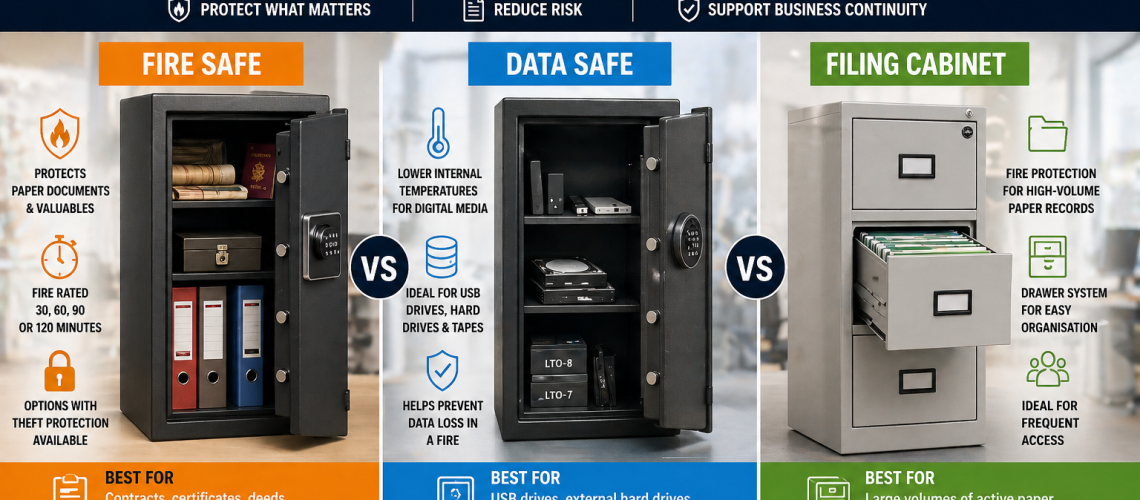
Choosing between a fire safe, data safe and fire-resistant filing cabinet depends on what you need to protect, how much of it you have and how often staff need access. These three products may all provide fire-related protection, but they are designed around different contents and working patterns.
A fire safe is generally suited to important paper documents and selected valuables. A data safe is designed for heat-sensitive digital media such as USB drives, external drives and backup media. A fire-resistant filing cabinet is intended for larger volumes of paper records that need organised, regular access.
This guide compares the three product types directly. For detailed information on media temperature limits, see our Data Safes vs Fire Safes UK guide. For USB-specific storage advice, see Can You Store USB Drives in a Fire Safe?.
Quick Answer: Fire Safe, Data Safe or Fire-Resistant Filing Cabinet?
| Storage need | Best fit | Why |
|---|---|---|
| Important paper documents | Fire safe | Compact protected storage for critical paperwork |
| USB drives, external drives and backup media | Data safe | Designed for more heat-sensitive digital media |
| Large volumes of active paper files | Fire-resistant filing cabinet | Drawer-based organisation with regular staff access |
| Cash or valuables | Appropriately security-rated fire safe | May combine document fire protection with theft resistance |
If you only remember one rule, use this: fire safe for critical paper, data safe for digital media, fire-resistant filing cabinet for high-volume active paper files.
Fire Safe vs Data Safe vs Filing Cabinet: Main Differences
The three product types overlap in purpose only at a very broad level. Each one is designed around a different combination of contents, capacity and access.
| Feature | Fire safe | Data safe | Fire-resistant filing cabinet |
|---|---|---|---|
| Main purpose | Protect important paper documents and selected valuables | Protect digital and backup media | Protect organised paper files |
| Typical contents | Contracts, deeds, certificates, policies, selected valuables | USB drives, external drives, backup tapes, discs and other media | HR files, client files, accounts, administrative records |
| Typical access pattern | Occasional or controlled | Usually occasional | Frequent |
| Storage format | Shelves or internal compartments | Media-focused internal storage | Drawers and suspension filing |
| Best when volume is | Low to moderate | Low to moderate, depending on range | High for paper records |
| Digital media suitability | Only where specifically rated for it | Yes, where the product specification matches the media | Normally intended for paper rather than digital media |
For detailed fire classifications and document-safe ratings, use the specialist fire-safe guides linked below. This page stays focused on choosing between the three storage formats.
When Is a Fire Safe the Better Choice?
A fire safe is the better choice when the business needs to protect a relatively compact set of important paper records or selected valuables that do not need constant staff access.
Typical contents include contracts, certificates, deeds, insurance documents, licences, policies and other records that are difficult to replace. A fire safe can also be appropriate for cash or valuables where the selected model has suitable security protection as well as the required fire performance.
Choose a fire safe when:
- You are protecting a relatively small or moderate volume of critical paper documents.
- Access is occasional, controlled or restricted.
- The contents are more important than day-to-day filing convenience.
- You need compact secure storage rather than a drawer-based filing system.
- Cash or valuables are being stored and the selected safe has suitable security protection.
Detailed fire classifications and duration ratings are covered separately in our Fire Safe Ratings Explained UK guide.
When Is a Data Safe the Better Choice?
A data safe is the better choice when the contents are digital or removable media that may need more specialist protection than a document fire safe provides.
Typical contents include USB drives, external hard drives, external SSDs, backup tapes, memory cards, discs and other business media. The important point is to check that the chosen product is rated for the type of media being stored.
Choose a data safe when:
- You store removable digital media on site.
- The contents include USB drives, external drives or backup media.
- The product specification needs to match digital or data media rather than paper only.
- Access is usually occasional rather than part of a high-frequency filing workflow.
- A normal document fire safe is not specified for the media being protected.
For detailed media temperature limits, use Data Safes vs Fire Safes UK. For USB-drive-specific storage questions, see Can You Store USB Drives in a Fire Safe?.
Commercial Data Safes
For businesses storing USB drives, external drives, backup media or other digital storage, compare the Data Safes range and check the individual product specification against the media being protected.
When Is a Fire-Resistant Filing Cabinet the Better Choice?
A fire-resistant filing cabinet is the better choice when the main problem is protecting a large volume of paper records without making those records awkward to use.
Drawer-based storage makes a filing cabinet more practical for active records than a conventional safe. Staff can retrieve individual files, return them quickly and keep records arranged by client, department, date or subject.
Choose a fire-resistant filing cabinet when:
- You store large quantities of paper files.
- Staff need access to records every day or every week.
- Suspension filing or drawer organisation is important.
- The records are active rather than simply archived.
- A conventional safe would be too small or inconvenient for the filing volume.
The key distinction here is practical use: fire-resistant filing cabinets suit larger volumes of active paper records where staff need regular drawer-based access.
Which Option Is Best for Different Access Frequencies?
Access frequency is one of the clearest ways to separate these products. The more often staff need to handle paper records, the stronger the case for drawer-based filing. Critical records and media that are accessed less frequently can be better suited to safes.
| Access pattern | Likely best fit | Reason |
|---|---|---|
| Paper files used throughout the working day | Fire-resistant filing cabinet | Fast drawer access and organised filing |
| Important documents accessed occasionally | Fire safe | Compact protected storage with controlled access |
| Backup media accessed occasionally | Data safe | Specialist protection for media without requiring daily filing access |
A product that is awkward to use can encourage staff to leave documents outside the protected storage area. For active paper records, usability is therefore part of the protection strategy.
Which Option Is Best for Different Storage Volumes?
Storage volume is another major dividing line. A safe can be ideal for a compact collection of important documents, but it becomes inefficient when staff are trying to manage hundreds of active files.
| Storage requirement | Likely best fit |
|---|---|
| Small set of critical documents | Fire safe |
| Moderate quantity of digital backup media | Data safe sized to the media |
| Large active paper filing system | Fire-resistant filing cabinet |
| Mixed paper and digital media | Separate products according to content type |
Common Business Scenarios
| Scenario | Typical requirement | Likely approach |
|---|---|---|
| Small office | Contracts, certificates and a limited number of important records | Fire safe |
| HR or administration department | Large volumes of active personnel or administrative files | Fire-resistant filing cabinet |
| Business storing local recovery media | USB drives, external drives or backup media | Data safe |
| Legal or professional practice | Active client files plus original critical documents | Filing cabinet plus fire safe |
| Mixed paper and digital archive | Documents plus heat-sensitive media | Separate fire-safe and data-safe protection as appropriate |
How to Choose Between the Three Options
1. Identify the contents
Separate critical paper documents, active paper files, digital media and valuables. This immediately removes many unsuitable products.
2. Estimate the storage volume
A small document set may fit a fire safe comfortably. A department-wide paper filing system is more likely to need drawers. Digital media should be sized separately according to the chosen data-safe range.
3. Consider access frequency
Daily paper access favours a filing cabinet. Occasional access to critical documents favours a fire safe. Occasional access to protected digital media favours a data safe.
4. Match the product to the contents
Do not assume that a product designed for paper also protects digital media. Equally, do not use an expensive specialist safe where the real requirement is simply organised, high-volume paper filing.
5. Check the exact product specification
Once the correct product type is clear, compare the individual model for usable capacity, access method and the protection specification relevant to the contents.
Compare Commercial Storage Options
Total Locker Service supplies all three storage formats covered in this comparison.
- Fireproof Safes and Cabinets – protected storage for important paper documents and business records.
- Data Safes – specialist storage for digital media, USB drives, hard drives and backup media.
- Fire-Resistant Filing Cabinets – drawer-based fire protection for larger volumes of active paper files.
Frequently Asked Questions
What is the difference between a fire safe, data safe and fire-resistant filing cabinet?
A fire safe is generally used for important paper documents and selected valuables. A data safe is designed for digital and backup media. A fire-resistant filing cabinet is designed for larger volumes of paper records that need organised, regular access.
When is a fire-resistant filing cabinet better than a fire safe?
A fire-resistant filing cabinet is usually more practical when staff need frequent access to large quantities of active paper files. A fire safe is better suited to a smaller quantity of critical documents that need controlled or occasional access.
When do I need a data safe instead of a fire safe?
Choose a data safe when the contents include digital or removable media and the product specification needs to protect that media rather than paper alone. Always check the exact rating of the selected model.
Which option is best for active paper records?
A fire-resistant filing cabinet is usually the most practical of the three options for active paper records because drawers support frequent retrieval, return and organisation of files.
Can one storage product protect both paper and digital media?
Only where the individual product is specifically rated for the contents being stored. In many workplaces, paper documents and digital media are better separated so each can be stored in a product designed for that content type.
Conclusion: Match the Product to the Contents and Workflow
Fire safes, data safes and fire-resistant filing cabinets are not interchangeable. A fire safe is generally the better fit for critical paper documents, a data safe for digital media, and a fire-resistant filing cabinet for high-volume paper records that staff need to access regularly.
The decision should therefore start with three questions: what are you storing, how much of it is there, and how often does it need to be accessed? Once those answers are clear, the correct product type is usually much easier to identify.
Related Guides
- Data Safes vs Fire Safes UK – detailed comparison of document and digital-media protection.
- Can You Store USB Drives in a Fire Safe? – focused removable-media guidance.
- Fire Safe Ratings UK – fire-duration and document-protection guidance.
- View Data Safes – commercial digital-media protection.
Discover more from Blog Total Locker Service
Subscribe to get the latest posts sent to your email.