Are Fire-Resistant Filing Cabinets Worth It? Cost, Benefits and Real Business Use Cases (UK Guide)
April 25, 2026
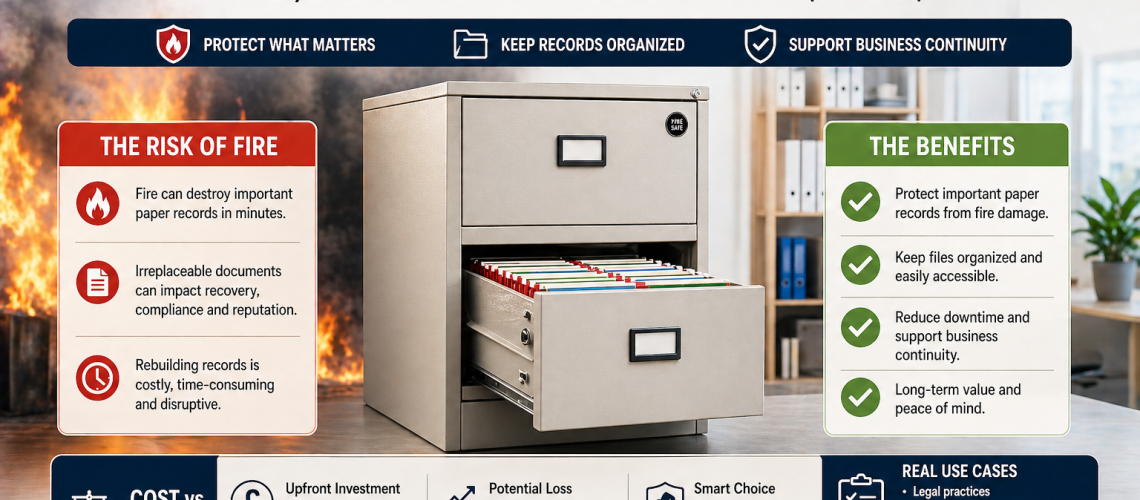
Fire-resistant filing cabinets cost more than standard office filing cabinets, so the real question is whether the records inside justify that extra protection. For businesses that keep important, active and difficult-to-replace paper files on site, the additional cost can be easier to justify than the disruption caused by losing those records in a fire.
This guide focuses on the value and justification question: when a fire-resistant filing cabinet is worth the extra cost, when a standard filing cabinet may be enough, and when a smaller fire safe may offer better value.
For a direct product comparison, use our Fire Safe vs Fire-Resistant Filing Cabinet guide. For a broader three-way comparison, see Fire Safe vs Data Safe vs Filing Cabinet.
Quick Answer: Are Fire-Resistant Filing Cabinets Worth It?
They are usually worth considering when a business keeps large volumes of important paper records that are difficult to replace, regularly accessed and operationally important. They are less likely to be justified where the paperwork is low risk, easily replaced or very limited in quantity.
| Situation | Likely value | Why |
|---|---|---|
| Large active HR, legal or accounts files | High | Records are important, organised and regularly used |
| Signed or original documents that are difficult to replace | High | Loss may create cost, delay or legal problems |
| Frequently accessed paper filing system | High | Drawer format combines protection with practical daily use |
| Small quantity of important documents | Moderate | A fire safe may offer better value |
| Low-value, easily replaced paperwork | Lower | The extra cost may not be justified |
What Does the Extra Cost Pay For?
A standard office filing cabinet is primarily designed to organise paper. A fire-resistant filing cabinet is designed to combine document organisation with tested fire protection for paper records.
The additional cost therefore pays for more than drawers and locks. It reflects the protected construction required to reduce the risk of important paper records being destroyed during a fire.
- Fire-resistant construction for paper records
- Drawer-based organisation for active files
- Protection without forcing staff to abandon a conventional filing workflow
- Reduced exposure to the cost and disruption of rebuilding lost records
The important question is whether those benefits matter for the particular records your organisation keeps.
1. How Valuable Are the Records to the Business?
The value of a paper record is not always its replacement cost. A file may be inexpensive to print but still be operationally important because it contains signatures, evidence, historic correspondence, personnel information or records needed to continue work after an incident.
Examples that may justify stronger protection include:
- HR and personnel files
- Contracts and signed agreements
- Accounts and financial records
- Legal and case files
- Compliance records
- Client or customer documentation
If the records are important to normal operations, the cost of losing them may be far greater than the cost of replacing the paper itself.
2. How Difficult Would the Records Be to Replace?
Replacement difficulty is one of the strongest arguments for fire-resistant storage. Some records can be reproduced quickly from another source. Others may require staff time, customer contact, legal reconstruction or manual investigation.
| Replacement difficulty | Typical justification |
|---|---|
| Easy to reproduce from another system | Lower justification |
| Requires staff time to rebuild | Moderate justification |
| Original signatures or unique evidence | Strong justification |
| Loss would interrupt service or compliance work | Strong justification |
3. How Often Do Staff Need the Files?
Frequency of access matters because protection is only useful if staff can work with it practically.
A fire-resistant filing cabinet has particular value where paper records are accessed daily or weekly. Staff can continue using an organised drawer system rather than repeatedly transferring files into and out of a separate storage format.
- Frequent access: strengthens the case for a protected filing cabinet.
- Occasional access: may still justify protection, but a smaller fire safe could be more economical.
- Rarely accessed, easily replaced paperwork: usually provides a weaker case for the additional cost.
4. How Much Paper Do You Need to Protect?
Document volume affects both value and practicality. A fire-resistant filing cabinet is easier to justify when the business has enough active paper records to make drawer-based protected storage useful.
If only a small collection of certificates, contracts or originals needs protection, buying a large filing cabinet may be unnecessary. In that situation, a suitable fire safe may offer better value.
If the organisation holds many files arranged by employee, client, account, year, site or case, a fire-resistant cabinet may become the more practical long-term investment because the protected storage also serves as the working filing system.
5. What Would Record Loss Do to the Business?
The strongest value test is often operational disruption. Ask what would happen if the paper records were unavailable after a fire.
- Would staff lose time rebuilding files?
- Would customers, employees or suppliers need to be contacted?
- Would work stop while records were reconstructed?
- Would compliance, audit or legal work become more difficult?
- Would signed or historic evidence be permanently lost?
The greater the likely disruption, the stronger the business case for protecting the files before an incident occurs.
When Is a Standard Filing Cabinet Enough?
Not every paper record needs fire-resistant storage. A standard cabinet may be sufficient where the documents are low risk, easily reproduced and not important to business recovery.
- Routine paperwork that can be regenerated easily
- Temporary working papers
- Duplicate copies where the master record is held elsewhere
- Files whose loss would cause little operational disruption
Using fire-resistant cabinets selectively for the records that actually justify protection can be more cost-effective than specifying them for every paper file in the building.
When Might a Fire Safe Be Better Value?
A fire safe may offer better value when the quantity of important paper is relatively small and the documents do not need to remain in a large working filing system.
- A small number of certificates or original contracts
- Documents accessed only occasionally
- Records that fit comfortably into shelf or compartment storage
- Situations where a full filing cabinet would provide unnecessary capacity
For the detailed product-choice distinction, see Fire Safe vs Fire-Resistant Filing Cabinet.
When Does a Fire-Resistant Cabinet Become the Better Long-Term Choice?
A fire-resistant filing cabinet becomes easier to justify when the organisation needs both protection and an active paper filing system.
- Paper records are expected to remain in use for years
- File volumes are substantial
- Staff retrieve documents regularly
- The records are difficult or expensive to reconstruct
- Loss would cause meaningful operational disruption
- The cabinet can replace an ordinary working filing cabinet rather than being an additional storage unit
In that situation, the value is not only the fire protection. The same cabinet also provides the day-to-day filing system, so the investment supports both normal operations and risk reduction.
Fire-Resistant Filing Cabinet Value Checklist
- Importance: are the records genuinely important to the organisation?
- Replacement difficulty: how hard would they be to reconstruct?
- Access frequency: are staff using the files regularly?
- Volume: is there enough paper to justify drawer-based protected storage?
- Disruption: what would happen if the files were lost?
- Alternative: could a smaller fire safe protect the important subset more economically?
- Long-term use: will the cabinet continue to serve as the working filing system for years?
If most of those answers point towards high-value, active and difficult-to-replace records, the extra cost of a fire-resistant filing cabinet is much easier to justify.
Commercial Fire-Resistant Filing Cabinets
Total Locker Service supplies fire-protected storage for business paper records, including fire-resistant filing cabinets and document safes.
- 4-Drawer Fire-Resistant Filing Cabinet – protected drawer storage for active business records.
- Fireproof Safes and Cabinets – browse the wider fire-protected storage range.
Frequently Asked Questions
Are fire-resistant filing cabinets worth the extra cost?
They can be when the cabinet protects important, active and difficult-to-replace paper records. The extra cost is easier to justify where losing the files would cause significant staff time, operational disruption or reconstruction costs.
When is a standard filing cabinet enough?
A standard cabinet may be enough for low-risk paperwork that is easy to reproduce and whose loss would cause little operational disruption.
What types of records most justify a fire-resistant filing cabinet?
Active HR, legal, accounts, compliance, client and signed records are among the stronger use cases, particularly where they are difficult to replace or regularly accessed.
Does frequent file access make a fire-resistant cabinet more worthwhile?
Yes. A fire-resistant cabinet can be especially useful when staff need regular drawer-based access because it combines protected storage with a familiar working filing system.
When might a fire safe be better value?
A fire safe may offer better value when only a small number of important paper documents need protection and they are accessed occasionally rather than used as part of a large active filing system.
Conclusion: Judge the Cabinet Against the Cost of Losing the Records
A fire-resistant filing cabinet is not automatically worth the extra cost for every business. Its value depends on the records being protected.
Where files are important, active, difficult to replace and expensive to lose operationally, the case for protected drawer storage becomes strong. Where paperwork is low risk, easily reproduced or limited in quantity, a standard cabinet or smaller fire safe may be more economical.
Related Guides
Discover more from Blog Total Locker Service
Subscribe to get the latest posts sent to your email.