Fire Safe vs Standard Safe: What’s the Difference and Do Safes Protect Against Fire?
April 24, 2026
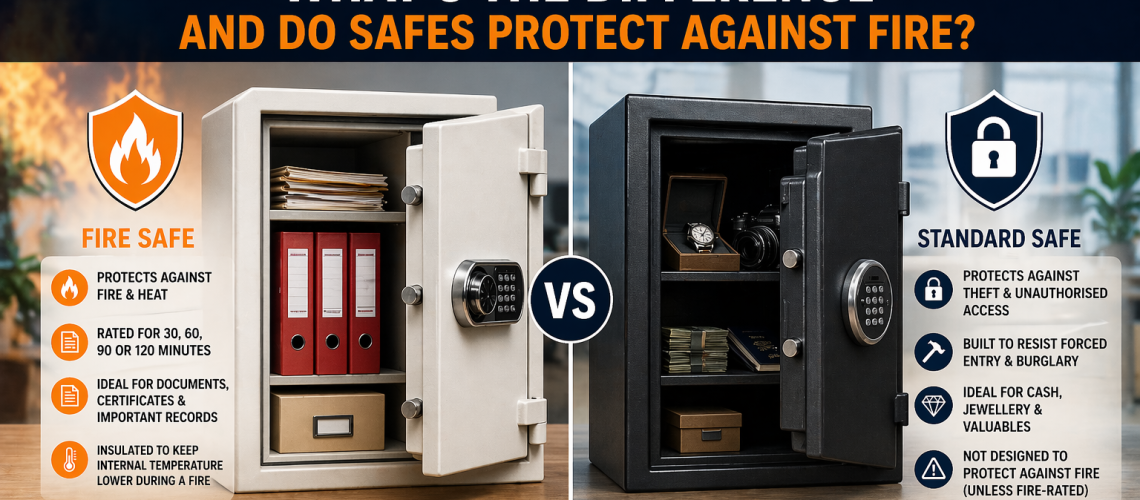
A fire safe and a standard safe are designed to solve different problems. A fire safe protects contents from heat and flame for a set period, while a standard safe is usually designed to resist theft, forced entry and unauthorised access.
Choosing the wrong type can leave important items unprotected. A burglary-rated safe may not protect documents in a fire, while a fire safe may not provide enough resistance against theft.
This guide explains the difference between fire safes and standard safes, what each type protects against and how to choose the right option for your business or home.
Quick Answer: Fire Safe vs Standard Safe
A fire safe protects contents from heat and flame for a rated period. A standard safe protects against theft and forced entry. Some safes combine both features, but many products are designed primarily for one purpose, not both.
| Protection type | Fire safe | Standard safe |
|---|---|---|
| Fire protection | Yes (rated duration) | Not usually |
| Theft resistance | Sometimes (varies) | Yes (main purpose) |
| Best for documents | Yes | No |
| Best for valuables | Sometimes | Yes |
| Best for data media | Only if data-rated | No |
The key decision is whether the main risk is fire, theft or both.
What Is a Fire Safe?
A fire safe is designed to protect its contents from heat and flame during a fire. It uses insulated construction to slow heat transfer and maintain a safer internal temperature for a specified period.
Common fire ratings include 30, 60, 90 and 120 minutes. These ratings indicate how long the safe is tested to protect its contents under controlled conditions.
Fire safes are usually used for paper documents, certificates, contracts, insurance records and other items that would be difficult to replace.
Some fire safes also include theft protection, but this varies by model. Fire resistance and burglary resistance are separate features and should always be checked individually.
Typical uses for a fire safe
- Contracts and legal documents
- Insurance papers
- Certificates and licences
- Business continuity records
- Personal documents such as passports and deeds
For a deeper explanation of fire protection levels, see our Fire Safe Ratings UK guide.
What Is a Standard Safe?
A standard safe, often called a security safe or burglary safe, is designed to resist forced entry. Its purpose is to protect valuables from theft rather than fire.
These safes typically use reinforced steel construction, secure locking systems and tested resistance to attack methods. Many are rated for cash or valuables based on insurance standards.
However, most standard safes do not provide meaningful fire protection unless they are specifically tested and rated for fire resistance.
Typical uses for a standard safe
- Cash storage
- Jewellery and valuables
- Payment devices and tills
- Sensitive items requiring restricted access
- High-value portable items
If fire protection is required as well, a combined fire and security safe may be the better option.
Main Differences Between Fire Safes and Standard Safes
The difference between these products is not just design. It is the risk they are built to address.
| Feature | Fire safe | Standard safe |
|---|---|---|
| Primary purpose | Fire protection | Theft protection |
| Heat resistance | Tested and rated | Not usually tested |
| Burglary resistance | Varies | Primary function |
| Internal insulation | Yes | Minimal or none |
| Typical contents | Documents | Cash and valuables |
This is why one safe rarely replaces the other completely. Each is built around a different type of risk.
Do Standard Safes Protect Against Fire?
Most standard safes do not protect against fire. They may provide some limited resistance due to their construction, but they are not designed or tested to maintain safe internal temperatures during a fire.
This means documents stored in a standard safe may be damaged or destroyed even if the safe itself remains intact.
If fire protection is required, the safe must be specifically rated for fire resistance. This is usually clearly stated in the product specification.
In simple terms, a burglary safe without a fire rating should not be relied on for document protection during a fire.
When to Choose a Fire Safe
- Documents are important or difficult to replace
- Business continuity records are stored on site
- Paper records must survive a fire event
- The risk of fire is a primary concern
- Insurance or compliance requires document protection
A fire safe is often the correct choice when the loss of documents would cause operational, legal or financial problems.
When to Choose a Standard Safe
- Cash or valuables need protection
- Theft risk is the main concern
- Items are compact but high value
- Access needs to be restricted
- Insurance requires a burglary-rated safe
A standard safe is usually the better choice where preventing theft is the primary requirement.
Fire and Security Safes: Combined Protection
Some safes combine fire protection and burglary resistance. These are often called fire and security safes.
They are designed for situations where both risks matter. For example, a business storing cash, documents and sensitive records may need both fire resistance and theft protection.
However, combined safes are usually more expensive and may be heavier. They should be selected carefully based on both fire rating and security rating.
For businesses with mixed storage needs, using separate safes can sometimes be more practical than relying on one combined unit.
Typical Business Scenarios
Office environments
Offices often store contracts, HR files and financial records. A fire safe is usually more suitable for these documents, especially where records must be retained.
Retail businesses
Retail sites often prioritise theft protection for cash and tills. A standard safe or a fire and security safe may be more appropriate.
Professional services
Accountants and legal practices may need both document protection and secure storage. This often leads to a combination of fire safes, filing cabinets and security safes.
Mixed-use businesses
Businesses with both valuables and documents may benefit from separate storage. A fire safe protects records, while a standard safe protects cash or high-value items.
Common Mistakes
- Assuming all safes protect against fire: many do not.
- Choosing by size alone: protection type matters more than capacity.
- Ignoring certification: always check ratings.
- Using one safe for all contents: different items may need different protection.
- Overlooking theft risk: fire protection does not equal security protection.
The most common error is treating all safes as the same. In reality, each type is designed for a specific risk.
Frequently Asked Questions
No. Only safes that are specifically fire-rated are designed to protect contents during a fire.
Not always. Some fire safes include theft protection, but this must be confirmed by a security rating.
You can store documents in a standard safe, but they may not survive a fire without a fire rating.
Businesses should choose based on risk. Fire safes protect documents, standard safes protect valuables and combined safes protect both.
Conclusion: Match the Safe to the Risk
Fire safes and standard safes are not interchangeable. One protects against fire, the other protects against theft. Choosing the right one depends on what you are storing and what risk matters most.
For many businesses, the best solution is a combination of both. Documents need fire protection, while cash and valuables need security protection.
The strongest decision comes from identifying the risk first, then choosing the safe designed to handle it.
Related Guides
Discover more from Blog Total Locker Service
Subscribe to get the latest posts sent to your email.