What Fire Safe Do I Need for My Business? UK Office Guide to Size, Ratings and Risk-Based Selection
April 24, 2026
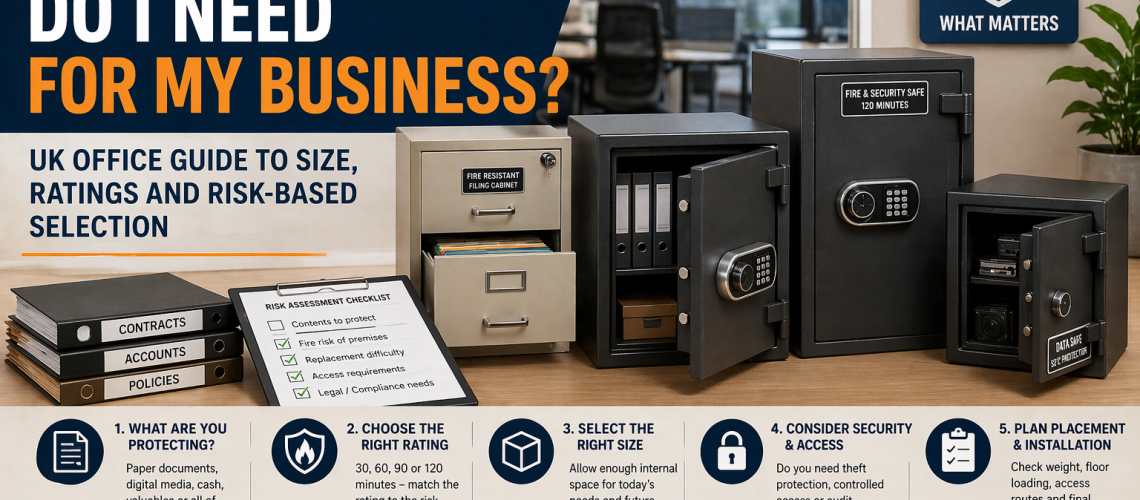
If your business already knows it needs fire-protected storage, the next step is to define the requirement clearly: what records need protecting, how important they are, how much space they take up, how often staff need access and whether the volume is better suited to a safe or a fire-resistant filing cabinet.
This page is the business fire-safe decision hub. It does not try to replace the specialist guides on ratings, size, lifecycle or product comparison. Its job is to help you make the first decisions and then send you to the right detailed guide.
Quick Answer: What Fire Safe Does My Business Need?
Start with the paper records that would cause the greatest difficulty if lost. Then judge their importance, the quantity you need to store and how often staff need access. A small set of critical documents usually points towards a document fire safe. Larger quantities may need a bigger safe. Large active filing systems often point towards a fire-resistant filing cabinet.
| Business requirement | Likely starting point | Next guide |
|---|---|---|
| Small quantity of critical paper records | Document fire safe | Check rating and size |
| Growing quantity of folders and binders | Larger document fire safe | Check usable capacity |
| Large volume of active organised paper files | Fire-resistant filing cabinet | Compare safe vs cabinet |
| Unsure which format best suits the business application | Application-led shortlist | Best Fire Safes for Businesses UK |
Business Fire Safe Decision Flow
- Identify the records: what paper documents genuinely need fire-protected storage?
- Judge importance: how difficult would those records be to replace?
- Estimate volume: is this a small set of critical documents or an active filing system?
- Check access frequency: are staff opening the storage occasionally or using the records every day?
- Choose the product format: compact safe, larger safe or fire-resistant filing cabinet.
- Move to the specialist guide: rating, size or comparison.
1. Identify Which Business Records Need Fire Protection
Do not begin with a safe model. Begin with the records.
Typical business paper records may include:
- signed contracts and agreements;
- insurance documents;
- company certificates and licences;
- property and lease documents;
- accounts and finance records;
- HR and personnel records;
- legal records;
- business-continuity paperwork;
- other original or difficult-to-replace business documents.
If your requirement is primarily digital media rather than paper records, use the separate Data Safes vs Fire Safes guide instead of trying to make this page cover both.
2. Decide Which Records Matter Most
Not every business document needs the same level of protected storage. The stronger candidates are records that would be difficult, expensive or operationally disruptive to replace.
- Original signed documents
- Long-retention records
- Records needed during recovery after an incident
- Documents with no easy duplicate
- Records whose loss would interrupt normal work
Once you know which records matter, the next decision is not automatically “which rating?”. First determine the storage format.
3. Small Quantity of Critical Documents: Start With a Document Fire Safe
A document fire safe is usually the clearest starting point where the business only needs to protect a limited number of important paper records.
- small number of contracts;
- certificates and licences;
- insurance documents;
- lease or property papers;
- selected original business records.
If this describes your requirement, the next two questions are the fire rating and the usable capacity.
- Fire Safe Ratings UK – interpret 30, 60, 90 and 120-minute protection.
- Fire Safe Sizes Explained – check internal dimensions, folders, binders and spare capacity.
4. Growing Record Volume: Consider a Larger Document Safe
A larger document safe can make sense when the requirement is still fundamentally a collection of important records rather than a working filing system.
This may include several binders, folders or record sets that are accessed occasionally but still need to remain protected together.
At this point, size becomes the dominant issue. Use the Fire Safe Sizes Explained guide rather than repeating internal-dimension and shelf-layout detail here.
5. Large Active Filing Requirement: Consider a Fire-Resistant Filing Cabinet
If staff regularly use large numbers of organised paper files, the requirement may have moved beyond what is practical in a conventional safe.
- HR personnel files
- accounts folders
- legal or case files
- client records
- long-retention administrative records
Where the records need regular drawer-based access, a fire-resistant filing cabinet can become the more practical format.
For the detailed two-way comparison, use Fire Safe vs Fire-Resistant Filing Cabinet.
6. Check How Often Staff Need Access
Access frequency helps confirm whether the storage format is practical.
| Access pattern | What it usually suggests |
|---|---|
| Occasional access to a small number of records | Document fire safe |
| Occasional access to a larger collection | Larger document fire safe |
| Frequent access to organised files | Fire-resistant filing cabinet |
The product should suit the workflow well enough that staff actually return the documents to protected storage.
Which Fire Safe Guide Should You Read Next?
| Your question | Use this guide |
|---|---|
| What do 30, 60, 90 and 120 minutes mean? | Fire Safe Ratings UK |
| What internal size and capacity do I need? | Fire Safe Sizes Explained |
| Which product suits my business situation? | Best Fire Safes for Businesses UK |
| Safe or fire-resistant filing cabinet? | Fire Safe vs Fire-Resistant Filing Cabinet |
| Is a fire-resistant filing cabinet worth the extra cost? | Are Fire-Resistant Filing Cabinets Worth It? |
| Should an existing fire safe be replaced? | How Long Do Fire Safes Last? |
| What changes between home and business use? | Fire Safe for Home vs Business |
| How do fire safe, data safe and filing cabinet differ? | Fire Safe vs Data Safe vs Filing Cabinet |
Need a Business-Specific Starting Point?
If you know the business situation but are unsure which fire-protected product type is the best starting point, use Best Fire Safes for Businesses UK.
That guide covers application-led examples such as small offices, HR departments, finance teams, legal practices, schools and branch offices without turning this pillar into another sector-by-sector article.
Business Fire Safe Checklist
- Which paper records genuinely need fire-protected storage?
- How difficult would those records be to replace?
- How much space do the records occupy now?
- How quickly is the record volume likely to grow?
- How often do staff need access?
- Is shelf storage practical, or has the requirement become a filing system?
- Which specialist guide answers the next question?
Fire Safes and Fire-Resistant Cabinets for UK Businesses
Total Locker Service supplies fire-protected storage for commercial paper records, from compact document safes to larger fire-resistant cabinets and filing systems.
- Fireproof Safes and Cabinets – browse fire-protected document storage.
- 4-Drawer Fire-Resistant Filing Cabinet – for larger active paper filing systems.
Business Fire Safe FAQs
What fire safe does my business need?
Start with the paper records that need protection, then assess their importance, volume and access frequency. A small set of critical records usually points towards a document fire safe, while large active filing systems may be better suited to a fire-resistant filing cabinet.
When does a business need a larger fire safe?
A larger document fire safe becomes useful when several folders or binders need protected storage but the requirement is still shelf-based rather than a large active filing system.
When should a business consider a fire-resistant filing cabinet?
Consider a fire-resistant filing cabinet when staff regularly access large volumes of organised paper records such as HR files, accounts folders, legal files or client records.
Should I choose the fire rating before choosing the product type?
First identify the records and the most practical storage format. Then use the specialist fire-rating guide to choose the appropriate tested protection for that product type.
Where do I compare fire-safe sizes?
Use the Fire Safe Sizes Explained guide for internal dimensions, usable capacity, folders, binders, shelf layout and growth allowance.
Conclusion: Use the Pillar to Choose the Route
The first business fire-safe decision is not the lock, rating or exact model. It is the storage requirement: which records matter, how much space they need and how staff use them.
Once that is clear, choose the likely format and move to the specialist guide for rating, size, application or safe-vs-cabinet detail. That keeps the decision process clear and avoids trying to make one article answer every fire-safe question.
Discover more from Blog Total Locker Service
Subscribe to get the latest posts sent to your email.