Locker Lock Selection Guide UK: Which Locker Lock Should You Choose?
May 8, 2026
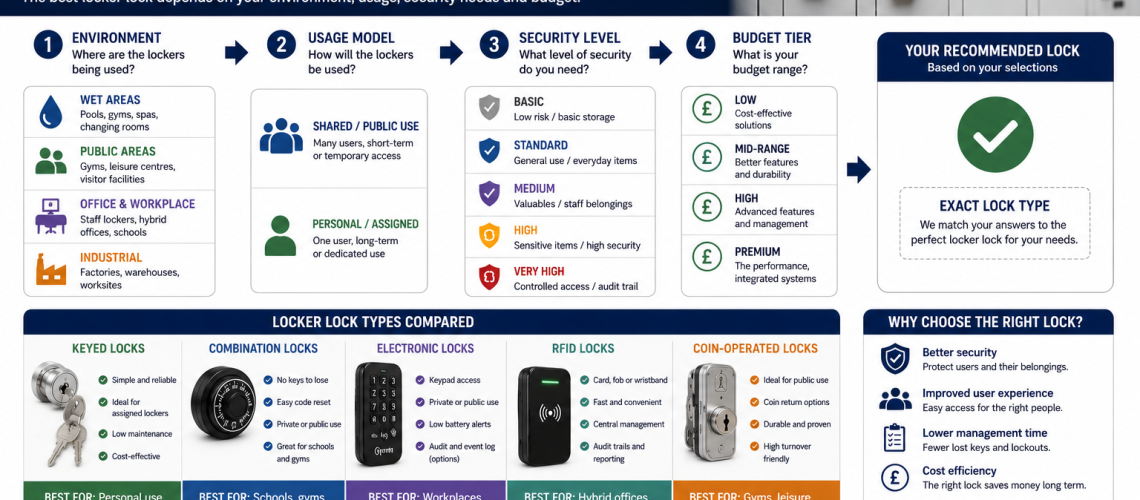
The best locker lock depends on where the lockers are used, whether lockers are shared or personal, the level of security required, the risk of vandalism, the budget available and the amount of management the site wants to handle. Schools, workplaces, gyms, leisure centres, factories, warehouses, NHS sites and public facilities all need different locker lock systems.
This guide acts as a locker lock selection engine for UK buyers. It helps facilities managers, site managers, schools, leisure operators and workplace buyers choose the right locker lock by environment, use pattern, security level, maintenance burden, compatibility risk and long-term cost.
Quick answer: Keyed locks suit assigned staff or pupil lockers, combination locks reduce lost key problems, coin-operated locks suit gyms and leisure centres, padlock fittings suit low-budget areas, and electronic or RFID locker locks work best in flexible shared-use environments.
For the wider category overview, read our locker locks UK guide. For product options, view our locker locks range or explore our guides to RFID locker locks, electronic locker locks and public-use vs private-use locker locks.
Start here:
- Need a simple staff locker lock? → Choose keyed or private-use combination locks.
- Need shared lockers? → Choose electronic, RFID or public-use combination locks.
- Need gym or leisure locks? → Choose coin-operated, digital or public-use locks.
- Need low-budget access? → Choose padlock fittings or basic keyed locks.
- Need future flexibility? → Choose RFID or smart locker systems.
Locker lock selector
| Situation | Recommended lock type | Why it works | Best next guide |
|---|---|---|---|
| Staff lockers with permanent users | Keyed locker locks | Simple long-term personal access | Keyed locker locks UK |
| Schools with lost key problems | Mechanical combination locks | Removes physical key management | Combination locker locks UK |
| Gyms and leisure centres | Coin-operated or public-use digital locks | Supports temporary locker turnover | Coin-operated locker locks UK |
| Hybrid offices and hot-desking | RFID or electronic locker locks | Flexible shared-use access | RFID locker locks UK |
| Factories and industrial sites | Heavy-duty keyed locks or padlock fittings | Durable and easy to maintain | Padlock fittings for lockers UK |
| Wet changing rooms | Moisture-resistant combination or digital locks | Better corrosion resistance | Locker locks for wet areas UK |
| Low-budget locker areas | Padlock fittings | Simple low-cost user-managed access | Padlock fittings for lockers UK |
| High-security workplace storage | Electronic or RFID locker locks | Better audit and access control | Electronic locker locks UK |
Commercial decision table
Use this table when comparing locker locks for procurement, facilities management or site-wide upgrades. The lowest-cost lock is not always the lowest-cost system over time.
| Decision factor | Best low-management choice | Best high-control choice | Watch point |
|---|---|---|---|
| Budget | Padlock fittings or keyed locks | Electronic or RFID locks | Low upfront cost can increase staff admin later |
| Admin load | Combination locks | RFID or managed electronic locks | Keyed locks need spare key control |
| Maintenance | Keyed or padlock systems | Electronic locks with planned battery checks | Wet areas need corrosion-resistant hardware |
| Vandal resistance | Heavy-duty keyed locks | Anti-vandal electronic or protected lock systems | Public areas need stronger policy and inspection |
| Compatibility | Like-for-like replacements | Retrofit electronic or RFID locks | Door thickness, cam and fixing footprint must be checked |
| Wet-area suitability | Corrosion-resistant padlock fittings | Moisture-resistant digital or RFID locks | Avoid low-grade locks in damp changing rooms |
| Key management burden | Combination locks | RFID or electronic systems | Lost keys create recurring admin and replacement cost |
Best option if…
- Best option if users keep the same locker: keyed locker locks or private-use combination locks.
- Best option if lockers are shared every day: public-use electronic locks, RFID locks or coin-operated locks.
- Best option if lost keys are the main problem: mechanical combination locks, digital locks or RFID locker locks.
- Best option if the site has a tight budget: padlock fittings or basic keyed locks.
- Best option if the site needs audit control: RFID or managed electronic locker locks.
- Best option if lockers are in wet changing rooms: corrosion-resistant combination or electronic locks.
- Best option if lockers are in schools: keyed, combination or anti-vandal lock systems depending on age group and supervision.
- Best option if lockers are in hybrid offices: RFID or smart locker systems.
Avoid this if…
- Avoid keyed locks if users change constantly and staff do not want to manage lost keys.
- Avoid low-grade locks in wet changing rooms, swimming pools and damp leisure areas.
- Avoid padlock fittings if abandoned padlocks or forced removal will become a regular staff issue.
- Avoid electronic locks if the site has no plan for battery checks, overrides or staff training.
- Avoid retrofit upgrades until door thickness, cam position, fixing holes and lock body depth have been checked.
- Avoid coin locks where users no longer carry coins or where coin collection creates extra administration.
Most common locker lock selection mistakes
- Choosing a lock by price only, without considering staff admin.
- Using assigned-use locks in shared-use locker areas.
- Ignoring wet-area corrosion risk.
- Replacing old locks without checking compatibility.
- Choosing electronic locks without planning battery maintenance.
- Using padlock fittings without an abandoned-locker policy.
- Failing to match lock strength to locker door strength.
- Not linking lock choice to the wider locker management process.
Step 1: Choose by environment
The environment usually determines the durability, corrosion resistance, access method and management level needed from the locker lock.
| Environment | Best lock choice | Avoid | Reason |
|---|---|---|---|
| Schools | Keyed, combination or anti-vandal locks | Over-complex systems for younger pupils | Needs simple access and strong admin control |
| Gyms | Coin, public-use digital or RFID locks | Assigned keyed locks for visitor areas | Users change throughout the day |
| Leisure centres | Wet-area digital, coin or RFID locks | Low-grade metal locks | Moisture and high turnover increase wear |
| Warehouses | Keyed locks or padlock fittings | Fragile electronic locks in rough areas | Durability and low maintenance matter |
| Factories | Heavy-duty keyed locks or padlock fittings | Light-duty fittings | Industrial areas need robust hardware |
| Offices | Combination, electronic or RFID locks | Key-heavy systems in hot-desking areas | Modern offices often need flexible access |
| NHS and healthcare sites | Managed electronic or RFID locks | Uncontrolled public-use systems | Access control, traceability and staff roles matter |
| Hybrid workplaces | RFID or smart locker systems | Permanent-only assigned key systems | Locker allocation changes by day and user |
Wet environments
Swimming pools, spas, leisure centres and wet changing rooms need locks that can cope with moisture, cleaning chemicals and repeated daily use.
- Best choice: moisture-resistant combination or electronic locks.
- Alternative: padlock fittings with corrosion-resistant hardware.
- Avoid: low-grade keyed systems prone to corrosion.
See our locker locks for wet areas UK guide.
Public-use environments
Public locker areas need fast turnover, easy resets and minimal staff intervention. They are common in gyms, visitor centres, leisure facilities, attractions, transport sites and shared public changing areas.
- Best choice: coin-operated or public-use electronic locks.
- Good alternative: mechanical combination locks.
- Avoid: traditional keyed systems for short-term public use.
Office and hybrid workplaces
Modern workplaces increasingly use shared lockers instead of permanently assigned storage. Hybrid offices benefit from flexible locker allocation, central control and reduced key handling.
- Best choice: RFID locker locks.
- Alternative: electronic keypad locks.
- Budget option: private-use combination locks.
Industrial and factory environments
Industrial lockers usually prioritise durability, low maintenance and straightforward operation. Rugged mechanical systems often work better than higher-maintenance systems in dusty, heavy-use or rough environments.
- Best choice: heavy-duty keyed locks.
- Alternative: padlock fittings.
- Higher-security option: mechanical combination locks.
Step 2: Shared-use or personal-use lockers?
The way lockers are used is often more important than the building type. A staff locker in a warehouse may need a different lock from a visitor locker in the same building.
| Usage model | Best lock types | Why | Common mistake |
|---|---|---|---|
| Assigned personal lockers | Keyed or private-use combination locks | Consistent long-term access | Over-specifying expensive systems |
| Shared-use lockers | Electronic, RFID or public-use combination locks | Fast reassignment and resets | Using keyed locks and creating key admin |
| Visitor lockers | Coin-operated or public-use digital locks | Supports short-term turnover | No clear reset or abandoned-locker process |
| Temporary contractor storage | Combination or RFID locks | Flexible access without key handling | No access removal process after use |
| Staff lockers | Keyed, combination or electronic locks | Depends on whether lockers are assigned or flexible | Choosing one lock type for all staff areas |
| High-turnover lockers | Electronic, RFID or coin-operated systems | Reduces staff involvement between users | Underestimating daily reset volume |
Shared-use lockers usually work best with electronic, RFID or combination systems because they reduce physical key management and make reassignment easier.
Step 3: Decide the security level
Not every locker needs the same level of protection. Security should match the items being stored, the surrounding environment and the level of supervision.
| Security level | Suitable lock types | Typical environments | Best option if… |
|---|---|---|---|
| Basic | Padlock fittings | Low-risk visitor storage | The site wants low-cost user-managed access |
| Standard | Keyed locker locks | Schools and workplaces | Users keep the same locker |
| Medium | Combination locks | Shared staff areas | Lost keys are a recurring issue |
| High | Electronic or RFID locks | Corporate offices and managed facilities | Locker access needs to be reset or reassigned |
| Very high | RFID locks with audit capability and master management | Healthcare, secure workplace and controlled-access environments | Access history and central control are important |
Electronic and RFID systems can support audit trails, central management and easier credential control where the system specification includes those features.
Step 4: Match the budget tier
| Budget level | Recommended systems | Typical costs and management | Best for |
|---|---|---|---|
| Low budget | Padlock fittings or basic keyed locks | Low installation cost and simple maintenance | Small sites and low-risk areas |
| Mid-range | Mechanical combination locks | Lower ongoing key replacement costs | Schools and workplaces with lost key problems |
| Higher budget | Electronic locker locks | Better flexibility and user management | Shared-use and high-turnover areas |
| Premium | RFID locker systems | Best for flexible workplaces and managed access | Hybrid offices, premium gyms and controlled facilities |
Electronic systems cost more initially but can reduce administration, lost keys and reassignment work over time. For a deeper cost comparison, read our locker lock cost UK guide.
Best locker lock by scenario
- School lockers: keyed or mechanical combination locks.
- Gym lockers: coin-operated or public-use digital locks.
- Leisure centre lockers: wet-area digital, coin or RFID locks.
- Hybrid office lockers: RFID locker locks or smart locker systems.
- Factory lockers: keyed locks or padlock fittings.
- Warehouse lockers: keyed locks, padlock fittings or heavy-duty mechanical locks.
- NHS staff lockers: managed electronic, RFID or keyed systems depending on access control requirements.
- Wet changing rooms: corrosion-resistant digital or combination locks.
- Shared visitor lockers: public-use electronic systems.
- High-security workplace storage: RFID locker locks with management software.
Need help choosing the right locker lock?
Send Total Locker Service the locker type, site environment, user pattern and any existing lock details. We can help match the lock type to the site before you order.
View our locker locks, check locker lock compatibility or compare long-term costs in the locker lock cost guide.
Related locker lock guides
- Locker locks UK guide
- Locker lock upgrade guide UK
- RFID locker locks UK
- Electronic locker locks UK
- Public-use vs private-use locker locks UK
- Locker lock management systems UK
- Retrofit locker locks UK
- Locker lock maintenance guide UK
- Master key locker systems UK
- Locker lock compatibility guide UK
FAQ
What locker lock is best for shared-use lockers?
Shared-use lockers usually work best with electronic, RFID, combination or coin-operated locks because they support temporary access, easier locker reassignment and reduced key handling.
What locker lock is best for workplaces?
Assigned staff lockers often suit keyed or private-use combination locks. Hybrid workplaces usually benefit from RFID, electronic or smart locker systems because locker use changes by day and user.
What locker lock is best for schools?
Schools often use keyed locks, mechanical combination locks or anti-vandal lock systems. The best choice depends on pupil age, supervision level, budget and how often keys are lost.
Are RFID locker locks worth it?
RFID locker locks are often worth the investment in shared workplaces, premium gyms and managed facilities because they improve flexibility, reduce key handling and support central management.
Which locker locks are best for wet areas?
Wet environments usually need moisture-resistant combination locks, corrosion-resistant padlock fittings or electronic systems designed for swimming pools, spas and changing rooms.
Are keyed locker locks still good?
Yes. Keyed locker locks remain one of the best solutions for assigned personal lockers because they are simple, familiar, cost-effective and easy to understand.
What is the cheapest locker lock option?
Padlock fittings and basic keyed locks are usually the lowest-cost options. However, the cheapest upfront option may not be the cheapest long term if it creates lost key problems, abandoned padlocks or high staff administration.
What is the most common locker lock selection mistake?
The most common mistake is choosing by lock type or price alone instead of matching the lock to the user pattern. Shared-use lockers, assigned lockers, wet areas and high-turnover sites all need different access systems.
Discover more from Blog Total Locker Service
Subscribe to get the latest posts sent to your email.