Locker Locks for Shared Use vs Assigned Use: Which Locker System Is Best?
May 7, 2026
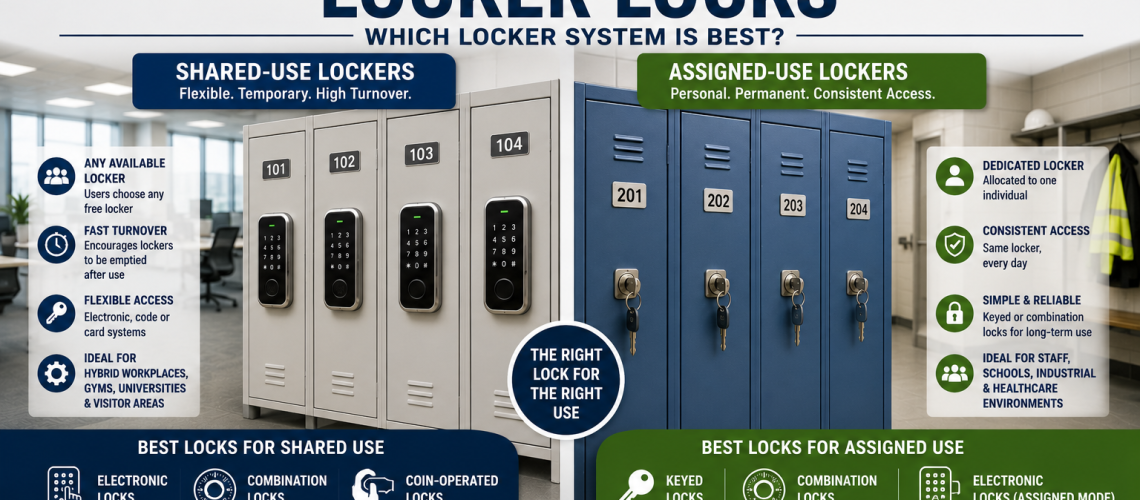
Shared-use and assigned-use describe how a locker is allocated over time, not which lock technology must be fitted. A shared-use locker returns to availability for different users, while an assigned-use locker remains associated with one regular user for an extended period.
Lock manufacturers may also use the terms public-use and private-use. In practical locker planning, public-use normally corresponds to shared use, while private-use normally corresponds to assigned use.
This guide owns the operational comparison between the two models: user turnover, allocation duration, release and reassignment, administration, abandoned lockers, capacity effects and record-keeping. It does not decide which lock technology is best.
Shared vs Assigned = how the locker is allocated. Access Control = how the locker opens.
Quick Answer: Shared-Use or Assigned-Use Lockers?
| Question | Shared / public use | Assigned / private use |
|---|---|---|
| Who uses the locker? | Different users over time | Normally one regular user |
| How long is it allocated? | Temporary session, shift, visit or short period | Days, weeks, term, employment period or another longer interval |
| What happens after use? | Locker is released and returns to availability | Locker remains allocated until formally reassigned |
| Main operational challenge | Release, reset, abandoned use and availability | Accurate assignment records and reassignment |
| Capacity effect | Can improve utilisation where users are not present at the same time | Reserves capacity for the assigned user even when absent |
| Typical record | Current or recent allocation / use status where required | User-to-locker assignment record |
The correct model depends on the operating requirement. A school pupil may need the same locker for an academic year, while a visitor may need a locker for only an hour. The sector name alone does not determine the answer.
What This Page Owns, and What It Hands Off
- Operational consequences of shared vs assigned use: this page
- Choosing the overall allocation model: Locker Allocation Systems UK
- Administering assignments and changes: Locker Management Systems UK
- Choosing keyed, combination, PIN, RFID or another access technology: Locker Access Control Systems UK
- Short-term credentials and temporary access: Temporary Locker Access Systems UK
- Actual usage and availability evidence: Locker Occupancy Management Systems UK
- Locker estate policy and standards: Locker Estate Governance UK
What Is a Shared-Use Locker?
A shared-use locker is not permanently reserved for one individual. Different users can use the same compartment at different times.
A typical operating cycle is:
- The locker is available.
- A user is allocated or selects the locker.
- The locker becomes occupied for the permitted period.
- The user removes their belongings.
- The locker is released, reset or cleared.
- The locker returns to availability for another user.
The important feature is not the lock type. It is that the allocation is temporary and the locker must return to general availability.
What Does Public-Use Mean?
Public-use is a term commonly used by lock manufacturers for temporary-user operation. It does not necessarily mean the locker is available to the general public.
A staff changing room, university library or contractor area can use a public-use lock mode even though access to the building is controlled. The important point is that the locker is released between users.
Depending on the product, the temporary access method might use a code, credential, token, coin or another mechanism. Which technology is appropriate belongs in Locker Access Control Systems UK.
What Is an Assigned-Use Locker?
An assigned-use locker remains allocated to one regular user for an extended period. The user normally returns to the same compartment rather than selecting another available locker each time.
The assignment might last:
- a school term or academic year;
- an employment period;
- a project or contract;
- a membership period;
- a departmental posting;
- or another defined long-term allocation.
The locker remains unavailable to other users until the assignment ends or is formally changed.
What Does Private-Use Mean?
Private-use is commonly used by lock manufacturers for an operating mode in which one regular user keeps continuing access to the same locker.
In practical planning, private-use normally aligns with assigned use. The access method may still be keyed, mechanical or electronic. The term describes the user relationship with the locker rather than one specific technology.
The Core Difference: Release vs Retention
The cleanest distinction between the two models is what happens after the user leaves.
| End of use | Shared / public use | Assigned / private use |
|---|---|---|
| User removes belongings | Locker should return to availability | Locker normally remains allocated |
| User leaves the site | Allocation may end immediately or after a defined period | Assignment normally continues until formally ended |
| Next user | Can receive the same locker once released | Cannot use it while the assignment remains active |
| Management task | Release, reset, clear or verify availability | Maintain and update the assignment record |
Shared Use Changes the Meaning of Availability
In a shared system, an unallocated locker and an actually empty locker are related but not always identical concepts.
A locker may appear unavailable because a user has not formally released it, even though nothing remains inside. Conversely, a locker may appear available in a record while belongings are still present if the process is poorly controlled.
If the organisation needs evidence of actual use rather than just allocation state, hand that question to Locker Occupancy Management Systems UK.
Assigned Use Changes the Meaning of Capacity
Assigned lockers reserve capacity for the named user even when that person is absent. That may be entirely appropriate where people need persistent storage, but it also means headline locker count and actual daily attendance can diverge.
For example, 300 employees with 300 permanently assigned lockers do not create spare locker capacity simply because only 180 employees attend on a particular day. The unused lockers remain assigned unless the operating model says otherwise.
Shared Use Can Improve Utilisation, but It Does Not Guarantee Fewer Lockers
Shared allocation can allow one locker to serve more than one person over time where users attend at different times or need only temporary storage.
However, shared use does not automatically mean a site can buy fewer lockers. Peak demand, overlap between users, storage duration, abandoned-use procedures and the requirement for contingency capacity still matter.
The question “how many lockers are needed?” belongs in the wider planning and capacity process rather than being decided by lock mode alone.
Assigned Use Can Simplify the User Experience
Assigned use can be operationally simple where people genuinely need persistent personal storage.
- The user knows which locker is theirs.
- Belongings can remain organised between visits where policy allows.
- There is no need to find an available locker each time.
- The allocation record can remain stable for long periods.
- Reassignment occurs only when the user’s entitlement changes.
The trade-off is that the locker remains reserved even when the user is absent.
Shared Use Requires a Clear Release Process
A shared locker system needs a defined way to return lockers to availability.
- User releases the locker at the end of use.
- System or administrator resets the locker after the permitted period.
- Abandoned lockers are escalated through an agreed process.
- Belongings are handled according to site policy.
- The locker is returned to available status only when appropriate.
The exact technical reset method belongs to the lock or software system. This page owns the operational requirement that a release process must exist.
Assigned Use Requires a Clear Reassignment Process
An assigned system needs a reliable process for ending one assignment and starting another.
- User leaves the organisation.
- Pupil changes year group or school.
- Employee changes department or location.
- Locker is taken out of service.
- Locker is reallocated to another user.
- Credential, key or code is recovered, replaced or reset as required.
- Assignment record is updated.
Ongoing administration of those records belongs to Locker Management Systems UK.
Abandoned Lockers Matter More in Shared-Use Systems
Shared-use capacity depends on lockers returning to service. A locker that remains apparently occupied after the user has gone reduces availability for everyone else.
A practical shared-use policy should define:
- how long a locker may remain allocated;
- what counts as abandoned use;
- who is authorised to open or reset it;
- how belongings are handled;
- how the locker is returned to service;
- and what record is retained where necessary.
This is an operating-process issue first. It should not be solved simply by choosing a more complicated lock.
Assigned Lockers Need Accurate Joiner, Mover and Leaver Administration
Long-term allocation becomes unreliable when assignment records are not updated as people join, move or leave.
- New users need an available compartment assigned.
- Moves between departments may require reassignment.
- Leavers should have locker access and allocation closed.
- Unreturned keys or credentials need an agreed process.
- Locker records should reflect the current user, not the historic user.
Shared vs Assigned Does Not Decide the Lock Technology
A shared locker does not automatically require RFID, and an assigned locker does not automatically require a key.
Different lock technologies can support different operating modes depending on the product and configuration. The technology decision should consider the actual access requirement, user population, management process, environment, support model and cost.
Use Locker Access Control Systems UK for that decision.
Temporary Credentials Are a Separate Question
Shared use often creates a need for temporary access, but shared allocation and temporary credential management are not the same topic.
A shared locker may use a temporary code, card, wristband, token or another method. The lifecycle of that credential, including issue, expiry, override and recovery, belongs in Temporary Locker Access Systems UK.
Shared vs Assigned in Hybrid Offices
Hybrid offices are a common example of why the allocation model should follow attendance rather than tradition.
Where employees attend on different days and do not need to leave belongings on site, shared lockers may reduce the amount of capacity held empty for absent staff. Where specific staff need persistent storage, assigned lockers may still be appropriate.
Many workplaces therefore use a mixed model rather than applying one rule to the whole building.
Shared vs Assigned in Schools
Schools often use assigned lockers because pupils need predictable access to the same compartment over a term or academic year.
That does not mean every school locker must be assigned. Visitor lockers, temporary staff storage, sports facilities or short-term device storage may follow a different model.
The operating requirement should be defined first, then the appropriate access technology selected separately.
Shared vs Assigned in Healthcare
Healthcare estates can contain both persistent and temporary storage requirements.
- Permanent staff may need an assigned locker for uniform or personal clothing.
- Bank, agency or temporary staff may need short-term access.
- Different departments may operate different shift and storage patterns.
- Some areas may require a shared pool while others retain named allocation.
The model should follow the actual staff and clothing workflow rather than assuming one healthcare-wide solution.
Shared vs Assigned in Factories and Warehouses
Factories and warehouses often use assigned lockers where staff leave workwear, footwear or PPE between shifts.
Shared lockers may still be appropriate for contractors, visitors, temporary labour or other users whose storage requirement ends with the shift or visit.
Shared vs Assigned in Leisure and Universities
Leisure centres, gyms and university estates often contain several use patterns within the same site.
- Short visits may favour temporary shared allocation.
- Staff lockers may remain assigned.
- Departmental student storage may be assigned for a term.
- Library or sports storage may be temporary.
- Specialist users may need persistent access even within an otherwise shared facility.
Again, the sector does not determine the model. The duration and purpose of the allocation do.
Mixed Locker Estates Are Normal
An organisation does not need to choose shared or assigned use for every locker in the estate.
A mixed estate can deliberately include:
- assigned staff lockers;
- shared visitor lockers;
- temporary contractor lockers;
- departmental lockers;
- short-term changing-room lockers;
- and contingency lockers held unassigned.
The important point is that each group has a defined operating model rather than an accidental mixture of practices.
Changing From Assigned to Shared Use
Moving from assigned to shared use changes more than the lock.
- Permanent assignments need to be closed.
- Users need a new way to obtain temporary access.
- A release or reset process is required.
- Abandoned-use rules are required.
- Capacity should be reassessed around peak simultaneous demand.
- Instructions may need to change.
- The access technology may need modification or replacement.
The operating-model change belongs here. The physical conversion of the lock belongs in Locker Lock Upgrade Guide UK and, where door modification is required, Retrofit Locker Locks UK.
Changing From Shared to Assigned Use
Moving from shared to assigned use means the locker stops returning automatically to a common pool and becomes associated with a particular user.
- Confirm how many users require persistent storage.
- Confirm enough locker capacity exists for those users.
- Create or update the assignment record.
- Define the start and end of each assignment.
- Define how keys, codes or credentials are issued and recovered.
- Define the reassignment process.
Security Is Not Determined by Shared or Assigned Use Alone
Shared use is not automatically less secure than assigned use, and assigned use is not automatically more secure.
Security depends on the complete system, including locker construction, lock specification, authorised override, credential control, location, supervision and response to lost or compromised access.
Choose the operating model for how the locker must function, then specify an appropriate access and security solution within that model.
Common Shared-Use Operating Mistakes
- No defined release or reset process.
- No rule for abandoned lockers.
- Users retaining lockers longer than intended.
- No process for returning cleared lockers to availability.
- Assuming a shared model automatically reduces locker numbers.
- Confusing an allocation record with proof of actual occupancy.
- Selecting technology before defining the operating process.
- No contingency for faults or temporarily unavailable lockers.
Common Assigned-Use Operating Mistakes
- Assignments not updated when users leave or move.
- Keeping permanent allocation where the storage need has disappeared.
- Confusing a historic assignment with current entitlement.
- No process for recovering keys or credentials.
- No defined reassignment process.
- Assuming every user requires permanent storage simply because the estate has always operated that way.
- Choosing complex access technology for a simple persistent-storage requirement without a clear operational reason.
Shared vs Assigned Comparison Checklist
- Does one user need continuing access to the same locker?
- Must belongings remain stored between visits?
- Will different users need the same compartment at different times?
- How long should an allocation remain valid?
- What event ends the allocation?
- Who releases or resets a locker?
- How are abandoned lockers handled?
- How are assigned lockers reassigned?
- How is current allocation recorded?
- Is evidence of actual occupancy needed?
- What is peak simultaneous demand?
- Does the site need a mixed shared/assigned model?
- What happens when a user leaves, moves or changes status?
- Only after those questions are answered: what access technology supports the requirement?
Where Shared vs Assigned Questions Go Next
| Question | Next guide |
|---|---|
| Which allocation model should the estate use? | Locker Allocation Systems UK |
| How are assignments administered? | Locker Management Systems UK |
| Which lock or credential technology should be used? | Locker Access Control Systems UK |
| How should temporary credentials be issued and retired? | Temporary Locker Access Systems UK |
| How do we know which lockers are actually being used? | Locker Occupancy Management Systems UK |
| How do we physically convert the existing locks? | Locker Lock Upgrade Guide UK |
| Does the locker door need physical modification? | Retrofit Locker Locks UK |
| What standards and responsibilities apply across the estate? | Locker Estate Governance UK |
Shared-Use and Assigned-Use Locker FAQs
What is a shared-use locker?
A shared-use locker is temporarily allocated and returns to availability so different people can use the same compartment at different times.
What is an assigned-use locker?
An assigned-use locker remains allocated to one regular user for a longer period and is not available to others until that assignment is ended or changed.
Is public-use the same as shared-use?
In locker terminology, public-use normally describes a temporary-user mode in which the locker is released between users, so it usually corresponds to shared use.
Is private-use the same as assigned-use?
Private-use normally means one regular user keeps continuing access to the same locker, so it usually corresponds to assigned use.
Does shared use always require an electronic or RFID lock?
No. Shared use describes the allocation model, not one required technology. Different products can support temporary use in different ways. Choose the access technology separately from the allocation model.
Does assigned use always mean a keyed locker?
No. Assigned lockers can use keys, combination locks, electronic credentials or other access methods. The defining feature is that the same user keeps the allocation.
Can a locker estate use both shared and assigned lockers?
Yes. Mixed estates are common. Different locker groups can use different allocation models where user needs, attendance patterns or storage duration differ.
Do shared lockers always reduce the number of lockers needed?
No. Shared use can improve utilisation where users attend at different times, but capacity still needs to reflect peak simultaneous demand, storage duration and operational contingency.
Summary
Shared-use and assigned-use are allocation models.
Shared use means the locker is temporary and returns to availability for another user. Assigned use means the locker remains associated with one regular user until the assignment is formally ended or changed.
Define that operating model before choosing lock technology. Use Allocation Systems to decide the model, Locker Management to administer it, Occupancy Management to measure actual use, Temporary Access for short-term credentials and Access Control to choose how the locker opens.
Discover more from Blog Total Locker Service
Subscribe to get the latest posts sent to your email.