Should Staff Lockers Be in Open Plan Areas or Separate Storage Zones?
April 2, 2026
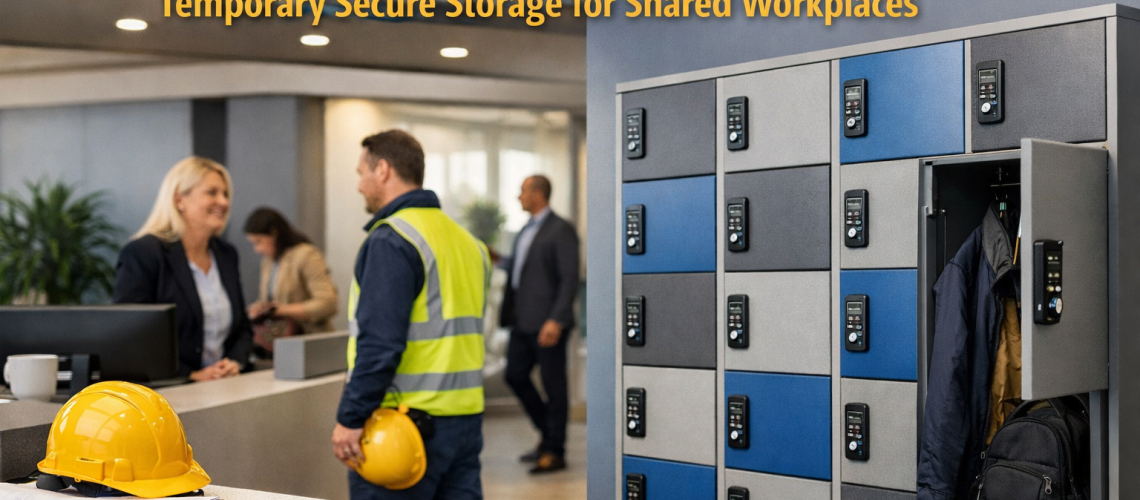
Staff lockers can sit within an open-plan office, at the edge of a hot-desking area, close to the staff arrival route or inside a separate storage zone. The best location depends on when employees use the lockers, what they store, how frequently they return to them and how locker activity affects nearby desks, circulation and visitors.
For many offices, the strongest solution is neither directly beside the desks nor hidden in a remote room. An edge-of-floor or arrival-adjacent storage zone often provides the best balance between convenience and keeping the main working area calm and uncluttered.
This guide compares open-plan, hot-desking, edge-of-zone, arrival-adjacent and separate locker locations. For the wider office specification process, see How to Choose Workplace Lockers for a New Office Fit-Out.
Quick Answer: Where Should Office Staff Lockers Go?
For lockers used mainly when staff arrive and leave, a strong starting position is:
Reception → personal storage → working area
For hot-desking areas, lockers often work best at the edge of the desk zone rather than inside the core desk cluster. This keeps them close enough to use naturally while reducing door movement, unpacking, bags and standing users immediately beside occupied workstations.
If staff regularly return to lockers during the day for devices or other frequently used equipment, closer positioning may be justified.
Think of Office Lockers as Transition Furniture
Office lockers can form the transition between arriving at work and entering the active working environment.
A well-positioned locker bank gives staff an obvious place for:
- coats and jackets;
- backpacks and laptop bags;
- lunch items;
- headphones and chargers;
- personal belongings;
- commuting items;
- and other possessions that do not need to remain at the desk.
If the storage point is inconvenient, belongings are more likely to continue into the workplace and appear on chairs, floors and desks.
Use the Arrival-to-Desk Journey to Test Locker Placement
- Employee enters the office.
- They pass reception or access control.
- They reach the locker area.
- Coats, bags and personal belongings are stored.
- They continue to the desk or working zone.
- They return to the locker during the day only where required.
- Belongings are collected naturally on departure.
If staff reach their desks before passing the lockers, arrival storage may be too deep within the office. If employees using the lockers obstruct reception, visitor check-in or the entrance, the locker bank may be too close to the front door.
Five Common Office Locker Locations
| Location | Main advantage | Main check |
|---|---|---|
| Open-plan integrated | Very convenient for frequent access | Noise, visual impact and activity near desks |
| Edge of hot-desking zone | Close to desks without placing storage inside the desk core | Protect circulation around the locker bank |
| Edge of work floor | Good balance between access and separation | Ensure the route remains convenient |
| Arrival-adjacent zone | Supports a clear arrival → storage → work sequence | Avoid congestion around reception |
| Separate storage room or zone | Keeps the main office visually calm | Do not make storage inconveniently remote |
Option 1: Lockers Within the Open-Plan Office
Open-plan placement means the lockers sit within or immediately beside the main working floor.
This can suit:
- smaller offices;
- agile workplaces;
- offices where staff need frequent locker access;
- workplaces with limited separate storage space;
- and fit-outs where lockers are deliberately integrated into the interior.
Advantages
- Very convenient throughout the day.
- Little additional walking.
- Can use perimeter space efficiently.
- Useful where lockers contain regularly accessed items.
Potential disadvantages
- Locker activity occurs close to active workstations.
- Doors, bags and users may affect circulation.
- Noise may become noticeable in quiet areas.
- The locker bank becomes a significant visual element.
- Nearby desks can become overflow storage or unpacking areas.
Option 2: Lockers at the Edge of a Hot-Desking Area
For many hybrid offices, edge-of-zone placement is a particularly strong option.
The lockers remain close enough that employees can use them naturally before choosing a desk, but there is enough separation to prevent the desk area itself becoming dominated by coats, bags, locker doors and people unpacking.
A practical sequence is:
Arrive → use locker → move a short distance to hot desk
This keeps personal storage relevant to the hot-desking routine while preserving a clearer identity for the actual working area.
How Close Should Lockers Be to Hot Desks?
There is no useful universal distance that suits every office. The better test is whether locker activity interferes with the desk zone.
The lockers are probably too close if:
- users stand immediately beside occupied desks;
- open locker doors narrow the desk circulation route;
- bags are regularly placed beside workstations while users unpack;
- locker noise distracts people working nearby;
- or the desk area visually feels like an extension of the storage zone.
The lockers may be too far away if:
- staff regularly carry coats and bags past the lockers to their desks;
- employees avoid returning to the locker because the route is inconvenient;
- personal belongings accumulate around workstations;
- or the locker bank feels disconnected from the normal arrival route.
The strongest position is generally close enough to use without thought, but outside the densest desk cluster.
Why Lockers Directly Among Hot Desks Can Cause Problems
Each locker interaction creates a small amount of activity. Staff stop, open a door, move bags or coats and often spend a short period organising belongings.
If that activity occurs repeatedly between active desk clusters, the working area can become unnecessarily busy.
- People may stand behind occupied chairs.
- Locker doors may project into circulation routes.
- Bags may temporarily sit on the floor.
- Arrival and departure activity can occur beside concentrated work.
- Open doors and movement may interrupt sightlines.
Moving the locker bank to the edge of the desk zone can preserve convenience while giving these activities their own space.
Why Lockers Should Not Be Too Far from Hot Desks Either
Remote storage can undermine the behaviour the lockers were intended to encourage.
If employees have to make a significant detour, they may simply take coats, bags and other belongings to the desk instead.
The storage should therefore form part of the natural journey into the workplace rather than requiring a separate trip.
Option 3: Arrival-Adjacent Locker Storage
Arrival-adjacent storage can work particularly well where lockers are mainly used at the start and end of the day.
Arrive → pass reception → store belongings → enter the working area
This prevents coats and bags travelling through the whole office while avoiding the congestion that can result from putting a large staff locker bank directly inside reception.
Keep Active Staff Locker Banks Out of Reception Pinch Points
Reception may already need to handle:
- visitors;
- waiting areas;
- access control;
- deliveries;
- contractors;
- and general entrance circulation.
A large employee locker bank can add another stream of people stopping and handling belongings.
Where possible, position staff lockers just beyond reception rather than directly within the busiest reception area.
Option 4: A Separate Staff Storage Zone
A separate zone can keep personal storage and locker activity away from active desks entirely.
Advantages
- Keeps the main office visually cleaner.
- Reduces locker activity around desks.
- Creates a clear boundary between personal storage and work.
- Can suit larger and more design-led offices.
- Can provide more deliberate access control.
Potential disadvantages
- The storage may become inconvenient if positioned too far away.
- Staff may return to keeping belongings at desks.
- A separate room uses dedicated floor area.
- Frequently accessed lockers can become frustrating if remote.
How Often the Locker Is Used Should Influence Its Location
| Locker use | Likely placement |
|---|---|
| Coats, bags and lunch used mainly on arrival/departure | Arrival-adjacent or separate storage zone |
| Occasional daytime access | Edge-of-floor or edge-of-hot-desking zone |
| Frequent access to work equipment | Closer to the working area |
| Charging or device storage accessed repeatedly | Convenient edge-of-zone position may be appropriate |
| Visitor and contractor storage | Near reception or another controlled arrival point |
Charging Lockers May Justify Slightly Closer Placement
Where office lockers include charging facilities, employees may return to them more frequently during the working day.
This can strengthen the case for a position closer to the hot-desking or working area. However, the same principle still applies: the lockers should remain convenient without turning the centre of the desk zone into an active storage area.
An edge-of-zone location can therefore remain a strong solution for charging lockers.
Shared Day-Use Lockers Need to Sit on a Natural Route
Hot-desking and shared day-use lockers often operate together. Their physical placement should make that shared-storage process feel automatic.
Staff should ideally pass the lockers naturally as they:
- arrive;
- select or access a locker;
- store belongings;
- choose a desk;
- and settle into work.
For the operational side of temporary allocation, clearing and abandoned belongings, use Day-Use Office Lockers for Hybrid Workplaces.
Hybrid Offices Need a Clear Storage Point
Hybrid employees often arrive carrying more equipment because less remains permanently at an assigned workstation.
- Laptop
- Backpack or work bag
- Chargers
- Headphones
- Coat
- Lunch
- Notebook
- Other personal items
A well-positioned locker bank gives this travelling bundle somewhere to go before the employee settles at a shared desk.
This is one reason hybrid offices often benefit from a clearly defined edge-of-floor or arrival-adjacent storage zone.
Keep Visitor and Staff Storage Routes Clear
Visitors and staff may enter through the same reception, but they do not necessarily need the same storage location.
- Employee storage can sit on the staff route towards the workplace.
- Visitor storage may work better nearer reception or controlled access.
- Large staff locker banks should not block visitor waiting or check-in space.
- Visitors should not have to enter staff-only areas simply to use temporary storage.
Consider Noise and Movement Around Desks
Locker use produces low-level but repeated activity:
- doors opening and closing;
- locks being operated;
- bags being moved;
- coats being handled;
- people stopping to organise belongings;
- and arrival or departure conversations.
This may be insignificant in a lively collaborative office but more noticeable beside quiet desks, meeting rooms or focused working zones.
Highly Visible Lockers Need to Suit the Office Interior
Lockers positioned within the working floor become part of the office design.
Consider:
- door colour;
- material;
- overall bank height;
- door proportions;
- lock appearance;
- numbering;
- bank length;
- and the effect on sightlines.
For office material choices, use What Materials Are Best for Office Lockers?
Placement and Locker Security
Open-plan and separate locker zones can both be secure, but the surrounding conditions differ.
- Open-plan storage often benefits from natural staff visibility.
- Separate zones may provide more deliberate access control.
- Visitor access should be considered separately from staff access.
- Override or master access should be managed appropriately.
- Locker location should be reasonably well lit.
For lock options, use Best Lock Options for Workplace Lockers.
Check the Complete Locker Footprint
Locker placement should be checked using more than cabinet width.
- Locker depth
- Open doors
- Lock or handle projection
- User standing space
- Bags being placed or removed
- Nearby desks
- Chairs
- Circulation routes
- Building services
For office locker sizing and the wider fit-out decision, use How to Choose Workplace Lockers for a New Office Fit-Out.
For workplace dimensions and physical layout, use Workplace Locker Sizes and Layouts for Staff Areas.
Office Locker Location Comparison
| Factor | Open-plan / beside work area | Edge-of-zone | Separate / arrival zone |
|---|---|---|---|
| Convenience | Very high | High | High if on natural route |
| Frequent access | Strong | Strong | Less convenient if remote |
| Desk disruption | Highest | Lower | Lowest |
| Visual separation | Low | Medium | High |
| Hot-desking | Can be too active | Often strongest balance | Good for arrival-led use |
| Hybrid working | Useful in compact offices | Often very effective | Strong where arrival sequence is clear |
| Charging lockers | Convenient but may disrupt desks | Often strong | Can be too remote for frequent access |
| Client-facing office | Requires careful integration | Good compromise | Keeps main floor visually cleaner |
Questions to Ask Before Choosing the Locker Location
- What do staff store?
- When do they use the locker?
- How often do they return to it?
- Are the lockers assigned or shared?
- Are charging points included?
- Where do employees enter?
- Where is reception?
- Where are the hot desks?
- Would staff naturally pass the lockers?
- Would locker activity disrupt nearby desks?
- Would a remote storage zone be ignored?
- Can the lockers sit at the edge of the desk area?
- Would arrival-adjacent storage work better?
- Are visitors using a different storage system?
- Can doors open without obstructing circulation?
Common Office and Hot-Desk Locker Placement Mistakes
- Putting lockers directly between active desk clusters.
- Positioning lockers beside desks simply because wall space exists.
- Hiding lockers so far away that staff stop using them.
- Ignoring the arrival route.
- Ignoring how often employees access the locker.
- Treating day-use lockers as optional storage away from the natural route.
- Allowing doors and users to narrow circulation around desks.
- Creating a storage-heavy visual centre around hot desks.
- Placing large staff locker banks directly inside reception.
- Failing to distinguish visitor and staff storage.
- Ignoring charging or frequent device access.
- Planning around the lockers rather than staff behaviour.
Step-by-Step Office Locker Placement Process
- Identify what staff need to store.
- Determine how often lockers are accessed.
- Map the staff arrival-to-desk journey.
- Map visitor routes separately.
- Mark hot-desking and quiet working zones.
- Identify possible arrival-adjacent positions.
- Identify possible edge-of-floor positions.
- Identify possible edge-of-hot-desk-zone positions.
- Consider whether a separate storage zone is practical.
- Check whether charging or frequent device access changes the requirement.
- Measure the complete locker footprint.
- Include open doors and users.
- Check desk and circulation interference.
- Review visual impact.
- Test the proposed route during peak arrival and departure.
- Choose the position that staff are most likely to use naturally.
Related Office Locker Guides
- How to Choose Workplace Lockers for a New Office Fit-Out
- Day-Use Office Lockers for Hybrid Workplaces
- Workplace Locker Sizes and Layouts for Staff Areas
- How Many Workplace Lockers Do You Need?
- What Materials Are Best for Office Lockers?
- Best Lock Options for Workplace Lockers
- Workplace Lockers UK: Staff Storage, Security, Compliance and Layout Guide
Office Locker Placement FAQs
Should lockers be right next to hot desks?
Usually not. Placing locker banks directly beside occupied hot desks can introduce extra movement, door activity, bags and visual clutter. An edge-of-zone location often provides a better balance between convenience and separation.
How far should lockers be from hot-desking areas?
There is no universal distance. They should be close enough to use naturally but sufficiently separate that locker activity does not interfere with the desk area. Edge-of-zone placement often works well.
Where should office staff lockers go?
Common locations include the edge of the open-plan floor, the edge of a hot-desking zone, an arrival-adjacent storage area or a separate staff storage zone. The best location depends on frequency of access and staff movement.
Should office lockers be placed directly in reception?
A heavily used staff locker bank can add congestion to reception. In many offices, positioning the lockers just beyond reception on the staff arrival route provides a clearer separation from visitor and entrance activity.
Do day-use lockers need to be close to hot desks?
They should normally sit on or close to the natural staff route between arrival and the working area. They do not need to be immediately beside the desks if staff mainly access them on arrival and departure.
Should charging lockers be positioned closer to desks?
They may need to be more convenient where staff regularly access devices during the day. An edge-of-work-zone position can provide easier access without placing the locker activity directly among desks.
Where should lockers go in a hybrid office?
Hybrid offices often benefit from lockers near the staff arrival route or at the edge of the hot-desking area. This allows employees to store laptops, coats, bags and personal belongings before settling into the working space.
What is an edge-of-zone locker position?
An edge-of-zone position keeps the locker bank close to the desks or work area while placing it outside the densest working cluster. It provides convenient access while reducing storage activity around active workstations.
What happens if office lockers are too far away?
If storage is inconvenient, staff may carry coats, bags and other belongings to their desks instead. This can weaken the purpose of the locker system and increase clutter around workstations.
What is the biggest mistake when positioning office lockers?
A common mistake is positioning lockers from spare wall space alone. The location should reflect the staff arrival route, access frequency, desk activity, visitor circulation and the space required while employees are actually using the lockers.
Keep Office Lockers Close Enough to Use, but Outside the Desk Core
Office lockers can work successfully within open-plan workplaces, hot-desking environments and separate storage zones. The right position depends on when employees use them and how locker activity affects the surrounding workplace.
For many modern offices, the strongest answer is an edge-of-floor, edge-of-hot-desking or arrival-adjacent position. Staff can store belongings naturally without turning the central desk area into a storage and unpacking zone.
For the wider office locker specification, continue with How to Choose Workplace Lockers for a New Office Fit-Out.
For help planning office locker locations, call Total Locker Service on 01284 749211 or email sales@totallocker.co.uk.
Discover more from Blog Total Locker Service
Subscribe to get the latest posts sent to your email.