Locker Parts, Repairs and Servicing UK: Replacement Parts & Maintenance Guide
May 7, 2026
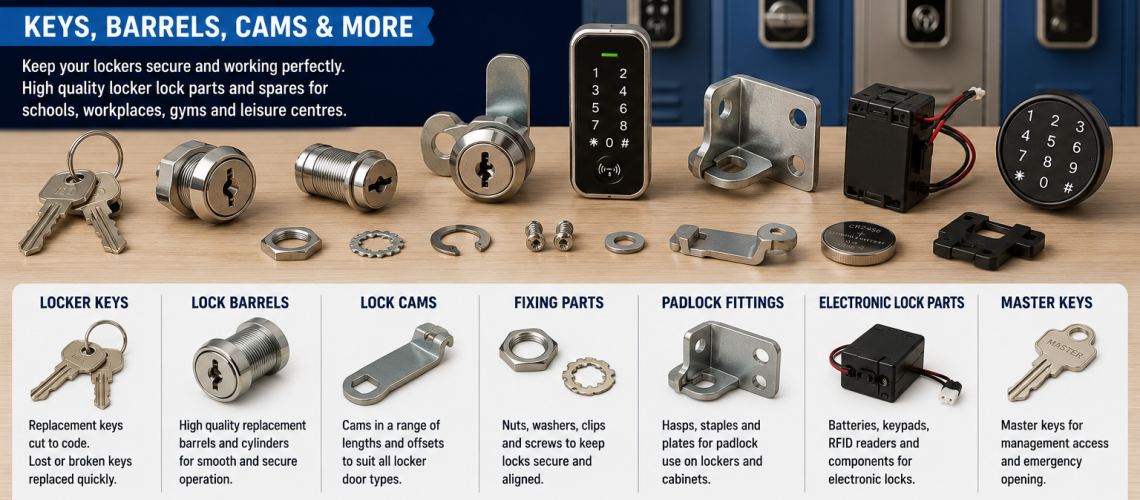
Damaged locker doors, missing keys, worn hinges, broken number plates and unreliable locks do not automatically mean that the complete locker installation needs replacing. In many cases, the correct replacement part, lock conversion or planned repair can return an existing locker to reliable service and extend its useful life.
This guide explains how to identify common locker faults, choose replacement locker parts, organise servicing and component repairs, plan preventative maintenance and provide the information needed for a locker service or repair quotation.
Its main role is practical maintenance: identifying what has failed and deciding the appropriate first repair or service action. Where the question becomes a wider asset decision — whether a locker bank should remain in service, be refurbished, be replaced or be decommissioned — use the Locker Lifecycle Management UK guide. If refurbishment has already been approved, use Locker Refurbishment UK. If replacement has already been approved, use Locker Replacement Planning UK.
Total Locker Service supports existing lockers used in schools, workplaces, factories, warehouses, healthcare facilities, gyms, swimming pools, leisure centres and other commercial buildings throughout the UK. We can assist with lockers supplied by a wide range of manufacturers, not only lockers originally supplied by Total Locker Service.
For products and service support, visit our locker parts and service hub. If you do not know which component you need, use our locker part identification service.
Quick Answer: What Should You Do When a Locker Develops a Fault?
Repair is usually worth considering first when the locker carcase remains structurally sound and the fault affects a replaceable component such as a lock, key, hinge, door, shelf, hook, number plate or fitting.
If inspection shows severe corrosion, distortion, instability, widespread structural failure, impractical parts availability or a locker configuration that no longer suits users, the issue has moved beyond a routine component repair. Record the evidence and pass the locker bank into Locker Lifecycle Management for the formal repair, refurbish, replace or decommission decision.
| Problem | Likely first step | What to check |
|---|---|---|
| Lost locker key | Replace the key where possible | Key or lock number and manufacturer |
| Failed lock | Repair, replace or convert the lock | Lock model, door preparation, cam and fixing |
| Loose or worn hinge | Adjust or replace hinge components | Locker make, hinge type and fixing positions |
| Damaged door | Assess replacement door | Manufacturer, size, material, colour and hinge arrangement |
| Missing shelf or hook | Replace the individual fitting | Locker model, width, depth and fixing method |
| Repeated faults across a site | Survey and planned maintenance | Fault quantities, locations and recurring components |
| Severe corrosion or distortion | Assess complete replacement | Structural condition and suitability of the original locker |
Find the Right Locker Part or Service
| What you need | Best next step |
|---|---|
| Replacement key with a readable number | Replacement locker keys |
| Replacement or upgrade lock | Locker locks |
| Door, hinge, shelf, number plate or fitting | Replacement locker parts |
| Unknown lock, key or component | Locker part identification |
| Several faulty lockers or complete locker bank | Locker servicing and repairs |
Why Locker Maintenance Matters
Locker faults often begin as relatively small problems. A loose hinge causes a door to drop. A misaligned door places additional load on a lock. A worn key becomes increasingly difficult to turn. A missing number plate makes faults harder to identify and record.
Dealing with these problems early can help keep more lockers available, reduce emergency repair work and extend the useful life of an otherwise sound installation.
Planned maintenance can also give facilities teams a clearer view of whether faults are isolated or whether an older locker estate is beginning to require a wider lifecycle review.
Maintenance records should provide evidence for that review rather than make the estate-level decision themselves. Use Locker Lifecycle Management UK where recurring faults, condition, parts availability or changing user requirements raise the question of refurbishment or replacement.
How Locker Environments Affect Maintenance
The type and frequency of locker faults are strongly influenced by the environment in which the lockers are installed.
| Environment | Typical maintenance pressures |
|---|---|
| Schools and colleges | Heavy daily use, impact damage, lost keys, damaged doors and worn locks |
| Gyms and leisure centres | High user turnover, humidity, wet-area exposure and frequent lock operation |
| Factories and warehouses | Shift use, workwear, dust, impact and heavy daily operation |
| Offices | Keys, electronic lock batteries, shared-use issues and appearance |
| Healthcare | Frequent use, changing staff groups, cleaning requirements and access continuity |
| Wet changing rooms | Moisture, corrosion and environmental suitability of locks and fittings |
Where lockers are installed in damp, wet, humid, corrosive or wash-down environments, replacement components should be checked for suitability rather than assuming a standard dry-area part is appropriate.
Common Locker Faults by Component
Locker Locks
Locks are one of the most frequently replaced locker components.
- lost keys;
- bent or broken keys;
- worn cylinders;
- damaged cams;
- jammed coin locks;
- failed hasps;
- forgotten combination codes;
- worn mechanical combination locks;
- flat electronic-lock batteries;
- damaged keypads;
- RFID credential problems;
- and failed lock mechanisms.
Where the door and locker body remain sound, replacing the lock is normally preferable to replacing the complete locker.
See our locker lock range or use the Locker Lock Replacement Guide UK.
Locker Doors
Locker doors receive much of the impact and repeated handling experienced by the installation.
- bent or twisted doors;
- damaged corners and edges;
- failed hinge points;
- door misalignment;
- damaged ventilation slots;
- broken lock preparation;
- and surface damage.
If the carcase remains structurally sound, a replacement door may allow the locker to remain in service.
A replacement door requires more than height and width. The locker manufacturer, range, material, colour, hinge arrangement, ventilation pattern and lock preparation may all affect compatibility.
Hinges and Door Alignment
A door that has dropped may appear to have a lock fault when the real problem is the hinge or door alignment.
- loose fixings;
- worn hinge pins;
- damaged hinges;
- failed door springs;
- distorted doors;
- and distorted locker frames.
Check alignment before replacing a lock simply because the cam no longer engages correctly.
Locker Bodies, Shelves and Dividers
The locker carcase will often outlast individual doors, locks and fittings, but it should still be inspected for structural problems.
- corrosion;
- distorted side panels;
- loose joins;
- damaged tops or bases;
- bent shelves;
- failed internal dividers;
- and loose fixing points.
Severe structural deterioration may make full replacement more appropriate even if replacement doors or locks remain available.
Hooks, Rails and Internal Fittings
Internal components can often be replaced independently.
- coat hooks;
- hanging rails;
- shelves;
- dividers;
- boot storage fittings;
- and other internal accessories.
Locker Number Plates and Identification
Clear numbering makes lockers easier to allocate, audit and repair.
Missing or inconsistent identification can make facilities management unnecessarily difficult. A fault report such as “locker 214, bank B” is considerably more useful than “one of the lockers near the door”.
Total Locker Service manufactures engraved laminate locker number discs, number plates, key fobs and other identification products for existing locker installations.
Replacement Locker Locks
Replacement locker locks are available in several operating formats.
| Lock type | Typical use | Important compatibility check |
|---|---|---|
| Key-operated cam lock | Assigned lockers | Barrel, fixing, cam and key system |
| Hasp lock | User-supplied padlock | Door preparation and hasp dimensions |
| Coin-operated lock | Leisure and public changing areas | Door preparation, currency/token operation and environment |
| Mechanical combination | Keyless assigned or shared use | Door thickness, fixing and operating mode |
| Electronic keypad | Keyless or shared use | Rear clearance, batteries and override |
| RFID lock | Card, fob or wristband access | Physical and credential compatibility |
Locks that look similar from the front may use different body dimensions, fixing arrangements, cams or mounting holes. Identify the existing lock before ordering wherever possible.
Replacement Locker Keys
Many locker keys can be cut from the number stamped on the key, lock face, barrel or a reliable site key schedule.
The number attached to the locker door is not automatically the key number. Only use a locker number as a key reference where your records specifically connect that number to the lock code.
Total Locker Service supplies replacement keys for many common locker and lock brands. Use our replacement locker key service when the required manufacturer and code are known.
Identifying an Unknown Locker Part
If the manufacturer or part number is unknown, photographs and measurements can often provide enough information to narrow the possibilities.
Useful Photographs
- the complete locker or locker bank;
- the complete affected door;
- the front of the lock or damaged component;
- the rear of the lock and fixing;
- the cam, rod or latch;
- the key;
- manufacturer labels;
- visible numbers or markings;
- and an undamaged equivalent component where available.
Useful Measurements
- door thickness;
- lock mounting-hole diameter or dimensions;
- lock body or thread length;
- cam length;
- cam offset;
- fixing-hole centres;
- door dimensions;
- component dimensions;
- and the quantity required.
Do not dismantle a working locker simply to provide a photograph or measurement if it cannot be done safely and returned to service correctly.
Send photographs and details through our Identify a Locker Part form.
For unknown locks specifically, see the Locker Lock Identification Guide UK.
Coin Locks, Refurbishment and Conversion
Coin-operated locker locks can develop problems through wear, damaged cylinders, missing cash boxes, jammed coins or tokens and worn internal components.
Depending on the lock, door and intended future use, possible options include:
- replace an individual component;
- fit a replacement coin lock;
- use a suitable refurbished lock;
- change the cylinder;
- convert the door to another locking method;
- or fit a hasp conversion system where appropriate.
Total Locker Service can also design and manufacture suitable conversion components for some existing locker-lock applications where a standard solution is unavailable. Compatibility must be established from the original lock, locker door and required operating method.
When a Routine Locker Repair Needs a Wider Lifecycle Review
A parts or servicing inspection can identify evidence that the problem is larger than an isolated component fault. Use the checks below as escalation indicators, not as a substitute for the formal lifecycle decision.
| Evidence | Routine repair evidence | Escalate for lifecycle review when |
|---|---|---|
| Locker body | Structurally sound | Severely corroded, distorted or unstable |
| Fault pattern | Locks, keys, hinges or isolated doors | Widespread structural failures |
| Parts | Compatible replacements remain available | Critical components are obsolete or impractical |
| User requirement | Existing locker sizes still work | Storage requirements have materially changed |
| Layout | Existing installation remains suitable | Room or capacity needs major redesign |
| Cost | Targeted repairs remain economical | Repeated repairs approach replacement cost |
Age alone should not decide whether lockers are replaced. Condition, parts availability, user suitability, environment and recurring maintenance cost are more useful evidence.
The formal intervention decision belongs in Locker Lifecycle Management UK. That guide determines whether the asset should continue in service, receive targeted repair, move into a refurbishment programme, be replaced or be decommissioned.
Signs That Targeted Repair May Be Sufficient
- The locker bodies are structurally sound.
- Most faults concern locks or keys.
- Only a small proportion of doors are damaged.
- Replacement hinges or fittings remain available.
- The current locker dimensions still suit the users.
- The existing room layout remains effective.
- Replacement parts can be identified reliably.
- A phased repair programme would cause less disruption than complete replacement.
Signs That the Locker Bank Should Be Escalated for Lifecycle Review
- Widespread corrosion affects structural integrity.
- Locker bodies are badly distorted.
- A high proportion of doors and hinges are failing.
- The locker configuration no longer suits users.
- Parts availability has become impractical.
- The original material is unsuitable for the environment.
- Repeated repairs are becoming uneconomic.
- A major redevelopment requires different locker dimensions or capacity.
For a large installation, a locker estate audit provides verified condition evidence. The subsequent lifecycle review owns the decision to retain, repair, refurbish, replace or decommission each asset or locker bank.
Preventative Locker Maintenance
Preventative maintenance aims to identify developing problems before lockers become unavailable.
- Check door alignment.
- Check hinges and hinge pins.
- Test each lock several times.
- Check cams and latches engage correctly.
- Inspect keys for wear or bending.
- Check number plates and identification.
- Inspect shelves, hooks and rails.
- Check locker fixings and stability.
- Look for corrosion or environmental damage.
- Replace electronic-lock batteries as required.
- Record recurring faults.
Reactive, Preventative and Condition-Based Maintenance
| Maintenance approach | How it works | Typical application |
|---|---|---|
| Reactive | Repair after the fault is reported | Small installations with occasional faults |
| Preventative | Inspect and service at planned intervals | Larger locker banks or important staff facilities |
| Condition based | Repair according to inspection results and fault history | Large or managed estates |
| Phased refurbishment | Repair or replace selected banks according to priority | Older estates with mixed condition |
There is no universal maintenance frequency for every locker installation. The appropriate interval depends on user numbers, environment, fault history, operating hours and the consequences of lockers being unavailable.
Create a Simple Locker Fault Register
Facilities teams can make maintenance substantially easier by recording faults against identifiable lockers.
| Field | Example |
|---|---|
| Site | Main warehouse |
| Locker bank | Changing Room A, Bank 3 |
| Locker number | 214 |
| Fault | Key turns but cam does not engage |
| Component | Cam lock |
| Status | Awaiting replacement part |
| Date reported | Recorded by facilities team |
| Repair history | Useful where faults recur |
This helps separate isolated defects from recurring failures and gives better information when ordering parts or requesting service work.
Locker Servicing and Repair Visits
Individual parts can often be supplied for straightforward repairs. Where faults have accumulated across a larger installation, an organised service visit may be more appropriate.
The agreed service scope may include:
- checking doors for closure and alignment;
- inspecting hinges, rods, catches and fixings;
- testing locks;
- identifying missing or damaged components;
- replacing agreed parts;
- checking shelves and internal fittings;
- checking locker numbering;
- recording faults that require further work;
- and recommending repair, conversion, refurbishment or phased replacement where appropriate.
Visit our locker servicing, repair and maintenance page for on-site support.
Information Needed for a Locker Service Quotation
- site name and location;
- locker manufacturer and range where known;
- approximate number of lockers and doors;
- number and type of known faults;
- photographs of representative lockers;
- photographs of damaged components;
- whether lockers remain in daily use;
- site access restrictions;
- parking or unloading restrictions;
- security or induction requirements;
- permitted working hours;
- required completion period;
- and any known purchasing or budget requirements.
For multi-site projects, provide a separate quantity and fault summary for each location where possible.
Holding Critical Locker Spare Parts
Larger schools, leisure facilities, factories and workplaces may benefit from holding a small quantity of commonly required compatible parts.
- replacement user keys;
- authorised master keys;
- common lock types;
- cams;
- hinge components;
- number plates;
- electronic-lock batteries;
- and other high-use components specific to the installation.
Only hold parts that have been confirmed as compatible with the actual locker estate. Apparently similar components are not necessarily interchangeable.
Parts and Maintenance Within an Approved Locker Refurbishment
Once a locker bank has already been approved for refurbishment, parts and maintenance work may form part of the defined renewal scope. The complete project — including scope, trial repairs, sequencing, surface work, completion standards and return to service — belongs in the Locker Refurbishment UK guide.
- repair or replace damaged doors;
- replace unreliable locks;
- renumber lockers consistently;
- replace missing hooks or shelves;
- correct door alignment;
- standardise lock types where practical;
- review master-key arrangements;
- replace obsolete components;
- and identify locker banks approaching structural replacement.
If the approved outcome is complete or phased replacement rather than refurbishment, use Locker Replacement Planning UK for scope, priorities, budget, procurement timing, installation windows, decommissioning and handover.
Upgrading Locker Locks Without Replacing the Lockers
Where the locker bodies remain serviceable, changing the locking method can sometimes modernise an existing installation without replacing the cabinets.
Possible changes include:
- keyed lock to hasp and padlock;
- coin lock to hasp conversion;
- keyed lock to mechanical combination;
- keyed lock to electronic keypad;
- or selected upgrades to RFID access.
Physical compatibility must be checked before ordering. Door thickness, cut-out dimensions, fixing method, cam position and rear clearance can all affect whether a conversion is practical.
Common Locker Repair and Maintenance Mistakes
- Replacing the whole locker because one lock has failed.
- Ordering a visually similar lock without checking dimensions.
- Using locker door numbers as key codes without confirming the relationship.
- Replacing a lock when door alignment is the real problem.
- Ordering doors from height and width alone.
- Ignoring the locker manufacturer and model.
- Using dry-area components in an unsuitable wet environment.
- Allowing missing locker numbers to remain unresolved.
- Waiting until a large number of lockers are out of service before reviewing maintenance.
- Failing to record recurring faults.
- Keeping no spare parts for a large critical locker estate.
- Replacing serviceable lockers simply because they are old.
- Continuing repeated repairs where the locker structure has reached the end of useful life.
- Ordering hundreds of replacement locks before proving one on the actual locker.
Locker Parts and Maintenance Checklist
- Identify the locker manufacturer.
- Record the locker model or range where known.
- Photograph the complete locker.
- Photograph the faulty component.
- Record visible markings and numbers.
- Measure the relevant component.
- Check whether the carcase remains structurally sound.
- Check door alignment.
- Check hinges.
- Check lock operation.
- Check the cam or latch.
- Check key condition.
- Check internal shelves and hooks.
- Check locker numbering.
- Check for corrosion.
- Confirm the operating environment.
- Record how many identical faults exist.
- Identify any recurring failures.
- Check replacement-part availability.
- Test one replacement where compatibility is uncertain.
- Escalate wider repair, refurbishment, replacement or decommissioning questions to Locker Lifecycle Management.
Related Locker Parts, Repair, Refurbishment and Replacement Guides
Use the route that matches the stage of the problem. Start with the failed component or service requirement, then move into lifecycle, refurbishment or replacement planning only where the evidence justifies it.
- Locker Parts and Service – main commercial hub for parts, repairs and service support.
- Replacement Locker Parts – doors, hinges, fittings and other serviceable components.
- Replacement Locker Locks – replace or upgrade compatible locker locks.
- Replacement Locker Keys – keys cut for many common locker lock ranges.
- Identify a Locker Part – provide photographs and measurements where the component is unknown.
- Locker Servicing and Repairs – on-site support for multiple faults or complete locker banks.
- Locker Lock Replacement Guide UK – detailed physical lock replacement and compatibility checks.
- Locker Lock Identification Guide UK – identify an existing lock before ordering.
- Locker Estate Audit UK – establish verified condition evidence across larger estates.
- Locker Lifecycle Management UK – decide whether assets should remain in service, be repaired, refurbished, replaced or decommissioned.
- Locker Refurbishment UK – deliver an approved refurbishment programme involving doors, locks, fittings, finishes and upgrades.
- Locker Replacement Planning UK – turn approved replacement candidates into a phased procurement and renewal programme.
- Commercial Lockers – compare replacement locker ranges once a new system is required.
Locker Parts, Repairs and Servicing FAQs
Can an old locker be repaired instead of replaced?
Often, yes. Where the locker carcase remains structurally sound, faults involving keys, locks, hinges, doors, shelves, hooks and other replaceable components can often be repaired without replacing the complete locker.
Can an old locker lock be replaced?
Many locker locks can be replaced or converted. Compatibility depends on the existing lock, fixing method, door thickness, cut-out, cam arrangement, rear clearance and operating requirements.
Can replacement locker keys be cut from a number?
Many locker keys can be cut from a valid manufacturer key number or lock code. The code may be stamped on the key, lock face, barrel or recorded in an accurate key schedule. The locker door number is not automatically the key code.
How do I identify an unknown locker lock or part?
Provide photographs of the complete locker, front and rear of the component, fixing arrangement, key and visible markings. Measurements such as door thickness, mounting-hole size and cam dimensions can also help identify compatible replacements.
Can you supply parts for lockers not originally supplied by Total Locker Service?
Total Locker Service supports many common locker and lock manufacturers. Availability depends on correctly identifying the existing locker and whether compatible replacement components remain available.
When should a locker fault be escalated beyond routine repair?
Escalation is appropriate where locker bodies are severely corroded, distorted or unstable, structural failures are widespread, important parts are impractical to obtain, recurring repair costs are increasing or the existing locker design no longer suits users. These factors should feed into a wider lifecycle decision rather than being treated as a routine component repair.
What does locker servicing include?
The agreed scope can include checking doors, hinges, locks, cams, catches, shelves and fittings, replacing approved components, recording unresolved faults and recommending further repair, refurbishment or replacement where appropriate.
Is preventative locker maintenance worthwhile?
It can be particularly useful for larger or heavily used locker estates because small problems such as loose hinges, worn locks, damaged keys and misaligned doors can be identified before lockers become unavailable.
Can coin-operated locker locks be converted to padlock operation?
Selected coin-lock installations can be converted using a compatible hasp conversion arrangement. The original lock, door preparation and required operation should be checked before specifying a conversion.
What information is needed for a locker service quotation?
Useful information includes the site location, locker manufacturer, approximate locker and door quantities, known faults, photographs, access restrictions, working-hour restrictions and the required completion period.
Start With the Fault, Then Escalate Only When the Evidence Requires It
A locker is a collection of serviceable components. Keys, locks, doors, hinges, shelves, hooks, number plates and other fittings can fail long before the locker carcase reaches the end of its useful life.
Identifying the actual fault first can reduce unnecessary replacement, maintain existing locker layouts and make better use of maintenance budgets. Where faults are widespread or structural condition, parts availability or user requirements have changed materially, record that evidence and move the affected locker bank into the appropriate lifecycle process rather than continuing repeated emergency repairs.
The route is intentionally simple: identify the fault → repair or service the component where appropriate → audit wider condition where necessary → make the lifecycle decision → refurbish or replace only after that decision has been made.
Browse our locker parts and service support, use the locker part identification service, or contact Total Locker Service for help with an existing installation.
Call 01284 749211 or email sales@totallocker.co.uk.
Discover more from Blog Total Locker Service
Subscribe to get the latest posts sent to your email.