Shared vs Assigned Charging Lockers
April 16, 2026
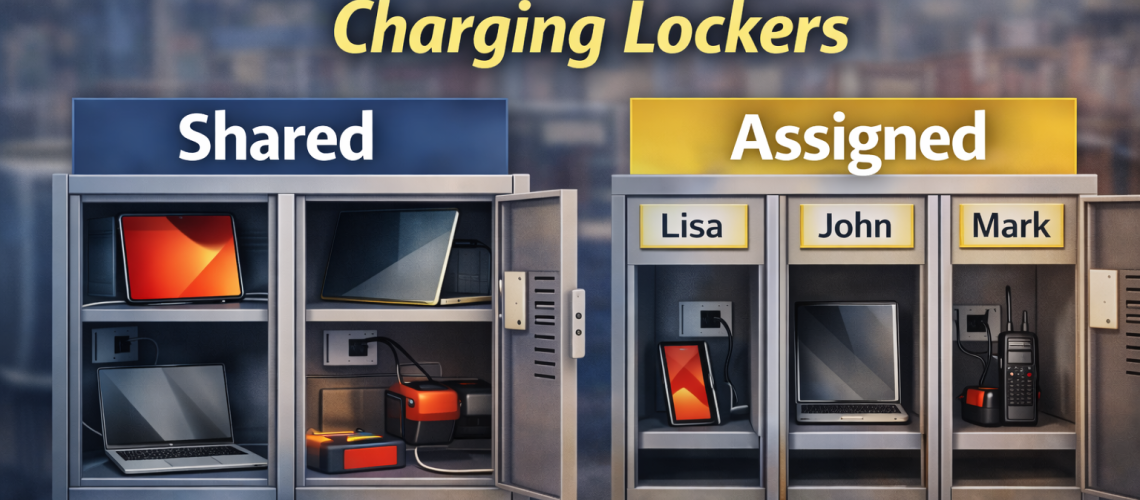
Shared and assigned charging lockers solve different device-management problems. A shared charging locker is designed around flexible users, pooled equipment or changing demand, while an assigned charging locker gives a specific person, team, role or device a consistent charging location.
The first decision should not be the locker size or lock type. It should be how the devices are owned, issued and returned. A class set of tablets, pool of loan laptops or shift-issued radios usually behaves very differently from laptops permanently allocated to named employees.
This guide explains how to choose between shared vs assigned charging lockers, including pooled and individually allocated devices, accountability, utilisation, hybrid working, class sets, shift equipment and mixed shared-and-assigned systems. For the wider charging-locker specification process, use the Charging Lockers UK guide.
Start with the device ownership model
Before deciding whether charging compartments should be shared or assigned, establish who or what actually owns the device during normal use.
| Device model | Typical example | Allocation implication |
|---|---|---|
| Personally allocated device | Named employee uses the same laptop every day | An assigned charging compartment is often straightforward |
| Pooled device | Loan laptop used by whichever employee needs it | Shared charging normally matches the operating model |
| Class or departmental set | Thirty tablets used by several classes | Shared storage usually suits the device pool |
| Shift-issued equipment | Radios or scanners handed to each incoming shift | Shared charging supports rotation between users |
| Role-based device | Supervisor tablet used by whoever fills that role | An assigned compartment can belong to the role rather than a named person |
| Mixed estate | Personal laptops plus loan devices | A hybrid shared-and-assigned arrangement may be appropriate |
This distinction matters because user ownership and device ownership are not the same thing. A device can be individually identified without permanently belonging to one person, and a charging compartment can be assigned without being reserved for one named employee.
What is a shared charging locker?
A shared charging locker is a charging system in which compartments or device positions are available to different users, teams or devices according to the operating routine rather than being permanently reserved for one named person.
The devices themselves may also be shared. Common examples include:
- class sets of school tablets;
- shared Chromebook or laptop pools;
- loan laptops in hybrid offices;
- visitor devices;
- radios issued at the beginning of a shift;
- warehouse scanners returned after use;
- shared handheld terminals;
- departmental tablets;
- spare devices used when primary equipment is unavailable.
The defining characteristic is flexibility. The charging space belongs to the operating system or device pool rather than permanently to one individual.
What is an assigned charging locker?
An assigned charging locker gives a charging compartment or position a fixed operational identity. That identity might be a named person, but it could also be a device, team, department, job role or work function.
Examples include:
- one employee returning the same laptop to the same compartment every evening;
- a named technician with an allocated tablet and charging position;
- a supervisor charging a role-specific radio in a fixed compartment;
- a department with several permanently allocated device positions;
- a specific high-value device that always returns to one controlled location.
Assigned does therefore not necessarily mean “one locker for one person”. An assigned compartment can belong to Team A, Duty Supervisor, Maintenance Radio 4 or IT Loan Device 7. What matters is that the charging position has a stable identity and expected return location.
Shared vs assigned charging lockers: decision table
| Situation | Usually better suited | Reason |
|---|---|---|
| Same person, same device, every day | Assigned | Creates a consistent return point and clear responsibility |
| Shared class set of tablets | Shared | The devices belong to the class or department rather than individual pupils |
| Loan laptops in a hybrid office | Shared | Different users may need the equipment on different days |
| Named employee laptop | Assigned | The device and user relationship is stable |
| Radios issued by shift | Shared | Equipment rotates between incoming and outgoing users |
| Supervisor device tied to one role | Assigned | The compartment can follow the role even when the person changes |
| Mixed permanent staff and pooled devices | Hybrid model | Different device groups have different allocation requirements |
| High accountability requirement | Assigned | A stable device or user location makes responsibility easier to trace |
| Maximum utilisation and flexibility | Shared | Compartments are not unnecessarily reserved for absent users |
This table describes the normal operational fit rather than a universal rule. The correct arrangement depends on how equipment actually moves through the organisation.
Separate user ownership from device ownership
One of the easiest mistakes is assuming that shared users automatically mean untracked equipment, or that assigned equipment must belong permanently to one individual.
There are really two separate questions:
- Who is allowed to use the charging position?
- Who or what is responsible for the device?
A school can operate a shared charging locker containing thirty individually numbered tablets. Pupils may change from lesson to lesson, while each tablet still has its own asset number and expected return position.
Similarly, a warehouse may share scanners between employees but track every scanner separately. The charging locker remains shared from the users’ perspective while device accountability is maintained through asset numbering, issue records or another management process.
The reverse can also apply. A compartment may be permanently assigned to the night supervisor role rather than to whichever individual currently holds that position.
Advantages of shared charging lockers
Shared charging lockers are particularly useful where equipment or users change frequently.
- Higher utilisation: charging positions do not need to remain empty simply because one particular person is absent.
- Flexible allocation: different users can access equipment according to demand.
- Good fit for pooled devices: class sets, loan laptops, radios and scanners naturally lend themselves to shared storage.
- Supports hybrid working: organisations do not necessarily need to reserve permanent charging positions for employees who attend intermittently.
- Easier adaptation: changes in staff, class groups, departments or shifts may require less physical reallocation.
- Centralised return point: shared devices can have one recognised place for collection, charging and return.
The benefit is not simply using fewer compartments. It is matching storage to an operating model in which people or equipment move.
Where shared charging needs stronger management
Flexibility creates its own management requirements. If nobody has a fixed compartment, the organisation needs another way to maintain order.
- Devices need clear identification.
- Users need to know where returned equipment belongs.
- Issue and return routines may be required.
- Shared devices may need asset numbers or sign-out records.
- Busy collection and return periods may need supervision.
- Faults need to be associated with the correct device rather than merely the compartment.
A shared locker can therefore provide excellent accountability, but accountability comes from the whole operating process, not from permanently assigning every compartment to an individual.
Advantages of assigned charging lockers
Assigned charging lockers provide a stable relationship between the charging space and the person, device, team or role using it.
- Clear accountability: a particular compartment has a recognised user, role or device.
- Predictable routine: equipment returns to the same location each time.
- Simpler user behaviour: users do not need to find an available charging space each day.
- Easy identification: numbering and records can correspond directly with equipment or users.
- Useful for individually issued devices: fixed charging complements permanent equipment allocation.
- Fault tracing: repeated problems involving one device or compartment can be easier to identify.
Assigned systems tend to work best where the operating pattern itself is stable.
Where assigned charging can reduce flexibility
The principal disadvantage of permanent allocation is that reserved capacity can remain unused.
- An absent employee’s charging position may remain empty.
- Changes in departments or responsibilities may require reassignment.
- Pooled equipment may become artificially tied to fixed users.
- A growing team may run out of available assigned positions even when existing compartments are frequently vacant.
- Labels, access records or allocation lists may need updating when users change.
This does not make assigned charging inefficient by definition. If accountability and consistency are operational priorities, reserved positions may be entirely justified.
Operational example: shared charging for a school class set
Consider a school with a set of thirty tablets used by several classes.
The tablets belong to the school rather than to individual pupils. Different pupils use them throughout the week, but each device has an asset number and a recognised charging position.
A shared charging arrangement fits this workflow because the users change while the device pool remains stable. The school can number the devices and charging positions so Tablet 01 returns to Position 01, without assigning that position permanently to one pupil.
Accountability can still be maintained through classroom issue records or supervision. The important distinction is that the charging infrastructure is organised around the class set, not personal locker ownership.
If you are deciding between charging provision for education and commercial environments more broadly, use Charging Lockers for Schools vs Workplaces.
Operational example: hybrid office with personal and loan laptops
Now consider an office with two different laptop populations.
- Twenty employees have individually issued laptops.
- Ten additional laptops form a pool for visitors, temporary staff and employees who need a spare.
Trying to force both groups into one allocation model creates unnecessary compromise.
The permanent employee devices may suit assigned charging compartments, particularly if the laptops are regularly left on site. The ten loan laptops are better treated as a shared pool because the user changes each time a device is issued.
This creates a hybrid charging arrangement in which one bank or section is assigned while another remains shared. Both operate within the same overall device-management strategy.
Operational example: radios and scanners issued by shift
A warehouse operates twenty handheld scanners. Workers collect a scanner when their shift begins and return it for charging at the end.
Although each scanner can be individually numbered and tracked, the equipment does not need to be permanently assigned to one employee. The next shift may use the same units.
A shared charging locker therefore mirrors the real workflow:
- scanner is collected;
- scanner is associated with the user or shift if required;
- equipment is used;
- scanner is returned to its charging position;
- the next authorised user can receive the equipment.
If one particular radio is permanently associated with the duty supervisor function, however, that device could have an assigned role-based position within the same installation.
Shared charging lockers for hot-desking and hybrid working
Hybrid working creates a particularly strong case for separating personal devices from pooled devices.
If employees take their assigned laptops home, reserving a permanent charging compartment for every employee may achieve little because many compartments will remain empty. A shared bank for temporary charging, loan equipment or on-site devices may provide better utilisation.
Where employees leave their individually issued laptops at work, assigned charging positions can still make sense even within a hybrid workplace.
The determining question is therefore not simply whether the office uses hot desks. It is what happens to the devices when people are not at their desks.
Using a mixed shared and assigned charging system
Many organisations do not fit cleanly into a single allocation model. A mixed system can divide the charging estate according to equipment ownership and operating requirements.
| Organisation | Assigned element | Shared element |
|---|---|---|
| School | Staff laptops | Pupil tablet or Chromebook sets |
| Hybrid office | Named employee devices left on site | Loan laptops and visitor equipment |
| Warehouse | Supervisor or specialist devices | Shift-issued scanners and radios |
| Facilities team | Role-specific tablets or test equipment | General radios, scanners or spare devices |
A mixed model can improve utilisation without giving up accountability where fixed responsibility is important. It also avoids making one allocation rule do several incompatible jobs.
Accountability in shared vs assigned charging
Assigned charging naturally creates a direct association between a compartment and its user, device, team or role. Shared systems require accountability to be created elsewhere.
That may involve:
- device asset numbers;
- numbered charging positions;
- issue and return records;
- staff supervision;
- departmental responsibility;
- device-management software;
- shift handover procedures.
A shared charging locker therefore does not have to mean anonymous or uncontrolled equipment use. It simply means permanent user-to-compartment allocation is not the primary management method.
Utilisation efficiency and flexibility
Shared systems can improve utilisation because available charging positions can serve whoever needs them. Assigned systems intentionally sacrifice some of that flexibility in return for consistency and clearer ownership.
The trade-off can be expressed simply:
- Shared charging: optimise around changing demand and flexible use.
- Assigned charging: optimise around stable responsibility and predictable return.
- Hybrid charging: apply each model only where it fits.
The most efficient arrangement is not automatically the system using the fewest compartments. A charging installation is only efficient if users can reliably find, return and identify the equipment they need.
How allocation affects charging locker capacity
Allocation affects the number of charging positions required, but detailed capacity calculation belongs to a separate stage. Assigned systems may need positions reserved for users or devices even when they are temporarily absent. Shared systems can potentially achieve higher utilisation, but still need enough positions for peak simultaneous demand.
Once you have chosen the allocation model, use How to Plan Charging Locker Capacity to calculate how many charging compartments are actually required.
Compartment size is a separate decision
Shared versus assigned describes who or what uses the charging space. It does not determine whether the equipment physically fits. Device dimensions, protective cases, chargers, plugs and cable clearance need to be checked separately.
For that stage, use Charging Locker Sizes Explained.
Lock type should follow the allocation model
The allocation decision can influence access requirements, but this page should not be used to select a lock. Shared use may require a different access routine from permanently assigned storage, and different sites may use keys, codes, electronic locks or other arrangements.
Once the shared, assigned or hybrid operating model is clear, compare access options in Best Lock Types for Charging Lockers.
If you need the technical charging explanation
The shared-versus-assigned decision concerns allocation and workflow rather than electrical operation. For sockets, charging arrangements, cables, powered storage and the general operating principle, use How Charging Lockers Work.
Questions to ask before choosing shared or assigned charging lockers
- Are devices personally allocated or pooled?
- Does the same person normally use the same device?
- Does each device need its own recognised return position?
- Do users change daily, weekly or by shift?
- Is equipment issued according to a job role rather than a person?
- How important is direct individual accountability?
- Would permanently reserved compartments frequently sit empty?
- Are devices collected and returned as a class set or shift pool?
- Does hot-desking make permanent user allocation unnecessary?
- Would separate shared and assigned sections better reflect actual use?
Choosing between shared and assigned charging lockers
The strongest starting point is device ownership and workflow.
Choose an assigned charging model where the same person, device, team or role needs a predictable charging position and clear responsibility is important.
Choose a shared charging model where devices are pooled, users change regularly or the organisation wants to maximise flexible use of charging positions.
Use a hybrid model where some equipment has permanent ownership while other devices circulate between users.
Once that operating model is established, you can compare suitable equipment through the Total Locker Service charging locker range. The product decision should follow the workflow rather than forcing the workflow to fit the locker.
Shared vs assigned charging lockers: FAQs
What is the difference between shared and assigned charging lockers?
A shared charging locker is used flexibly by different users, teams or pooled devices. An assigned charging locker gives a particular person, device, team or role a consistent charging position.
Are shared charging lockers suitable for individually tracked devices?
Yes. Devices can still have individual asset numbers, issue records or numbered return positions even when the charging locker is shared between different users.
Does an assigned charging locker have to belong to one person?
No. A charging compartment can be assigned to a particular device, team, department or job role as well as to a named individual.
Are shared charging lockers better for school tablets?
Shared charging often suits class sets and departmental tablet pools because different pupils may use the same devices. The individual tablets can still be numbered and tracked without assigning each charging position to one pupil.
Are assigned charging lockers suitable for hybrid offices?
They can be where employees use the same device and leave it on site. Where attendance changes and devices are pooled or loaned between users, shared charging may use the available storage more flexibly.
Should shift-issued radios and scanners use shared charging lockers?
Shared charging often matches shift-issued equipment because devices rotate between users. Individual radios or scanners can still be numbered and tracked while the charging system remains shared.
Can shared and assigned charging lockers be combined?
Yes. A mixed system can use assigned positions for personal or role-specific devices and shared positions for pooled, loan or shift-issued equipment.
Shared vs assigned charging lockers: summary
Shared and assigned charging lockers should be chosen according to the way equipment is owned, issued and returned.
Shared charging suits pooled equipment, changing users, class sets, loan devices, hot-desking and shift-issued radios or scanners. Assigned charging suits stable users, named devices, fixed teams or defined roles where predictable return and accountability matter. Many organisations benefit from combining the two.
After deciding the allocation model, move to charging locker capacity, charging locker sizes and charging locker lock types as separate specification decisions.
For the complete category overview, return to the Charging Lockers UK guide. When you are ready to compare products, browse our charging lockers for laptops, tablets, phones and tools.
Discover more from Blog Total Locker Service
Subscribe to get the latest posts sent to your email.