Charging Lockers UK: What They Are, How They Work & How to Choose
April 16, 2026
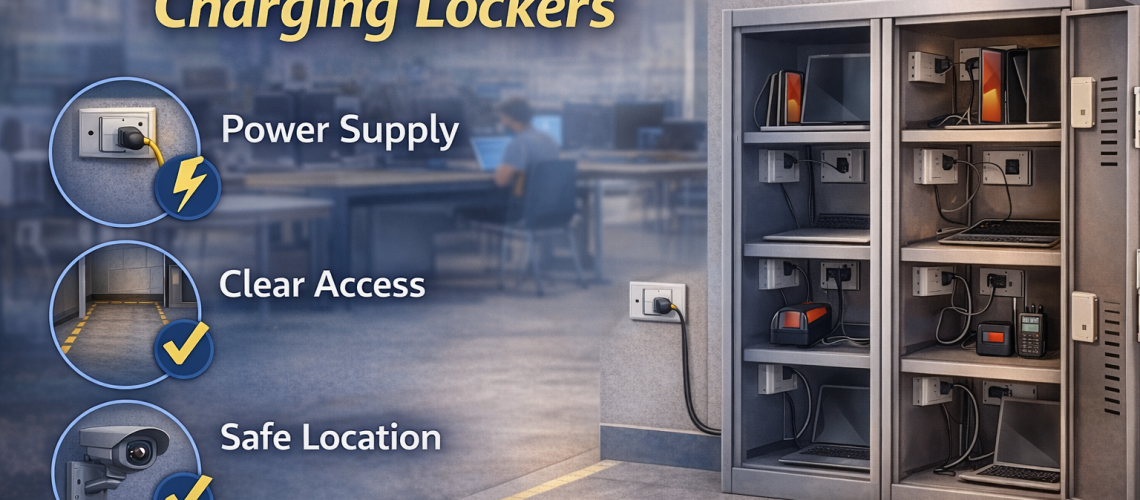
The best place to install charging lockers is a secure, practical internal location that users can reach easily, with suitable electrical provision, enough space for doors to open, clear approach space and room for maintenance. The location should support the way devices are issued, returned and charged without creating congestion or forcing cables through circulation routes.
This guide focuses specifically on where to install charging lockers. It covers room selection, power access, door clearance, user approach space, supervision, schools, offices, warehouses, workshops, maintenance access and locations to avoid. For the wider product and buying overview, use our Charging Lockers UK guide.
Quick Answer: Where Should Charging Lockers Be Installed?
A good charging-locker location normally has all of the following:
- a dry internal environment appropriate for the locker model;
- suitable electrical provision nearby;
- enough wall or floor space for the complete locker footprint;
- clear space for every door to open fully;
- enough room for users to stand, return devices and move away without blocking others;
- a position away from busy doorways and narrow circulation routes;
- appropriate visibility or supervision for the way the devices are managed;
- easy access for maintenance, inspection and power isolation;
- a location that fits naturally into the device issue-and-return routine.
The ideal room is not simply the first place where the cabinet physically fits. It is the place where the locker, users, power supply and surrounding workflow fit together.
Start With the Device Workflow, Not the Spare Wall
Before deciding on a room, map the normal device journey.
- Where are devices collected?
- Who issues them?
- Who returns them?
- Do several users arrive at the same time?
- Are devices returned during the day, at the end of a lesson or at shift change?
- Who checks that equipment has been returned correctly?
- Where should charged equipment be ready for the next user?
The charging locker should sit close enough to that routine to be convenient without being positioned directly in the busiest route through the building.
A locker placed far away from the natural issue-and-return point may encourage users to leave devices elsewhere. A locker placed directly in the flow of people may create queues and obstruction. The strongest position usually sits just off the main circulation path but close to the activity it supports.
Choose the Right Room or Area
The room should suit powered equipment as well as the people using it. In most everyday applications, charging lockers are best placed in a stable internal environment that is dry, accessible and easy to manage.
Good candidate locations can include:
- IT suites;
- school resource rooms;
- managed classrooms;
- staff rooms;
- secure office equipment areas;
- hot-desking support zones;
- warehouse equipment issue points;
- supervisor-controlled rooms;
- maintenance bases;
- workshop support areas where the locker model suits the environment.
The room should also be assessed for surrounding heat, moisture, dust, cleaning routines and other environmental conditions. Do not assume every charging locker is suitable for every internal or external environment. Follow the product specification for the actual unit being considered.
Access to Power: Close Enough Without Improvised Cable Routes
A charging locker needs suitable electrical provision, but the placement decision should not be reduced to “put it beside the nearest socket”.
A good location allows the electrical connection to be provided neatly and safely without trailing leads across walkways, cables passing through door openings or temporary extension arrangements becoming part of normal operation.
The actual electrical demand, socket or circuit requirements and combined load for one or more charging lockers should be checked separately. Use our Charging Locker Power Requirements Explained guide for that calculation.
Allow Full Door-Opening Clearance
The space occupied by the cabinet is only part of the installation footprint. Users also need space for locker doors to open.
Before fixing the final position, check:
- the direction each door opens;
- the maximum door swing;
- whether an open door clashes with a wall, column, radiator, desk or neighbouring cabinet;
- whether two banks of lockers face each other;
- whether open doors project into a circulation route;
- whether a user can stand in front of the locker while the door is open.
Do not rely only on the closed cabinet dimensions. Use the actual product dimensions and door arrangement when setting out the installation.
For the physical dimensions of charging lockers, compartment sizes and overall footprint, use our Charging Locker Sizes Explained guide.
Allow Space for Users to Approach, Stop and Return Devices
A charging locker creates a stopping point. Users do not simply walk past it. They stop, unlock a door, handle a device or charger, return equipment and close the compartment.
This means the area in front of the locker can matter as much as the footprint against the wall.
Where several people may use the locker together, allow enough surrounding space for one user to complete the return process without preventing others from moving through the room.
This is especially important for:
- school class sets returned after a lesson;
- shared laptops collected at the start of the working day;
- warehouse scanners returned at shift change;
- radios issued to several employees together;
- tool batteries returned by maintenance teams.
Avoid Narrow Corridors, Doorways and Other Busy Routes
A wall can appear to offer useful spare space while still being a poor charging-locker location.
Avoid positions where users returning equipment would:
- narrow an already busy walkway;
- stand directly beside a heavily used doorway;
- block access to another room or storage area;
- open locker doors across a main route;
- create queues in a corridor;
- interfere with nearby desks or workstations;
- obstruct access needed for other equipment or building services.
Any proposed position should also be checked against the site’s wider circulation, fire-safety and accessibility requirements. This page does not set universal clearance dimensions because those depend on the building, locker arrangement and applicable site requirements.
Decide How Much Supervision and Visibility the Location Needs
Some charging-locker systems work best in visible managed areas. Others are better inside staff-only or controlled equipment rooms.
The right position depends on who uses the equipment and who is responsible for it.
Visibility may be particularly useful where:
- pupils return shared devices;
- staff issue equipment from a central point;
- several users share the same device pool;
- supervisors need to see whether equipment has been returned;
- devices are collected at predictable busy periods.
A more secure back-office location may be preferable where valuable devices are managed by a smaller authorised team.
The detailed access-control decision belongs in our Charging Locker Lock Types guide.
Place Shared Charging Lockers Near the Device Issue-and-Return Point
Where equipment is shared, the best placement often follows the issue-and-return process.
Examples include:
- Chromebooks returned to an IT or resource room;
- loan laptops collected from an office support area;
- warehouse scanners issued from a supervisor point;
- radios returned to an equipment room;
- maintenance devices kept near a facilities base.
Keeping charging storage close to the management point reduces unnecessary carrying distance and makes it easier to notice equipment that has not been returned.
If the project is still deciding between shared and individually allocated compartments, use our Shared vs Assigned Charging Lockers guide.
Where to Install Charging Lockers in Schools
Schools often have several viable locations. The best one depends on whether devices are tied to a classroom, department or central pool.
IT Suite or Resource Room
This is often a strong location for centrally managed laptops, Chromebooks or tablets. Devices can be issued and returned from one controlled point, and staff supervision is straightforward.
It can work especially well where multiple classes borrow devices but the equipment belongs to the school or department rather than an individual pupil.
Classroom
A classroom can be appropriate where the devices mainly serve that room or teaching group. It reduces transport and can make lesson preparation easier.
The location within the classroom matters. Avoid positions beside the main entrance, in narrow routes between furniture or where students queue directly across teaching space.
Library or Central Learning Space
A managed library or learning resource area can work well where devices are borrowed centrally. The charging locker should sit close to the issue point but outside the main pedestrian flow.
Staff Room or Administrative Area
This can suit staff laptops, teaching tablets or smaller equipment pools that do not need pupil access.
For the wider operational differences between education and workplace projects, see Charging Lockers for Schools vs Workplaces.
Where to Install Charging Lockers in Offices
Office placement should follow the way staff use their devices.
Near Hot-Desking Areas
Where shared or loan laptops support hybrid working, locating charging lockers close to the hot-desk zone can make collection and return straightforward.
Keep the locker close enough to be convenient but outside the main route between desks, meeting rooms and entrances.
Staff Storage Areas
A shared staff-storage area can work well where charging lockers sit alongside ordinary personal storage. This keeps powered equipment away from individual desks while remaining easy to reach.
Secure Equipment or IT Room
This is often appropriate for higher-value equipment, central device pools or laptops managed by IT staff rather than individual employees.
Break-Out and Informal Areas
These may suit smaller personal-device charging lockers where the area is secure, dry and spacious enough. They are generally less suitable for large device banks if users would gather in a confined social space.
Where to Install Charging Lockers in Warehouses and Distribution Sites
Warehouse charging lockers often support radios, scanners, handheld terminals and other shared operational equipment. The strongest locations are usually tied to shift handover or equipment issue.
Equipment Issue Point
If staff already collect scanners or radios from a known point, the charging locker should normally be close to that process. This supports quick handover and makes missing equipment easier to identify.
Supervisor-Controlled Area
A supervisor base can work well where accountability matters or where equipment is issued to specific teams at the start of a shift.
Near the Shift-Change Route, Not in It
Being close to the shift-change process can improve compliance, but avoid positioning the locker directly where incoming and outgoing teams already create congestion.
The useful position is normally adjacent to the handover zone rather than inside the main flow.
Where to Install Charging Lockers in Workshops and Maintenance Areas
Tool and battery charging requires the location to suit the actual equipment and locker specification.
A maintenance base or workshop support area can be practical where:
- the charging locker is designed for the intended tools or batteries;
- the environment is within the product’s stated conditions;
- electrical provision is appropriate;
- the locker is protected from avoidable impact or obstruction;
- maintenance staff can reach it easily;
- ventilation openings are not blocked.
For tool-specific storage, browse our tool and battery charging lockers. For the airflow question, use Do Charging Lockers Need Ventilation?
Choose a Suitable Dry Internal Environment Unless the Product Says Otherwise
Most ordinary charging-locker installations are better suited to controlled internal environments than to exposed or wet locations.
Avoid assuming a standard charging locker can be installed:
- outdoors;
- in exposed loading areas;
- where water or cleaning spray can reach electrical components;
- in excessively dusty areas;
- beside significant heat sources;
- in other environments outside the product specification.
If the environment is unusual, check the actual product specification before selecting the location.
Leave Ventilation Openings Clear
Charging equipment can generate heat, so vents, perforations or other designed airflow paths should not be pushed hard against obstructions, covered by stored items or blocked by surrounding furniture.
This page only covers the placement consequence. For passive ventilation, charging density, tool batteries and airflow requirements, use our Charging Locker Ventilation guide.
Plan for Maintenance and Electrical Access
A location that works for users must also work for the people who inspect and maintain the locker.
Before installation, consider whether authorised maintenance staff can:
- reach the locker safely;
- open relevant doors and panels;
- inspect cables, sockets and charging equipment;
- access the electrical connection where required;
- isolate power using the site’s intended arrangement;
- remove a locker or component for repair if necessary;
- clean around the unit without blocking vents or damaging cables.
Do not trap a charging locker permanently behind desks, shelving or other fixed equipment if those items prevent sensible maintenance access.
Good Charging-Locker Location vs Poor Location
| Good location | Poor location |
|---|---|
| Close to the normal device issue-and-return point | Far from where devices are actually used or managed |
| Suitable electrical provision can be provided neatly | Requires trailing leads or improvised cable routes |
| Doors can open without obstruction | Doors clash with walls, desks or pedestrian routes |
| Users can stop without blocking circulation | Users queue in a narrow corridor or doorway |
| Appropriate supervision or controlled access | Either unnecessarily exposed or too hidden to manage |
| Dry, stable internal environment suitable for the product | Wet, exposed, excessively hot or unsuitable environment |
| Ventilation openings remain clear | Vents are blocked by walls, furniture or stored items |
| Maintenance staff can inspect and isolate the system | Locker is inaccessible once installed |
| Placement matches the equipment workflow | Locker uses spare space but does not support real operations |
Locations to Avoid When Installing Charging Lockers
- Narrow corridors: users and open doors can obstruct movement.
- Immediately beside busy doorways: device return can conflict with people entering or leaving.
- Across escape or essential circulation routes: the locker should not create an obstruction.
- Locations requiring trailing extension leads: electrical provision should be planned properly.
- Cramped corners: access, door swing and ventilation can all suffer.
- Against blocked ventilation paths: the locker should retain the airflow intended by its design.
- Areas outside the product’s environmental specification: particularly exposed, wet, excessively dusty or unusually hot locations.
- Positions hidden from necessary supervision: especially where shared devices are managed centrally.
- Places that maintenance staff cannot access: electrical and mechanical inspection must remain practical.
- Temporary spare spaces likely to change use: relocation later can create unnecessary electrical and installation work.
Charging Locker Placement Checklist
Before approving the final location, check each point below.
- Is the proposed environment suitable for the charging-locker model?
- Is the locker close to the real issue-and-return point?
- Can suitable electrical provision be made available?
- Will cables and electrical connections remain clear of circulation routes?
- Does the closed locker fit the available space?
- Can every door open fully?
- Can users stand in front of the locker without blocking others?
- Will several simultaneous users create congestion?
- Is the locker clear of busy doorways?
- Is the level of supervision appropriate?
- Are ventilation openings unobstructed?
- Can maintenance staff inspect and service the unit?
- Can the electrical supply be accessed or isolated as intended?
- Is the location compatible with future room use?
- Has the exact locker footprint been checked before final fixing?
If Many Users Arrive Together, Check Capacity Separately
Placement and capacity affect each other, but they are not the same decision. A busy school or shift-based workplace may need enough compartments for peak charging demand and enough surrounding space for peak user access.
For the number of charging positions and locker units required, use our Charging Locker Capacity Planning guide.
Use the Right Guide for the Next Charging-Locker Question
| Question | Dedicated guide |
|---|---|
| What electrical supply is required? | Charging Locker Power Requirements |
| Does the locker need ventilation? | Charging Locker Ventilation Guide |
| What overall dimensions and footprint are required? | Charging Locker Sizes Explained |
| How many charging positions are needed? | Charging Locker Capacity Planning |
| How does the powered system work? | How Charging Lockers Work |
| How do school and workplace requirements differ? | Charging Lockers for Schools vs Workplaces |
| Which lock type should be used? | Charging Locker Lock Types |
| I need the complete buying overview | Charging Lockers UK Guide |
Where to Install Charging Lockers FAQs
Where should charging lockers be installed?
Charging lockers should normally be installed in a secure, suitable internal location with appropriate electrical provision, enough space for doors and users, clear circulation and practical access for supervision and maintenance.
Can charging lockers be installed in corridors?
A corridor is only appropriate if the locker and people using it do not obstruct circulation, doorways, escape routes or other building functions. Narrow and heavily used corridors are usually poor locations.
How much space should be left in front of a charging locker?
Leave enough space for the actual locker doors to open fully and for users to stand, load or unload equipment and move away without blocking circulation. The exact clearance depends on the locker design, room layout and site requirements.
Should a charging locker be installed beside an electrical socket?
The locker needs suitable electrical provision, but an existing nearby socket should not automatically be assumed suitable. The proposed charging load and existing electrical installation should be assessed for the actual project.
Where is the best place for charging lockers in a school?
Common school locations include IT suites, resource rooms, managed classrooms, libraries and staff areas. The best choice depends on where devices are issued, returned and supervised.
Where is the best place for charging lockers in an office?
Charging lockers can work well near hot-desking areas, in staff storage zones or in secure IT and equipment rooms. The location should follow the way laptops and other devices are actually issued and returned.
Where should charging lockers be installed in a warehouse?
Warehouses often benefit from charging lockers near equipment issue points, supervisor-controlled areas or shift-change zones, provided they are positioned outside the main pedestrian flow.
Can charging lockers be installed outdoors?
Do not assume an ordinary charging locker is suitable outdoors. Installation must follow the environmental rating and specification of the actual product. Many everyday charging lockers are intended for controlled internal locations.
Do charging lockers need space for ventilation?
Designed ventilation openings and airflow paths should remain unobstructed. The detailed ventilation requirement depends on the equipment, charging density and locker design.
Why does maintenance access matter when positioning charging lockers?
Maintenance staff may need to inspect the locker, charging equipment, cables and electrical connection or isolate power. The final position should therefore remain accessible after surrounding furniture and equipment are installed.
Where to Install Charging Lockers: Summary
The best charging-locker location supports the complete device routine. It should be close to where equipment is issued and returned, have appropriate electrical provision, allow doors to open fully, provide enough user approach space and remain clear of busy circulation routes.
Schools often benefit from IT suites, resource rooms or managed classrooms. Offices may use staff-storage, hot-desking or secure equipment areas. Warehouses and operational sites often work best when charging storage sits beside the equipment issue or shift-handover process without blocking it.
Do not choose the installation point from spare wall space alone. Check the actual locker footprint, user movement, electrical provision, room conditions, ventilation paths and future maintenance access before fixing the final position.
To compare current product options, browse the Total Locker Service charging locker range.
Discover more from Blog Total Locker Service
Subscribe to get the latest posts sent to your email.