Key Storage for Businesses UK: Choosing Secure Workplace Key Storage
April 27, 2026
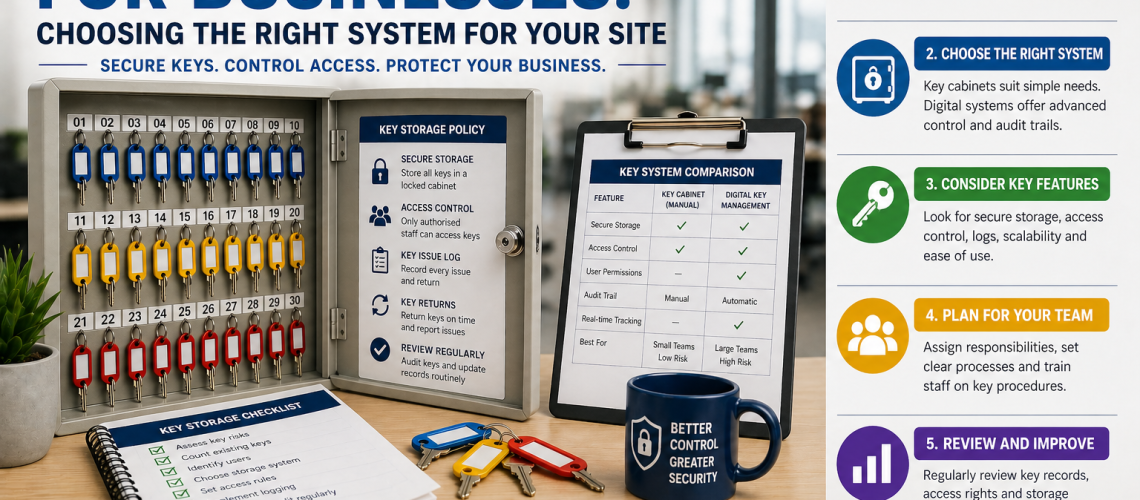
Key storage for businesses should provide a secure, organised home for the physical keys used across a workplace. The appropriate arrangement depends on what the keys protect, how many different key groups the business manages and whether some keys need stronger physical protection than others.
A small office may only need a conventional wall-mounted key cabinet. A larger workplace, warehouse, fleet operation or facilities team may need greater capacity, separate storage for particular key groups or stronger physical protection.
This guide focuses on the broad business key-storage decision: what kinds of workplace keys need storing, when a basic cabinet is enough, when stronger storage may be justified and how requirements change between offices, industrial sites, fleets and larger managed workplaces.
For the physical storage formats themselves, see Key Storage Systems UK. For cabinet types, see Key Cabinets Explained.
Quick Answer: What Key Storage Does a Business Need?
Most businesses need a defined, lockable and staff-controlled location for physical keys rather than storing them in desks, drawers or open offices.
A conventional commercial key cabinet is often enough for routine workplace keys. Stronger or separate storage may be appropriate where keys provide wider access, protect valuable assets or need to be available to a smaller authorised group.
The storage decision should start with what the keys protect, not simply how many hooks a cabinet provides.
What Is Business Key Storage?
Business key storage is the physical arrangement used to keep workplace keys secure, identifiable and available to the appropriate staff.
It can include keys for:
- external doors and gates;
- internal rooms and offices;
- cupboards and filing cabinets;
- lockers;
- stores and stock rooms;
- plant rooms;
- vehicles;
- equipment and machinery;
- service areas;
- master and sub-master systems;
- spare and duplicate keys.
The aim is to give each key or key group an appropriate physical storage location rather than allowing important keys to become dispersed around the workplace.
Start With What the Keys Protect
Not every business key creates the same level of exposure if it is lost, taken or used without permission.
For example, a key for an internal stationery cupboard usually presents a different storage requirement from a master key, vehicle key or key providing external building access.
| Key group | Typical storage consideration |
|---|---|
| Routine office and cupboard keys | A conventional controlled key cabinet may be sufficient |
| External doors and gates | Consider the wider access the key provides |
| Master and sub-master keys | May justify access by a smaller authorised group |
| Vehicle keys | Consider asset value, bulky fobs and frequent use |
| Plant and service keys | Storage should reflect the operational areas they unlock |
| Spare and duplicate keys | Keep controlled rather than leaving reserve copies dispersed around the site |
This does not mean every higher-risk key requires a completely different product. In some businesses, separate sections or a smaller restricted cabinet may provide sufficient physical separation.
When Is a Basic Key Cabinet Enough?
A conventional lockable key cabinet can be entirely appropriate where the physical key estate is straightforward.
It may suit a business where:
- the number of keys is manageable;
- most keys are routine workplace keys;
- the authorised user group is relatively small;
- the cabinet can be placed in a controlled staff-only area;
- individual electronic credentials provide little practical benefit;
- and the business does not need stronger physical protection for the whole key estate.
Simple should not be confused with inadequate. A well-positioned conventional cabinet can be the correct business solution where the requirement itself is simple.
For small workplaces specifically, see Small Business Key Storage UK.
When Might a Business Need Stronger Key Storage?
Stronger physical storage may be worth considering where the keys themselves provide particularly broad or important access.
- master or sub-master keys;
- external building keys;
- vehicle keys;
- high-value equipment keys;
- keys for restricted stores or rooms;
- keys providing access to important plant or infrastructure;
- or reserve key sets that should not be routinely accessible.
The key question is whether the physical cabinet itself needs greater protection, rather than whether the business simply needs more hooks or a different access method.
For reinforced cabinet construction and physical security, use High-Security Key Cabinets UK.
Typical Business Key Groups
Separating keys into logical groups helps a business understand the physical storage requirement before choosing equipment.
| Key group | Examples |
|---|---|
| Building access | External doors, gates, shutters and internal rooms |
| Office and administration | Offices, filing cabinets, cupboards and archives |
| Facilities and maintenance | Plant rooms, stores, roofs and service areas |
| Staff storage | Locker keys, override keys and staff-room storage |
| Fleet | Cars, vans, plant and associated remote fobs |
| Master systems | Master and sub-master keys |
| Reserve keys | Spare, duplicate and emergency copies |
A small company may only use two or three of these groups. A facilities department or larger site may use all of them.
Key Storage for Offices
Office key estates are often comparatively straightforward.
Typical requirements include:
- external entrance keys;
- internal offices;
- meeting rooms;
- filing cabinets;
- storage cupboards;
- staff lockers;
- and spare keys.
A conventional wall-mounted cabinet in a staff-only administrative or facilities area may be sufficient for many offices.
Key Storage for Retail and Commercial Premises
Retail and customer-facing businesses may manage keys for shutters, stock rooms, offices, cabinets, tills, gates and delivery areas.
Physical key storage should normally remain on the staff side of the operation rather than being visible or accessible from customer areas.
Keys affecting external access, stock or other important areas may justify greater restriction than routine cupboard keys.
Key Storage for Warehouses and Industrial Sites
Warehouses and industrial workplaces often have a wider mixture of key types.
- plant-room keys;
- equipment cages;
- stores;
- workshop areas;
- external compounds;
- vehicles;
- gates and shutters;
- and office areas.
The key-storage arrangement should remain practical for operational staff while avoiding unnecessary access to keys outside each user’s role.
Business Vehicle Key Storage
Vehicle keys deserve separate consideration because they often combine higher asset value with greater physical size.
Modern vehicle sets may include:
- remote fobs;
- physical keys;
- fuel or access fobs;
- fleet identification tags;
- and spare keys.
This can make ordinary shallow key cabinets less practical even where the nominal hook count appears sufficient.
Capacity planning for vehicle keys belongs in Key Cabinet Sizes and Capacity UK.
Key Storage for Facilities Teams
Facilities teams often manage a wider key estate than the business departments they support.
This may include:
- multiple buildings;
- plant areas;
- roof access;
- service rooms;
- cleaning stores;
- vehicles;
- contractor keys;
- and master key systems.
Where the estate becomes large enough that several cabinets, buildings or sites need coordinating, use Managing Large Key Estates UK.
Schools and Healthcare Sites
Schools and healthcare environments have sector-specific key groups and operational considerations that go beyond a general business overview.
Rather than duplicating those requirements here, use Key Storage for Schools, Healthcare and Facilities Management UK for the detailed sector comparison.
How Much Business Key Storage Capacity Do You Need?
Capacity matters, but this page does not need to calculate it in detail.
At a broad level, businesses should consider:
- current keys;
- spare and duplicate keys;
- vehicle fobs and bulky sets;
- future additions;
- and any groups that will be stored separately.
For hook counts, usable capacity, key bunches, fobs and future growth, use Key Cabinet Sizes and Capacity UK: How Many Keys Do You Need to Store?.
Where Should Business Keys Be Stored?
The physical storage point should normally be in a secure staff-only area rather than in an open office, customer area, reception counter or unlocked cupboard.
The cabinet should also remain close enough to the responsible team to be practical in everyday use.
Detailed placement, fixing, mounting height and visibility guidance belongs in Where to Install Key Cabinets UK.
Basic Cabinet or High-Security Key Cabinet?
The decision should be based on the physical protection required for the keys rather than the size of the business.
| Requirement | Broad storage approach |
|---|---|
| Routine workplace keys | Conventional commercial key cabinet may be sufficient |
| Limited higher-risk key group | Consider separate restricted storage |
| Keys requiring stronger physical cabinet protection | Consider a high-security key cabinet |
| Very small number of particularly important keys | A suitable safe may sometimes be more appropriate than a large key cabinet |
For the physical differences between cabinets, lockable boxes, safes and other storage formats, use Key Storage Systems UK.
What About Mechanical or Digital Key Cabinets?
A business may eventually need to decide whether cabinet access should use a conventional key, mechanical code, electronic PIN or another credential.
That is a technology decision, not the core purpose of this business-storage overview.
Use Mechanical vs Digital Key Cabinets UK for that comparison.
What About Key Issue, Return and Tracking?
Physical storage is only one part of workplace key management.
Once keys are shared between employees, contractors or departments, the business may also need a defined operating and recording process.
Those subjects now have their own owners:
- Managing Keys in the Workplace UK for issue, return, responsibility and lost keys;
- Key Tracking Methods UK for logs, sign-out sheets and audit trails;
- Key Control Systems UK for the overall manual, electronic or managed control model;
- Key Storage Compliance UK for policy, governance and evidence.
Business Key Storage by Scale
| Business situation | Likely physical storage requirement |
|---|---|
| Small office | Compact controlled key cabinet may be sufficient |
| Growing workplace | Larger cabinet with space for additional key groups |
| Warehouse or industrial site | Cabinet sized for rooms, plant, gates, vehicles and service keys |
| Fleet operator | Storage with sufficient depth and spacing for vehicle fobs and key sets |
| Facilities department | Structured storage across several operational key groups |
| Large multi-building estate | Several cabinets or a more structured estate-wide arrangement may be required |
Common Business Key-Storage Mistakes
- leaving shared keys in desk drawers;
- keeping important keys in unlocked cupboards;
- choosing storage purely from hook count;
- treating master keys like routine cupboard keys;
- forgetting vehicle fobs require extra physical room;
- mixing spare and operational keys without a clear structure;
- putting the cabinet in a public-facing location;
- buying electronic technology before deciding whether it solves a real problem;
- and allowing the key estate to outgrow the physical storage arrangement.
Business Key Storage Checklist
- Identify the main groups of physical keys.
- Consider what each key group protects.
- Separate routine keys from keys requiring tighter physical control.
- Identify whether bulky vehicle fobs or bunches need extra room.
- Choose an appropriate physical storage format.
- Check that the cabinet has sufficient capacity.
- Use stronger physical storage where the risk justifies it.
- Install the storage in a controlled staff-only location.
- Keep operational procedure separate from the physical-storage decision.
- Review the storage arrangement as the business grows.
Related Business Key-Storage Guides
| Question | Guide |
|---|---|
| What broad storage approach suits a business? | This guide |
| Cabinet, key box, safe or another physical format? | Key Storage Systems UK |
| What types of key cabinet are available? | Key Cabinets Explained |
| How many key positions do I need? | Key Cabinet Sizes and Capacity UK |
| Mechanical or digital cabinet? | Mechanical vs Digital Key Cabinets UK |
| When is stronger physical protection needed? | High-Security Key Cabinets UK |
| Where should the cabinet be installed? | Where to Install Key Cabinets UK |
| How should staff issue and return keys? | Managing Keys in the Workplace UK |
| How should key movement be recorded? | Key Tracking Methods UK |
| How should hundreds of keys across buildings or sites be structured? | Managing Large Key Estates UK |
Commercial Key Cabinets for Businesses
Total Locker Service supplies commercial key cabinets for offices, workplaces, schools, facilities departments, warehouses, industrial sites and vehicle fleets.
For keys requiring stronger physical cabinet protection, see our high-security key cabinets.
Choose the physical storage approach first, then use the dedicated sizing, access-technology and workplace-management guides to refine the specification.
Key Storage for Businesses FAQs
What is the best key storage system for a business?
The appropriate system depends on the types of keys being stored and what they protect. Many businesses can use a conventional commercial key cabinet, while higher-risk keys may justify separate or stronger physical storage.
Should business keys be stored in a key cabinet?
A lockable key cabinet is suitable for many workplaces because it gives physical keys a defined staff-controlled storage location rather than leaving them in desks, drawers or open areas.
When does a business need a high-security key cabinet?
Stronger physical cabinet protection may be appropriate where keys provide broad access, protect valuable assets or need greater resistance to unauthorised access. The decision should reflect the actual key risk rather than business size alone.
Where should a business keep its keys?
Business keys should normally be kept in a controlled staff-only area close enough to the responsible team for practical use and away from unnecessary public visibility.
Do vehicle keys need different storage from ordinary office keys?
Vehicle keys often require more physical space because of remote fobs, tags and larger key sets. Their connection to valuable assets may also justify tighter physical control.
Does a larger business automatically need digital key management?
No. Business size alone does not determine the access technology. A conventional cabinet may remain suitable where the key estate and authorised user group are manageable. Digital systems are useful where they solve a genuine access or administration requirement.
How large should a business key cabinet be?
The cabinet should comfortably accommodate current keys, spare and duplicate keys, bulky fobs and expected future growth. Detailed sizing should be based on the actual physical key estate.
Choosing Key Storage for a Business
Business key storage should start with the physical keys and what they protect. Routine office keys may only require a conventional commercial cabinet, while master keys, vehicle keys and other important key groups may justify tighter or stronger storage.
Keep the broad business decision separate from detailed cabinet capacity, mechanical-versus-digital technology, tracking records and workplace operating procedures.
Once the physical storage approach is clear, use the specialist guides in the key-management cluster to finalise capacity, installation, access technology and day-to-day control.
Discover more from Blog Total Locker Service
Subscribe to get the latest posts sent to your email.