Key Control Systems UK: Manual, Electronic and Managed Key Control
April 27, 2026
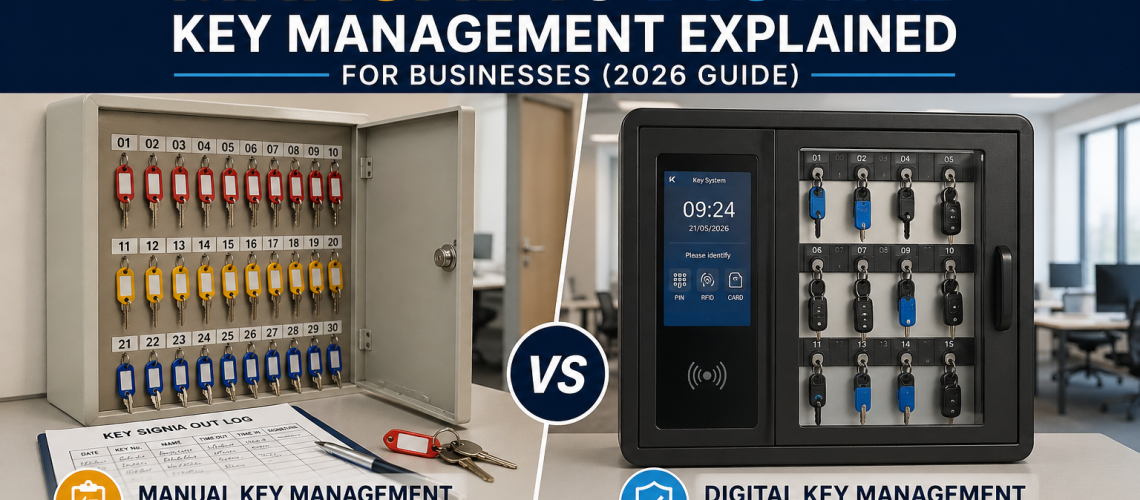
A key control system determines the overall method an organisation uses to keep physical keys under control. It can be as simple as one locked cabinet managed by a nominated person, or as structured as an electronically managed system controlling access to individual keys.
The correct approach depends less on how modern the technology is and more on how the keys are actually used: how many people need them, how frequently they move, whether different groups need different levels of control and how serious the consequences would be if a key could not be accounted for.
This guide focuses specifically on choosing the key-control model: simple manual control, structured issue systems, peg or token control, centralised and departmental control, electronic key management and mixed manual/digital arrangements.
For the detail of recording individual movements, use Key Tracking Methods UK. For wider workplace procedures and responsibilities, see Managing Keys in the Workplace UK. For the cabinet technology purchase decision, use Mechanical vs Digital Key Cabinets UK.
Quick Answer: What Key Control System Should You Use?
Use the simplest control model that can reliably manage the way your organisation actually uses keys.
| Situation | Likely control model |
|---|---|
| Small site, few users, limited key movement | Simple cabinet and register |
| Shared keys issued regularly | Structured manual issue and return system |
| Need to see quickly which user has taken a key | Peg, token or other visible issue-control method |
| Several departments with different operational responsibility | Departmental or distributed control |
| Important keys managed from one security or facilities point | Centralised key control |
| Frequent transactions, many users or changing permissions | Electronic key management may be justified |
| Mix of routine and higher-risk keys | Hybrid manual and electronic control |
Key quantity matters, but movement, user numbers and risk are often more important than the number of hooks in the cabinet.
What Is a Key Control System?
A key control system is the overall arrangement used to keep physical keys under organised control.
It combines storage with an operating model. Depending on the organisation, that model might involve:
- one central cabinet managed by an office manager;
- a cabinet and manual issue process;
- a peg or token system showing which user has taken a key;
- separate departmental cabinets;
- a central security or facilities key room;
- electronic access to individually controlled keys;
- or a combination of different approaches for different key groups.
The key-control model should answer a broader question than storage alone:
How much control does this organisation actually need over access to its physical keys?
Key Storage vs Key Control
Key storage and key control are related but they are not the same subject.
Key storage is primarily about where the keys are physically kept. Key control is about the management model surrounding access to those keys.
| Question | Primary guide |
|---|---|
| Where and how should keys physically be stored? | Key Storage Systems UK |
| What types of cabinet are available? | Key Cabinets Explained |
| How large should the cabinet be? | Commercial Key Cabinet Sizes UK |
| Which cabinet technology should we buy? | Mechanical vs Digital Key Cabinets UK |
| What overall key-control model should we use? | This guide |
| How should individual key movements be recorded? | Key Tracking Methods UK |
| How should the workplace process operate day to day? | Managing Keys in the Workplace UK |
Simple Manual Key Control
The simplest form of key control is a secure cabinet managed by one person or a small authorised group.
This can work well where:
- the key estate is relatively small;
- few people need access;
- keys do not move constantly throughout the day;
- responsibilities are stable;
- and the consequences of a temporary missing key are manageable.
A small office, workshop or local business may need little more than numbered positions, matching key references and a straightforward register.
For this smaller end of the market, see Small Business Key Storage UK.
Structured Manual Key Control
Manual key control can remain practical even when keys are regularly shared, provided the process is structured and easy to follow.
A more formal manual arrangement can combine:
- a lockable cabinet;
- clearly identified key positions;
- matching key tags;
- a controlled issue point;
- a manual record of movement where required;
- and a nominated person or team responsible for the system.
The important distinction is that the cabinet itself does not create the control. The organisation surrounding the cabinet does.
Detailed log fields and sign-out formats belong in Key Tracking Methods UK.
Peg and Token Key Control Systems
A peg or token system provides a simple physical indication that a key has been taken.
Instead of leaving an empty hook with no immediate explanation, the user places an identifying peg, token or marker in the key position when the key is removed.
This can provide a useful middle ground between a basic cabinet and a fully electronic key-management system.
- no network or software is required;
- the missing key is visually obvious;
- the responsible user can be identified from the peg or token;
- staff can understand the method quickly;
- and the system can reduce reliance on memory.
Its main limitation is the same as other manual systems: the process only works reliably when users follow it consistently.
Centralised Key Control
Centralised control places responsibility for most controlled keys at one main location such as a security office, facilities department, reception point or key room.
This model can work well where the organisation values a single point of responsibility.
- one team can supervise the system;
- staff know where controlled keys should be returned;
- management is less fragmented;
- changes can be coordinated from one point;
- and higher-risk keys can remain under closer supervision.
The disadvantage is convenience. On a large or dispersed site, staff may need to travel considerable distances simply to collect or return routine keys.
Departmental and Distributed Key Control
Distributed control places different key groups under different departments, buildings or operational teams.
For example:
- facilities controls plant and maintenance keys;
- fleet controls vehicle keys;
- IT controls communications-room keys;
- individual buildings maintain routine local keys;
- while security retains master or strategically important keys.
This can make access more practical and align responsibility with the people who actually use the keys.
The trade-off is that the organisation now has several control points instead of one. Clear ownership becomes more important as control is distributed.
Centralised vs Departmental Key Control
| Consideration | Centralised | Departmental/distributed |
|---|---|---|
| Responsibility | Concentrated in one team | Shared between operational areas |
| User convenience | May require travel to central point | Keys can remain closer to users |
| Consistency | Easier to standardise | Requires coordination between departments |
| Local knowledge | Central team may know less about individual operations | Keys managed by people familiar with their use |
| High-risk keys | Easy to retain centrally | May still need separate central control |
Many organisations ultimately use a hybrid arrangement: routine keys are distributed locally while master, spare or higher-risk keys remain under central control.
Electronic Key Control
Electronic key management can provide more structured control where manual processes become difficult to supervise.
Depending on the system, an authorised user identifies themselves using a PIN, card, fob or other credential before gaining access to permitted keys.
The potential advantage is not simply that the cabinet is electronic. It is that the system can link access to individual users and reduce dependence on separate manual procedures.
- different users can be given different levels of access;
- access can be associated with individual credentials;
- transactions can be recorded automatically;
- key availability may be easier to establish;
- and administration can become more manageable where many users share keys.
That does not mean electronic control is automatically better. It introduces technology, administration, configuration and support requirements that may be unnecessary for simpler workplaces.
For the equipment-level comparison itself, use Mechanical vs Digital Key Cabinets UK.
Manual vs Electronic Key Control
| Control issue | Manual system | Electronic system |
|---|---|---|
| Initial complexity | Low | Higher |
| User identification | Procedure or manual record | Usually linked to user credential |
| Transaction record | Relies on manual completion | Can be captured automatically |
| Different access levels | Managed procedurally | Can often be configured per user |
| Technology dependence | Minimal | Higher |
| Best fit | Stable and manageable key use | Frequent, complex or higher-control use |
The correct comparison is therefore not old versus modern. It is which model provides enough control without creating unnecessary administration?
When Is a Cabinet and Register Enough?
A conventional cabinet and simple manual process can remain entirely suitable where:
- the user group is small;
- key movement is infrequent;
- responsibilities are stable;
- the cabinet is easy to supervise;
- few keys require exceptional control;
- and missing keys can be identified without extensive investigation.
Introducing electronic control into this environment may add cost and servicing without solving a meaningful problem.
When Does More Structured Key Control Become Necessary?
A simple system starts to struggle when the number of interactions around the keys becomes difficult to supervise.
Typical warning signs include:
- many users repeatedly sharing keys;
- several shifts using the same key pool;
- different departments requiring different access;
- vehicle or plant keys changing hands frequently;
- manual procedures being ignored;
- staff regularly being unable to identify who has a key;
- higher-risk keys being mixed with routine keys;
- and administration consuming increasing amounts of staff time.
At that stage, improve the control model before simply buying a larger cabinet.
When Is Electronic Key Management Worthwhile?
Electronic key management becomes most useful where it removes a real weakness in the manual process.
- many people need controlled access;
- key movement is frequent;
- access rights change regularly;
- different users need different key groups;
- manual records are repeatedly incomplete;
- vehicle, plant or master keys are heavily shared;
- management needs reliable evidence of key access;
- or investigating missing keys takes too much time.
A site with 500 keys that rarely move may still work effectively with manual control. A depot with 40 vehicle keys being exchanged continuously may gain much more from electronic management.
Transaction complexity matters more than key quantity alone.
Manual and Electronic Key Control Can Work Together
Organisations do not necessarily need one control model for every key.
A mixed approach may be more proportionate.
| Key group | Possible control model |
|---|---|
| Routine office keys | Manual cabinet |
| Departmental maintenance keys | Controlled manual issue |
| Shared vehicle keys | More structured or electronic control |
| Master keys | Restricted central control |
| Rarely used spare keys | Separate secure manual storage |
| Frequently accessed high-risk keys | Electronic management may be justified |
This avoids paying for high levels of technology where they add little value while still strengthening control over the key groups that justify it.
Vehicle and Fleet Key Control
Vehicle keys are a good example of why the control model should follow operational use rather than key quantity.
A small company with three vehicles used by named drivers may manage perfectly well with a standard cabinet.
A depot with dozens of vehicles shared between shifts may need much more structured control because responsibility changes repeatedly throughout the day.
Possible models include:
- simple central cabinet;
- manual issue from a supervisor;
- peg or token identification;
- structured sign-out control;
- or electronic management for high transaction volumes.
The exact information recorded for each transaction belongs in Key Tracking Methods UK.
Higher-Risk and Master Keys
Not every key needs the same control model.
A master key, vehicle key or key to a restricted plant area can have very different consequences from a stationery cupboard key.
It can therefore be sensible to operate stronger control for selected key groups rather than making the entire organisation use the same process.
Where stronger physical protection is required, see High-Security Key Cabinets UK. Detailed master-key design and management belongs in the relevant Master Key Systems guide.
Key Control for Large Estates
Large key estates often use several control methods because one process is rarely ideal for every building, department and key type.
However, this page does not own the detailed architecture of hundreds of keys across multiple buildings and sites.
For that subject, see Managing Large Key Estates UK.
How to Choose a Key Control Model
- Identify the key groups. Routine rooms, master keys, vehicles, plant, stores and other assets.
- Identify the user groups. Staff, facilities teams, drivers, contractors, managers or security staff.
- Measure movement. Establish how often keys actually change hands.
- Separate routine and higher-risk keys. They may not need the same control model.
- Decide whether one central point is practical.
- Consider departmental control where local access is more efficient.
- Determine whether manual administration remains reliable.
- Identify any genuine need for different user permissions.
- Assess whether automatic records would solve a recurring problem.
- Choose the least complex system that reliably meets those requirements.
Common Key Control Mistakes
Starting With the Cabinet Instead of the Process
A cabinet is only one component. Define how the keys need to be controlled before choosing the storage hardware.
Assuming Electronic Control Is Automatically Better
Electronic management can be extremely useful where the operational requirement justifies it. Where key use is simple and stable, it may add unnecessary complexity.
Using the Same Control Level for Every Key
Routine office keys and master or vehicle keys may justify different arrangements.
Centralising Everything Unnecessarily
A single key room may create unnecessary travel and administration if routine departmental keys are better controlled locally.
Fragmenting Control Without Clear Ownership
Distributed key control only works if each department or location clearly understands which keys it owns.
Confusing Key Control With Key Tracking
Control defines the management model. Tracking records individual movements within that model. They support each other but are not the same topic.
Key Control System Checklist
- Identify the key groups that require control.
- Identify who needs operational access.
- Measure how often keys change hands.
- Separate routine and higher-risk keys.
- Choose between centralised, departmental or hybrid control.
- Decide whether a simple cabinet-and-register approach is sufficient.
- Consider peg or token control where visible manual accountability would help.
- Assess whether manual administration remains reliable.
- Consider electronic management where transactions or permissions have become complex.
- Avoid introducing technology that solves no identifiable problem.
- Use different control models for different key groups where appropriate.
- Then select storage hardware that supports the chosen process.
Where Key Control Questions Go Next
| Question | Guide |
|---|---|
| Where should keys physically be stored? | Key Storage Systems UK |
| What types of cabinet are available? | Key Cabinets Explained |
| How many key positions do we need? | Commercial Key Cabinet Sizes UK |
| Should we buy a mechanical or digital cabinet? | Mechanical vs Digital Key Cabinets UK |
| How should individual issue and return movements be recorded? | Key Tracking Methods UK |
| How should workplace responsibilities and procedures operate? | Managing Keys in the Workplace UK |
| How should hundreds of keys across multiple sites be structured? | Managing Large Key Estates UK |
| When is reinforced physical key storage justified? | High-Security Key Cabinets UK |
| What governance or evidence requirements should we consider? | Key Storage Compliance UK |
Key Cabinets for Manual and Managed Key Control
Once the control model is clear, the physical storage can be selected to support it.
Total Locker Service supplies commercial key cabinets for workplaces, facilities teams, schools, vehicle fleets and other organisations managing physical keys.
Do not choose cabinet capacity purely from the number printed in the product description. Key bunches, vehicle fobs, spare positions and future growth can all affect practical capacity. See Commercial Key Cabinet Sizes UK for detailed sizing guidance.
Key Control Systems FAQs
What is a key control system?
A key control system is the overall method an organisation uses to keep physical keys under organised control. It may use simple manual procedures, structured issue systems, departmental control, electronic management or a combination of approaches.
What is the difference between key storage and key control?
Key storage concerns where keys are physically kept. Key control concerns the wider management model used to control access to those keys and maintain responsibility for them.
Is a key cabinet a key control system?
A key cabinet can form part of a key control system, but the cabinet alone does not create the control. The organisation also needs an appropriate method for managing access and responsibility.
When is manual key control sufficient?
Manual control can work well where key movement is limited, the user group is manageable and the organisation can reliably supervise the process without excessive administration.
When is electronic key management worth considering?
Electronic key management becomes more useful when many users share keys, transactions are frequent, different users need different levels of access or manual administration is no longer reliable enough.
Can manual and electronic key control be used together?
Yes. An organisation may use simple manual control for routine keys while applying stronger electronic management to frequently shared, vehicle, master or higher-risk keys.
Should key control be centralised?
Not always. Centralised control can simplify responsibility, while departmental control may place routine keys closer to the people who use them. Many organisations use a hybrid approach.
What is a peg key control system?
A peg key control system uses an identifying peg, token or marker in place of a removed key so staff can see that the key is in use and identify the responsible user.
Choosing the Right Key Control System
The best key control system is not necessarily the most sophisticated one.
A small, stable workplace may need nothing more than a secure cabinet and clearly managed manual process. A busy depot, facilities operation or high-turnover site may benefit from structured issue control or electronic key management.
Start with the way the keys actually move through the organisation. Decide whether responsibility should be centralised or distributed, whether routine and higher-risk keys require different treatment and whether manual administration remains reliable.
Then choose the least complex control model that provides the level of management the organisation genuinely needs.
Once that decision is made, browse our commercial key cabinets or continue to Mechanical vs Digital Key Cabinets UK to compare the cabinet technology that can support the chosen system.
Discover more from Blog Total Locker Service
Subscribe to get the latest posts sent to your email.