Managing Keys in the Workplace UK: Issue, Return, Responsibility and Lost Keys
April 27, 2026
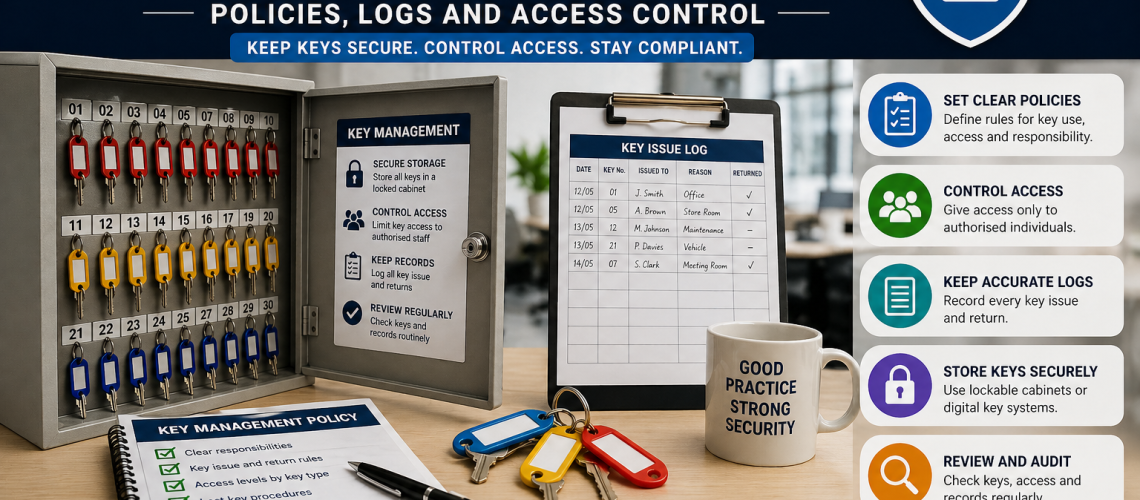
Workplace key management is the day-to-day process of making sure keys are stored, issued, returned and handled consistently by staff, managers and contractors. A secure cabinet helps, but the quality of the process depends on clear responsibilities, practical rules and what happens when a key is lost, retained or used outside the expected procedure.
This guide focuses on workplace policy and operating procedure: who is responsible for keys, how staff should use them, how contractors and leavers are handled, how lost keys are escalated and how procedures are kept up to date.
For the wider control architecture, including manual vs digital issuing and permissions, use Key Control Systems UK. For detailed recording methods such as paper logs, spreadsheets and digital audit trails, use Key Tracking Methods UK.
Why Workplace Key Management Matters
Keys may protect offices, stores, vehicles, plant rooms, lockers, cabinets, medicines, documents and restricted areas. Poor handling can create confusion, downtime, replacement costs and avoidable security problems.
The practical aim is simple: every key should have a known storage location, an agreed user group, a clear issue and return process and an escalation route if something goes wrong.
Assign Clear Responsibility for Key Management
Someone should be responsible for the workplace key process. Depending on the organisation, this may be facilities, reception, security, administration, a site manager or another named role.
- maintain the key list or register;
- control access to higher-risk keys;
- make sure issue and return procedures are followed;
- follow up missing keys;
- update the process when staff roles change;
- coordinate contractor access;
- review exceptions and recurring problems.
Responsibility should be attached to a role rather than relying on informal knowledge held by one individual.
Create a Practical Workplace Key Policy
A workplace key policy should explain the rules clearly enough that staff know what is expected without needing to interpret them differently each time.
- where keys must be stored;
- who can issue keys;
- who may receive different categories of key;
- whether approval is needed for higher-risk keys;
- how keys must be returned;
- what staff must do if a key is missing or damaged;
- how contractors and temporary users are handled;
- what happens when an employee leaves or changes role;
- who reviews exceptions and recurring failures.
The policy should be proportionate. Routine office keys may need a simple process, while master keys, vehicle keys and restricted-area keys may justify tighter controls.
Use Secure Key Storage
Keys should have a fixed storage location rather than being left in drawers, open offices, desk trays or unlocked cupboards.
The detailed choice of cabinet, capacity and access technology belongs in the dedicated storage guides. For broader options, use Key Storage Systems UK, Key Cabinets Explained and Mechanical vs Digital Key Cabinets.
Set Key Access Rules by Risk
Not every key needs the same operating procedure. A stationery cupboard key creates a different risk from a master key, vehicle key or restricted-area key.
| Key category | Typical workplace rule |
|---|---|
| Routine office keys | Available to approved staff through normal issue procedure |
| Store or equipment keys | Limited to relevant staff or departments |
| Vehicle keys | Issued to authorised drivers or users and returned after use |
| Master keys | Restricted to named authorised staff with stronger oversight |
| Restricted-area keys | Issued only where the user has a legitimate operational need |
The detailed permission architecture belongs in Key Control Systems UK. This page focuses on making those rules workable in day-to-day operations.
Set Clear Staff Issue and Return Rules
Staff should know exactly what to do when taking and returning a shared key.
- Take only the key required.
- Complete the required issue record.
- Keep the key under personal control while it is issued.
- Do not pass it informally to another user unless the procedure allows this.
- Return it to the correct location after use.
- Complete the return record where required.
- Report loss, damage or delay immediately.
For the exact fields to record, use Key Tracking Methods UK.
Label and Identify Keys Clearly
Keys need consistent references so staff can identify the correct item without exposing unnecessary information if a key is lost.
- use numbered or coded tags;
- keep references consistent with the key register;
- avoid unnecessary plain-language descriptions of sensitive locations;
- replace damaged or unreadable tags promptly;
- avoid duplicate references.
A coded reference such as “A12” can be linked to a controlled key list instead of displaying the full protected location on the tag itself.
Use a Stronger Procedure for Master Keys
Master keys deserve tighter operational control because one key may provide access to many rooms, cabinets or restricted areas.
- limit use to named authorised staff;
- avoid casual or shared access;
- record issue and return clearly;
- store master keys separately where the risk justifies it;
- escalate missing master keys immediately;
- review whether the user still needs access after role changes.
For the technical and administrative structure of master-key systems, use Master Key Locker Systems UK where relevant.
Manage Contractor Key Access
Contractors often need temporary access to plant rooms, service areas, roof spaces, stores or maintenance areas. Their key access should be limited to the task and period required.
- Confirm the contractor or visitor identity.
- Issue only the keys needed for the work.
- Record the issue.
- Explain any return or escort requirements.
- Set an expected return point.
- Confirm all keys are returned before access closes.
- Escalate any missing key immediately.
Detailed tracking fields belong in Key Tracking Methods UK.
Control Temporary and Loan Keys
Temporary keys can be useful for visitors, temporary staff, contractors or short-term operational access, but they should not become permanent informal access.
- define the purpose of the loan;
- identify the responsible user;
- set a return expectation;
- remove access when the need ends;
- avoid leaving temporary keys permanently in circulation.
Handle Leavers and Role Changes
Key access should change when employment or responsibilities change. A person who no longer performs a role should not retain keys simply because they once needed them.
- recover issued keys when staff leave;
- check departmental or role-specific keys;
- update records where responsibility transfers;
- remove digital permissions where applicable;
- review master-key access after promotions, transfers or role changes;
- investigate any key that cannot be accounted for.
Control Spare and Duplicate Keys
Spare and duplicate keys should be managed deliberately rather than accumulating without records.
- record authorised duplicates;
- keep spare keys in controlled storage;
- avoid creating unnecessary copies;
- identify who may request or approve duplicates;
- update the key register when copies are added or withdrawn.
For replacement locker keys and cut-to-code ordering, use replacement locker keys where applicable.
What to Do if a Workplace Key Is Lost
A missing key should be reported promptly. The response should be based on what the key opens, whether it is identifiable and what could happen if it is found or misused.
- Record the missing key.
- Confirm the last known user.
- Identify what the key opens.
- Search likely locations.
- Assess the operational and security consequence.
- Decide whether access needs to be restricted, a lock changed or another corrective action taken.
- Update the key register and incident record.
- Review why the loss occurred and whether the procedure needs changing.
The response to a missing master key or restricted-area key may be very different from the response to a low-risk cupboard key.
Review the Workplace Key Process
Key-management procedures should be reviewed often enough to identify outdated access, repeated missing-key problems and processes that staff are no longer following.
The review frequency should be proportionate to:
- the number of keys;
- the number of users;
- the risk associated with the keys;
- how frequently keys are issued;
- contractor and temporary access;
- the operational consequence of a missing key;
- internal policy or audit requirements.
There is no single weekly or monthly interval that is appropriate for every workplace.
What a Workplace Key Review Should Check
- responsibilities are still clear;
- staff access still reflects current roles;
- contractor procedures are being followed;
- lost or overdue keys have been resolved;
- spare and duplicate keys remain accounted for;
- records and references remain usable;
- repeated process failures have been addressed;
- the policy still reflects the building and organisation.
Workplace Key Management Checklist
- Assign responsibility for workplace key management.
- Give keys a secure storage location.
- Group keys by operational risk.
- Define who may receive each category.
- Set clear issue and return rules.
- Use consistent key references.
- Control master keys more tightly.
- Manage contractor and temporary access.
- Recover keys from leavers and staff changing roles.
- Control spare and duplicate keys.
- Escalate missing keys promptly.
- Review the procedure at a frequency proportionate to risk.
Related Key Management Guides
| Question | Guide |
|---|---|
| How should keys be issued, returned and controlled? | Key Control Systems UK |
| How should key movement be recorded? | Key Tracking Methods UK |
| Where should keys be stored? | Key Storage Systems UK |
| What key cabinet types are available? | Key Cabinets Explained |
| What cabinet capacity is required? | Commercial Key Cabinet Sizes UK |
| Mechanical or electronic cabinet? | Mechanical vs Digital Key Cabinets |
| What formal compliance issues apply? | Key Storage Compliance UK |
Workplace Key Management FAQs
What is workplace key management?
Workplace key management is the day-to-day process of storing, issuing, returning and controlling keys used by staff, managers, contractors and temporary users.
Who should be responsible for workplace keys?
Responsibility should be assigned to a clear role such as facilities, reception, security, administration or site management so the process does not rely on informal knowledge.
What should a workplace key policy include?
A workplace key policy should define storage rules, responsibilities, issue and return procedures, higher-risk key controls, contractor access, lost-key escalation and what happens when staff leave or change roles.
How should contractor keys be managed?
Issue only the keys needed for the task, record who received them, set a return expectation and confirm they have been returned before temporary access closes.
What should happen when an employee leaves?
Recover issued keys, update records, remove digital permissions where applicable and investigate any key that cannot be accounted for.
How often should workplace key procedures be reviewed?
Review frequency should be proportionate to key risk, number of users, frequency of issue, contractor access and the operational consequences of a missing key. There is no single interval suitable for every workplace.
Summary: Managing Keys in the Workplace
Effective workplace key management is mainly about consistent behaviour and clear responsibility. Secure storage, good records and suitable technology all help, but they need to sit inside a practical day-to-day procedure.
Keep the workplace policy focused on who is responsible, who may receive keys, how they are returned, what happens when circumstances change and how problems are escalated.
Discover more from Blog Total Locker Service
Subscribe to get the latest posts sent to your email.