Key Cabinet Installation in Staff-Only Offices: Secure Placement, Access Control and Best Practice (UK Guide 2026)
April 27, 2026
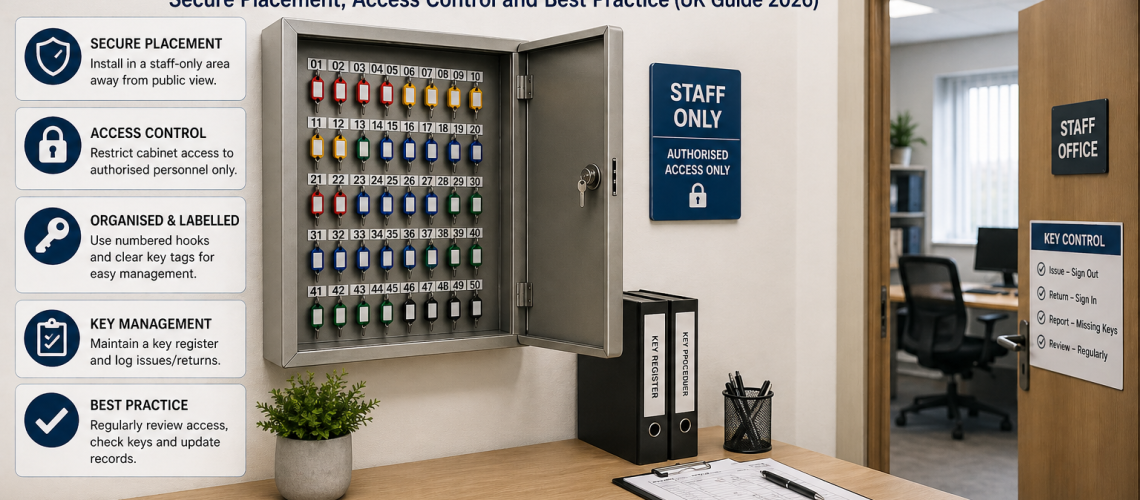
A key cabinet installed in a secure staff-only office provides controlled access, clear organisation and a reliable system for managing workplace keys. The right setup ensures keys are protected, easy to find and returned correctly after use.
In most workplaces, a wall-mounted key cabinet located in a staff-only office is one of the most effective ways to manage keys. It combines physical security with practical access, allowing authorised staff to issue, return and check keys without exposing them to public view.
This guide explains how a secure office-based key cabinet setup works, why it is effective and how to implement it properly in a UK workplace environment.
Why install a key cabinet in a staff-only office?
A staff-only office provides a controlled environment. Access is limited to authorised personnel, which reduces the risk of unauthorised viewing, tampering or misuse of keys.
Unlike public-facing areas, a private office allows key management to be handled as part of a structured process. Staff can issue and return keys with less distraction and better oversight.
- Reduces visibility to visitors and unauthorised users
- Supports controlled access procedures
- Allows better supervision of key use
- Improves accountability for issued keys
- Keeps key labels and indexing protected
This setup is widely used in offices, schools, warehouses, healthcare environments and commercial sites where controlled access is required.
Benefits of a wall-mounted key cabinet
A wall-mounted cabinet keeps keys secure, visible and organised. It also prevents keys from being stored in drawers, cupboards or temporary locations where they can be lost or misused.
Mounting the cabinet on a wall ensures it remains fixed in one location, making it easier for staff to follow a consistent process.
- Keys remain in a fixed, known location
- Hooks and tags keep keys organised
- Missing keys are easier to identify
- Cabinet cannot be easily moved or misplaced
- Supports structured key management systems
For sizing guidance, see key cabinet sizes and capacity.
Controlled access and accountability
Installing the cabinet in a staff-only office allows access to be restricted to specific individuals. This creates a clear boundary between authorised and unauthorised users.
Access can be controlled using a key lock, combination lock or digital system depending on the level of security required. Limiting who can open the cabinet improves accountability and reduces the risk of keys being taken without record.
- Limit access to authorised staff only
- Assign responsibility to a named person or team
- Use a key log or audit system where required
- Review access permissions regularly
For process guidance, see managing keys in the workplace.
Organised key storage and clear layout
A well-installed cabinet should present keys in a clear and logical layout. Numbered hooks, labelled tags and a matching index help staff find and return keys quickly.
Organisation becomes more important as the number of keys increases. Even a small cabinet benefits from consistent labelling and grouping.
- Use numbered hook positions
- Assign matching numbered key tags
- Group keys by area or department
- Maintain an index or key register
- Update labels when locks or locations change
A clear layout reduces mistakes and makes it easier to identify missing keys during checks.
Supporting key issue and return process
The cabinet location should support the process of issuing and returning keys. A staff-only office provides space for logs, checks and supervision.
Where keys are shared, a simple log can record who has taken a key and when it is returned. This helps reduce loss and improves accountability.
- Provide a nearby writing surface or log sheet
- Record key issue and return where needed
- Check keys back into the correct position
- Review missing or overdue keys
For system comparison, see mechanical vs digital key cabinets.
Placement within the office
Even within a staff-only office, placement matters. The cabinet should be installed in a position that is easy to access for authorised staff but not directly visible from doorways or visitor entry points.
- Mount on a solid internal wall
- Avoid direct line of sight from open doors
- Ensure good lighting for reading labels
- Allow space for the cabinet door to open fully
- Position at a comfortable working height
The aim is to create a controlled and practical working area for key management.
Security considerations
While a staff-only office improves security, additional precautions may still be required depending on the keys stored. Master keys, vehicle keys and restricted-area keys may need stronger controls.
- Use coded labels instead of sensitive descriptions
- Restrict access to higher-risk keys
- Separate high-risk keys where needed
- Consider digital key control for audit tracking
- Review access regularly
Security should be proportionate to risk. Not all keys require the same level of control.
Best use cases for office-based key cabinets
A key cabinet in a staff-only office is suitable for a wide range of environments where controlled access is needed.
- Office buildings and workplaces
- Schools and colleges
- Warehouses and industrial sites
- Healthcare and care settings
- Retail back offices
- Facilities and estates teams
In each case, the cabinet supports a structured system for managing keys across the site.
Common mistakes to avoid
- Installing the cabinet in a public-facing area
- Placing it where visitors can see key labels
- Mounting it too far from the responsible team
- Failing to fix the cabinet securely
- Using unclear or inconsistent labelling
- Allowing too many people to access the cabinet
- Not keeping a key log where needed
- Overfilling the cabinet beyond its capacity
Avoiding these mistakes ensures the cabinet remains effective over time.
Key cabinet setup checklist
- Install in a staff-only controlled office
- Fix securely to a suitable wall
- Position at a practical working height
- Use numbered hooks and key tags
- Maintain a clear key index
- Limit access to authorised staff
- Use a log for shared or sensitive keys
- Separate higher-risk keys if needed
- Review the system regularly
FAQs
Why install a key cabinet in a staff-only office?
A staff-only office limits access to authorised users and protects keys from public visibility, improving overall security and control.
Is a wall-mounted key cabinet secure?
Yes, when fixed properly to a suitable wall and used with controlled access, a wall-mounted cabinet provides secure and organised key storage.
Who should have access to the key cabinet?
Access should be limited to authorised staff responsible for managing keys. This improves accountability and reduces misuse.
Should key cabinets be visible?
They should be accessible to authorised staff but not openly visible to visitors or unauthorised users.
Summary
A key cabinet installed in a secure staff-only office provides one of the most effective setups for workplace key management. It combines controlled access, organised storage and practical usability.
By fixing the cabinet securely, limiting access, using clear labelling and supporting a structured issue process, businesses can reduce lost keys, improve accountability and maintain a reliable key management system.
Discover more from Blog Total Locker Service
Subscribe to get the latest posts sent to your email.