Key Cabinet Sizes and Capacity UK: How Many Keys Do You Need to Store? (2026 Guide)
April 27, 2026
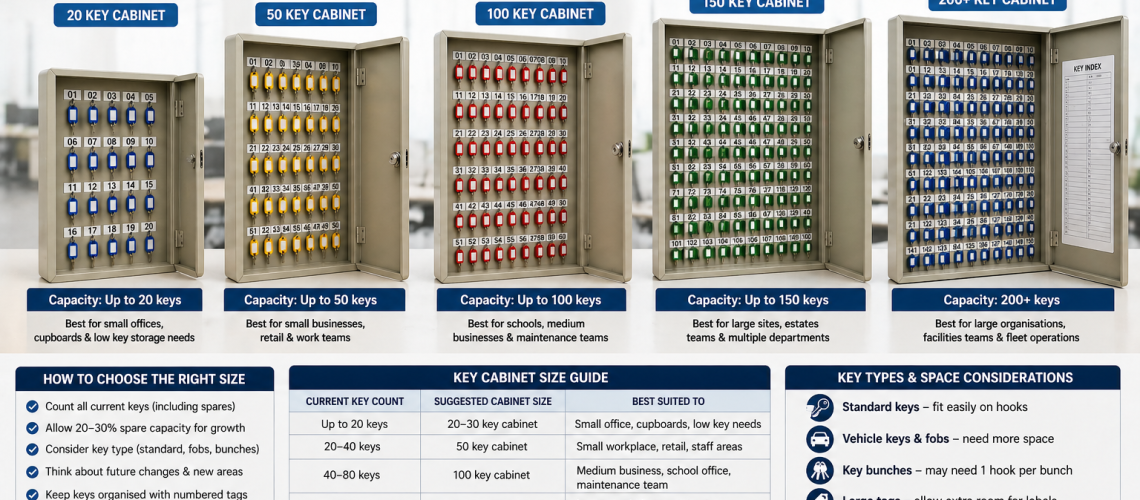
The right key cabinet size depends on the number of key sets you need to store, their physical size and the spare capacity required for future changes. A cabinet that is technically large enough today can still become difficult to use if every hook is immediately filled.
Small offices may only need a compact cabinet for a few dozen keys, while schools, workplaces, estates teams, warehouses and fleet operators may need 100, 200 or more key positions.
This guide focuses specifically on physical key cabinet capacity: current key count, spare keys, duplicates, bulky fobs, key bunches, future growth and the practical difference between advertised hook capacity and usable space.
For the wider combination of cabinets, permissions, issue and return procedures, start with our key storage systems UK guide.
For cabinet types, use Key Cabinets Explained. For mechanical versus electronic access, use Mechanical vs Digital Key Cabinets UK. For large multi-building key estates, use Managing Large Key Estates UK.
Quick Answer: What Size Key Cabinet Do You Need?
Count each separately stored key or key set once, including spares and duplicates that will return to the cabinet. Add planned new positions and a suitable growth allowance, then check that the actual bunches, fobs and tags fit the proposed layout.
Do not choose a cabinet that exactly matches today’s key count. A cabinet with no spare positions can become overcrowded as soon as a new door, locker, vehicle or spare key is added.
| Current requirement | Capacity approach | Typical situation |
|---|---|---|
| Up to around 20 positions | Small cabinet with some spare capacity | Small office, cupboard keys, limited spares |
| Around 20–40 positions | Often worth considering a 50-position cabinet | Small workplace, retail or local business |
| Around 40–80 positions | Consider a cabinet around the 100-position range | Medium workplace, school office or maintenance team |
| Around 80–150 positions | Look at higher-capacity cabinets with room for growth | Larger workplace, warehouse or estates team |
| 150+ positions | Large cabinet or structured multiple-cabinet arrangement | Large sites, fleets and substantial key estates |
These are planning examples rather than fixed rules. The correct size depends on the physical keys, the cabinet layout and how much spare capacity the organisation actually needs.
Why Key Cabinet Capacity Matters
Capacity affects usability as well as storage quantity.
When a cabinet is completely full:
- key tags can overlap;
- large bunches can obstruct neighbouring positions;
- vehicle fobs can become difficult to remove;
- staff may double keys onto one hook;
- new keys may be stored outside the intended system;
- and the cabinet can become harder to check visually.
A well-sized cabinet gives keys a clear physical position and leaves enough working room for staff to remove and return them without unnecessary congestion.
Count Every Key Before Choosing a Cabinet
Start with a complete physical count rather than estimating from the keys used most frequently.
Include:
- external door keys;
- internal room keys;
- locker keys;
- desk and cabinet keys;
- store-room keys;
- gate and shutter keys;
- plant-room keys;
- vehicle keys;
- master and sub-master keys;
- spare keys;
- duplicate keys;
- and keys retained for occasional or emergency use.
Include keys temporarily issued to staff or contractors if they will need a position when returned. Reconcile the physical count against the register so issued keys are not omitted and duplicates already counted are not counted twice.
Count Storage Positions, Not Only Individual Keys
Cabinet capacity is usually expressed as a number of key positions, but the physical storage requirement may not match the number of individual metal keys.
For example:
- a bunch containing five related keys may occupy one cabinet position;
- a vehicle key and remote fob may require substantially more room than a small door key;
- one hook may carry a tagged key set rather than a single key;
- and some large tags can interfere with adjacent positions.
Count the way keys will actually be stored inside the cabinet, not simply the number of keys on the estate.
Worked example: calculate the positions you need
Illustrative example: an office needs 36 positions for active key sets and eight separate spare sets. Ten planned additions bring the total to 36 + 8 + 10 = 54 positions. These numbers count stored sets, not individual metal keys; do not add the eight spare sets again if they are already included in the active inventory.
A cabinet offering at least 54 nominal positions would only be a starting point. Allow any additional future capacity you need and check the real keys against hook spacing, internal panels and door clearance. If bulky bunches obstruct adjacent hooks, usable capacity will be lower than the advertised count.
Allow Spare Capacity for Future Growth
Most workplaces gain keys over time.
- new doors may be added;
- additional lockers or cupboards may be installed;
- vehicles may be added to a fleet;
- departments may expand;
- spare keys may be created;
- replacement key sets may be introduced;
- and new buildings or areas may become part of the site.
There is no universal percentage of spare capacity that suits every organisation. A stable small office may need relatively little additional room, while a growing estate, school, warehouse or vehicle fleet may justify substantially more.
The important point is to leave meaningful usable capacity rather than filling the cabinet immediately after installation.
Separate expected additions from an optional contingency allowance. Record the assumptions behind both so another person can review the sizing decision when the fleet, building or staffing arrangements change. There is no need to invent a fixed spare-capacity percentage for every site.
Key Type Affects Usable Cabinet Capacity
Advertised capacity does not always equal comfortable usable capacity.
| Key type | Capacity consideration |
|---|---|
| Small single door keys | Usually make efficient use of standard hook spacing |
| Keys with large tags | May overlap adjacent positions |
| Vehicle keys and remote fobs | Require more physical depth and spacing |
| Key bunches | Often need one position per bunch rather than per individual key |
| Large access or security keys | May require greater spacing than ordinary cylinder keys |
| Master and restricted key sets | Physical capacity may be affected if these are stored separately |
Capacity is therefore not just a hook count. It also depends on key size, bunch size, fobs, tags and how easily staff can reach the required position.
Measure depth, hook spacing and panel clearance
Measure representative sets in millimetres, including the ring, identification tag and any remote fob. Check their hanging length, width and projection from the hook. Compare usable internal dimensions with the keys fitted, not just the cabinet’s external depth.
Where the cabinet has internal or door-mounted panels, check the space between loaded surfaces when closed. Confirm that keys clear the bottom and do not press against the door, lock housing or another panel. Adjustable rails may help accommodate longer keys, but their arrangement can affect the number of positions available.
For heavy bunches, confirm any hook, panel and overall load limits with the manufacturer. A larger number of hooks does not establish a suitable weight capacity. Ask for a layout drawing or check a representative set where fit is uncertain.
Vehicle Keys and Fobs Need More Space
Vehicle keys are one of the clearest examples of why nominal cabinet capacity can be misleading.
Modern vehicle sets may include:
- a large remote fob;
- a physical emergency key;
- fleet identification tags;
- fuel or access fobs;
- and other keys on the same ring.
A cabinet that comfortably stores 100 small door keys may feel much more crowded if a large proportion of those positions contain vehicle sets.
Fleet operators should therefore assess the actual size of representative key sets before choosing capacity.
Key Bunches Can Reduce Practical Capacity
Some workplaces store several related keys together as one bunch.
Examples can include:
- a maintenance key set;
- a building-opening set;
- a cleaning set;
- a vehicle and equipment set;
- or a group of keys for one department or area.
In capacity planning, one bunch normally needs to be treated as one physical storage item even though it contains several individual keys.
Heavy or bulky bunches may also need additional clearance from neighbouring hooks.
Remember Duplicate and Spare Keys
Duplicate and spare keys can add significant volume to a key estate.
Examples include:
- emergency spares;
- maintenance duplicates;
- manager copies;
- replacement keys held in reserve;
- spare vehicle keys;
- and keys retained during building or tenancy changes.
Decide whether these duplicates need positions in the main cabinet or whether they are intentionally stored separately. Either way, they should be included when calculating total storage requirements.
Key Cabinet Capacity by Site Type
Site type can help indicate the likely scale of the key estate, but it should not replace a physical key count.
Small Offices
A small office may only need positions for entrance doors, internal rooms, filing cabinets, cupboards and a limited number of spare keys.
Compact cabinets can work well where the key estate is stable, but a slightly larger cabinet may be worthwhile if new rooms or staff areas are likely to be added.
Retail and Local Businesses
Retail key estates may include shutters, stock rooms, tills, offices, display cabinets, external doors and spare keys.
The physical count should include keys that are only used during opening, closing, deliveries or maintenance.
Schools and Colleges
Education sites can accumulate large numbers of classroom, office, gate, store, locker, maintenance and contractor keys.
Campus size and the number of separate buildings can quickly increase capacity requirements. For the wider sector-specific storage approach, see Key Storage for Schools, Healthcare and Facilities Management UK.
Warehouses and Industrial Sites
Industrial key estates may include offices, stores, plant rooms, cages, gates, vehicles and equipment areas.
Bulky equipment and vehicle keys can reduce usable capacity even where the advertised hook count appears sufficient.
Fleet and Vehicle Sites
Fleet key storage should be sized around actual fobs and key sets rather than simply the number of vehicles.
Spare vehicle keys and associated tags should also be counted.
What Happens When One Key Cabinet Is No Longer Large Enough?
If the required key estate exceeds the practical capacity of one cabinet, there are several physical options.
- move to a larger-capacity cabinet;
- add a second cabinet;
- separate particularly bulky key groups;
- or divide storage by building, department or function where the wider control structure supports that approach.
If storage is split between cabinets, keep each key reference and storage location clear. Decide who may use each cabinet and how movements between locations will be recorded; adding another cabinet should not create an untracked collection of keys.
For the overall operating model, see Key Control Systems UK. For hundreds of keys across multiple buildings or sites, see Managing Large Key Estates UK.
Capacity Does Not Decide Security Level
A larger cabinet is not automatically a more secure cabinet.
Capacity answers:
How many physical key positions do we need?
It does not answer:
- how resistant the cabinet should be to attack;
- which users should have access;
- whether the cabinet should use mechanical or electronic access;
- how key movements should be recorded;
- or whether several cabinets should be distributed around the estate.
For stronger physical construction, see High-Security Key Cabinets UK.
Key Cabinet Sizing Checklist
- Count all active keys.
- Include spare and duplicate keys.
- Count key bunches as physical storage items.
- Check the size of vehicle keys and remote fobs.
- Allow room for identification tags.
- Identify any keys that will intentionally be stored separately.
- Consider expected future growth.
- Avoid choosing a cabinet that will be full immediately.
- Check whether the cabinet has enough physical depth for bulky key sets.
- Consider whether neighbouring hooks remain usable when large keys are fitted.
- Review capacity again if the site, fleet or building estate changes.
Related Key Cabinet Guides
| Question | Guide |
|---|---|
| How do cabinets, access rules and records work together? | Key Storage Systems UK |
| How many key positions do I need? | This guide |
| What types of key cabinet are available? | Key Cabinets Explained |
| Mechanical or electronic access? | Mechanical vs Digital Key Cabinets UK |
| Where should the cabinet be installed? | Where to Install Key Cabinets UK |
| When is reinforced physical protection needed? | High-Security Key Cabinets UK |
| How should a large estate of hundreds of keys be structured? | Managing Large Key Estates UK |
| What overall key-control model should we use? | Key Control Systems UK |
View Commercial Key Cabinets
Total Locker Service supplies commercial key cabinets for workplaces, schools, facilities teams, warehouses, fleet operators and other organisations managing physical keys.
The Phoenix KC0600 commercial key cabinet range includes models advertised from 42 to 600 hooks. Compare the exact variant’s dimensions and internal arrangement; models within a range do not all provide the same depth or clearance.
Before ordering, confirm the number of stored sets, spare positions, bunch dimensions and available installation space. Bulky fobs and tags can reduce usable capacity, so you may need a larger or deeper model than the hook count alone suggests.
Key Cabinet Sizes and Capacity FAQs
What size key cabinet do I need?
Count each separately stored key or set once, including controlled spares and temporarily issued sets that will return. Allow for planned additions, then check hook spacing, depth, panels and door clearance against the real keys.
Should I buy a larger key cabinet than I currently need?
Usually some spare capacity is sensible because key estates can grow over time. The amount depends on the site, expected changes and the physical size of the stored keys.
Do vehicle keys need more space in a key cabinet?
Yes. Vehicle keys and remote fobs are usually bulkier than ordinary door keys and can reduce the practical capacity of a cabinet.
Should a key bunch count as one key position?
Treat a complete bunch as one storage item where it is stored together, but check its dimensions and weight. A bulky bunch may obstruct neighbouring positions, so one item does not always use only one hook’s share of space.
Is advertised key capacity always the same as usable capacity?
Not necessarily. Large tags, vehicle fobs and bulky key bunches can overlap neighbouring positions, so the practical capacity may be lower than the nominal hook count.
How much spare capacity should a key cabinet have?
There is no universal percentage suitable for every site. Allow enough spare capacity for realistic future growth, duplicates, replacements and any bulky keys that reduce usable space.
What should I do if one cabinet is not large enough?
You may need a larger cabinet, an additional cabinet or separate storage for particular key groups. The wider decision about central or distributed key control should be considered separately.
Should I count keys that are currently issued to staff?
Yes, if they will return to this cabinet. Include their assigned positions in the inventory and avoid counting the same key set twice.
Does a deeper cabinet always hold more key sets?
No. Depth can improve clearance for fobs and bunches, but usable capacity also depends on hook spacing, panel layout and the actual items. Check the exact model with representative key sets.
Key Cabinet Capacity Is More Than a Hook Count
The right key cabinet size is the one that stores the real key estate comfortably while leaving enough usable space for future changes.
Count active keys, spares, duplicates, key bunches and vehicle fobs. Consider the physical size of the items as well as the advertised capacity of the cabinet.
Keep the sizing decision separate from access technology, security construction and wider key-control architecture. Those questions have their own dedicated guides.
Discover more from Blog Total Locker Service
Subscribe to get the latest posts sent to your email.