Where to Install Key Cabinets: Placement, Security and Access Planning
April 27, 2026
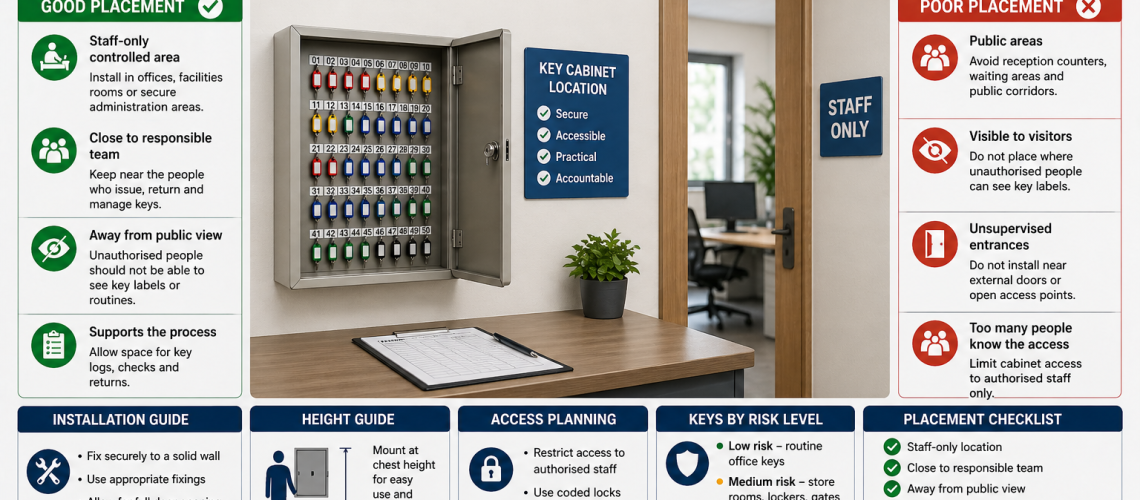
Key cabinets should be installed in a secure, controlled and practical location. The best position allows authorised staff to access keys quickly, while keeping the cabinet away from public areas, casual visitors and unauthorised users.
Good placement improves both security and daily use. A cabinet fitted in the wrong place may encourage staff to take shortcuts, leave keys elsewhere or share access too widely. A well-planned location supports better control, clearer accountability and easier key management.
This guide explains where to install key cabinets in workplaces, schools, offices, warehouses, care settings and commercial sites. It covers placement, fixing, access planning, visibility and common installation mistakes.
Where to install a key cabinet: quick answer
Install a key cabinet in a secure staff-only area, close to the people who manage keys, but away from reception desks, public corridors, open offices and unsupervised entrances. The cabinet should be fixed securely to a suitable wall and positioned at a practical working height.
Takeaway: the best location balances security, convenience and accountability. Too public is risky. Too hidden or inconvenient encourages poor use.
Why key cabinet placement matters
A key cabinet protects access to the wider site. If it is installed in the wrong place, the cabinet may be physically secure but operationally weak.
For example, a cabinet placed in a busy public-facing area may expose key routines to visitors. A cabinet placed too far from the team that uses it may lead to keys being kept in drawers, pockets or informal handover points.
Placement affects:
- Who can see the cabinet
- Who can reach it
- How easily staff can sign keys in and out
- Whether access can be supervised
- How quickly missing keys are noticed
- Whether staff follow the correct process
For wider selection guidance, see our guide to key storage for businesses.
Install key cabinets in staff-only areas
The safest general location is a controlled staff-only area. This may be an office, secure administration room, facilities office, site manager’s room, back office or controlled staff area.
A staff-only location reduces casual visibility and prevents visitors from standing near the cabinet. It also makes it easier to control who can open the cabinet and who can observe key issue procedures.
- Facilities office
- Site manager’s room
- Secure administration office
- Back office
- Staff-only reception support room
- Controlled stores office
- Security office
The cabinet should not be treated as general office equipment. It should be part of the site’s access-control process.
Avoid public and high-traffic areas
Key cabinets should not normally be installed where customers, visitors, pupils, contractors or delivery drivers can easily see or reach them.
Public placement can reveal too much information about site access. Even if the cabinet is locked, visible key labels, staff routines and cabinet access patterns can create avoidable risk.
- Main reception counters
- Public corridors
- Waiting areas
- Open customer-facing offices
- Unsupervised entrances
- Shared break areas used by visitors or contractors
If a cabinet must be near reception, place it in a staff-only back office rather than on the public side of the counter.
Keep the cabinet close to the responsible team
The cabinet should be close to the person or team responsible for issuing, returning and checking keys. This improves supervision and makes the process easier to follow.
If the cabinet is too far from the responsible team, staff may create shortcuts. Keys may be left on desks, stored temporarily in drawers or passed between users without being logged.
Good placement supports good behaviour. The cabinet should be easy for authorised staff to use, but difficult for unauthorised people to access casually.
Plan the workflow around key issue and return
Key cabinet placement should support the issue and return process. Staff need space to open the cabinet, read key labels, complete a log and return keys correctly.
Where a paper log is used, provide a nearby writing surface or clipboard. Where a digital system is used, ensure staff can access the screen, keypad or reader comfortably.
- Can the cabinet door open fully?
- Is there enough light to read labels?
- Is the cabinet at a comfortable height?
- Can staff complete a key log nearby?
- Is the area free from obstruction?
- Can returns be checked quickly?
For policy and logging advice, see our guide to managing keys in the workplace.
Fix the key cabinet securely
A key cabinet should be fixed securely to a suitable wall or structure. The fixing method should match the cabinet size, expected weight and wall type.
Larger cabinets can become heavy when full. Keys, tags and bunches add weight, so the fixing surface matters. A cabinet should not be mounted to a weak partition without suitable fixings or support.
- Use a solid wall where possible
- Check the wall type before fixing
- Use fixings suitable for the surface
- Allow for the cabinet’s loaded weight
- Make sure the door can open fully
- Avoid mounting too close to corners or obstructions
For larger cabinets, installation should be planned carefully rather than treated as a quick wall-mounting task.
Choose a practical installation height
The cabinet should be installed at a height that allows staff to see and reach the hooks safely. If the cabinet is too high, staff may struggle to identify keys. If it is too low, access may be awkward and labels may be harder to read.
A practical working height also reduces mistakes. Staff should be able to remove and return keys without stretching, bending excessively or blocking nearby walkways.
Where several staff members use the cabinet, choose a height that works for normal daily use, not just the person installing it.
Protect key labels from unnecessary visibility
Even when a cabinet is locked, visible labels can create security risk. Avoid placing cabinets where unauthorised people can read labels, codes or key references.
For higher-risk keys, use coded labels instead of full room names. A tag marked “A12” is usually safer than one marked “Server Room Master Key”. Keep the index in a controlled location.
This is especially important in schools, public buildings, shared offices and visitor-facing environments.
Match placement to key risk
Not all keys need the same level of protection. Routine cupboard keys may be suitable in a standard staff office cabinet. Master keys, vehicle keys, plant room keys and restricted-area keys may need stronger placement or separate storage.
| Key type | Placement recommendation | Reason |
|---|---|---|
| Low-risk office keys | Staff office or back office | Simple controlled storage |
| Store room keys | Near responsible manager or department | Supports supervision |
| Vehicle keys | Facilities, transport or security office | Issue and return tracking is easier |
| Master keys | Restricted office or separate cabinet | Higher access risk |
| Plant room keys | Facilities office or controlled maintenance area | Limits contractor and unauthorised access |
| Contractor keys | Supervised issue point | Supports temporary access control |
Specification consequence: a single cabinet location may not be right for every key. Sensitive keys may need separate storage or stricter access.
One cabinet or several cabinets?
A single central cabinet can make auditing easier. It gives one controlled point for issue, return and review. This works well when one person or department manages all keys.
Several smaller cabinets may be better for larger sites, multiple buildings or departments with different responsibilities. Local cabinets can reduce travel and improve practical use, but they need clear ownership.
| Setup | Best for | Main benefit |
|---|---|---|
| One central cabinet | Small to medium sites with one responsible team | Clear control and easier audits |
| Department cabinets | Larger workplaces or schools | Keys stay close to the responsible team |
| Separate high-risk cabinet | Master keys, vehicle keys, restricted keys | Better protection for sensitive access |
| Digital cabinet | Shared access and audit requirements | Stronger accountability and tracking |
For capacity planning, see our guide to key cabinet sizes and capacity.
Placement for different site types
The right location depends on the building, staff structure and key risk. The following examples give a practical starting point.
Offices
In offices, key cabinets are usually best placed in a secure administration office, facilities office or manager’s room. Avoid public reception counters or shared open-plan areas where many people can see the cabinet.
Schools and colleges
Schools often need controlled storage for classroom keys, gates, cupboards, maintenance areas and contractor access. Suitable locations include the site manager’s office, estates office or secure administration area.
Avoid placing key cabinets where pupils, visitors or unsupervised contractors can observe labels or key routines.
Warehouses and industrial sites
Warehouses and industrial sites may need cabinets near a supervisor’s office, security office, facilities room or transport office. If keys are used across shifts, the cabinet should be accessible to authorised shift leaders without becoming open to the whole workforce.
Care and healthcare settings
Care and healthcare settings should keep key cabinets in staff-only controlled areas. Sensitive keys may need restricted access, especially where they relate to medicines, records or treatment areas.
Fleet and vehicle sites
Vehicle keys should be stored near the team responsible for vehicle issue and return. A transport office, facilities office or supervised security point is often suitable. Where many users share vehicles, a digital key cabinet may provide stronger accountability.
Should key cabinets be hidden?
A key cabinet does not always need to be hidden, but it should not be openly visible to unauthorised people. The aim is controlled visibility. Authorised staff should know where it is, while visitors and casual users should not be able to observe key labels or access routines.
Hiding a cabinet too well can also create problems. If it is awkward to reach, poorly lit or far from the responsible team, staff may stop using it properly.
The best approach is a secure staff-only location with practical access and clear responsibility.
Key cabinet placement checklist
- Choose a staff-only controlled location
- Avoid public counters, corridors and waiting areas
- Keep the cabinet near the responsible person or team
- Make sure the wall or structure is suitable for fixing
- Allow for the cabinet’s loaded weight
- Install at a practical working height
- Ensure the door can open fully
- Provide enough light to read labels
- Keep key logs or records nearby
- Use coded labels for sensitive keys
- Separate higher-risk keys where needed
- Review placement if staff create shortcuts
Common key cabinet placement mistakes
- Installing the cabinet in a public reception area
- Placing it where visitors can read key labels
- Mounting it too far from the responsible team
- Fixing a heavy cabinet to an unsuitable wall
- Installing it too high or too low for daily use
- Leaving no space for the cabinet door to open fully
- Using one cabinet for both low-risk and high-risk keys without separation
- Failing to provide a nearby key log or writing surface
- Allowing too many people to know the cabinet code
- Not reviewing the location after site changes
FAQs about key cabinet placement
Where is the best place to install a key cabinet?
The best place is a secure staff-only area near the person or team responsible for key control. It should be away from public spaces, visitors and unsupervised access points.
Should a key cabinet be in reception?
A key cabinet should not usually be on the public side of reception. If reception staff manage keys, place the cabinet in a staff-only back office or controlled area behind reception.
Can a key cabinet be installed in an open office?
An open office may be suitable only if access is controlled and visitors cannot observe labels or routines. A private office or staff-only area is usually better.
How high should a key cabinet be mounted?
Mount the cabinet at a practical working height so authorised staff can read labels, reach hooks and return keys safely without stretching or bending awkwardly.
Should high-risk keys be stored separately?
High-risk keys, such as master keys, vehicle keys or restricted-area keys, may need separate storage, limited access or digital key control depending on the site risk.
Summary: where to install key cabinets
Install key cabinets in secure staff-only areas where authorised staff can use them easily and unauthorised people cannot observe or access them. The location should support the key issue process, not make it harder.
Good placement balances security, convenience and accountability. Keep the cabinet near the responsible team, fix it securely, protect key labels from unnecessary visibility and separate higher-risk keys where needed.
Discover more from Blog Total Locker Service
Subscribe to get the latest posts sent to your email.