Locker Specification Planning UK: Choosing the Right Locker System Before You Buy
May 13, 2026
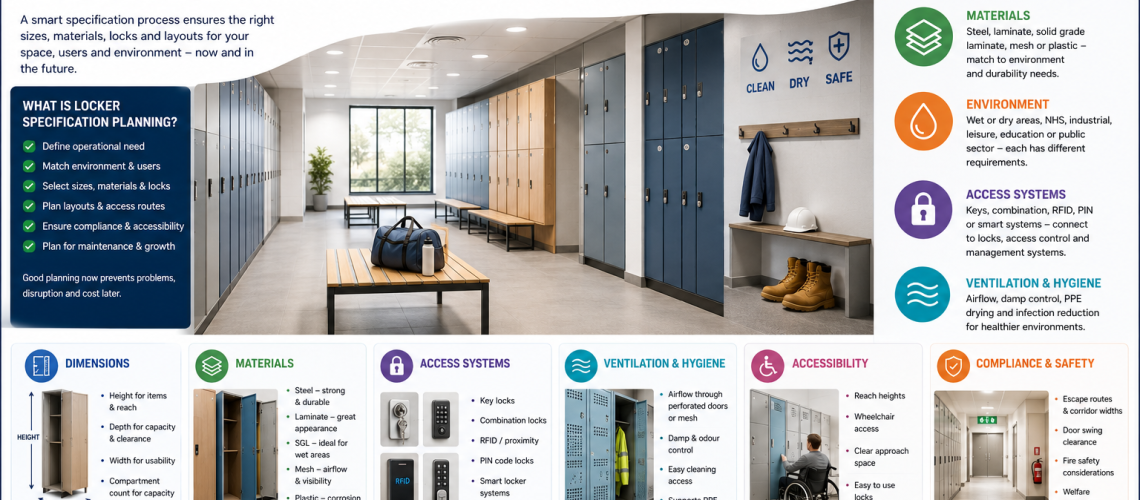
Locker specification planning is the process of choosing the right locker sizes, materials, locks, layouts and management approach before a purchase is made. A good specification helps organisations avoid poor fit, blocked access routes, weak security, damp storage, difficult maintenance and expensive replacement problems later.
This guide explains how to specify lockers for schools, workplaces, leisure centres, NHS areas, industrial sites and public buildings. It is written for architects, procurement teams, facilities managers, contractors, estates teams and operational planners who need a practical locker system, not just a row of storage units.
For wider layout planning, use our locker planning UK guide. For detailed arrangement of lockers, benches and routes, see our locker layout planning UK guide.
Quick Answer: What Should a Locker Specification Include?
A locker specification should include user numbers, locker dimensions, compartment layout, material type, lock system, ventilation, hygiene needs, installation method, access routes, accessibility requirements, maintenance access and future expansion allowance.
| Specification Area | What to Decide | Why It Matters |
|---|---|---|
| Dimensions | Height, width, depth and compartment count | Controls capacity, usability and space demand |
| Material | Steel, laminate, solid grade laminate, mesh or plastic | Affects durability, hygiene and environment suitability |
| Environment | Wet, dry, industrial, education, NHS or public sector | Prevents corrosion, hygiene issues and poor performance |
| Access system | Keys, combination, RFID, PIN or smart access | Controls security, administration and user management |
| Ventilation | Airflow, drying and odour control | Important for PPE, sportswear and damp areas |
| Compliance | Routes, welfare, accessibility and fire considerations | Reduces safety and operational risks |
| Lifecycle | Maintenance, replacement and expansion | Protects long-term value |
What Is Locker Specification Planning?
Locker specification planning is the decision stage before ordering lockers. It defines what the locker system must do, who will use it, where it will be installed, how it will be managed and how long it must remain practical.
This is different from simply choosing a locker product. A product choice focuses on the unit. A specification looks at the whole system. It includes layout, access control, user behaviour, cleaning, maintenance, safety, future demand and daily operation.
A strong specification should answer five questions:
- Who will use the lockers?
- What will they store?
- Where will the lockers be installed?
- How will access be controlled?
- How will the system be maintained and expanded?
Why Locker Specification Matters Before Purchase
Locker mistakes often appear after installation. Doors clash with benches. Aisles feel tight. Wet clothing does not dry. Keys are lost. Compartments are too small. Cleaning teams cannot reach behind the units. Staff numbers increase and there is no spare capacity.
Specification planning prevents these problems by connecting the locker choice to real use. This is why it is valuable for architects, procurement teams, contractors, facilities managers and estates departments.
The strongest locker specification is not based on the cheapest unit. It is based on suitability, durability, management and lifecycle value.
1. Locker Dimensions: Height, Width, Depth and Compartments
Locker dimensions should be chosen around the items being stored, the number of users, the space available and the required access route around the lockers.
Locker Height
Full-height lockers are useful for coats, uniforms, workwear and PPE. Lower or multi-tier lockers are better when users only need space for bags, small items or personal belongings.
Locker Depth
Locker depth affects storage capacity and corridor projection. A deeper locker may be more practical for bulky clothing, helmets or equipment, but it also needs more floor space. For detailed depth planning, see our locker depth and projection guide UK.
Locker Width
Wider lockers improve usability for larger items. Narrow lockers increase the number of compartments in a fixed space. The correct choice depends on what users need to store and how often they access the locker.
Compartment Count
Single-door lockers suit larger storage needs. Two-tier, three-tier, four-tier and six-tier lockers increase capacity where users store smaller items. However, high-tier lockers can reduce accessibility for some users, especially where reach height is important.
2. Material Selection: Choosing the Right Locker Construction
The locker material should match the building, user behaviour, cleaning regime and environment. A locker that works well in a dry office may not suit a swimming pool, factory or healthcare changing area.
| Material | Best For | Key Consideration |
|---|---|---|
| Steel lockers | Offices, schools, workplaces and general staff areas | Durable, cost-effective and widely used |
| Laminate lockers | Schools, offices and front-of-house areas | Good appearance and strong door finish |
| Solid grade laminate lockers | Wet areas, leisure centres and changing rooms | Excellent moisture resistance |
| Mesh lockers | Industrial PPE, drying areas and visibility-controlled storage | High airflow and easy visual inspection |
| Plastic lockers | Wet, outdoor or corrosion-prone areas | Moisture-resistant and easy to clean |
Material choice should never be separated from environment. Moisture, cleaning chemicals, impact risk, vandalism, hygiene expectations and visual appearance all affect the correct specification.
3. Environmental Suitability
Different sites need different locker systems. A school corridor, NHS changing room, warehouse welfare area and leisure centre changing room all create different specification pressures.
Wet Areas
Wet areas need moisture-resistant materials, good drainage awareness, corrosion-resistant fittings and ventilation. Leisure centres, swimming pools, spas and shower areas often need solid grade laminate or plastic lockers rather than standard dry-area units.
Dry Areas
Dry offices, schools and staff rooms can often use steel or laminate lockers. The main decisions are usually compartment size, lock type, visual finish, user allocation and access route planning.
NHS and Healthcare Areas
Healthcare environments need cleanable surfaces, controlled access, separation of personal items and practical staff flow. Infection reduction, cleaning access and user behaviour should be considered early.
Industrial Sites
Industrial sites may need PPE storage, boot storage, drying airflow, high durability and clear separation between clean and dirty workwear. Mesh lockers and ventilated steel lockers can be useful where airflow and inspection matter.
Public Sector Buildings
Public sector projects often need strong accessibility planning, lifecycle value, easy maintenance, safe circulation and robust procurement justification. A clear specification helps avoid ambiguity during tendering.
4. Access Systems: Locks, Keys, RFID, PIN and Smart Management
The access system is one of the most important specification decisions. It affects security, administration, replacement costs, emergency access and user experience.
For a full overview of lock types, use our locker locks UK guide. For wider governance, see our locker access control systems UK guide. For operational administration, see our locker management systems UK guide.
| Access Type | Best For | Specification Note |
|---|---|---|
| Key locks | Assigned staff lockers and simple systems | Needs key control and replacement process |
| Combination locks | Schools, workplaces and shared sites | Reduces lost key issues |
| Coin locks | Leisure centres and public changing areas | Useful for temporary users |
| RFID locks | Workplaces, education and managed estates | Supports card-based access |
| PIN locks | Shared-use lockers and flexible areas | Removes physical key issue |
| Smart locker systems | Enterprise, hybrid offices and high-control sites | Supports software, audit trails and remote management |
5. Ventilation and Hygiene
Ventilation is often missed during locker specification. It becomes important when users store damp clothing, sportswear, workwear, boots, PPE or uniforms.
A good locker specification should consider:
- airflow through doors or mesh panels
- drying requirements for clothing and PPE
- odour control
- cleaning access
- separation of clean and dirty items
- infection reduction in healthcare or welfare areas
Where hygiene is important, avoid creating hidden dirt traps, blocked cleaning routes or enclosed damp storage. Materials and layout should support the cleaning routine, not work against it.
6. Fire, Safety and Compliance Considerations
Locker specification should support safe building use. Lockers must not reduce escape route width, block fire exits, obstruct corridors or create unsafe bottlenecks.
Important planning checks include:
- escape route clearance
- corridor encroachment
- door swing space
- bench position
- safe access around open locker doors
- floor fixing where stability is needed
- welfare and changing room suitability
For spacing and movement planning, use our locker aisle width guide UK and locker door clearance guide UK.
7. Accessibility: Reach Heights, Wheelchair Access and Inclusive Use
Locker systems should be usable by the people who need them. Accessibility should be considered before compartment heights, lock types and aisle widths are finalised.
Important accessibility decisions include:
- reachable compartment heights
- clear approach space
- wheelchair turning space where required
- lock type and ease of operation
- bench spacing
- visual access and signage
- provision for ambulant users
For a deeper accessibility route, see our locker accessibility and DDA planning UK guide.
8. Lifecycle Planning: Maintenance, Replacement and Expansion
A locker system should be specified for years of use, not just installation day. Lifecycle planning protects the investment and reduces future disruption.
Lifecycle planning should include:
- replacement lock availability
- spare keys or code management
- door and hinge durability
- cleaning access
- maintenance access
- future expansion space
- ability to change lock systems later
- repair and replacement scheduling
This is especially important for schools, NHS sites, workplaces and industrial facilities where lockers form part of daily operations.
Locker Specification by Environment
| Environment | Main Specification Priority | Recommended Planning Focus |
|---|---|---|
| Schools | Durability, supervision and congestion control | Corridor width, break-time flow and robust locks |
| Workplaces | Staff welfare, allocation and space efficiency | Compartment mix, access control and future growth |
| NHS and healthcare | Cleanability, controlled access and staff flow | Hygiene, separation and easy maintenance |
| Leisure centres | Wet-area durability and shared use | Moisture-resistant materials and temporary access |
| Industrial sites | PPE storage, ventilation and durability | Mesh or ventilated units, dirty/clean separation |
| Public sector | Lifecycle value and accessibility | Inclusive design, maintenance and procurement clarity |
Common Locker Specification Mistakes
- choosing lockers before calculating user numbers
- using dry-area lockers in damp environments
- forgetting door swing and bench clearance
- choosing key locks without a key management process
- specifying compartments that are too small for real items
- blocking corridors or reducing access routes
- forgetting cleaning and maintenance access
- not allowing space for future expansion
- ignoring accessibility until late in the project
Locker Specification Checklist
Use this checklist before requesting prices or placing an order.
- Define user numbers and peak demand.
- List what users need to store.
- Confirm the locker environment.
- Choose suitable locker dimensions.
- Select the right material.
- Choose the access system.
- Check aisle width and door clearance.
- Review ventilation and hygiene needs.
- Check fire routes and corridor impact.
- Include accessibility requirements.
- Plan maintenance access.
- Allow for future expansion.
How Locker Specification Connects to Locker Planning
Specification and layout should be developed together. A specification defines the locker system. A layout proves that the system works inside the space.
For best results, connect this page with:
- Locker Planning UK: Layout, Space and Installation Guide
- Locker Layout Planning UK
- Locker Aisle Width Guide UK
- Locker Door Clearance Guide UK
- Locker Depth and Projection Guide UK
- Locker Accessibility and DDA Planning UK
- Locker Access Control Systems UK
- Locker Management Systems UK
Final Recommendation
The best locker specification starts with operational need, not product choice. Decide who will use the lockers, what they will store, how the space works, how access is controlled and how the system will be maintained.
Once those decisions are clear, the right locker size, material, lock type and layout become much easier to choose. That creates a safer, more durable and more efficient locker system for the building.
FAQ: Locker Specification Planning UK
What is locker specification planning?
Locker specification planning is the process of deciding the correct locker size, material, lock type, layout, ventilation, accessibility and maintenance approach before buying or installing lockers.
Who should be involved in locker specification?
Facilities managers, procurement teams, architects, contractors, estates teams, health and safety staff and operational managers may all need to be involved, depending on the site.
What locker material is best?
The best material depends on the environment. Steel suits many dry workplaces and schools. Solid grade laminate and plastic are better for wet areas. Mesh lockers are useful for PPE storage and airflow.
How do I choose the right locker size?
Choose locker size based on what users need to store, how many users need access, the available floor space and the clearance needed around open locker doors.
Should locker locks be specified at the start?
Yes. Lock choice affects security, administration, replacement costs, user experience and future upgrades. Key locks, combination locks, RFID locks and smart systems all have different management needs.
Why is ventilation important in locker planning?
Ventilation helps reduce damp, odour and poor drying. It is especially important for sportswear, uniforms, PPE, boots and wet changing areas.
What is the biggest locker specification mistake?
The biggest mistake is choosing lockers only by product size or price without checking user needs, access routes, environment, lock management and long-term maintenance.
Discover more from Blog Total Locker Service
Subscribe to get the latest posts sent to your email.