Replacement Locker Keys by Code UK: Cut-to-Code Ordering Guide
May 14, 2026
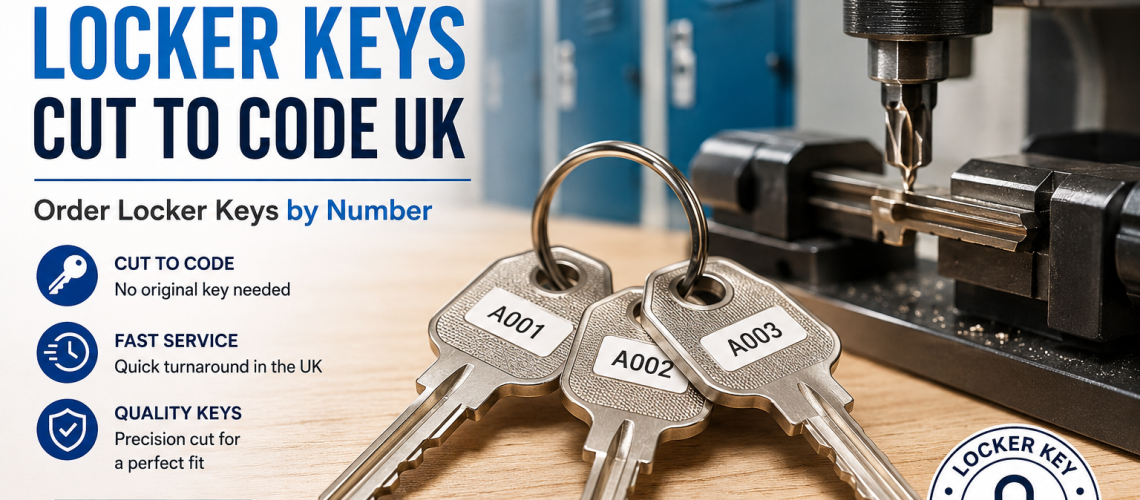
Replacement locker keys by code provide a straightforward way to replace lost, damaged or missing locker keys without changing an otherwise serviceable lock. Instead of copying an existing key, the replacement is selected or cut using the correct key number or lock code for the original lock series.
This is commonly known as cut-to-code key replacement. It is particularly useful for schools, workplaces, factories, warehouses, leisure centres, gyms, healthcare facilities and other organisations managing large numbers of lockers.
The most important part of the process is identifying the correct code. Locker door numbers, asset numbers and key numbers are not automatically the same thing, and different lock manufacturers use different key series.
If you already have a clear key number or lock code, use our replacement locker key service. If you still need to locate or identify the number, first read our How to Find Your Locker Key Code UK guide.
Quick Answer: Can Locker Keys Be Replaced From a Code?
Many locker keys can be replaced from the correct manufacturer key number or lock code. The code may be stamped on the original key, shown on the lock face or barrel, or recorded in an accurate site key register.
Where the lock is still working correctly, replacing the key is normally simpler and less disruptive than changing the complete locker lock.
Use the key or lock code, not simply the number printed on the locker door.
What Does Cut to Code Mean?
Cut to code means producing a key from the manufacturer’s coded cutting information rather than using an existing physical key as the pattern.
The code identifies the required key pattern within a particular lock or key series. Once the correct manufacturer and code are established, a suitable replacement can be produced without having the original key available for copying.
| Method | How it works | Original key required? |
|---|---|---|
| Key copying | A replacement is copied from an existing physical key | Yes |
| Cut to code | A replacement is produced from the correct manufacturer key code | Usually no |
Cut-to-code replacement can also avoid reproducing wear from an old or heavily used key because the replacement is based on the coded specification rather than the worn physical sample.
Where Can I Find the Locker Key Code?
The code may appear in several places depending on the lock manufacturer and how the locker estate is managed.
| Code source | Useful for ordering? | What to check |
|---|---|---|
| Original key | Usually | Stamped, engraved or printed code |
| Locker lock face | Often | Number or letters beside the keyway |
| Lock barrel | Sometimes | Manufacturer or code markings |
| Site key register | Yes, if current | Correct link between locker and key code |
| Previous order or invoice | Sometimes | Check whether the lock has since been changed |
| Locker door number | Not automatically | Only use if records confirm it matches the key code |
If the code cannot be found confidently, do not guess. Use our locker key code identification guide or send photographs through our locker lock and part identification service.
Locker Number vs Key Number
The number displayed on a locker door normally identifies the physical compartment. It does not necessarily identify the key used to operate the lock.
| Number type | What it normally means | Can it be used to order a key? |
|---|---|---|
| Locker number | Identifies the locker or compartment | Only if linked to a key register |
| Key number | Identifies the replacement key pattern | Usually |
| Lock-face code | Identifies a lock/key series reference | Often |
| Asset number | Internal facilities reference | Normally no |
| Master-key number | Identifies management-level access | Not normally for an individual user key |
For example, locker 125 may contain a lock using key code 92201. Ordering key 125 simply because that number appears on the locker door could therefore produce the wrong result.
Check the Locker Key Manufacturer
A number alone may not always be sufficient because different manufacturers can use different key profiles and code ranges.
Locker and lock brands commonly found in UK installations include:
- Lowe & Fletcher;
- Ojmar;
- ASSA;
- Ronis;
- Probe;
- Pure;
- Helmsman;
- Link;
- Garran;
- QMP;
- and other specialist locker-lock ranges.
If the manufacturer is known, use our locker keys by brand page to narrow the ordering route.
How to Order Replacement Locker Keys by Code
- Find the number stamped on the key or locker lock.
- Record the code exactly, including letters or prefixes.
- Identify the lock manufacturer where possible.
- Keep the locker door number separate from the key code.
- Check whether the existing lock still operates correctly.
- Confirm how many replacement keys are required.
- Check whether a master-key arrangement must remain compatible.
- Use the appropriate range on our locker keys page.
Common Key-Code Reading Errors
Small errors can result in the wrong replacement key, so read the code carefully before ordering.
| Possible mistake | Examples | What to do |
|---|---|---|
| Letter O and zero | O / 0 | Use a close-up photograph |
| Letter I and number one | I / 1 | Check the complete code series |
| Letter S and number five | S / 5 | Check under good lighting |
| Letter B and number eight | B / 8 | Photograph from several angles |
| Missing prefix | ABC123 recorded as 123 | Record all letters and numbers |
| Using the locker number | Locker 25 assumed to use key 25 | Check the lock or key itself |
What If the Locker Key Code Is Worn or Unclear?
Do not guess an unclear code. A single incorrect digit or letter can identify a completely different key.
- Check both sides of the original key.
- Inspect the lock face under good lighting.
- Take several close-up photographs.
- Check spare keys.
- Check key tags.
- Check the site’s key register.
- Check previous orders and invoices.
- Check another locker using the same lock range.
If the code still cannot be identified, use our Locker Lock Identification Guide UK.
What If There Is No Key Code?
If no usable code exists, the next step depends on the condition of the lock.
- Identify the lock manufacturer and series.
- Look for another locker using the same lock.
- Check old site records.
- Send photographs for identification.
- Consider replacing the lock if reliable key identification is impossible.
Do not replace a working lock unnecessarily, but do not repeatedly order speculative keys when the code cannot be established.
Replacement Locker Key or Replacement Lock?
| Replacement key is normally appropriate when | Consider replacing the lock when |
|---|---|
| The correct code is known | No reliable code can be established |
| The lock operates smoothly | The lock is seized or damaged |
| Only the original key is missing | The barrel has been forced |
| The site wants to retain the current locking system | The existing lock type is obsolete |
| Master-key arrangements remain suitable | Security has been compromised |
| Spare keys are required | The organisation wants a different access method |
If the complete lock needs changing, use our Locker Lock Replacement Guide UK.
Why Cut-to-Code Replacement Works Well for Locker Estates
Large locker installations often contain many locks from defined manufacturer code ranges. Once those codes are recorded accurately, replacement keys can be ordered without removing individual locks from every locker.
This can be useful for facilities teams managing:
- schools and colleges;
- staff changing rooms;
- factories;
- warehouses;
- offices;
- leisure centres;
- universities;
- healthcare sites;
- and multi-site locker estates.
Bulk Replacement Locker Keys
Where several keys are missing, it can be more efficient to review the complete locker bank and order replacements together rather than dealing with each loss as a separate emergency.
- Record the locker number.
- Record the key code separately.
- Record the manufacturer.
- Record the quantity of spare keys currently held.
- Record whether the lock has been changed previously.
- Identify lockers with damaged locks separately.
- Check master-key arrangements.
- Group confirmed codes before ordering.
A simple review can also identify locks that should be repaired or replaced rather than ordering additional keys for equipment that is already failing.
Create a Locker Key Register
A reliable key register makes repeat ordering easier and reduces the risk of confusing locker numbers with key codes.
| Register field | Purpose |
|---|---|
| Locker number | Identifies the physical compartment |
| Location | Identifies site, room or locker bank |
| Lock manufacturer | Identifies the relevant key series |
| Key code | Provides the replacement-key reference |
| Master group | Records management access where applicable |
| Spare keys held | Helps manage stock |
| Last replacement issued | Supports key control |
| Lock replaced | Prevents obsolete key codes remaining on records |
Replacement Locker Keys for Schools
Schools can generate substantial replacement-key demand because keys are issued across large pupil populations and may be lost during the academic year.
- Keep locker numbers and key codes separate.
- Record keys issued to pupils.
- Keep controlled spare-key stock.
- Check keys returned when lockers are reassigned.
- Record replacement locks immediately.
- Check master-key compatibility before changing lock barrels.
- Review missing keys during term breaks.
Replacement Locker Keys for Workplaces
Workplace locker keys may be required for staff clothing lockers, PPE lockers, uniform storage, changing rooms and personal storage.
Where employees change roles or leave the organisation, key recovery should form part of the locker offboarding process. If keys are not returned, check whether replacement by code is sufficient or whether the security circumstances justify changing the lock.
Replacement Locker Keys for Factories and Warehouses
Factories and warehouses may have large locker banks serving shift workers, permanent staff, agency workers and contractors.
- Use clear locker identification.
- Record key codes by locker bank.
- Keep common replacements available where justified.
- Separate damaged locks from simple lost-key cases.
- Review keys when workers leave or change shifts.
Replacement Locker Keys for Leisure Centres and Gyms
Leisure sites may operate several different locker access systems. Cut-to-code replacement applies primarily to suitable keyed locks.
Coin locks, mechanical combinations, electronic locks and RFID systems may instead require service keys, override keys, cylinders, tokens, wristbands, batteries or other components.
Identify the actual locking system before ordering a conventional replacement user key.
Replacement User Keys, Master Keys and Override Keys
Not every locker key has the same purpose.
| Key type | Purpose |
|---|---|
| User key | Normally opens one individual locker lock |
| Spare user key | Duplicate or replacement for the same individual lock |
| Master key | Provides authorised access to a compatible group of locks |
| Override or service key | Provides management access to certain combination, coin or electronic systems |
Master and override keys should be treated differently from ordinary user-key replacements because they can provide access to multiple lockers.
For the wider subject, see our Master Key Locker Systems UK guide.
When a Replacement Key Does Not Open the Locker
If a correctly identified replacement key does not operate the lock normally, do not force it.
- Recheck the code.
- Recheck the manufacturer and key series.
- Confirm that the lock has not previously been changed.
- Check for wear or damage to the keyway.
- Check whether the barrel is seized.
- Check whether the door is placing pressure on the lock or cam.
- Inspect the lock before ordering additional keys.
Common Replacement Locker Key Mistakes
- Ordering from the locker number rather than the key code.
- Guessing an unclear digit or letter.
- Ignoring a letter prefix.
- Assuming similar-looking keys are interchangeable.
- Ignoring the lock manufacturer.
- Using an old key register after locks have been changed.
- Ordering a new key for a seized or damaged lock.
- Failing to distinguish user keys from master keys.
- Ordering large quantities before confirming the correct code.
- Changing a complete lock when only a replacement key is required.
Replacement Locker Key Ordering Checklist
- Have you found the actual key or lock code?
- Have you recorded all letters and numbers?
- Is the code clearly readable?
- Do you know where the code came from?
- Have you kept the locker number separate?
- Do you know the lock manufacturer?
- Does the existing lock operate correctly?
- Has the lock previously been replaced?
- Is an existing master-key system involved?
- How many replacement keys are required?
- Have you checked existing spare-key stock?
- For a large order, have you confirmed the code on a representative lock?
Related Locker Key Guides
- Locker Keys – order replacement locker keys.
- Locker Keys by Brand – find keys using the lock or locker manufacturer.
- How to Find Your Locker Key Code UK – locate an unknown key or lock number.
- Locker Lock Identification Guide UK – identify an unknown complete locker lock.
- Locker Key Management Systems UK – key allocation, tracking and governance.
- Master Key Locker Systems UK – master, service and override key control.
- Locker Lock Replacement Guide UK – when the complete lock needs replacing.
- Locker Locks – replacement and upgrade locker locks.
Replacement Locker Keys by Code FAQs
Can I order a replacement locker key from a code?
Many locker keys can be supplied from the correct manufacturer key number or lock code without requiring the original physical key.
What does cut to code mean?
Cut to code means producing a replacement key from the coded cutting specification associated with the lock rather than copying an existing physical key.
Where is the locker key code?
The code may be stamped or printed on the original key, shown on the lock face or barrel, or recorded in an accurate site key register or previous order record.
Is the locker number the same as the key number?
Not necessarily. The locker number normally identifies the physical compartment, while the key number identifies the key pattern. Only use a locker number for ordering where reliable records confirm that it matches the key code.
Can a locker key be replaced if the original key is lost?
Often, yes. If the correct key or lock code can be identified, a replacement can frequently be supplied without the original key.
Should I guess a worn locker key code?
No. Check spare keys, the lock face, site records and photographs instead. A single incorrect letter or number can result in the wrong replacement key.
Is cut-to-code better than copying an old locker key?
Cut-to-code replacement can avoid reproducing wear from an old key because the replacement is based on the coded key specification rather than the worn physical sample.
When should I replace the locker lock instead of the key?
Consider replacing the lock if it is seized, damaged, forced, obsolete, cannot be identified reliably or no longer suits the required locker access method.
Can replacement locker keys be ordered in bulk?
Yes. Organisations managing large locker estates can record manufacturer and key-code information and order multiple confirmed replacement keys together.
Do I need to remove the locker lock to order a replacement key?
Usually not where the correct code is clearly visible on the key or lock face or is held in reliable site records.
Find the Code, Confirm the Lock, Then Order
Cut-to-code replacement is one of the simplest ways to restore access to a locker when the original key is missing. The existing lock can remain in service and a replacement key can be supplied from the correct code where the manufacturer and key series can be established.
The important part is accuracy. Keep locker numbers and key codes separate, record all letters and digits, check the lock manufacturer and do not guess unclear markings.
If the key code is already known, use our replacement locker key service. If it is not known, start with our locker key code guide.
Call 01284 749211 or email sales@totallocker.co.uk if you need help identifying an existing locker key or lock.
Discover more from Blog Total Locker Service
Subscribe to get the latest posts sent to your email.