Lost Locker Keys UK
May 14, 2026
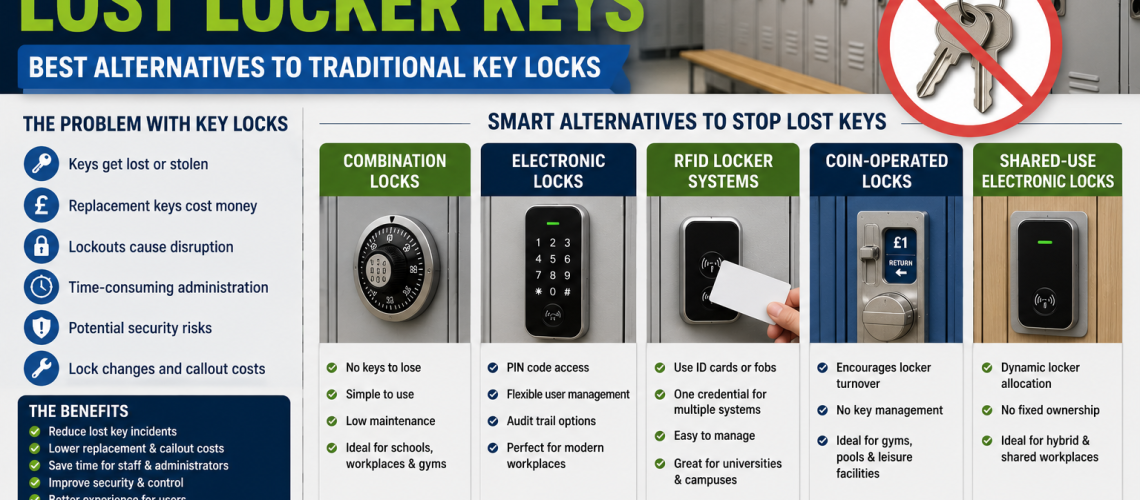
Lost locker keys are a common problem in schools, workplaces, gyms, leisure centres, warehouses, hospitals and staff changing rooms. In many cases, you do not need to replace the whole locker lock. A replacement key may be possible if the key number or lock number can be identified.
This guide explains what to do when a locker key is lost, how to find the right key number, when to order a replacement key and when a full lock replacement may be needed.
Quick answer: what should you do if you lose a locker key?
If you lose a locker key, first check whether there is a spare key, master key or key register. Then check the lock face for a key number. If the number is visible, a replacement locker key may be ordered. If the number cannot be identified, the lock may need to be opened, removed or replaced.
| Situation | Best next step |
|---|---|
| Key lost but number known | Order a replacement locker key |
| Key lost and number visible on lock | Use the lock face number for identification |
| Key lost and no number visible | Send clear photos or consider lock replacement |
| Key snapped in lock | Assess lock damage before ordering a key |
| Locker is urgent to access | Use authorised site access or maintenance support |
| Many keys are missing | Create or update a locker key register |
Step 1: Check for a spare locker key
Before replacing the lock, check whether a spare key already exists. Many sites hold spare keys in a key cabinet, reception office, estates office, maintenance store or facilities department.
- Check the site key cabinet.
- Ask the facilities or estates team.
- Check old handover records.
- Look for spare keys labelled by locker number.
- Check whether a master key is available.
If the spare key is found, record the key number before returning it to storage. This makes future replacement easier.
Step 2: Check the lock face for a key number
If the key is lost, the lock face is the next place to check. Many locker locks have a number stamped, engraved or printed around the key slot. This number may help identify the replacement key.
Look closely at the front of the lock. The number may be above the key slot, below the key slot or around the edge of the lock face.
For more detail, see our Locker Key Number Guide UK.
Step 3: Check whether the locker number is different from the key number
The locker number and key number are not always the same. The locker number identifies the door. The key number identifies the key or lock code.
Do not order a key using only the locker door number unless your site records confirm that the locker number and key number are matched.
| Number type | What it means | Use for ordering? |
|---|---|---|
| Locker number | Door or compartment number | Only if linked to key records |
| Key number | Replacement key code | Yes |
| Lock number | Code shown on lock face | Often useful |
| Master key number | Site management access code | Not usually for standard user keys |
Step 4: Take clear photos before ordering
Clear photos help avoid wrong-key orders. If the key is lost, take photos of the locker door and lock face.
- Full locker door photo.
- Close-up of the lock face.
- Close-up of any visible number.
- Photo of the locker number.
- Photo of the rear of the lock if the door is open.
- Photo of any matching spare key, if available.
If several lockers are affected, label the photos clearly by room, locker bank and locker number.
Step 5: Decide whether you need a key or a lock
A lost key does not always mean a broken lock. If the lock is working and the correct number is known, a replacement key is usually the better first option.
A replacement lock may be better if the lock is damaged, forced, worn, obsolete or impossible to identify.
| Choose replacement key when | Choose replacement lock when |
|---|---|
| The key number is known | No key number can be found |
| The lock is still in good condition | The lock is damaged or seized |
| The site wants to keep the same access system | The site wants to change lock type |
| Only one or two keys are missing | Many locks are old or inconsistent |
| The lock face number is readable | The lock has been forced or vandalised |
Can a replacement locker key be made without the original key?
Often, yes. If the lock face has a readable key number or the site has an accurate key register, a replacement locker key may be possible without the original key.
If there is no visible number and no record, identification becomes harder. In that case, the lock type, brand, cam and keyway may still help, but replacing the lock may be the simplest option.
Lost locker keys in schools
Schools often deal with lost locker keys during term time. A simple key register can reduce disruption and stop every lost key becoming a lock replacement job.
- Record every student locker number.
- Record the matching key number separately.
- Keep spare keys in controlled storage.
- Review lost key patterns at the end of each term.
- Replace damaged locks during school holidays where possible.
For school locker projects, replacement keys should be linked to wider locker maintenance and allocation records.
Lost locker keys in gyms and leisure centres
Gyms and leisure centres may use keyed locks, coin locks, hasp locks, wristband locks or RFID systems. If the site uses standard keyed locker locks, the key number is the main detail to find.
If the site uses coin locks or RFID systems, the issue may not be a standard replacement key. You may need a service key, master key, wristband, card, token or lock component.
Lost locker keys in workplaces
Workplaces often need replacement keys for staff lockers, changing room lockers, PPE lockers, uniform lockers and personal storage lockers. Lost keys can delay staff access and create unnecessary maintenance work.
A key register helps office managers, facilities teams and warehouse supervisors track access properly.
Lost master keys
A lost master key is more serious than a lost user key. A master key may open multiple lockers within the same lock system. If a master key is missing, the site should review access risk, key control records and whether affected locks need to be changed.
Master keys should be stored securely, issued only to authorised staff and recorded in a controlled key management process.
How to prevent lost locker keys
Lost keys cannot be removed completely, but they can be reduced with better records, clear user rules and suitable lock choices.
- Keep a locker key register.
- Use numbered key tags.
- Store spare keys securely.
- Record key issue and return dates.
- Audit keys during site inspections.
- Consider hasp, combination or digital locks where keys are a repeated problem.
If lost keys are a regular issue, see our Locker Key Management Systems UK guide.
Lost locker key checklist
| Check | Completed? |
|---|---|
| Spare key checked | Yes / No |
| Master key checked | Yes / No |
| Lock face number recorded | Yes / No |
| Locker number recorded separately | Yes / No |
| Photos taken | Yes / No |
| Lock condition checked | Yes / No |
| Replacement key or lock decision made | Yes / No |
Internal links for lost locker key support
- Locker Keys UK – order replacement locker keys.
- Locker Key Number Guide UK – find and read locker key numbers.
- How to Identify Your Locker Lock UK – identify lock type, cam and lock face details.
- Locker Locks – replacement locker locks and lock parts.
- Locker Lock Replacement Guide UK – when to replace the full lock.
- Locker Key Management Systems UK – prevent repeated lost key issues.
FAQ: lost locker keys
Can I replace a lost locker key?
Yes, in many cases. If the key number is known or the lock face has a readable code, a replacement locker key may be possible.
Do I need to replace the whole lock if the key is lost?
Not always. If the lock is working and the correct key number can be identified, replacing the key is usually the first option.
What if there is no number on the locker lock?
If no number is visible and there is no key record, the lock may need to be identified from photos or replaced.
Is the number on the locker door the key number?
Not usually. The door number identifies the locker. The key number identifies the key or lock code. Check records before ordering.
What should I send when asking for a replacement key?
Send the key number if known, a clear photo of the lock face, the locker number, lock brand if visible and the number of keys required.
Need help with lost locker keys?
Total Locker Service can help with replacement locker keys, locker lock identification and replacement locker locks. Start by checking the lock face for a number and taking a clear photo before ordering.
Discover more from Blog Total Locker Service
Subscribe to get the latest posts sent to your email.