Locker Key Number Guide UK
May 14, 2026
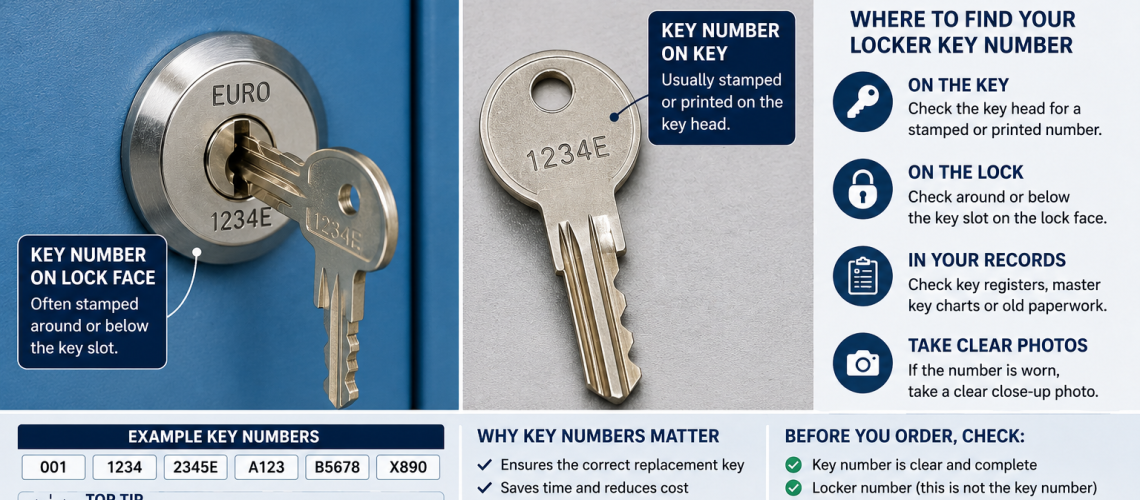
A locker key number is the code used to identify a replacement locker key. It may be stamped on the key, engraved on the lock face or recorded in a site key register.
This guide explains where to find a locker key number, what it means, why it matters and how to avoid ordering the wrong replacement key.
Quick answer: what is a locker key number?
A locker key number is a code that helps identify the correct replacement key for a locker lock. It is usually found on the key head, the lock face or in the organisation’s key records. Without the correct number, the wrong key may be supplied.
| Where to check | What to look for |
|---|---|
| Key head | Stamped or printed number |
| Lock face | Number around or below the key slot |
| Spare key records | Locker number matched to key number |
| Master key chart | Lock series and key range |
| Old order paperwork | Previous key code or lock reference |
Found the Locker Key Number?
Why locker key numbers matter
Locker key numbers help match a key to a specific lock series. They reduce guesswork, speed up replacement orders and help facilities teams manage large locker estates.
They are especially important in schools, gyms, leisure centres, workplaces, warehouses, hospitals and staff changing rooms where many lockers may look the same.
- They help identify the right replacement locker key.
- They reduce the risk of ordering the wrong key.
- They support key control across multiple locker banks.
- They help match lockers to users, rooms and departments.
- They make maintenance and lock replacement easier.
Where is the locker key number?
The key number is usually marked in one of several places. Always check both the key and the lock before ordering.
On the key
Many locker keys have the number stamped or printed on the head of the key. This is often the easiest place to find it.
On the lock face
Some locker locks show the number on the visible front of the lock. It may appear above, below or around the key slot.
On the lock barrel
Some lock barrels have a code on the side or rear. This may only be visible after the lock is removed from the locker door.
In a key register
Larger sites often keep a key register. This should record the locker number, room location, lock type, key number and spare key status.
Locker number vs locker key number
Treat the locker number as a door reference, not a cutting code. If your site records confirm that the locker number matches the key number, make that clear when ordering. Otherwise, use the stamped key number, lock face number or key register code for locker key replacement by number.
A locker number and a locker key number are not always the same. The locker number identifies the door or compartment. The key number identifies the key or lock code.
| Item | Meaning | Example use |
|---|---|---|
| Locker number | The number on the locker door | Locker 24 in changing room A |
| Key number | The number used to cut or identify the key | Replacement key request |
| Lock series | The lock range or manufacturer system | Compatibility check |
| Master key number | A management key reference | Site access control |
Do not assume locker 24 uses key 24. Some sites are arranged that way, but many are not.
How to read a locker key number
Locker key numbers may include numbers, letters or a combination of both. The format depends on the lock manufacturer and key series.
- Check every character carefully.
- Look for letters that may look like numbers.
- Check whether the code starts with a prefix.
- Do not ignore small stamped marks.
- Take a clear photo if the number is worn.
Common mistakes include confusing O with 0, I with 1, S with 5 and B with 8.
What if the key number is worn?
If the number is worn, try viewing it under bright light from different angles. A close-up photo can also help. Sometimes a shallow stamped mark becomes clearer when photographed from the side.
- Clean the key gently.
- Use good lighting.
- Take several close-up photos.
- Check the lock face for the same number.
- Check spare key records or old order details.
What if the key is lost?
If the key is lost, check the lock face. Many locker locks have a number on the front. This may be enough to identify the replacement key.
If no number is visible, take clear photos of the lock face, locker door and rear of the lock if accessible. You may need a replacement lock if the key number cannot be identified.
What if there is no number on the lock?
Some locks have no visible key number. In that case, identification becomes harder. The lock brand, keyway shape, cam type and lock body may help, but a new lock may be the most practical solution.
For this situation, use our How to Identify Your Locker Lock UK guide before ordering.
How to order replacement locker keys
Before ordering replacement locker keys, collect the correct details. This reduces delays and helps confirm whether a key can be supplied.
- Key number.
- Lock number if visible.
- Locker number.
- Lock brand if known.
- Clear photo of the key.
- Clear photo of the lock face.
- Number of keys required.
- Delivery address and contact details.
You can start from our replacement locker keys page.
Locker key number checklist
| Check | Complete? |
|---|---|
| Key number recorded clearly | Yes / No |
| Lock face number checked | Yes / No |
| Locker number recorded separately | Yes / No |
| Lock brand checked | Yes / No |
| Photo taken of key | Yes / No |
| Photo taken of lock | Yes / No |
| Quantity confirmed | Yes / No |
Common locker key number mistakes
Most wrong-key problems come from unclear numbers, mixed-up locker numbers or missing lock series information.
| Mistake | How to avoid it |
|---|---|
| Using the locker door number as the key number | Check the key or lock face code |
| Misreading worn digits | Send a clear close-up photo |
| Ignoring letters in the code | Record the full code exactly |
| Ordering from an old list | Check the current lock fitted to the door |
| Mixing up several locker banks | Record room and locker location |
Should you replace the key or the lock?
If the lock works and the number is known, a replacement key is usually the first option. If the lock is damaged, seized, forced, obsolete or has no readable number, replacing the lock may be better.
For lock replacement, see our Locker Lock Replacement Guide UK and locker locks range.
Locker key numbers for schools
Schools often handle many lost keys during the year. A clear key number register helps site teams replace keys quickly and avoid changing locks unnecessarily.
- Record student locker numbers separately from key numbers.
- Keep spare keys controlled.
- Track lost key history.
- Check lock condition during term breaks.
- Standardise locks where practical.
Locker key numbers for gyms and leisure centres
Gyms, pools and leisure centres may use keyed locks, coin locks, wristband locks or RFID systems. Key numbers are most relevant where traditional keyed locker locks are fitted.
Where coin or RFID locks are used, the site may need replacement wristbands, master keys, service keys or lock components instead of standard replacement keys.
Locker key numbers for workplaces
Workplaces often need replacement keys for staff lockers, PPE lockers, changing rooms, uniform lockers and personal storage areas. A key register can reduce delays when staff leave, change roles or lose access.
Create a locker key register
A locker key register is a simple record that links each locker to its key details. It is useful for facilities managers, site teams, estates teams and office managers.
A clear key register makes repeat orders faster. Record the locker number, location, key number, lock manufacturer, lock type and spare key quantity. Where the code and manufacturer are known, facilities teams can place accurate bulk replacement locker key orders without removing every lock.
| Field | Purpose |
|---|---|
| Locker number | Identifies the locker door |
| Location | Shows building, room or area |
| Key number | Supports replacement key ordering |
| Lock type | Shows whether the lock uses a key, hasp, coin or code |
| Spare key held | Confirms whether a spare exists |
| User or department | Supports allocation control |
| Last checked | Supports audits and maintenance |
Internal links for this topic
- Locker Keys UK – replacement locker keys and ordering support.
- How to Identify Your Locker Lock UK – identify lock type, cam and key details.
- Locker Locks – replacement locks and lock options.
- Locker Lock Replacement Guide UK – when to replace the full lock.
- Locker Lock Compatibility Guide UK – check lock fit before ordering.
- Locker Key Management Systems UK – manage keys across larger sites.
- Locker Keys UK guide – full guide to key types, manufacturers, codes and ordering routes.
FAQ: locker key numbers
Is the locker number the same as the key number?
Not always. The locker number identifies the door. The key number identifies the key or lock code. Always check the key or lock face before ordering.
Can I order a replacement locker key from the lock number?
In many cases, yes. If the lock face has a readable key number, it may be possible to supply a replacement key.
What should I do if my locker key number is unreadable?
Take clear photos of the key and lock face. Check old records and spare keys. If the number cannot be identified, replacing the lock may be the best option.
Why did my replacement locker key not work?
The wrong number may have been supplied, the code may have been misread, the lock may have been changed or the barrel may be worn or damaged.
Should every site keep a locker key register?
Yes, especially where there are many lockers. A register helps manage spare keys, lost keys, lock replacement and access control.
Need replacement locker keys?
Total Locker Service can help with replacement locker keys, locker lock identification, spare keys and replacement lock options. Record the key number clearly and include photos where possible.
Discover more from Blog Total Locker Service
Subscribe to get the latest posts sent to your email.