Medicine Trolleys UK: Care Home Buying Guide for Safe Storage, Rounds and Daily Workflow (2026)
May 6, 2026
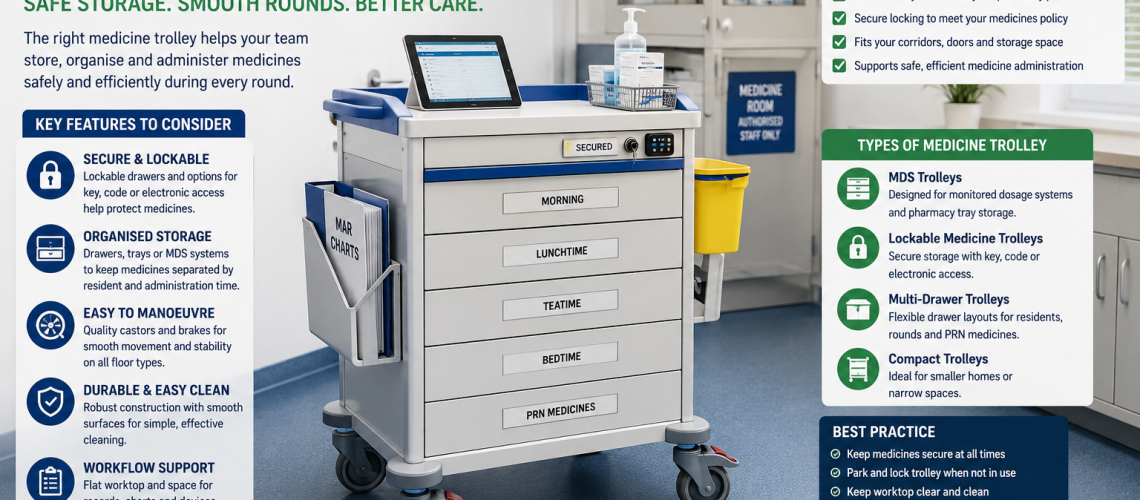
Medicine trolleys help care homes store, organise and move medicines safely during medicine rounds. The right trolley should support secure access, clear resident separation, easy checking, safe movement, cleaning routines and daily medicine administration.
This buying guide explains how to choose medicine trolleys for UK care homes. It covers trolley size, locking, trays, MDS storage, wheels, workflow, parking space, staff access and common buying mistakes.
Start here: This page forms part of the Medical Cabinets UK: Medicines Storage, Compliance and Security Guide, which explains how to choose, secure and manage medicine storage systems in UK workplaces and care settings.
Medicine trolleys support mobile handling, but they should sit within a wider secure medicine storage setup. Start with the Medical Cabinets UK: Medicines Storage, Compliance and Security Guide before choosing trolleys, cabinets or access controls.
Start here: This page forms part of the main Medical Cabinets UK: Medicines Storage, Compliance and Security Guide, which explains how to choose, plan and manage secure medicine storage.
Medicine trolleys support mobile storage and medicine rounds. For the wider cabinet, access and workflow model, see the medical cabinets and medicine storage systems guide.
Medicine trolleys support mobile storage and distribution. For the wider cabinet, access and workflow model, see the medical cabinets and medicine storage systems guide.
Care homes must store medicines safely and in a way that keeps them effective when administered. Medicines may be stored centrally or for individuals, depending on the care plan, risk assessment and home setup. NICE also expects care homes to have clear processes for handling, administering and managing medicines. CQC guidance and NICE SC1 should be used alongside your local medicines policy.
For room layout, see the care home medicine room design guide. For wider secure storage, see the care home medicine storage UK guide and the medical cabinets UK guide.
Quick answer: what medicine trolley does a care home need?
A care home usually needs a lockable medicine trolley with enough capacity for the medicine round, clear resident or round separation, smooth castors, easy-clean surfaces, secure drawer or tray access and a size that fits the medicine room, corridors and resident areas. The trolley should support the home’s medicines policy, not replace secure medicine cabinets, controlled drug storage or fridge storage.
What is a medicine trolley?
A medicine trolley is a mobile storage unit used to organise and transport medicines during care home medicine rounds. It normally includes drawers, trays, compartments or cassette systems. Many models are lockable and are designed to help authorised staff move medicines from a secure storage area to residents safely and efficiently.
In care homes, trolleys should support controlled access, stock visibility and safe administration. See care home medicine storage for the full care-home setup.
In care homes, trolleys should support controlled access, stock visibility and safe administration. See care home medicine storage for the full care-home setup.
A trolley is part of the medicine management system. It should work with cabinets, medicine rooms, records, access control and staff procedures. It should not become uncontrolled storage or a general-purpose trolley.
When care homes use medicine trolleys
Medicine trolleys are most useful where staff need to complete regular medicine rounds across resident rooms, wings, floors or communal areas. They help reduce repeated trips back to the medicine room and can make stock, MAR records and round supplies easier to manage.
- Residential care homes with regular medicine rounds.
- Nursing homes with higher medicine volumes.
- Homes using monitored dosage systems.
- Sites with several resident areas or floors.
- Homes needing organised stock separation by resident, round or medicine type.
- Settings where staff need a mobile, lockable working point during administration.
Medicine trolley vs medicine cabinet
A medicine trolley and a medicine cabinet do different jobs. The cabinet is usually the secure fixed storage point. The trolley is the mobile round tool. In many care homes, both are needed.
| Storage type | Main role | Best used for |
|---|---|---|
| Medicine trolley | Mobile organisation during medicine rounds | Resident rounds, MDS trays, daily administration workflow |
| Medicine cabinet | Fixed secure storage | Central stock, boxed medicines, backup stock, room-based storage |
| Controlled drug cabinet | Dedicated controlled drug security | Controlled medicines requiring tighter control and records |
| Medicine fridge | Cold-chain storage | Medicines requiring refrigeration, usually 2°C to 8°C where specified by packaging |
CQC states that refrigerated medicines must be managed so they remain safe and effective, and that many cold-chain medicines need storage between 2°C and 8°C. These medicines should not be placed in a standard trolley unless a specific authorised process allows safe temporary handling during administration. CQC fridge guidance
Main types of medicine trolley
MDS medicine trolleys
MDS medicine trolleys are designed for monitored dosage systems. They usually hold trays, cassettes or blister packs in a structured format. They suit care homes that receive medicines organised by resident and administration time.
- Good for organised medicine rounds.
- Useful where residents have regular repeat medicines.
- Can reduce searching during administration.
- Needs enough capacity for the number of residents and rounds.
Lockable medicine trolleys
Lockable trolleys help restrict access during rounds and between use. The lock should be practical for staff but strong enough to prevent casual access. Key control, code control or electronic access should match the care home’s policy.
Treatment and dressing trolleys
Treatment trolleys are often used for dressings, clinical supplies and care equipment. They should not be confused with medicine trolleys unless they are specifically used and controlled under the home’s medicine system.
Small medicine trolleys
Small medicine trolleys suit smaller care homes, smaller units, short medicine rounds or low medicine volumes. They are easier to move and park but can become overcrowded if capacity is underestimated.
Large medicine trolleys
Large medicine trolleys suit homes with higher resident numbers or larger medicine volumes. They offer more capacity but need wider routes, better parking space and careful handling.
Medicine trolley buying checklist
| Feature | What to check | Why it matters |
|---|---|---|
| Capacity | Number of residents, trays, boxes and rounds | Prevents overcrowding and confusion |
| Locking | Key, code, central locking or electronic access | Controls access to medicines |
| Drawer layout | Resident separation, round separation and visibility | Supports safer administration |
| Castors | Smooth movement, brakes and floor suitability | Improves handling and stability |
| Size | Width, depth, height and turning space | Ensures the trolley fits rooms and corridors |
| Work surface | Clean, usable top area | Supports checking and preparation |
| Cleaning | Wipe-clean materials and accessible surfaces | Supports hygiene routines |
| Records space | MAR charts, folders or digital device area | Keeps administration records close to the round |
| Security between rounds | Parking point, locking and staff access | Prevents uncontrolled storage |
| Compatibility | MDS trays, pharmacy packs and local systems | Avoids workflow problems after delivery |
For fixed storage alongside medicine trolleys, compare secure medical cabinets and use the medical cabinets UK guide.
How to choose the right trolley capacity
Capacity should be based on real medicine volume, not just resident numbers. Two homes with the same number of residents may need different trolley sizes because prescription volume, PRN medicines, creams, liquids, inhalers and records vary.
- Count the number of residents served by each round.
- Check how medicines are supplied by the pharmacy.
- Measure MDS trays or cassette formats.
- Allow space for liquids, inhalers, creams and non-standard packs.
- Allow room for changes in resident needs.
- Avoid filling every drawer to maximum capacity from day one.
A trolley that is too small becomes cluttered. A trolley that is too large can be hard to move, hard to park and awkward in narrow corridors. The best size is the smallest trolley that safely holds the required stock without crowding.
Locking and access control
Access control is one of the most important buying decisions. The trolley should only be accessed by authorised staff. It should remain locked when not in active use, and the key, code or access method should be controlled under the home’s medicine policy.
- Key locks: simple and familiar, but key control must be strict.
- Digital code locks: remove physical key handling, but codes must be changed when needed.
- Central locking: useful where several drawers need to be secured together.
- Electronic access: useful where audit trails or tighter access control are required.
Do not judge security by the lock alone. A medicine trolley also needs a safe parking point, staff accountability, clear procedures and good supervision during rounds.
Drawers, trays and resident separation
A good trolley makes it easy to find the right medicine for the right resident at the right time. Internal layout matters as much as external size.
- Use clear separation by resident, round or medicine type.
- Keep labels easy to read.
- Avoid mixing returned items with active medicines.
- Keep PRN medicines controlled and easy to identify.
- Leave space for non-standard packs.
- Check whether drawer stops prevent accidental drawer removal.
Resident dignity and confidentiality also matter. Labelling should help staff work safely without exposing unnecessary personal information to residents, visitors or unauthorised people.
Wheels, brakes and safe movement
A medicine trolley is used repeatedly. Poor castors can make medicine rounds slower, noisier and harder to control. Check how the trolley moves on the actual floor surfaces in the home.
- Use smooth castors suited to care home flooring.
- Check brakes before purchase and during routine checks.
- Make sure the trolley turns safely in corridors and bedrooms.
- Avoid overloading the top surface.
- Check handles, edges and stability.
- Confirm that staff can move the trolley without strain.
Medicine room parking and storage
The trolley needs a defined home position when not in use. Ideally, this should be inside the medicine room or another secure staff-controlled area. The parking point should not block cabinets, fridge access, doors, records or checking surfaces.
For design guidance, see the care home medicine room design guide.
What should not be stored in a standard medicine trolley?
A standard medicine trolley should not become a catch-all storage unit. Some items need separate storage or tighter control.
- Medicines requiring refrigeration, unless being handled temporarily under a safe process.
- Controlled drugs, unless your policy and equipment are suitable for that use.
- Returned or expired medicines mixed with current stock.
- Cleaning chemicals or unrelated care equipment.
- Confidential records left visible to unauthorised people.
- Loose medicines without clear identification.
Medicine trolley workflow
The trolley should support the full round, from preparation to return. The safest trolley is not always the one with the most drawers. It is the one that fits the home’s process.
| Stage | Trolley requirement |
|---|---|
| Before round | Clear checking space, correct stock, records available |
| During round | Stable movement, secure access, easy resident separation |
| PRN use | Clear storage and recording process |
| After round | Return to secure parking point and lock trolley |
| Restocking | Enough worktop space and clear separation from returns |
| Audit | Stock visible, records accessible and discrepancies easy to investigate |
Common medicine trolley buying mistakes
- Buying too small: drawers become overcrowded and harder to check.
- Buying too large: the trolley becomes hard to move and park.
- Ignoring corridor width: the trolley may not turn safely in real use.
- Choosing weak access control: the trolley may be easy to access without authorisation.
- Forgetting records: staff need space for MAR charts or digital devices.
- Mixing medicines and general supplies: this weakens organisation and control.
- Not checking pharmacy format: the trolley may not fit MDS trays or packs.
- No secure parking plan: the trolley becomes a mobile risk point.
Best medicine trolley by care home situation
| Care home situation | Best trolley priority |
|---|---|
| Small home | Compact lockable trolley with clear resident separation |
| Large home | Higher-capacity trolley or separate trolleys by wing/floor |
| MDS system | Trolley compatible with pharmacy tray or cassette format |
| Narrow corridors | Smaller footprint, good castors and tight turning ability |
| High PRN use | Clear PRN separation and strong record access |
| Multiple staff teams | Access control that supports accountability |
| Medicine room storage | Trolley that fits the room without blocking cabinets or fridge |
Final advice
The right medicine trolley should make safe medicine rounds easier. It should be secure, organised, easy to move, simple to clean and correctly sized for the home’s residents, pharmacy supply method and medicine room layout.
Start with the workflow. Count the residents served by each round, check the medicine format, measure the storage and route space, then choose a trolley that supports staff without creating clutter or access risks.
For help planning wider care home storage, see care home medicine storage UK, care home medicine room design and medical cabinets UK.
- Medicine storage systems UK
- Medical storage compliance UK
- Care home medicine storage
- Medical cabinet range
Next step: Return to the Medical Cabinets UK guide to choose the correct storage setup.
FAQ: Medicine trolleys UK
What is a medicine trolley used for in a care home?
A medicine trolley is used to organise and move medicines during medicine rounds. It helps authorised staff keep medicines, records and administration supplies together while moving safely between residents.
Does a care home need a lockable medicine trolley?
Most care homes using medicine trolleys should choose a lockable model. Medicines must be protected from unauthorised access, and the trolley should remain locked when not in active use.
Are medicine trolleys the same as medical trolleys?
No. Medical trolleys can include treatment, dressing, equipment or notes trolleys. A medicine trolley is specifically used for medicine organisation, storage and administration workflow.
Can controlled drugs be kept in a medicine trolley?
Controlled drugs need appropriate secure storage, records and access control. They should not be treated as ordinary trolley stock unless the home’s policy, equipment and legal requirements support that arrangement.
What size medicine trolley does a care home need?
The right size depends on the number of residents, medicine volume, pharmacy supply format, number of rounds, corridor width and medicine room parking space. Avoid buying only by resident count.
Where should a medicine trolley be kept?
A medicine trolley should be kept in a secure staff-controlled area when not in use, often inside the medicine room. It should not block doors, cabinets, fridge access, records or checking surfaces.
Can a medicine trolley store refrigerated medicines?
Standard medicine trolleys should not be used as refrigerated storage. Medicines that require refrigeration should be kept in a suitable medicine fridge and handled according to the home’s cold-chain process.
Discover more from Blog Total Locker Service
Subscribe to get the latest posts sent to your email.