Care Home Medicine Room Design UK: Safe Layout, Storage Zones, Cabinets and Compliance (2026 Guide)
May 6, 2026
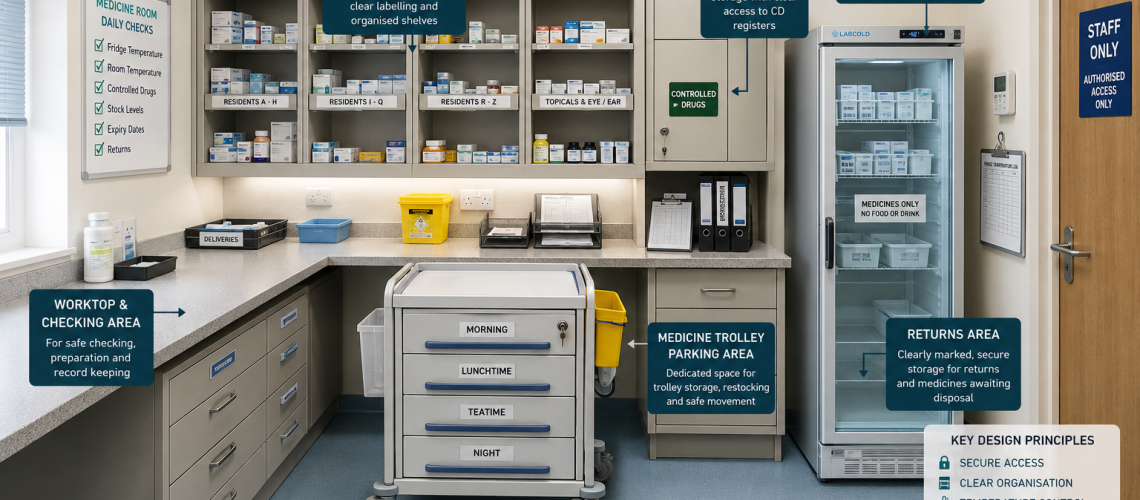
A care home medicine room should keep medicines secure, organised, easy to audit and protected from avoidable risks. Good design brings together cabinets, medicine trolleys, controlled drug storage, fridge space, temperature checks, staff access, work surfaces, lighting, records and clear daily routines.
Start here: This page forms part of the main Medical Cabinets UK: Medicines Storage, Compliance and Security Guide, which explains how to choose, plan and manage secure medicine storage.
Start here: This page forms part of the Medical Cabinets UK: Medicines Storage, Compliance and Security Guide, which explains how to choose, secure and manage medicine storage systems in UK workplaces and care settings.
This guide explains how to design a practical medicine room for a UK care home. It covers layout, storage zones, medicine cabinets, controlled drugs, medicine fridges, access control, audit points and common design mistakes.
Start here: This page forms part of the Medical Cabinets UK: Medicines Storage, Compliance and Security Guide, which explains how to choose, secure and manage medicine storage systems in UK workplaces and care settings.
For wider cabinet selection, see the medical cabinets UK guide. For care-home-specific storage routines, see the care home medicine storage guide.
Quick answer: what should a care home medicine room include?
A care home medicine room should include lockable medicine storage, controlled drug storage where required, a medicine fridge if cold-chain medicines are used, a clean work surface, good lighting, clear stock separation, secure records, temperature monitoring, restricted staff access and enough space for medicine trolleys to be checked, restocked and moved safely.
Why medicine room design matters
Medicine room design affects safety, compliance and daily working speed. A poor layout can cause selection errors, missed stock checks, weak access control, poor temperature control and confusion between current, returned, expired or refused medicines.
CQC guidance states that medicines should be stored safely and remain effective when administered. It also explains that medicines may be stored centrally or in individual rooms, depending on the care home setup and assessed need. NICE guidance also expects care homes to have clear systems for ordering, storing, administering, recording and disposing of medicines.
The room does not need to be complicated. It needs to be controlled, logical and easy for trained staff to use consistently.
Core design principles
- Security: restrict access to authorised staff only.
- Separation: keep different medicine categories clearly divided.
- Visibility: make labels, stock levels and expiry dates easy to check.
- Temperature control: protect ambient and refrigerated medicines.
- Workflow: support ordering, receipt, checking, administration and returns.
- Auditability: make stock checks and record keeping simple.
- Cleanliness: use surfaces and layouts that are easy to clean.
Recommended medicine room zones
The best medicine rooms are arranged into simple zones. This helps staff move from task to task without mixing stock or creating avoidable errors.
| Zone | Purpose | Typical equipment |
|---|---|---|
| Receiving zone | Checking new medicines against records | Worktop, trays, delivery paperwork area |
| Current medicines zone | Secure storage for active medicines | Lockable medicine cabinets or cupboards |
| Controlled drug zone | Extra-secure storage and records | Controlled drug cabinet and register area |
| Cold-chain zone | Medicines requiring refrigeration | Medicine fridge and temperature log |
| Trolley zone | Storage, restocking and checking of trolleys | Medicine trolley parking space |
| Returns zone | Medicines awaiting return or disposal | Clearly marked secure container or cupboard |
| Records zone | Secure access to medicine records | MAR records, folders or digital workstation |
Medicine cabinets and cupboards
Lockable medicine cabinets are usually the core of the room. They should be easy to access by authorised staff, difficult for unauthorised people to access, and large enough to prevent overcrowding.
Avoid choosing cabinets only by width. Check internal shelf space, shelf adjustment, door swing, lock type, fixing method and whether the cabinet will still work when stock levels increase.
- Use separate shelves or cabinets for different residents, rounds or medicine types.
- Keep labels visible from the front.
- Avoid deep cluttered storage where items become hidden.
- Allow enough space for the door to open fully.
- Use clear local labelling without exposing unnecessary personal information.
For product selection, see medical cabinets and storage cabinets.
Controlled drug storage
If controlled drugs are stored, the medicine room should include a separate controlled drug storage point. This should not be treated as normal cabinet storage. It needs stronger access control, clear records and a layout that supports regular checks.
Controlled drug storage should be positioned where authorised staff can access it safely, but where it is not exposed to visitors, residents or unnecessary passing traffic.
- Use a dedicated controlled drug cabinet where required.
- Keep controlled drug records close enough for checks, but secure.
- Avoid placing controlled drug storage beside an open doorway.
- Leave clear space for two-person checks where your policy requires them.
- Use a fixing position suitable for the cabinet and wall structure.
Medicine fridge position
Some medicines must be stored in a medicine fridge. CQC guidance says cold-chain medicines should usually be stored between 2°C and 8°C. The fridge should be easy to monitor, not overloaded and not placed where heat sources affect temperature stability.
- Do not place the fridge beside a radiator, boiler, sunny window or hot pipework.
- Allow ventilation around the fridge.
- Keep a daily temperature log close to the fridge.
- Use a dedicated medicine fridge, not a food fridge.
- Make sure staff can check the fridge without blocking the room.
Room temperature control
Many medicines have ambient storage requirements. NHS Specialist Pharmacy Service guidance says ambient medicine storage areas should ideally be controlled between 15°C and 25°C. The medicine room should therefore avoid excessive heat, poor ventilation and direct sunlight.
- Use a room thermometer or monitoring system.
- Record room temperature in line with local policy.
- Fit blinds or shading if sunlight affects the room.
- Avoid storing medicines above heat-generating equipment.
- Escalate repeated temperature problems rather than just recording them.
Worktop and checking space
A medicine room needs a clear work surface. This is where deliveries are checked, trolleys are restocked, expiry dates are reviewed and records are compared. Without a clean surface, staff are more likely to place medicines on trolleys, boxes or unstable areas.
- Keep the worktop clear of unrelated items.
- Use wipe-clean surfaces.
- Provide enough space for trays, paperwork and barcode checks if used.
- Avoid using the medicine room as general storage.
- Keep waste, returns and current stock separate.
Medicine trolley parking and movement
If the care home uses medicine trolleys, the room should include a proper trolley parking space. The trolley should not block cabinets, exits, fridge access or the checking surface.
Plan the room around the trolley footprint, turning space and door opening. A small room can still work well if the trolley has a fixed position and the main storage is arranged around the workflow.
- Allow space to open trolley drawers or compartments.
- Keep trolley charging points away from water and clutter, if powered systems are used.
- Do not park trolleys in corridors unless this is part of a controlled local process.
- Keep trolley keys or access controls managed under the home’s medicine policy.
Access control and staff-only use
The medicine room should be a controlled staff area. Access should be limited to authorised staff, with clear key or code control. The room should not be used as a shortcut, office overflow, cleaner storage area or general cupboard.
Good access control includes the door, medicine cabinets, controlled drug storage, fridge security, trolley access and record storage. One weak point can undermine the whole system.
- Use a lockable door.
- Restrict keys, fobs or codes to authorised staff.
- Remove access promptly when staff roles change.
- Keep visitor access controlled.
- Audit access arrangements regularly.
Records and MAR space
Medicine records must be secure, accurate and easy to access by authorised staff. CQC guidance links good medicines records to safe care, treatment and governance. The room should therefore support clear record handling rather than leaving records balanced on trolleys or mixed with stock.
- Provide a fixed records area or secure digital workstation.
- Keep current records separate from archived records.
- Protect confidential information from unnecessary viewing.
- Keep controlled drug records secure and easy to check.
- Make sure staff can compare records and stock without crowding.
Lighting and visibility
Poor lighting increases the risk of selection errors. Staff need to read labels, strengths, expiry dates, resident names and instructions clearly. Medicine storage should not depend on shadows, torches or awkward shelf positions.
- Use bright, even lighting.
- Avoid deep shelves where labels are hidden.
- Keep frequently checked items between comfortable waist and eye height where possible.
- Use clear shelf labels.
- Remove expired or returned medicines from active stock areas promptly.
How much space does a medicine room need?
There is no single room size that suits every care home. The right size depends on resident numbers, medicine volume, whether trolleys are used, whether medicines are stored centrally, fridge requirements, controlled drug storage and how often deliveries are received.
As a practical rule, the room should allow one trained member of staff to work safely without blocking storage, and should allow two staff to complete checks where local procedures require this.
| Care home situation | Design priority |
|---|---|
| Small care home | Compact cabinets, clear shelving and one clean checking surface |
| Larger care home | Separate storage zones, trolley parking and wider work surface |
| High medicine volume | More shelf capacity and stronger stock separation |
| Cold-chain medicines | Dedicated fridge position and temperature log space |
| Controlled drugs | Separate controlled drug storage and checking space |
| Multiple medicine rounds | Trolley flow, resident separation and restocking space |
Common care home medicine room design mistakes
- Using the room for general storage: this adds clutter and weakens control.
- Not allowing for trolley space: trolleys then block cabinets or doors.
- Putting the fridge in a hot corner: this can make temperature control harder.
- Mixing current and returned medicines: this creates avoidable confusion.
- Overfilling cabinets: staff cannot see stock properly.
- Poor lighting: labels and expiry dates become harder to check.
- Weak key control: storage is only secure if access is controlled.
- No clear checking surface: staff end up working from boxes or trolleys.
Care home medicine room design checklist
- Is the medicine room restricted to authorised staff?
- Can cabinets, trolleys and fridge doors open without obstruction?
- Are current medicines separated from returns and expired stock?
- Is there a dedicated controlled drug area if required?
- Is there a clean work surface for checking and restocking?
- Is the medicine fridge correctly positioned and monitored?
- Can staff record room and fridge temperatures easily?
- Are medicine records secure but accessible to authorised staff?
- Is lighting good enough to read labels and expiry dates?
- Is there enough space for medicine trolleys?
- Are cabinets fixed, labelled and sized correctly?
- Is the room easy to clean and keep uncluttered?
How this page fits the medical storage canister
This page should sit below the main medical cabinets pillar. Its role is room design, workflow and layout. It should not replace pages about cabinet selection, controlled drug cabinets, medicine trolleys or medicine storage rules.
Use these supporting links to keep the canister clear:
- Medical cabinets UK guide — main pillar page.
- Care home medicine storage UK — storage rules and daily routines.
- Medical cabinets — product range.
- Storage cabinets — wider cabinet options.
- COSHH cabinets — hazardous substance storage.
- Safes and security cabinets — valuables and document security.
Next step: Return to the Medical Cabinets UK guide to choose the correct storage setup.
Next step: Return to the Medical Cabinets UK guide to choose the correct storage setup.
FAQs
Does a care home need a dedicated medicine room?
Not every care home has the same setup, but medicines must be stored safely, securely and in line with their storage requirements. A dedicated medicine room is often the most practical way to control access, organise stock, monitor temperatures and support medicine administration routines.
What should be in a care home medicine room?
A care home medicine room should usually include lockable medicine cabinets, a clean checking surface, secure records, temperature monitoring, trolley space, returned medicine storage and a medicine fridge where cold-chain medicines are used. Controlled drug storage may also be required.
Where should a medicine fridge go?
A medicine fridge should be placed away from heat sources, direct sunlight and cramped corners. It needs ventilation, easy staff access and a nearby temperature log. It should be used only for medicines, not food or general items.
How should controlled drugs be stored in a care home?
Controlled drugs should be stored separately and securely, with appropriate records and access controls. The storage position should support safe checking and should not be exposed to unauthorised access or unnecessary traffic.
Can medicine trolleys be kept in the medicine room?
Yes, medicine trolleys can be kept in the medicine room if there is enough space and they do not block cabinets, exits, records, fridge access or checking surfaces. The trolley should have a defined parking and restocking position.
What temperature should a medicine room be?
Many ambient medicines should be protected from excessive heat. NHS SPS guidance says ambient medicine storage areas should ideally be controlled between 15°C and 25°C. Always check medicine packaging and local policy.
What is the biggest medicine room design mistake?
The biggest mistake is treating the medicine room as a general storage cupboard. This creates clutter, weakens access control and makes medicine checks harder. The room should be designed around medicine safety, not spare storage capacity.
Discover more from Blog Total Locker Service
Subscribe to get the latest posts sent to your email.