Hybrid Locker Estates UK: Mixed Lock Systems, Phased Upgrades and Retrofit Planning
May 12, 2026
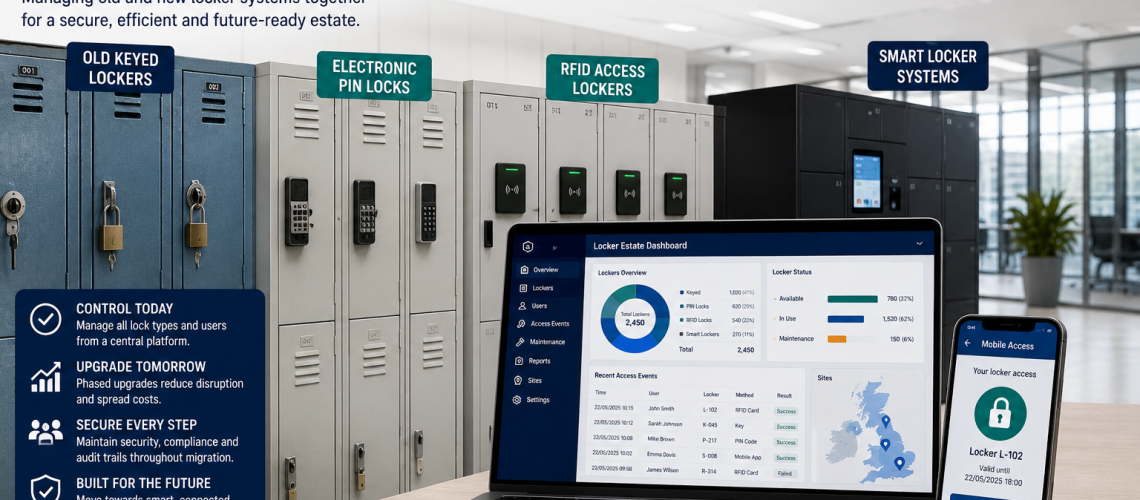
A hybrid locker estate is an organisation operating several generations of lockers, locks or access systems at the same time while older equipment is retained, upgraded or gradually replaced.
That can include older metal lockers with keyed locks, later combination-lock installations, converted doors using electronic locks, RFID locker banks and newer smart locker systems across the same organisation.
A mixed estate is not necessarily a problem. The management challenge is knowing what remains serviceable, what is supported, what is being migrated, what the intended future standard is and how older and newer systems will coexist during the transition.
A good hybrid locker strategy does not replace working equipment merely to create uniformity. It creates controlled convergence towards appropriate standards.
Quick Answer: What Is a Hybrid Locker Estate?
A hybrid locker estate contains more than one generation of locker equipment or access technology in active service. Older lockers may remain alongside newer products while locks, doors, components or complete locker banks are upgraded in phases.
The objective is to manage that coexistence deliberately: record existing systems, identify supported and unsupported equipment, define intended future standards, maintain spare parts during transition and migrate appropriate areas without unnecessarily replacing serviceable lockers.
| Estate state | Meaning |
|---|---|
| Legacy | Older locker or lock system remains the normal supported arrangement |
| Mixed | Several locker or access generations operate together |
| Transition | Defined locker banks or sites are actively being converted |
| Converging | New work follows an approved standard while legacy systems reduce gradually |
| Specialist exception | A different system remains because its environment or operating requirement justifies it |
| Completed migration | The intended system is established and obsolete support arrangements have been closed |
What This Hybrid Locker Estate Guide Owns
This page owns the transition between old and new locker systems. Its main subjects are:
- legacy and newer lockers operating together;
- mixed mechanical and electronic lock estates;
- multiple locker manufacturers within one organisation;
- supported and unsupported legacy equipment;
- target standards for future work;
- phased locker and lock migration;
- service continuity while upgrades are completed;
- supporting old and new spare parts simultaneously;
- recording temporary migration states;
- gradual convergence towards approved locker and lock families;
- closing obsolete systems when migration is complete.
What This Page Hands Off
- Multi-site portfolio coordination: Multi-Site Locker Estate Management UK
- Choosing key, hasp, combination, PIN, RFID or electronic access: Locker Access Control Systems UK
- Whether a replacement lock physically fits: Locker Lock Compatibility Guide UK
- RFID technology: RFID Locker Locks UK
- Connected smart-locker systems: Smart Locker Systems UK
- Access permissions and overrides: Locker Access Permissions & Governance UK
- Access-event records and evidence: Locker Access Audit Systems UK
- Detailed locker asset records: Locker Asset Register UK
- Repair, refurbish or replace decisions: Locker Lifecycle Management UK
- Approved replacement scope and project phasing: Locker Replacement Planning UK
Why Hybrid Locker Estates Develop
Most organisations do not install every locker at the same time. Buildings open at different dates, departments have different requirements and locker banks are repaired or replaced at different points in their working life.
- Older lockers remain structurally serviceable.
- Different sites were fitted by different suppliers.
- Budgets are released in phases.
- One building is refurbished before another.
- Some doors or locks are upgraded without replacing the carcasses.
- Different environments require different materials or access methods.
- A pilot installation is introduced before wider rollout.
- New buildings adopt current standards while older buildings retain legacy equipment.
- Spare parts remain available for some older products but not others.
- Replacing an entire estate at once would cause unnecessary cost or disruption.
The important distinction is therefore not simply old versus new. It is whether each part of the estate is understood, supportable and intentionally retained or moving towards an agreed future state.
Start by Mapping the Existing Hybrid Estate
Before choosing what to upgrade, establish what actually exists.
| Field | Why it matters |
|---|---|
| Site / building / area | Identifies where the equipment is installed |
| Locker-bank ID | Connects the migration plan with the physical asset |
| Locker manufacturer / family | Helps identify compatible doors, hinges, locks and parts |
| Approximate generation or installation period | Provides useful context for support and compatibility |
| Door and carcass type | Shows what may be retained during refurbishment |
| Current lock type | Identifies the present access system |
| Credential | Key, combination, PIN, card, wristband or other method |
| Support status | Shows whether keys, locks and parts remain obtainable |
| Migration state | Retain, prepare, convert, stabilise or complete |
| Target state | Records the intended future arrangement |
The full permanent record belongs in the Locker Asset Register UK. The hybrid-estate view only needs enough information to manage coexistence and migration.
Classify Legacy Locker Systems Before Replacing Anything
Not every older locker should be treated the same way. A useful first step is to classify each significant product or lock family.
| Classification | Meaning |
|---|---|
| Supported legacy | Older equipment remains serviceable and parts or support are still available |
| Supported exception | Different equipment remains because a specialist requirement still justifies it |
| Transitional | Still operational but scheduled for a defined migration |
| Unsupported | Key, lock, component or technical support is becoming unreliable or unavailable |
| Target standard | Current approved product or technology for suitable new work |
| Under review | Future state has not yet been decided |
This prevents the common mistake of treating every old locker as obsolete simply because a newer product exists.
Retain Serviceable Legacy Lockers Where Appropriate
Locker modernisation should normally solve a real operational, maintenance or support problem. Age by itself does not necessarily justify replacement.
- The locker carcass remains structurally sound.
- Doors and hinges remain serviceable.
- Locks can still be maintained or replaced.
- Replacement keys or components remain obtainable.
- The dimensions still suit the users.
- The material remains appropriate for the environment.
- The current access method remains manageable.
- There is no operational requirement that requires another system.
A legacy locker may therefore remain in service while newer systems are introduced elsewhere.
The actual repair, refurbishment or replacement decision belongs in Locker Lifecycle Management UK.
Define the Intended Future State
Hybrid estates become difficult when temporary arrangements have no defined destination. Each significant area should therefore have an intended long-term status.
- Retain the current locker and lock system.
- Retain the locker but standardise the lock.
- Refurbish doors and components.
- Convert keyed locks to another mechanical system.
- Convert to standalone PIN or electronic locks.
- Convert to RFID.
- Move to connected smart locker management.
- Replace the locker bank when its lifecycle case supports replacement.
- Retain as a specialist exception.
- Leave under review until another building project occurs.
The end state does not need to be identical across an organisation. A swimming-pool changing area, industrial PPE room, office and school corridor can legitimately require different approved locker or lock systems.
Standardise New Work Before Replacing the Whole Estate
One of the least disruptive ways to reduce complexity is to standardise future work first.
- Use approved locker families for new installations.
- Use approved lock families for replacements and conversions.
- Prefer common components where compatibility allows.
- Avoid introducing additional unsupported manufacturers.
- Record genuine specialist exceptions.
- Let older supported products decline naturally as refurbishment and replacement occur.
This produces gradual convergence instead of an unnecessary estate-wide replacement project.
Phased Locker Migration
Migration can be phased by site, building, floor, department, changing room or individual locker bank.
The right unit of migration is usually the smallest practical area that can be converted without making everyday operation unnecessarily confusing.
- Map the existing system. Identify lockers, locks, users and support status.
- Identify the reason for change. Do not migrate purely because newer technology exists.
- Define the target state. Establish what the converted area should become.
- Check what can be retained. Carcasses, doors or existing accessories may remain usable.
- Check lock compatibility. Confirm that proposed hardware fits the existing locker where conversion is intended.
- Identify dependencies. Budget, refurbishment, credentials, software, building access and procurement may affect timing.
- Plan continuity. Users may still require storage throughout the work.
- Convert a manageable area.
- Stabilise the new arrangement. Resolve installation or administration problems.
- Close obsolete support processes.
- Use what was learned before beginning the next phase.
Useful Hybrid Locker Migration States
| State | Meaning | Next action |
|---|---|---|
| Retain | Current system remains suitable and supported | Continue normal support |
| Review | Future requirement is uncertain | Gather evidence before committing |
| Prepare | Migration intended but dependencies remain | Resolve compatibility, budget or programme issues |
| Pilot | Alternative is being tested in a controlled area | Assess practical results |
| Convert | Locker bank is actively being migrated | Maintain continuity and track work |
| Stabilise | New system is live but still under increased support | Resolve defects and confirm ownership |
| Complete | New arrangement is operating normally | Close obsolete legacy processes |
Lock Conversion Without Replacing the Locker
One important hybrid-estate option is to retain a usable locker carcass and door while changing the lock or access method.
This can be attractive where the physical locker remains sound but the existing locking system creates key-management, availability, support or user problems.
- Key lock to hasp lock
- Old key lock to a current key-lock family
- Key lock to mechanical combination
- Mechanical lock to standalone electronic PIN
- Mechanical lock to RFID
- Older electronic system to a currently supported electronic platform
Conversion feasibility depends on the door, lock opening, fixing method, cam geometry and internal clearance. Use the Locker Lock Compatibility Guide UK for the technical compatibility check.
Physical Compatibility During Locker Migration
A proposed lock may offer the right access method but still be unsuitable for the existing locker.
- Door material
- Door thickness
- Existing lock-hole dimensions
- Fixing method
- Cam geometry
- Cam throw
- Spindle or barrel length
- Lock-body depth
- Internal obstructions
- Door frame arrangement
- Battery access
- Reader or keypad clearance
The hybrid-estate plan should require compatibility to be confirmed before conversion begins. It should not duplicate the detailed engineering assessment.
Support Old and New Systems at the Same Time
Migration creates a period when the organisation may need to support two or more systems simultaneously.
- Legacy replacement keys
- Master keys where applicable
- Lock barrels
- Cams
- Replacement doors
- Hinges and small components
- Combination-reset procedures
- Battery replacement for electronic locks
- Programming tools
- RFID cards, fobs or wristbands
- Administrator credentials
- Supplier and product references
Do not withdraw support merely because a new standard has been approved. Legacy support should continue until the affected lockers have genuinely left active service.
Plan Legacy Spare Parts Through the Migration
Hybrid estates need to balance two opposite risks: running out of parts while legacy systems are still active, and buying excessive stock shortly before those systems are retired.
| Estate stage | Typical parts approach |
|---|---|
| Legacy system dominant | Maintain normal support stock |
| Early transition | Support both existing and target systems |
| Mid-transition | Review stock against the remaining active legacy quantity |
| Late transition | Reduce legacy purchases carefully |
| Migration complete | Close or retain only justified residual stock |
Avoid Creating New Legacy Problems
A modernisation programme can increase complexity rather than reduce it if every phase introduces a different product.
- Avoid introducing unnecessary additional lock families.
- Use current supported products where practical.
- Check replacement-part availability before large rollouts.
- Record exact product references.
- Keep programming or administration tools controlled.
- Document specialist exceptions.
- Consider how the new system will be supported after installation.
The goal is not merely to replace old technology. It is to leave the estate easier to support than it was before the project.
Operational Continuity During Locker Conversion
Users still need secure storage while locks, doors or locker banks are being converted.
- Convert one locker bank or zone at a time.
- Schedule disruptive work outside peak use where practical.
- Provide temporary lockers where necessary.
- Use temporary keys, PINs or credentials where appropriate.
- Tell users which locker banks are affected.
- Keep a controlled recovery route during commissioning.
- Confirm that users can operate the new system before withdrawing the old arrangement.
- Avoid decommissioning large amounts of storage simultaneously unless sufficient alternative capacity exists.
Mechanical and Electronic Locks Can Coexist
A hybrid estate does not need to move every locker through the same technological sequence.
- Older assigned staff lockers may remain keyed.
- A flexible office area may use PIN or RFID locks.
- Industrial PPE lockers may retain robust mechanical locks.
- A leisure area may use coin, token or wristband access.
- A new building may use connected smart lockers.
- Temporary-user lockers may use another controlled access model.
The important questions are why the system remains, whether it is supported and whether it represents the intended long-term arrangement.
Migration Should Solve a Defined Problem
Replacing one lock technology with another simply because it is newer can add cost and administrative complexity without producing a useful improvement.
Useful migration drivers can include:
- excessive lost-key administration;
- obsolete or unavailable replacement parts;
- frequent lock failures;
- changing from assigned to shared locker use;
- supporting temporary or changing users;
- integrating lockers with an existing credential;
- removing an unsupported manufacturer;
- improving central administration;
- supporting a wider building refurbishment;
- replacing equipment whose physical lifecycle is ending.
For the actual choice between key, hasp, combination, PIN, RFID and electronic systems, use Locker Access Control Systems UK.
RFID as One Possible Migration Destination
RFID can be useful where an organisation already issues compatible cards, fobs or wristbands and wants those credentials to operate suitable lockers.
It is not automatically the correct next step for every keyed or combination-lock estate. Credential compatibility, operating mode, administration and the physical locker all need to be considered.
For the technology itself, see RFID Locker Locks UK.
Smart Lockers as One Possible Migration Destination
Some areas may justify connected smart locker management, especially where allocation, access administration, usage information or integration provides a clear operational benefit.
That does not mean the entire hybrid estate needs to become smart. Mechanical or standalone electronic systems may remain the better solution elsewhere.
For connected architecture and management, see Smart Locker Systems UK.
Phasing Locker Replacement by Site or Building
Where complete locker replacement has already been justified, the hybrid estate may temporarily contain both the old and new physical locker specifications.
- One building may be replaced before another.
- One floor may move to the new standard during refurbishment.
- Damaged locker banks may be replaced before serviceable ones.
- New buildings may adopt the target standard immediately.
- Older sites may remain on supported legacy products until their planned renewal point.
The hybrid-estate page owns the coexistence created by that phased programme. The detailed replacement quantities, procurement package and installation phases belong in Locker Replacement Planning UK.
Do Not Let Migration Replace Lifecycle Decision-Making
A hybrid strategy can identify that equipment is old, unsupported or creating repeated problems. It should not independently conclude that the locker should be replaced.
The evidence for continued repair, refurbishment or physical replacement belongs in Locker Lifecycle Management UK.
Once replacement is approved, Hybrid Estate Management can coordinate how that new equipment coexists with the remaining estate during the transition.
Migration Dependencies
Locker conversion can depend on other projects or systems. Starting before those dependencies are resolved can leave a half-completed hybrid arrangement.
- Budget approval
- Building refurbishment
- Locker replacement programme
- Credential compatibility
- Network or power availability
- Software integration
- Procurement lead times
- Access to the building or changing room
- Availability of installers
- User communication
- Support-team training
- Availability of temporary storage
A migration phase should begin when the required dependencies are sufficiently resolved, not simply when new hardware becomes available.
Record Temporary Hybrid States
One of the risks in a long migration is losing track of which arrangement is temporary and which is intended to remain.
For each transitional area, record:
- current locker family;
- current lock system;
- target arrangement;
- migration status;
- temporary access arrangements;
- support requirements;
- known outstanding work;
- responsible owner;
- whether the old system is still required;
- date the transition was last reviewed.
This reduces the chance that a temporary workaround quietly becomes the permanent operating model.
Know When a Migration Phase Is Complete
Installation of the new hardware is not necessarily the end of migration. The new arrangement should be operating reliably before the old support structure is closed.
- The intended lockers or locks have been installed.
- The hardware has been commissioned.
- Users can gain access successfully.
- Administrator ownership is clear.
- Recovery or fallback procedures have been tested where relevant.
- The asset record has been updated.
- Outstanding defects have owners.
- Required replacement parts are identified.
- Obsolete keys or credentials are recovered where appropriate.
- Unneeded legacy support stock has been reviewed.
- The old operating process can be closed safely.
Converging Towards a More Maintainable Locker Estate
A hybrid estate can become progressively simpler without a single large replacement programme.
- Standardise new locker purchases.
- Reduce unnecessary lock families.
- Use compatible approved replacement parts.
- Convert unsupported locks where practical.
- Retire obsolete products when intervention is already justified.
- Keep specialist exceptions visible.
- Standardise records and product naming.
- Feed migration experience into future specifications.
The result is controlled convergence rather than forced uniformity.
Hybrid Locker Estates Across Multiple Sites
A multi-site organisation may have a different migration state at each location. One site may already use the target standard, another may be actively converting and a third may retain supported legacy lockers for several more years.
The hybrid-estate process should record those states. The wider rules for coordinating sites, responsibilities and common estate structures belong in Multi-Site Locker Estate Management UK.
Hybrid Locker Estates in Schools
A school or academy trust may have keyed lockers in older blocks, combination locks in newer areas and electronic or RFID systems in selected sixth-form, staff or sports facilities.
Migration can be planned around school holidays, refurbishment programmes and pupil-access requirements rather than replacing every school locker simultaneously.
For wider education specification, see School Lockers UK.
Hybrid Locker Estates in NHS and Healthcare Facilities
Hospitals and healthcare estates may contain several generations of staff lockers across departments, changing rooms and community sites.
A conversion programme should preserve staff access around shift changes while recognising that specialist departments or environments may continue to require different locker or lock specifications.
For healthcare changing facilities, see NHS & Healthcare Changing Room Planning UK.
Hybrid Locker Estates in Workplaces
A workplace may retain existing keyed assigned lockers while new hybrid-working areas use shared lockers with PIN, RFID or smart access.
Those systems can coexist if their different purposes are understood. The older lockers do not necessarily need conversion merely because a new flexible-working system has been introduced elsewhere.
Hybrid Locker Estates in Industrial and Warehouse Sites
Industrial sites may deliberately retain durable mechanical locking in harsh production or PPE areas while offices and controlled zones adopt electronic access.
The desired end state should follow durability, supportability, shift patterns and user requirements rather than assuming the newest technology belongs everywhere.
Hybrid Locker Estates in Leisure Facilities
Leisure centres may combine coin or token locks, wristband-operated lockers, keyed staff lockers and newer electronic public-use systems within the same facility.
Wet-area suitability, customer turnover and existing credential systems can justify continued variation even after other areas have been modernised.
Common Hybrid Locker Estate Mistakes
- Assuming every old locker needs replacing. Serviceable legacy equipment can remain useful.
- Treating mixed equipment as inherently bad. Deliberate variation may be appropriate.
- Having no target state. Temporary systems then become permanent by accident.
- Introducing a new lock family with every project. Modernisation can increase complexity.
- Replacing good carcasses unnecessarily. Lock or door conversion may sometimes solve the actual problem.
- Skipping compatibility checks. The intended new lock may not fit the existing locker.
- Stopping legacy support too soon. Active lockers still need parts and keys.
- Holding excessive obsolete stock. Legacy stock should decline with the active estate.
- No continuity plan. Users still require secure storage during conversion.
- Confusing migration with replacement justification. Lifecycle should own the intervention decision.
- No completion criteria. Old keys, processes and temporary arrangements remain indefinitely.
- Assuming smart access is always the final destination. Different environments may justify simpler systems.
Hybrid Locker Estate Migration Checklist
- Have existing locker families been mapped?
- Have current lock systems been identified?
- Are supported and unsupported legacy products distinguished?
- Does each major area have an intended future state?
- Is there a clear reason for each proposed migration?
- Can existing locker carcasses or doors be retained?
- Has lock compatibility been checked?
- Are required keys and replacement parts still available?
- Are legacy spares proportionate to the remaining estate?
- Are new purchases following an approved standard?
- Are specialist exceptions recorded?
- Are migration dependencies known?
- Is operational continuity planned?
- Are temporary transition states recorded?
- Are lifecycle decisions kept separate from the migration process?
- Are completion criteria defined?
- Will obsolete keys, tools, credentials and support arrangements be closed?
- Will lessons from each migration phase influence the next one?
Related Hybrid Locker Estate Guides
- Multi-Site Locker Estate Management UK — coordinating standards and responsibilities across several locations.
- Locker Asset Register UK — recording locker assets, locations, locks and status.
- Locker Access Control Systems UK — choosing key, hasp, combination, PIN, RFID and electronic access.
- Locker Lock Compatibility Guide UK — determining whether replacement locks fit existing lockers.
- RFID Locker Locks UK — card, fob and wristband locker access.
- Smart Locker Systems UK — connected locker architecture and management.
- Locker Access Permissions & Governance UK — reset, override and administrator authority.
- Locker Access Audit Systems UK — access-event records and evidence.
- Locker Lifecycle Management UK — repair, refurbishment and replacement decisions.
- Locker Replacement Planning UK — approved replacement scope, procurement and phasing.
Hybrid Locker Estates UK FAQs
What is a hybrid locker estate?
A hybrid locker estate contains several generations of lockers, lock systems or access technologies operating at the same time while older equipment is retained, converted or gradually replaced.
Do all legacy lockers need replacing?
No. Serviceable legacy lockers can remain in use where their dimensions, condition, lock system and available support continue to meet the operating requirement.
Can an old locker be fitted with a new lock?
Sometimes. Compatibility depends on factors including the door material and thickness, existing lock opening, fixing method, cam geometry and internal clearance. Compatibility should be checked before conversion.
What is phased locker migration?
Phased locker migration moves selected sites, buildings or locker banks towards an intended future standard in controlled stages instead of replacing or converting the entire estate at once.
Can keyed, combination and RFID lockers operate in the same organisation?
Yes. Different lock technologies can coexist where their purpose, support arrangements, responsible owners and long-term status are understood and documented.
How should legacy locker spare parts be managed during migration?
Maintain enough keys and replacement parts to support the remaining active legacy lockers, then reduce stock carefully as the number of lockers using those components declines.
When is a locker migration complete?
A migration phase is complete when the intended equipment is installed and stable, users and administrators can operate it, records and support arrangements are current, and obsolete legacy processes can be closed safely.
Does a hybrid locker estate need to become fully smart?
No. Smart locker systems may suit some areas while keyed, combination, PIN, RFID or other standalone systems remain appropriate elsewhere. The technology should follow the operating requirement.
Summary
A hybrid locker estate is not simply an estate containing old locks and new locks. It is an estate in which different generations of lockers, components and access systems must remain manageable while change occurs over time.
The strongest approach is to map what exists, distinguish supported legacy equipment from genuinely unsupported systems, define appropriate future standards and migrate in controlled phases while keeping users supplied with secure storage.
Do not replace serviceable lockers merely to create uniformity. Where the physical locker remains suitable, lock conversion or gradual standardisation may provide a cleaner route. Where condition or support problems justify physical intervention, hand the decision to Locker Lifecycle Management and the approved project to Locker Replacement Planning.
For new locker installations or replacement projects, review the current commercial locker ranges from Total Locker Service. For an existing mixed estate, provide the locker manufacturers, lock types, approximate quantities, sites involved and the intended migration objective so suitable replacement, conversion or standardisation options can be considered.
Discover more from Blog Total Locker Service
Subscribe to get the latest posts sent to your email.