Charging Lockers vs Standard Lockers: What’s the Difference?
April 16, 2026
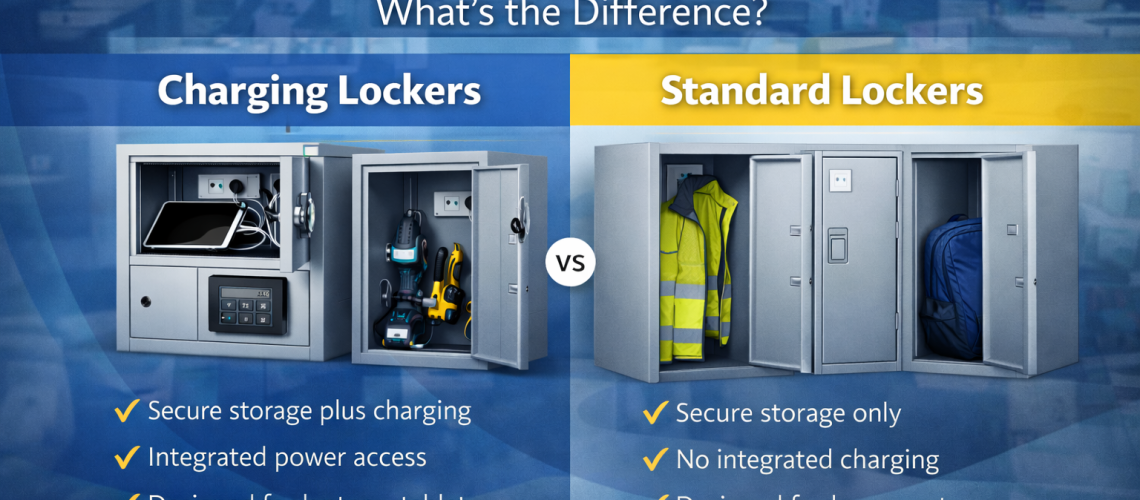
Charging lockers and standard lockers solve different storage problems. A standard locker is designed to keep belongings, PPE, clothing, books or general equipment secure. A charging locker is designed for equipment that needs to remain secure and receive power while it is stored.
The buying decision is therefore not simply “which locker is better?” It is do the items need charging while they are stored? If the answer is no, a standard locker is usually the simpler and lower-cost option. If laptops, tablets, phones, radios, scanners, tools or batteries need to be secure and ready for their next use, a purpose-built charging locker is normally the more appropriate category.
This guide stays focused on that decision: charging locker vs standard locker, secure storage vs secure powered storage, when charging is genuinely necessary, when ordinary lockers make more sense, and the practical differences in power, cable space and internal configuration. For the wider charging-locker buying process, use our Charging Lockers UK guide.
Charging Locker vs Standard Locker: What Is the Difference?
The simplest distinction is:
- Standard locker: secure storage for items that do not need power while stored.
- Charging locker: secure powered storage for equipment that needs to charge while stored.
That difference changes the internal design. A standard locker mainly needs enough usable space for the stored items and a suitable lock. A charging locker also needs to accommodate the device, charger, plug, cable routing and powered connection.
Charging lockers may look similar to ordinary lockers from the outside, but they have a more specialised role. If you need the technical operating principle rather than the buying comparison, read How Charging Lockers Work.
Charging Lockers vs Standard Lockers: Side-by-Side Comparison
| Feature | Standard locker | Charging locker |
|---|---|---|
| Main purpose | Secure storage | Secure storage plus charging |
| Typical contents | Coats, bags, PPE, uniforms, books, personal belongings and general equipment | Laptops, tablets, phones, radios, scanners, tools and rechargeable batteries |
| Integrated power | No | Yes, according to the charging-locker design |
| Charger space | Normally not required | May need space for adapters, power bricks or charging docks |
| Cable management | Normally not part of the design | Needs practical space for plugs, connectors and cables |
| Internal layout | Designed around general storage | Designed around powered equipment and its charging arrangement |
| Electrical connection | Not required | Required |
| Typical cost | Usually lower where only storage is required | Usually higher because powered components are included |
| Best choice when | The item only needs secure storage | The item needs secure storage and charging between uses |
What Standard Lockers Are Designed to Hold
Standard lockers are the general-purpose option. They are appropriate where users need a secure place for belongings or equipment but there is no reason for the locker itself to provide power.
Common contents include:
- coats and personal clothing;
- bags and backpacks;
- uniforms and workwear;
- PPE that does not require powered charging;
- books and school belongings;
- documents and small personal items;
- manual tools;
- general workplace equipment;
- sports and leisure belongings.
If none of the stored items needs power while inside the locker, a conventional locker normally avoids paying for electrical functionality that will not be used.
For current commercial options, browse the main Total Locker Service locker range.
What Charging Lockers Are Designed to Hold
Charging lockers are intended for powered equipment that needs to be secured and recharged between uses.
Typical examples include:
- laptops;
- tablets;
- phones;
- radios;
- barcode scanners and handheld terminals;
- portable work devices;
- cordless power tools;
- rechargeable tool batteries;
- other equipment compatible with the charging system provided.
The important point is not that an item contains a battery. The question is whether the organisation genuinely needs that item to charge while it is securely stored.
To compare current powered storage options, browse our charging lockers.
When Is a Charging Locker Genuinely Necessary?
A charging locker becomes useful when ordinary storage leaves a second unresolved problem: the equipment still has to be taken somewhere else to charge.
Charging is more likely to justify a dedicated locker when:
- equipment must be ready at the start of a lesson, shift or task;
- devices are valuable and should not be left exposed while charging;
- the organisation manages a pool of shared devices;
- users currently leave chargers and equipment on desks or benches;
- equipment is repeatedly moved between secure storage and separate charging points;
- chargers regularly become separated from the equipment;
- several powered items need an organised return-and-charge location;
- rechargeable tools or batteries form part of the daily working process.
If secure storage and charging are both required at the same time, a charging locker solves both parts of the problem in one system.
When a Standard Locker Is the Better and Cheaper Choice
A standard locker is usually the more economical choice when the storage requirement does not include charging.
Examples include:
- staff coats and bags;
- pupil belongings;
- ordinary changing-room storage;
- workwear and uniforms;
- PPE without a charging requirement;
- sports equipment;
- personal effects;
- manual tools;
- general secure storage.
In these applications, a charging locker adds electrical components, specialist internal layout and installation requirements without solving an actual additional need.
Do not buy a charging locker simply because some users own phones or laptops. If those devices are not intended to be stored and charged in the locker, the powered function may provide little value.
Which One Do I Need? Charging Locker or Standard Locker Decision Table
| Your requirement | Usually choose | Why |
|---|---|---|
| Store coats, bags or personal belongings | Standard locker | No charging requirement |
| Store workwear or PPE only | Standard locker | Secure storage is the main need |
| Secure laptops and charge them between uses | Charging locker | Storage and readiness are both required |
| Store pupil books and bags | Standard locker | Powered storage adds no benefit |
| Store and charge a shared set of tablets | Charging locker | Devices can remain secure while charging |
| Store manual hand tools | Standard locker | No powered function required |
| Store and recharge cordless tool batteries | Charging locker | Charging is part of the storage process |
| Store radios or scanners overnight and have them ready for the next shift | Charging locker | Operational readiness matters |
| Store devices securely but charge them elsewhere by design | Standard locker may be sufficient | Charging inside the locker is not required |
| Unsure whether the locker needs power | Define the workflow first | Do not pay for powered storage until the charging need is clear |
Power: The Main Design Difference
A standard locker does not need an electrical connection. A charging locker does.
That affects product selection and installation because a charging locker must provide an appropriate powered arrangement for the equipment being stored.
This comparison guide deliberately stops there. If you need socket arrangements, electrical loading, supply capacity or connection detail, use our Charging Locker Power Requirements Explained guide.
Cable and Charger Space
An ordinary locker only needs to fit the stored item. A charging locker may need to fit the stored item plus its charging equipment.
Depending on the application, that can include:
- mains plugs;
- USB adapters;
- laptop power supplies;
- charging cradles;
- tool-battery chargers;
- charging connectors;
- spare cable length.
This is why a device fitting physically inside a standard locker does not automatically mean a charging locker of the same compartment size will work. The complete charging arrangement needs usable space as well.
For measurements and usable compartment dimensions, use our Charging Locker Sizes UK guide.
Internal Configuration: General Storage vs Powered Equipment
Standard lockers can be configured around general storage: hanging space, shelves, compartments or open internal volume.
Charging lockers need an internal arrangement that works around the equipment and its charging process. The design may need to consider where the charger sits, where cables run and whether the compartment is large enough for the device while connected.
That does not make charging lockers universally better. It makes them more specialised.
What About Ventilation?
Powered equipment and chargers can generate heat. Charging lockers therefore need to be used with their designed ventilation and airflow requirements in mind, whereas ordinary lockers used for non-powered belongings do not have the same charging-related requirement. For the full topic, read Do Charging Lockers Need Ventilation?
Charging Locker vs Standard Locker Cost
Charging lockers generally cost more than equivalent ordinary storage because they include powered functionality and a more specialised internal arrangement.
That extra cost only makes sense when the powered function solves a genuine operational requirement.
| Situation | Value judgement |
|---|---|
| You only need secure personal storage | A standard locker is usually better value |
| You need secure storage and charging | A charging locker may justify its higher specification |
| You buy a standard locker but still need a separate secure charging area | The lower locker price may not solve the complete problem |
| You buy charging lockers for items that never need charging | You are paying for functionality you do not need |
The useful comparison is therefore not simply purchase price. It is whether the locker solves the complete requirement without unnecessary specification.
Example: School Lockers
A school can need both types of locker for completely different reasons.
Pupil bags, books, coats and personal belongings: standard lockers are usually appropriate because the contents only need secure storage.
Shared tablets or laptops: charging lockers may be more appropriate where devices need to be returned securely and charged ready for the next lesson.
The same site can therefore use standard lockers for people and charging lockers for its device fleet without any contradiction.
Example: Office and Hybrid Workplace
An office providing day storage for coats, bags and personal effects normally needs standard staff lockers.
A hybrid workplace managing pooled laptops may have a different requirement. If laptops need to remain secure and recharge between users, a charging locker can combine the return, storage and charging process.
If employees simply take their laptops home and only need a place for coats or personal items while on site, powered lockers may be unnecessary.
Example: Workshop, Factory or Maintenance Team
A workshop storing hand tools, PPE or workwear can often use standard lockers or other secure storage.
If the team relies on cordless drills, drivers, batteries or other rechargeable equipment that must be ready for the next job, powered tool storage may be more useful.
The deciding factor remains the same: does the equipment need to charge while securely stored?
Example: Ordinary Staff Storage
For normal staff-changing or personal-storage projects, charging lockers are often unnecessary.
If the requirement is simply:
- one locker per employee;
- space for clothing and bags;
- secure personal storage;
- uniform or PPE storage;
- a choice of key, combination or electronic lock;
then a conventional locker is normally the logical starting point. Browse commercial lockers rather than adding charging functionality by default.
Charging Locker or Standard Locker: The Purchase Decision
Before requesting prices, define the storage requirement in one sentence.
If your sentence is:
“We need somewhere secure to store these items.”
start with a standard locker.
If your sentence is:
“We need somewhere secure to store these devices and they need to charge while they are there.”
start with a charging locker.
Once you have chosen the charging category, do not make this comparison page carry the rest of the specification. Move to the dedicated guide for the next question.
If You Need a Charging Locker, What Comes Next?
| Next question | Dedicated guide |
|---|---|
| How does the powered system actually work? | How Charging Lockers Work |
| What size locker or compartment do I need? | Charging Locker Sizes Explained |
| Do charging lockers need ventilation? | Charging Locker Ventilation Guide |
| What electrical supply is required? | Charging Locker Power Requirements |
| How many compartments do I need? | Charging Locker Capacity Planning |
| Where should the locker be positioned? | Where to Install Charging Lockers |
| Which lock type should I use? | Charging Locker Lock Types |
| I need the full buying overview | Charging Lockers UK Guide |
Questions to Ask Before Buying Either Type
- What exactly will be stored?
- Does any of it need charging while stored?
- Does charging need to happen securely?
- Is the equipment assigned to individuals or shared?
- Does it need to be ready for the next shift, lesson or user?
- Would a standard locker leave a separate charging problem unresolved?
- Would a charging locker add functionality that nobody will actually use?
- Do you need personal storage, device storage or both?
Those questions normally identify the correct locker category before you begin comparing dimensions, compartment counts or lock options.
Common Charging Locker vs Standard Locker Mistakes
- Buying charging lockers for ordinary belongings. Coats, bags and non-powered PPE generally do not justify powered storage.
- Buying standard lockers for devices that must charge securely. This can leave the original charging problem unresolved.
- Assuming a laptop automatically needs a charging locker. It only does if charging while stored is part of the requirement.
- Comparing price before defining the task. The cheaper product is not better value if it only solves half the problem.
- Choosing by external appearance. Similar-looking cabinets can have very different internal functions.
- Trying to cover every charging specification question at once. Decide whether powered storage is required first, then use the dedicated sizing, power, ventilation, capacity and placement guides.
Charging Lockers vs Standard Lockers FAQs
What is the main difference between a charging locker and a standard locker?
A standard locker provides secure storage. A charging locker provides secure storage plus a powered charging arrangement so compatible equipment can charge while it remains stored.
Do I need a charging locker for laptops?
Only if the laptops need to charge while they are securely stored. If the laptops are charged elsewhere and the requirement is storage only, a standard locker may be sufficient.
When is a standard locker better than a charging locker?
A standard locker is usually better when the contents only need secure storage, such as coats, bags, books, uniforms, non-powered PPE or personal belongings. It avoids paying for powered functionality that is not required.
Are charging lockers more expensive than standard lockers?
Charging lockers generally have a higher specification because they include powered components and need to accommodate chargers and cables. A standard locker is normally the better-value option where no charging requirement exists.
Can a standard locker store a laptop?
Yes, if the compartment is suitable for the laptop and the requirement is secure storage only. If the laptop needs to charge while stored, a purpose-built charging locker is the more appropriate category.
Can standard lockers be used to charge devices?
Standard lockers are not normally designed as powered charging systems. Where secure charging is required, use a locker designed and specified for that purpose rather than assuming ordinary storage can provide the same function.
Which locker is better for school tablets?
If tablets need secure storage and charging between lessons, a charging locker is normally more appropriate. If the school only needs secure storage and charging happens elsewhere, a standard locker may be enough.
Which locker is better for staff bags and coats?
A standard locker is normally the appropriate choice for staff bags, coats and personal belongings because those items do not require powered charging.
Which locker is better for cordless tools and batteries?
If cordless tools or batteries need to recharge while securely stored, a charging locker designed for that equipment is usually more appropriate. If the requirement is storage only, ordinary secure storage may be sufficient.
How do I decide between charging lockers and standard lockers?
Ask whether the stored items need to receive power while they are locked away. If the answer is no, start with standard lockers. If secure charging is part of the requirement, start with charging lockers and then check size, capacity, power, ventilation, location and lock type.
Charging Locker vs Standard Locker: Summary
The decision comes down to one functional difference. Standard lockers provide secure storage. Charging lockers provide secure powered storage.
If you are storing coats, bags, uniforms, PPE, books or general belongings, a standard locker is usually the simpler and more economical choice. If you are storing laptops, tablets, radios, scanners, tools or batteries that must recharge while secured, compare our charging lockers.
If powered storage is the correct category, continue with the Charging Lockers UK guide for the wider buying process, then use the dedicated sizing, capacity, ventilation, power, placement and lock guides for the detailed specification.
Discover more from Blog Total Locker Service
Subscribe to get the latest posts sent to your email.