Retrofit Locker Locks UK: How to Upgrade Existing Lockers Without Full Replacement
May 8, 2026
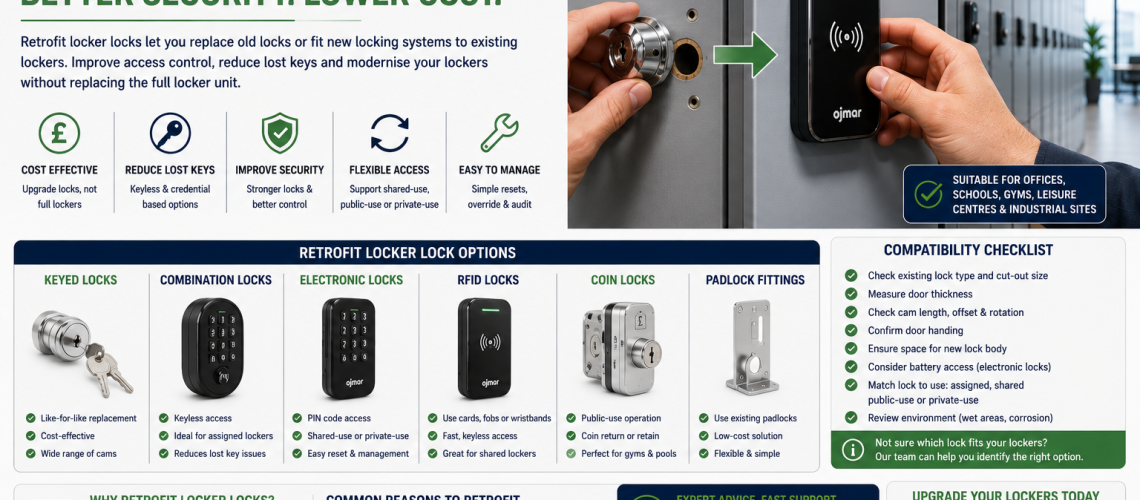
Retrofitting a locker lock means physically adapting an existing locker door so a different lock can be fitted correctly and operate reliably. The job is about door preparation, cut-outs, fixing points, lock footprint, cam or latch geometry, rear clearance, adaptor plates, battery access and the finished fit.
This guide owns the physical retrofit process. It does not decide whether the locker should remain in service, which lock technology should be selected or how users should be transitioned from the old access method to the new one.
For whether the locker should be retained, use Locker Lifecycle Management Systems UK. For technology selection, use Locker Access Control Systems UK. For the access-method transition, use Locker Lock Upgrade Guide UK.
Compatibility = determine whether it can fit. Retrofit = physically make it fit. Upgrade = transition from the old access method to the new one.
Quick Answer: What Does a Locker Lock Retrofit Involve?
A locker lock retrofit can involve removing the old lock, measuring the existing door preparation, modifying the cut-out, drilling new fixing holes, using an adaptor or conversion plate, changing the cam or latch, checking rear clearance, fitting the new lock and testing the finished door repeatedly.
| Retrofit area | What must be checked |
|---|---|
| Door preparation | Existing hole, cut-out, fixings and surrounding condition |
| Door thickness | Complete fixing thickness including reinforcement or adaptor plates |
| Lock footprint | Whether the new lock covers or conflicts with the old preparation |
| Cam / latch | Length, offset, rotation, handing and frame engagement |
| Rear clearance | Space for lock body, battery compartment and full cam movement |
| Modification | Drilling, cutting, reinforcement, adaptor or conversion plate |
| Finished fit | Door closure, user operation, management access and service access |
What This Page Owns, and What It Hands Off
- Physical conversion of an existing locker door to accept a different lock: this page
- Whether the locker should be retained: Locker Lifecycle Management Systems UK
- Which access technology should be selected: Locker Access Control Systems UK
- Detailed fit assessment before modification: Locker Lock Compatibility Guide UK
- User and administrator transition from old access to new: Locker Lock Upgrade Guide UK
- Like-for-like replacement: Locker Lock Replacement Guide UK
- Physical lock ownership cost: Locker Lock Cost UK
- Mixed old and new estates during phased migration: Hybrid Locker Estates UK
Start With the Existing Locker Door
Physical retrofit work should begin with the actual locker door, not the appearance of the proposed replacement lock.
- Locker make or range where known
- Door material
- Door thickness
- Existing lock type
- Existing lock opening
- Fixing-hole pattern
- Reinforcement plate
- Existing cam or latch
- Rear clearance
- Door handing
- Frame position
If the existing lock cannot be identified, photographs of the front, rear, cam, fixing and visible markings can help. Total Locker Service also provides an Identify a Locker Lock or Part service.
Remove the Existing Lock Carefully
The old lock should be removed without enlarging or damaging the door opening unnecessarily.
- Photograph the original lock before removal.
- Record the cam position.
- Record the locked and unlocked positions.
- Keep the original fixing hardware until the replacement is proven.
- Keep the old cam for comparison.
- Avoid distorting thin steel around the lock opening.
- Do not drill additional holes until the new lock position has been confirmed.
Measure the Existing Lock Cut-Out
The existing opening is one of the main physical constraints in a retrofit project.
- Diameter of round openings
- Width and height of rectangular openings
- Anti-rotation flats
- Square or shaped cut-outs
- Recessed areas
- Fixing-hole positions
- Fixing-hole centres
- Distance from the door edge
A proposed lock may fit through the opening but still leave old holes exposed, clash with reinforcement or fail to cover the existing footprint.
Reuse, Enlarge or Adapt the Existing Opening?
Once the existing preparation is recorded, decide whether the new lock can use it directly or needs physical adaptation.
| Situation | Possible retrofit approach |
|---|---|
| New lock matches existing cut-out | Direct fit where all other dimensions also match |
| New lock needs a slightly larger opening | Controlled enlargement if the door remains structurally sound |
| Existing opening is larger than required | Adaptor or conversion plate may provide a new mounting surface |
| Old fixing holes remain exposed | Cover plate or revised lock footprint may be needed |
| Previous lock has distorted the door | Repair or reinforce before fitting the new lock |
| New lock requires completely different preparation | Assess whether modification remains practical before proceeding |
Drilling and Cutting Locker Doors
Where the new lock requires additional drilling or cutting, the door should be supported and marked carefully before modification.
- Confirm the final lock centre before drilling.
- Check both sides of the door for hidden reinforcement or components.
- Protect finished surfaces from scratching.
- Use suitable tools for the door material.
- Remove sharp edges and swarf after cutting metal.
- Protect exposed metal where appropriate.
- Do not enlarge the opening more than the lock or conversion plate requires.
- Check the finished opening before fitting the new lock.
For large quantities, establish the final drilling or cutting method on a sample door before repeating it across the locker bank.
Door Thickness
The replacement lock must accommodate the complete thickness through which it is fixed.
- Steel door skin
- Laminate
- Timber or composite panel
- Reinforcement plate
- Adaptor plate
- Existing mounting bracket
A lock that suits a thin steel door may not suit a thicker laminate or timber door using the same fixing components.
Adaptor and Conversion Plates
An adaptor or conversion plate can be useful when the new lock does not share the same footprint or fixing pattern as the old one.
- Cover an oversized previous opening
- Cover redundant fixing holes
- Create a new fixing surface
- Spread load across a larger area
- Provide a consistent interface for a conversion lock
- Allow a replacement system to use an older locker door
The plate itself becomes part of the fixing thickness and should be included in the final dimensional check.
Door Reinforcement Around the Lock
The area around the existing lock should be sound before a new lock is fitted.
- Distortion around the opening
- Cracking in laminate or timber
- Oversized previous holes
- Loose reinforcement plates
- Corrosion
- Damage from forced entry
Where the door is fundamentally sound, reinforcement or an adaptor plate may provide a suitable mounting surface. Where the structural condition of the locker is in question, return the decision to Locker Lifecycle Management Systems UK.
Cam Length
The cam must reach the locker frame correctly when the door closes.
A cam that is too short may fail to secure the door. A cam that is too long may strike the cabinet, prevent full rotation or place unnecessary load on the lock.
Keep the original cam available during the trial fit so the old and new geometry can be compared.
Cam Offset and Shape
Some lockers use a straight cam while others need a cranked or offset cam to reach the correct locking surface.
- Measure the original cam length.
- Record the direction of any offset.
- Record the amount of offset.
- Check whether the cam is straight, stepped or cranked.
- Check the fixing method to the lock spindle.
Cam Rotation and Locked Position
Record how the existing cam moves between unlocked and locked positions.
- Clockwise or anticlockwise rotation
- Quarter-turn or other movement
- Horizontal or vertical locked position
- Frame engagement point
- Clearance through the full rotation
A lock can fit perfectly into the door and still fail as a retrofit because its cam movement does not suit the frame.
Door Handing
Some retrofit arrangements are affected by whether the door is left-hand or right-hand hung.
Where a locker bank contains both arrangements, confirm whether the proposed lock and cam can be configured for each one before the bulk quantity is ordered.
Rear Clearance
The rear lock body can be much larger than the visible front face, particularly on combination, electronic and RFID locks.
- Shelves
- Internal dividers
- Door stiffeners
- Frame sections
- Adjacent lock components
- Stored items
- Full cam movement
Open and close the finished test door fully before approving the retrofit.
Battery Access
Battery-powered locks need enough clearance for both installation and future servicing.
- Can the battery cover be removed after installation?
- Can batteries be changed without removing the lock?
- Does the locker frame block the battery compartment?
- Can the compartment be reached when adjacent lockers are in use?
- Is emergency-power access still available where the product provides it?
Battery replacement planning itself belongs in the maintenance process. This page owns only the physical service clearance.
Reader and Keypad Clearance
Electronic locks may need a larger external footprint than the original lock.
- Check clearance from door folds and edges.
- Check adjacent locker doors.
- Check handles or label holders.
- Check that buttons or reader surfaces remain accessible.
- Check that the unit sits flat against the finished door.
Retrofitting a Keyed Locker to a Different Lock
Keyed cam locks are often a straightforward starting point for retrofit because the existing door already contains a lock opening and cam arrangement.
- Remove the existing keyed lock.
- Record the old cut-out and fixing.
- Compare the new lock footprint.
- Check the new lock’s fixing thickness.
- Confirm the new cam geometry.
- Modify the opening only where required.
- Fit the proposed lock.
- Check door closure and frame engagement.
Whether the new lock should be combination, PIN, RFID or another technology is not decided here. That belongs in Locker Access Control Systems UK.
Retrofitting Mechanical Combination Locks
A mechanical combination lock may require a larger front footprint or different spindle and cam arrangement from the original keyed lock.
- Check the mounting footprint.
- Check the door thickness range.
- Check rear body depth.
- Check cam position.
- Check access to any reset mechanism.
- Confirm that the finished lock does not interfere with adjacent doors or locker frames.
Retrofitting Electronic PIN Locks
Electronic PIN locks can require greater door modification than a simple cam-lock replacement.
- Front keypad footprint
- Rear body depth
- Door thickness
- Fixing-hole pattern
- Battery compartment clearance
- Cam or latch position
- Emergency-access feature clearance
Where the system uses wiring, controllers or network hardware, the project moves beyond a simple door-lock retrofit and should also be coordinated with the appropriate smart-system or access-system design.
Retrofitting RFID Locker Locks
The physical retrofit of an RFID lock still depends on ordinary door geometry.
- Front reader footprint
- Rear lock-body depth
- Battery or power access
- Door thickness
- Fixing pattern
- Cam or latch
- Clearance from reinforcement or shelving
Credential compatibility is a separate requirement. For RFID technology and credential considerations, use RFID Locker Locks UK.
Coin-Lock Retrofit and Conversion
Coin and token locks can use manufacturer-specific door preparations, handing and latch arrangements. Identify the original mechanism before selecting conversion hardware.
- Original lock manufacturer
- Coin-retain or coin-return function
- Handing
- Door opening
- Latch position
- Fixing pattern
- Existing cut-out
- Any removable or reusable mounting plate
The selected conversion may use a replacement coin lock, combination lock, electronic lock or conversion fitting. The technology decision belongs in Access Control and the physical fit belongs here.
Coin Lock to Hasp Conversion
Where coin operation is being removed, a compatible hasp conversion can reuse an existing locker while changing the physical locking interface.
Total Locker Service supplies conversion solutions for selected coin-lock installations and can design and manufacture conversion components for some non-standard applications where the original lock and locker door can be assessed.
See the Ojmar hasp conversion and locker lock conversion products.
Protect the Locker Door During Modification
Retrofit work should leave the door structurally sound and presentable.
- Protect painted, laminate or finished surfaces before cutting.
- Support thin doors while drilling.
- Remove swarf and sharp edges.
- Avoid unnecessary enlargement of the original opening.
- Use plates where they provide a cleaner and stronger finish.
- Check that the finished lock sits squarely.
- Check that no fixing protrudes into the compartment unnecessarily.
Test One Representative Retrofit Before Ordering in Bulk
- Select a representative locker.
- Photograph and record the existing lock.
- Remove the old lock carefully.
- Measure the existing preparation.
- Fit or adapt the opening for the proposed lock.
- Fit the new lock.
- Check the front mounting.
- Check rear clearance.
- Check cam or latch engagement.
- Open and close the door repeatedly.
- Check ordinary user operation.
- Check management / override operation.
- Check battery or service access where applicable.
- Record the modification time and tools required.
- Approve the wider quantity only after the sample is satisfactory.
If the site contains different locker ranges, ages or door constructions, test each distinct arrangement.
Create a Repeatable Retrofit Method
Once the representative conversion is proven, document the physical method so later lockers are modified consistently.
- Template or drilling dimensions
- Required tools
- Adaptor plate reference
- Cam reference
- Fixing method
- Battery-clearance requirement
- Finished lock orientation
- Door-closing test
- Commissioning check
For a large project, this reduces the chance of each installer interpreting the conversion differently.
Physical Commissioning After Retrofit
- The lock is secure in the door.
- The front face sits correctly.
- Unused old holes are safely covered where required.
- The cam or latch clears the frame.
- The cam or latch engages fully.
- The door closes without abnormal force.
- The lock operates repeatedly.
- Management / override operation works.
- Battery or service access remains available.
- No sharp edges or swarf remain.
The user transition and old-process retirement then belong in Locker Lock Upgrade Guide UK.
Wet and Humid Area Retrofit
Wet or humid environments add another physical constraint to the retrofit.
- Inspect the existing door for corrosion before modification.
- Use lock hardware suitable for the stated environment.
- Check manufacturer guidance for moisture exposure.
- Use suitable conversion plates and fixings.
- Do not create unprotected cut edges unnecessarily.
- Check battery and electronic component access after installation.
Environmental suitability should already have been considered during technology selection. This page owns the physical consequences for the retrofit.
Standardising the Physical Retrofit
Where several existing lock types are being converted to one approved replacement, physical standardisation can reduce the number of conversion methods used across the estate.
- Common conversion plate
- Common cam family
- Common fixing method
- Common drilling template
- Common spare-lock fit
Do not force one physical solution where different door types genuinely require different hardware.
Do Not Turn Retrofit Into Technology Selection
The retrofit page should not conclude that combination, PIN or RFID is “best” for a school, office, gym or warehouse. The correct access technology depends on the operating requirement.
This page begins after the candidate lock has been selected and asks whether and how it can be fitted correctly to the existing locker.
Do Not Turn Retrofit Into the Lifecycle Decision
A physical conversion can be technically possible even when keeping the wider locker estate is no longer the right intervention.
Questions about structural condition, unsuitable locker dimensions, location or whether full replacement is more appropriate belong in Locker Lifecycle Management Systems UK.
Do Not Turn Retrofit Into the Upgrade Programme
Maintaining user access, moving people from keys to codes or RFID, administrator training and retiring the old access method are upgrade-programme tasks.
Use Locker Lock Upgrade Guide UK for that transition.
Retrofit Cost Belongs in the Cost Guides
A physical retrofit can add costs for drilling, cutting, adaptor plates, cams, fitting labour and door repair. Record those items, but keep the detailed cost model in Locker Lock Cost UK and Locker Access System Cost Guide UK.
Common Locker Lock Retrofit Mistakes
- Ordering the new locks before measuring the existing door.
- Checking only the front opening and ignoring the rear lock body.
- Ignoring door thickness.
- Ignoring the old lock footprint.
- Leaving redundant fixing holes exposed unnecessarily.
- Ignoring cam length or offset.
- Ignoring cam rotation.
- Ignoring door handing.
- Ignoring battery-service clearance.
- Enlarging the cut-out before the final position is confirmed.
- Using the new lock to compensate for a structurally damaged door.
- Assuming one test door represents several different locker ranges.
- Ordering a full quantity before proving the conversion.
- Using the retrofit page to decide which technology is best.
- Using the retrofit page to decide whether the entire locker should be replaced.
Locker Lock Retrofit Checklist
- Is the existing lock identified?
- Is the selected replacement lock already approved?
- Is the door material known?
- Is the complete door thickness measured?
- Is the existing cut-out measured?
- Are fixing-hole positions recorded?
- Does the new lock cover the old footprint?
- Is an adaptor or conversion plate required?
- Is the area around the lock structurally sound?
- Is reinforcement required?
- Is the cam length correct?
- Is the cam offset correct?
- Is the rotation correct?
- Is door handing relevant?
- Is there enough rear clearance?
- Is battery access preserved?
- Is reader or keypad clearance sufficient?
- Has one representative retrofit been completed?
- Have all distinct door types been tested?
- Is there a repeatable drilling or cutting method?
- Has the finished door been commissioned physically?
Where Locker Lock Retrofit Questions Go Next
| Question | Next guide |
|---|---|
| Should the locker remain in service? | Locker Lifecycle Management Systems UK |
| Which access technology should be selected? | Locker Access Control Systems UK |
| Will the proposed lock fit before modification? | Locker Lock Compatibility Guide UK |
| How should users transition from the old access method to the new one? | Locker Lock Upgrade Guide UK |
| How is a failed lock replaced like for like? | Locker Lock Replacement Guide UK |
| What does the physical lock and retrofit cost? | Locker Lock Cost UK |
| What does the complete access system cost? | Locker Access System Cost Guide UK |
| How should old and new systems coexist during migration? | Hybrid Locker Estates UK |
Retrofit Locker Locks UK FAQs
What is a retrofit locker lock?
A retrofit locker lock is a different lock physically fitted to an existing locker door, sometimes using drilling, cutting, a different cam or an adaptor or conversion plate.
Can a new locker lock use the existing hole?
Sometimes. The new lock must match the opening, door thickness, fixing arrangement, rear clearance and cam or latch geometry. A conversion plate or modified cut-out may be required.
Why is cam geometry important when retrofitting a locker lock?
The cam must reach and engage the locker frame correctly. Length, offset, shape and rotation can all determine whether the finished lock actually secures the door.
When is an adaptor plate useful?
An adaptor or conversion plate can cover an oversized old opening, hide redundant holes, create a new fixing surface or spread the load around a previous lock preparation.
Can coin-operated lockers be physically converted to hasp operation?
Some can. The original lock, handing, latch and door preparation should be assessed so a compatible hasp conversion can be selected or designed.
Should one retrofit lock be tested before modifying a full locker bank?
Yes. A representative trial can confirm the cut-out, fixing, rear clearance, cam or latch engagement, door closure and future service access before the method is repeated.
Does a successful physical retrofit mean the upgrade project is complete?
No. Physical retrofit only proves and completes the fitting. User transition, administrator handover and retirement of the old access method belong in the wider lock-upgrade process.
Summary
Retrofit locker locks should remain focused on physically adapting an existing locker door so a different lock can be installed correctly.
Keep technology selection with Access Control, the retain/replace decision with Lifecycle, detailed pre-fit assessment with Compatibility and the user/administrator transition with the Upgrade Guide.
The strongest retrofit process measures the existing door, proves the new lock on a representative sample, modifies only what is necessary, checks cam and latch engagement, preserves service access and turns the successful trial into a repeatable installation method.
Discover more from Blog Total Locker Service
Subscribe to get the latest posts sent to your email.