Locker Management Systems UK: Allocation, Access Control and Operational Control
May 12, 2026
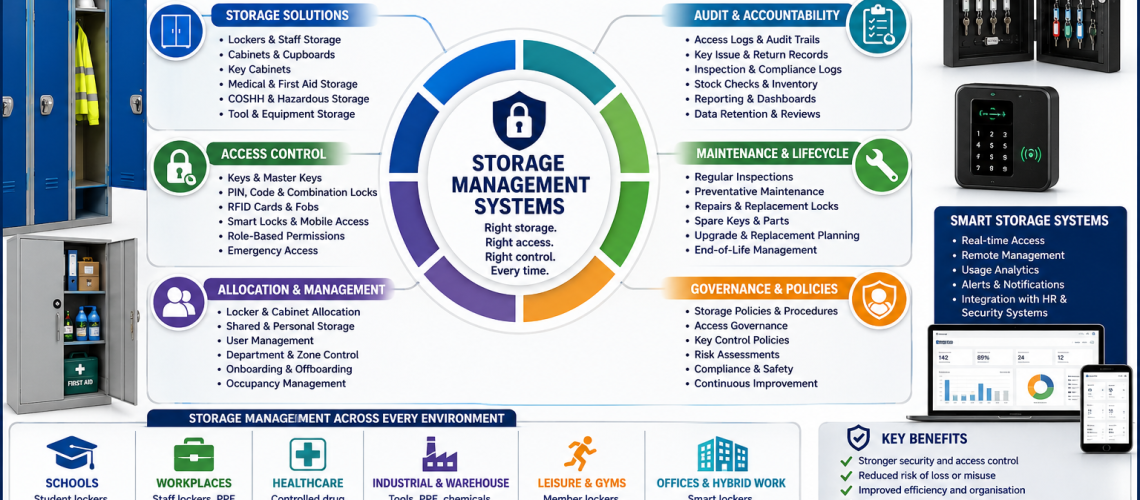
A locker management system is the complete process used to assign lockers, control access, monitor use, manage keys or digital credentials, maintain locks and keep locker estates secure, organised and accountable.
This guide explains how UK schools, workplaces, healthcare sites, leisure centres, offices, factories and public facilities can manage lockers as an operational system rather than a set of individual storage units.
Quick answer: what is a locker management system?
A locker management system controls how lockers are allocated, accessed, audited, maintained and reviewed. It includes assigned lockers, shared-use lockers, hot lockers, keys, master keys, PIN locks, RFID access, smart locker software, occupancy tracking, emergency access and maintenance procedures.
What locker management includes
| Management area | What it controls | Why it matters |
|---|---|---|
| Allocation | Assigned, temporary, shared-use and hot lockers | Prevents confusion and improves space use |
| Access control | Keys, PINs, RFID, smart credentials and master keys | Controls who can open lockers |
| Occupancy | Vacant lockers, active lockers and abandoned use | Improves utilisation and planning |
| Key management | Issue, return, replacement and master key control | Reduces lost key problems |
| Audit trails | Access records, assignment logs and maintenance records | Supports accountability |
| Maintenance | Locks, doors, hinges, numbering and replacement parts | Keeps lockers working safely |
Why locker management matters
Lockers are used every day, so poor management quickly creates operational problems. Lost keys, unclear ownership, abandoned lockers, broken locks, overcrowded areas and unmanaged shared use can all reduce security and efficiency.
- Improves locker security and accountability.
- Reduces lost keys and unmanaged access.
- Helps facilities teams track locker use.
- Supports shared-use and hybrid workplace storage.
- Improves locker availability in high-demand areas.
- Makes maintenance and replacement easier to plan.
- Supports schools, workplaces, leisure centres and industrial sites.
1. Locker allocation management
Locker allocation defines who uses each locker and for how long. This may be a fixed assignment, temporary assignment, shared-use arrangement or hot locker system.
| Allocation model | Best for | Management need |
|---|---|---|
| Assigned lockers | Staff, students and long-term users | Named records and key issue control |
| Temporary lockers | Visitors, contractors and short-term use | Time-limited access and return checks |
| Shared-use lockers | Gyms, leisure centres and shift work | Reset process and occupancy control |
| Hot lockers | Hybrid offices and flexible workplaces | Booking, release and usage monitoring |
| Department lockers | Teams, zones and work areas | Supervisor ownership and access rules |
2. Locker access control
Access control decides how users open lockers. The right system depends on user turnover, security level, maintenance workload, budget and whether lockers are assigned or shared.
- Keyed locks: simple and familiar for assigned users.
- Master key systems: useful for controlled override access.
- Combination locks: reduce physical key handling.
- Coin locks: suit leisure centres and public changing areas.
- PIN locks: useful for shared or managed use.
- RFID locks: support cards, fobs and staff credentials.
- Smart locker systems: add dashboards, audit trails and remote control.
For deeper access planning, use the locker access control systems UK and locker access governance UK guides.
3. Locker key management
Key management is one of the most important parts of a locker management system. A site needs to know which keys have been issued, who holds them, which keys have been lost and when replacement keys or locks are needed.
- Issue keys against named users.
- Record locker numbers and key numbers.
- Control replacement key orders.
- Store master keys securely.
- Use sign-out records for spare keys.
- Review repeated lost key problems.
- Replace locks when key control is compromised.
Useful supporting guides include locker key management systems UK, locker keys UK and replacement locker keys cut to code UK.
4. Locker occupancy management
Occupancy management helps organisations understand how lockers are actually used. It is useful where lockers are in short supply, shared between users or affected by hybrid work patterns.
- Track vacant lockers.
- Identify abandoned lockers.
- Monitor shared-use turnover.
- Plan extra lockers where demand is high.
- Reduce unused or duplicated storage.
- Support hybrid workplace planning.
For deeper planning, see locker occupancy management systems UK.
5. Smart locker management systems
Smart locker management systems use software, digital credentials, RFID, PINs, dashboards and usage reporting. They are useful for organisations that need more control than traditional keys can provide.
- Remote locker administration.
- Digital user credentials.
- Access logs and audit trails.
- Usage reporting.
- Temporary access permissions.
- Locker release and reset controls.
- Hybrid workplace locker management.
For more detail, see the smart locker systems UK guide.
6. Audit trails and reporting
Audit trails help prove how lockers are managed. They show who had access, when a key or credential was issued, when a locker was reassigned and when maintenance was completed.
- Locker assignment records.
- Key issue and return records.
- Lost key reports.
- Replacement lock records.
- Master key use records.
- Smart locker access logs.
- Maintenance reports.
- Occupancy reports.
7. Locker maintenance management
Locker management should include planned maintenance. Regular checks help prevent broken locks, stiff doors, missing number plates, damaged hinges and avoidable access problems.
- Check locks, cams and keys.
- Inspect hinges, doors and frames.
- Replace damaged number plates.
- Review locker cleanliness and condition.
- Keep spare parts available for common lock types.
- Replace obsolete or unreliable locks.
- Plan larger upgrades before failure becomes disruptive.
For technical upgrade checks, use the locker lock compatibility guide UK, locker lock dimensions and standards UK and replacement locker locks UK guides.
Locker management by environment
| Environment | Main locker challenge | Best management focus |
|---|---|---|
| Schools | Student turnover, lost keys and corridor pressure | Assignment records, term-end collection and master key control |
| Workplaces | Staff changes, hybrid work and shared storage | Onboarding, offboarding and occupancy planning |
| Healthcare | Restricted staff areas and clean changing spaces | Controlled access, audit records and reliable maintenance |
| Leisure centres | High turnover, wet areas and public use | Coin, RFID or shared-use locker control |
| Industrial sites | PPE, tools, shift work and heavy use | Durable lockers, supervisor access and planned repairs |
| Offices | Flexible working and personal storage | Hot lockers, smart access and usage reporting |
Locker management checklist
- Are all lockers assigned, shared or marked as available?
- Is there a record of who uses each locker?
- Are issued keys and credentials recorded?
- Are master keys controlled securely?
- Can access be removed when a user leaves?
- Are abandoned lockers reviewed?
- Are broken locks logged and repaired?
- Are replacement keys ordered through a controlled process?
- Are locker numbers and records kept up to date?
- Are usage patterns reviewed before buying more lockers?
Best locker management system by use case
| Use case | Recommended system | Why |
|---|---|---|
| Small staff locker room | Assigned lockers with key issue records | Simple and cost-effective |
| Large school locker estate | Student assignment records with master key control | Supports termly management and lost key control |
| Leisure centre changing rooms | Coin, RFID or shared-use locks | Handles high user turnover |
| Hybrid office | Smart lockers with occupancy reporting | Supports flexible working |
| Industrial workplace | Durable assigned lockers with supervisor access | Supports PPE and shift work |
| Multi-site organisation | Standardised access and maintenance records | Improves control across locations |
Related locker management guides
Use these guides to build a complete locker management system:
- Locker Access Control Systems UK
- Locker Access Governance UK
- Locker Key Management Systems UK
- Locker Occupancy Management Systems UK
- Smart Locker Systems UK
- Locker Lock Compatibility Guide UK
- Replacement Locker Locks UK
- Replacement Locker Keys Cut to Code UK
- Locker Locks
- Lockers
Final advice
A good locker management system makes locker use clear, secure and easy to maintain. It should define who uses each locker, how access is controlled, how keys or credentials are managed, how occupancy is reviewed and how faults are repaired.
For smaller sites, this may be a simple key register and assigned locker list. For larger estates, it may include smart locker software, digital credentials, occupancy dashboards, audit trails and planned maintenance schedules. The strongest approach is the one that keeps access controlled, records accurate and lockers available when users need them.
Discover more from Blog Total Locker Service
Subscribe to get the latest posts sent to your email.