Medical Storage Systems UK: Secure Medicine, First Aid and Healthcare Storage Planning
May 12, 2026
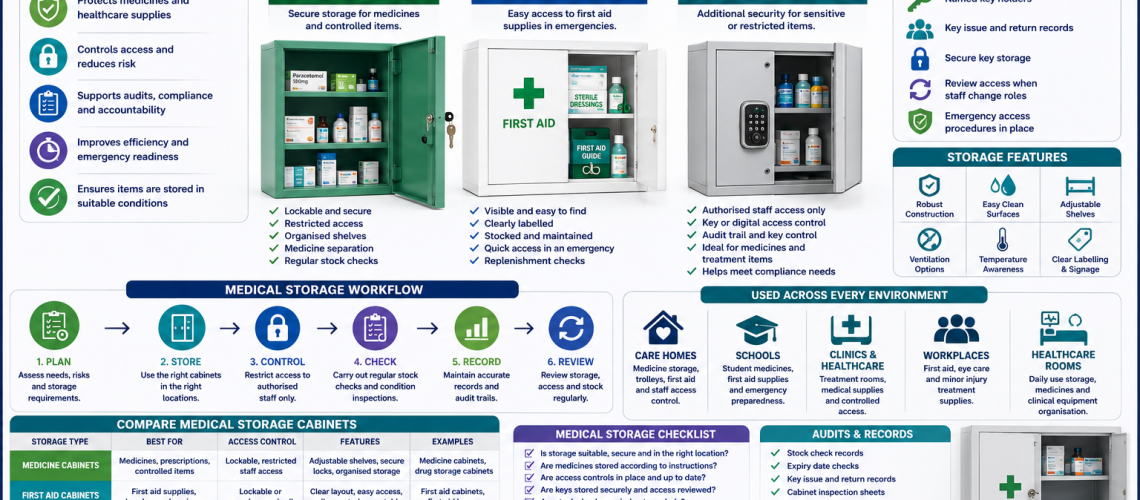
A medical storage system is the complete framework used to store, secure, organise, monitor and control access to medicines, first aid supplies, healthcare equipment and clinical storage items.
This guide explains how UK care homes, schools, workplaces, clinics, healthcare rooms and facilities teams can plan medical storage as a managed system rather than a single cabinet or cupboard.
Quick answer: what is a medical storage system?
A medical storage system combines storage units, access control, staff responsibility, audit records, stock checks, labelling, location planning and review procedures. It may include medical cabinets, medicine cabinets, first aid cabinets, controlled access cupboards, medicine trolleys, staff lockers, key cabinets and secure storage areas.
What a medical storage system includes
| System layer | What it includes | Why it matters |
|---|---|---|
| Storage units | Medical cabinets, medicine cabinets, first aid cabinets, trolleys and cupboards | Provides secure and organised storage |
| Access control | Keys, locks, restricted staff access and key control | Helps prevent unauthorised access |
| Location planning | Clinical rooms, care areas, offices, schools and first aid points | Keeps storage practical and appropriate |
| Audit records | Stock checks, issue records, inspection sheets and review logs | Supports accountability |
| Environmental awareness | Temperature, light, moisture and cleanliness checks | Protects stored items |
| Governance | Responsibilities, procedures, access reviews and escalation routes | Keeps the system controlled over time |
Why medical storage systems matter
Medical storage needs more control than general workplace storage. Items may be sensitive, time-critical, restricted, temperature-aware or needed quickly in an emergency. A clear system helps staff find, secure and manage medical items properly.
- Improves security and access control.
- Helps staff find items quickly.
- Supports medicine and first aid stock checks.
- Reduces misplaced, expired or poorly stored items.
- Improves accountability for shared healthcare storage.
- Supports safer storage in care homes, schools, clinics and workplaces.
Medical storage by storage type
Medicine cabinets
Medicine cabinets are used to store medicines securely and separately from general supplies. They should be suitable for the setting, easy for authorised staff to access and positioned where routine checks can be completed without disruption.
- Lockable medicine storage.
- Clear responsibility for access.
- Suitable location away from general public access.
- Regular stock review.
- Clear labelling and separation.
First aid cabinets
First aid cabinets should be easy to find and simple to check. They are usually used for first aid supplies rather than routine medicine storage. Clear location, labelling and replenishment checks are important.
- Visible first aid location.
- Simple stock layout.
- Regular replenishment checks.
- Clear separation from medicine storage where needed.
- Suitable access for appointed staff.
Controlled access medical storage
Some medical storage areas need tighter access control. This may include restricted key access, named staff responsibility, secure key storage and regular review of who can open the cabinet or cupboard.
- Named authorised users.
- Secure key control.
- Access review after staff changes.
- Clear override procedures.
- Audit records for sensitive storage areas.
Medicine trolleys
Medicine trolleys can support mobile healthcare workflows in care homes, clinics and treatment areas. They need secure storage when not in use, clear responsibility and a practical route for daily use.
- Secure parking location.
- Controlled access.
- Daily use checks.
- Cleanable surfaces.
- Clear responsibility between shifts.
Medical staff lockers
Staff lockers support healthcare storage by separating personal belongings from clinical storage areas. They help keep workspaces clearer and reduce the risk of personal items being stored in unsuitable areas.
For wider locker planning, see locker management systems UK and locker access governance UK.
Medical storage by environment
| Environment | Main storage need | Best system focus |
|---|---|---|
| Care homes | Medicines, records, trolleys and daily routines | Controlled access, audit records and staff responsibility |
| Schools | Student medicines and first aid supplies | Separate storage, named responsibility and easy emergency access |
| Workplaces | First aid cabinets and optional medical storage | Clear location, stock checks and appointed access |
| Clinics | Treatment room storage, medical supplies and secure cabinets | Clean storage, staff access control and regular review |
| Healthcare rooms | Medicines, PPE, equipment and records | Defined zones and secure storage |
| Mobile care settings | Transportable supplies and controlled access | Portable secure storage and documented handover |
Access control for medical storage
Access control is central to medical storage. Staff should know who is allowed to open storage, where keys are kept, how access is recorded and what happens when a key is lost or a staff member changes role.
- Use lockable storage where items need controlled access.
- Limit access to authorised staff.
- Store keys securely.
- Record key issue where appropriate.
- Review access after staff changes.
- Use clear emergency access procedures.
For broader access planning, use the storage management systems UK and locker access control systems UK guides.
Key control and responsibility
Keys are often the weakest point in a medical storage system. A locked cabinet only works if the key is controlled. Key issue, key return, spare key storage and replacement key procedures should be clear.
- Keep a record of authorised key holders.
- Do not leave keys in open access areas.
- Use secure key cabinets where needed.
- Record replacement key requests.
- Review locks if key control is lost.
- Remove access when staff leave.
Medical storage location planning
The location of medical storage affects security, speed and daily workflow. Storage should be practical for authorised staff, but not exposed to unnecessary public or unauthorised access.
- Choose a location near the point of use where practical.
- Avoid obstructed or hidden areas that make checks difficult.
- Separate medical storage from general storage where needed.
- Keep first aid supplies visible and easy to locate.
- Keep restricted items in controlled areas.
- Review storage after layout or staffing changes.
Temperature, cleanliness and storage conditions
Some medical items may have storage requirements linked to temperature, light, moisture or cleanliness. The storage system should make it easy for staff to check whether items are being stored in suitable conditions.
- Check product storage instructions.
- Avoid damp or unsuitable areas.
- Keep cabinets clean and organised.
- Use suitable storage for refrigerated items where required.
- Separate expired or damaged items.
- Record checks where the setting requires it.
Audits and stock checks
Medical storage should be easy to audit. Clear records help staff check what is stored, what has been used, what needs replacing and what should be removed.
- Stock check records.
- Expiry date checks.
- Medicine receipt and return records.
- First aid replenishment records.
- Cabinet inspection sheets.
- Key holder records.
- Incident and exception reports.
- Cleaning and maintenance checks.
Medical storage checklist
- Is medical storage separate from general storage where needed?
- Is access limited to authorised staff?
- Are keys controlled and stored securely?
- Are first aid supplies easy to find?
- Are stock checks carried out regularly?
- Are expired or damaged items removed?
- Are cabinets labelled clearly?
- Are medicines stored according to their instructions?
- Are staff responsibilities documented?
- Is emergency access clearly defined?
Best medical storage system by use case
| Use case | Recommended storage system | Why |
|---|---|---|
| Workplace first aid | Wall-mounted first aid cabinet | Visible, simple and easy to check |
| School medical room | Separate first aid and medicine cabinets | Supports clear separation and responsibility |
| Care home medicine storage | Lockable medicine cabinet or trolley system | Supports daily routines and controlled access |
| Clinic treatment room | Lockable medical cabinets with cleanable surfaces | Supports organised clinical storage |
| Restricted storage area | Controlled access cabinet with key control | Improves accountability |
| Multi-room healthcare setting | Standardised cabinets and audit records | Improves consistency across rooms |
Common medical storage problems
- Medicines stored with general supplies.
- No clear key holder responsibility.
- First aid cabinets not checked often enough.
- Expired items left in cabinets.
- Storage placed in unsuitable locations.
- Staff unsure who can access the cabinet.
- No record of stock checks or inspections.
- Keys kept too openly or shared informally.
Related medical and storage guides
Use these guides to build a stronger medical storage system:
- Storage Management Systems UK
- Medical Cabinets UK
- Care Home Medicine Storage Guide UK
- Medicine Storage Compliance UK
- First Aid Cabinet Guide UK
- Medicine Cabinet Audit Checklist UK
- Medicine Storage Temperature and Location Guide UK
- Locker Management Systems UK
- Locker Access Governance UK
Final advice
A strong medical storage system is built around control, clarity and daily usability. The right cabinet is important, but it is only one part of the system. Access control, stock checks, staff responsibility, location planning and audit records are just as important.
For simple workplaces, this may mean a clearly labelled first aid cabinet with regular checks. For care homes, schools and clinics, it may require lockable medicine cabinets, controlled access, clear staff responsibility and documented review procedures. The best system keeps medical items secure, organised and ready when they are needed.
Discover more from Blog Total Locker Service
Subscribe to get the latest posts sent to your email.