Locker Locks for Wet Areas UK: Pool, Spa and Leisure Locks, IP Ratings and Corrosion Protection Guide
May 8, 2026
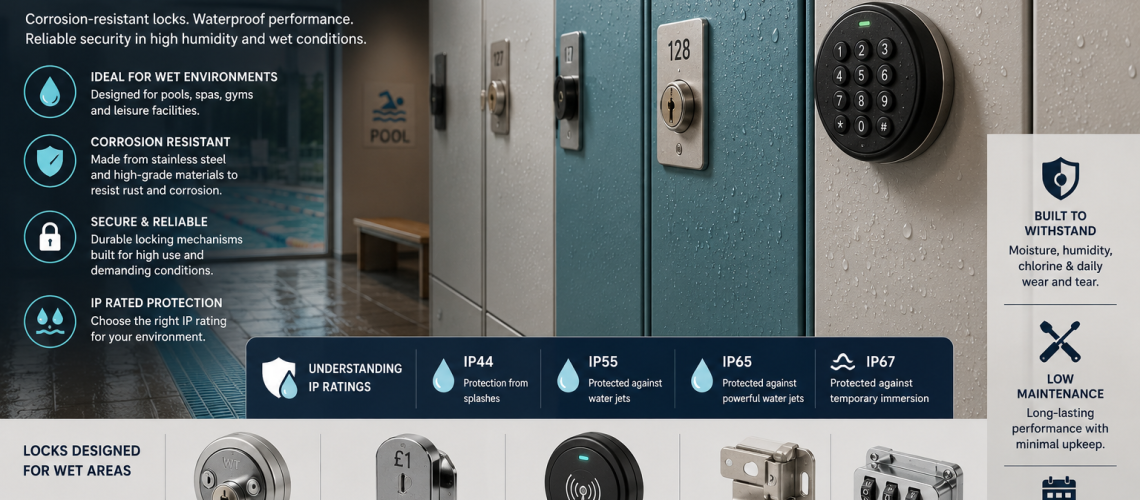
Locker locks used in wet or humid areas need to be specified around the actual environmental exposure. Moisture, condensation, splash, chlorine, cleaning chemicals and repeated wet use can all affect lock bodies, fasteners, cams, latches, electronic components, seals and battery compartments.
This guide owns the specialist question: what does a wet, humid or chemically aggressive environment change about locker-lock specification?
It does not decide whether the site should use a key, combination, coin, RFID or electronic system. That technology choice belongs in Locker Access Control Systems UK.
Wet-Area Locks = define environmental exposure and material protection. Access Control = choose the access technology.
Quick Answer: What Makes a Locker Lock Suitable for a Wet Area?
A wet-area locker lock should be selected against the real conditions where it will operate, not against a generic label such as “pool lock” or “waterproof lock”.
- How much direct splash reaches the lock?
- Is the area persistently humid?
- Does condensation form on or behind the locker door?
- Are chlorine, chlorides or other aggressive chemicals present?
- Which cleaning products contact the lock?
- How often is the lock handled with wet hands?
- How frequently is the lock operated?
- Are seals, gaskets or protected battery compartments required?
- Are cams, fasteners and internal parts made from suitable materials?
- What environmental guidance does the manufacturer provide?
The correct specification is therefore based on exposure, material compatibility, ingress protection where relevant, inspection and maintenance requirements.
What This Page Owns, and What It Hands Off
- Moisture, humidity, splash and condensation exposure: this page
- Chlorine, cleaning chemicals and corrosion risk: this page
- Seals, gaskets, protected housings and moisture traps: this page
- Environmental interpretation of manufacturer IP ratings: this page
- Whether to use key, coin, combination, RFID or electronic access: Locker Access Control Systems UK
- Leisure-centre temporary-use and visitor-flow requirements: Leisure Locker Access Systems UK
- Repeated heavy-use duty: Locker Locks for High-Traffic Areas UK
- Electronic lock hardware: Electronic Locker Locks UK
- RFID credential and reader behaviour: RFID Locker Locks UK
- Coin mechanism operation: Coin-Operated Locker Locks UK
- Replacement parts: Locker Parts
Not Every Wet Area Has the Same Exposure
“Wet area” can describe several very different environments.
| Exposure type | Typical concern |
|---|---|
| Dry changing area near showers | Raised humidity and occasional wet-hand contact |
| Damp changing room | Persistent humidity and condensation |
| Splash-prone area | Direct water contact on exposed lock surfaces |
| Poolside environment | Humidity, splash and chemically aggressive atmosphere |
| Spa or wellness area | Humidity, condensation and cleaning exposure |
| Outdoor locker area | Rain, temperature variation and environmental contamination |
Do not specify every one of these locations as though the exposure were identical. The actual position of the locker and lock matters.
Humidity Can Damage Locks Without Direct Splash
A lock does not need to be sprayed directly with water to experience moisture-related problems.
- Warm humid air can condense on cooler metal parts.
- Moisture can remain around cams, fasteners and rear lock bodies.
- Closed locker construction can slow drying.
- Repeated humidity cycles can expose vulnerable finishes and interfaces.
- Electronic compartments may be affected if moisture reaches unsuitable components.
Rear components are therefore as important as the visible lock face.
Direct Splash Creates a Different Requirement
If the lock is likely to receive direct splash from showers, wet users, cleaning equipment or poolside activity, the specification should consider direct ingress as well as ambient humidity.
- Reader or keypad face
- Button gaps and seams
- Keyway or coin slot
- Battery compartment
- Front-to-door gasket
- Rear housing
- Cable entries where present
A front face that appears protected does not prove the complete installed lock is protected against the same exposure.
Condensation Is Easy to Miss
Condensation can form where warm moist air meets colder surfaces, including locker doors and internal metal components.
Inspect both sides of the locker door. Moisture behind the door can affect:
- cams;
- latches;
- retaining nuts;
- mounting plates;
- battery housings;
- electronic connectors;
- and untreated cut edges around door preparation.
Chlorine and Chloride Exposure Can Accelerate Corrosion
Pool and leisure environments can be chemically more aggressive than ordinary damp rooms.
The specification should consider not only visible water but also the atmosphere and residues around the locker area.
- Check lock-body materials and finish.
- Check exposed screws and fasteners.
- Check cams and rear latch parts.
- Check whether dissimilar metals are used together.
- Check manufacturer guidance for the intended environment.
A corrosion-resistant front plate is not enough if the rear mechanism remains vulnerable.
Cleaning Chemicals Also Matter
Locker locks in changing rooms may be exposed to cleaning products more frequently than to pool water itself.
- Identify the cleaning products used near the lockers.
- Follow lock and locker manufacturer cleaning guidance.
- Avoid assuming that a corrosion-resistant metal is resistant to every chemical.
- Do not flood keypad, reader, keyway or coin mechanisms during cleaning.
- Inspect seals and finishes where repeated cleaning occurs.
Where chemical exposure is significant, compatibility should be confirmed rather than guessed from appearance.
Corrosion Resistance Is a Whole-Lock Question
A wet-area lock should be assessed as a complete assembly.
| Component | What to check |
|---|---|
| Front housing | Material, finish and environmental guidance |
| Buttons / keypad / reader | Exposure resistance and sealing |
| Fixings | Corrosion resistance and compatibility with locker material |
| Cam / latch / bolt | Rear-side corrosion resistance and freedom of movement |
| Battery compartment | Protection, gasket condition and service access |
| Door cut-out | Protection of exposed edges and moisture traps |
| Rear mounting plate | Material condition and condensation exposure |
Seals and Gaskets Need to Be Installed Correctly
Where a lock relies on a gasket, seal or protected housing, the installation itself matters.
- Use the correct gasket for the lock model.
- Do not omit seals supplied for the intended installation.
- Check that the door surface allows the gasket to seat correctly.
- Avoid trapping debris beneath seals.
- Do not overtighten fixings if that distorts the housing or gasket.
- Inspect aged or damaged seals during servicing.
Avoid Moisture Traps Around the Lock
Water or condensation can collect around poorly detailed interfaces even where the lock itself uses suitable materials.
- Recesses that hold water
- Unsealed door cut-outs
- Horizontal ledges behind the lock
- Overlapping plates that trap moisture
- Damaged paint or coating around drilled holes
- Debris collecting around coin slots or keyways
Good wet-area specification therefore includes the door preparation and fixing detail, not just the product name.
Understanding IP Ratings Without Treating Them as a Universal Answer
An IP rating provides information about a product’s tested resistance to ingress under defined conditions. It can be useful evidence when assessing an electronic or sealed lock, but it should not be turned into a universal rule for every locker installation.
The required protection depends on the actual exposure:
- ambient humidity only;
- occasional splash;
- regular direct water contact;
- cleaning methods;
- dust or contamination;
- location of the lock on the door;
- and whether the complete installed assembly retains the stated protection.
Use the manufacturer’s declared environmental and ingress-protection information for the exact product, then compare it with the real installation conditions.
Do Not Specify a Universal Minimum IP Rating
A single IP number should not be presented as the minimum for every UK pool, spa or leisure installation.
A lock in a relatively dry changing area may experience very different exposure from a lock next to showers or directly beside a pool. Conversely, a high stated IP rating does not automatically prove compatibility with chlorine, cleaning chemicals, corrosion or the full locker installation.
Specify against the actual environment and manufacturer guidance rather than using one generic threshold.
Mechanical Locks Still Need Environmental Checks
A mechanical lock has no electronic circuit or battery, but that does not make it immune to wet-area problems.
- Keyways can collect contamination.
- Cylinders and internal components can corrode.
- Cams and fasteners can seize or deteriorate.
- Combination mechanisms can become stiff.
- Padlock fittings can corrode at exposed interfaces.
Mechanical versus electronic is therefore a technology choice, not a shortcut around environmental specification.
Electronic Locks Need Additional Wet-Area Checks
Electronic locks add components that may need protection from moisture and chemicals.
- Keypad or reader face
- Housing seams
- Battery compartment
- Battery contacts
- Emergency-power point where fitted
- Programming or service ports
- Internal connectors
- Electronic actuator
Use Electronic Locker Locks UK for the hardware and fault layer. This wet-area guide only defines the environmental checks that should be applied to the selected product.
RFID Does Not Automatically Mean Wet-Area Suitable
RFID can be convenient in leisure settings because users may carry cards, fobs or wristbands, but credential type and environmental suitability are separate questions.
An RFID reader and lock still need to be checked for:
- moisture exposure;
- reader-face sealing;
- battery protection;
- corrosion;
- cleaning chemicals;
- and the manufacturer’s stated environment.
Use RFID Locker Locks UK for credential compatibility and lock-level RFID behaviour.
Coin Locks Need Wet-Area Checks Too
Coin-operated locks are often installed in leisure environments, but the coin mechanism can introduce additional openings, internal paths and moving parts.
- Coin or token slot condition
- Internal mechanism cleanliness
- Corrosion on return or retain components
- Service-key access
- Collection-box condition where used
- Cam and latch condition
Use Coin-Operated Locker Locks UK for return, retain and token mechanism operation.
High Traffic and Wet Exposure Are Separate Stressors
Leisure locks may experience both moisture and very high operating frequency. These should be assessed separately.
- Wet-area specification: moisture, chemicals, corrosion and sealing.
- High-traffic specification: repeated operation, wear, user force and service intervals.
Use Locker Locks for High-Traffic Areas UK for the repeated-use duty.
Inspection Points for Wet-Area Locker Locks
Wet-area inspections should look for early environmental deterioration before the lock reaches complete failure.
- Discolouration or staining around fixings
- Surface rust or pitting
- Stiff key, cam or latch movement
- Swollen, cracked or displaced gaskets
- Moisture inside battery compartments
- Corrosion on battery contacts
- Damaged keypad or reader faces
- Residue around coin slots or keyways
- Loose fasteners
- Corrosion behind the door
- Damage to protective coatings around cut-outs
Early Corrosion Indicators
Early intervention is easier when the site recognises minor changes rather than waiting for a seized or failed lock.
- Brown or orange staining
- White or powdery deposits on some metal surfaces
- Loss of surface finish
- Rough movement
- Increasing force required to operate the lock
- Repeated sticking after cleaning or humid periods
- Fasteners becoming difficult to remove
Repeated environmental damage across several lockers may indicate that the specification, cleaning method or local exposure needs reviewing rather than treating each lock as an isolated fault.
Maintenance Should Match the Environment
Wet-area locks generally need inspection and cleaning appropriate to the actual exposure.
- Follow manufacturer cleaning and maintenance instructions.
- Remove residues before they build up.
- Use products compatible with the lock materials.
- Check moving parts for stiffness or corrosion.
- Check seals and gaskets.
- Replace damaged components before they affect the full mechanism.
- Keep suitable replacement parts available where failures would disrupt operations.
The complete maintenance programme sits outside this page. For physical replacement parts, see Locker Parts.
Wet-Area Locker Lock Specification Matrix
| Question | What it affects | Next owner if needed |
|---|---|---|
| How wet is the location? | Ingress, sealing and material specification | This guide |
| Are chlorine or cleaning chemicals present? | Material and finish compatibility | This guide |
| How often is the lock operated? | Wear and duty cycle | High-Traffic Locks |
| Should access use key, coin, combination, RFID or PIN? | Access technology | Access Control |
| How should temporary leisure users operate lockers? | Session use, release and reset | Leisure Access |
| How does the RFID reader behave? | Credential and reader operation | RFID Locks |
| How does the electronic lock behave? | Battery, keypad, actuator and override | Electronic Locks |
| How does the coin mechanism work? | Return, retain or token cycle | Coin Locks |
Common Wet-Area Locker Lock Mistakes
- Using one universal IP rating as the answer for every wet environment.
- Checking only the visible lock face and ignoring the rear mechanism.
- Assuming stainless-looking parts are automatically suitable.
- Ignoring cleaning chemicals.
- Ignoring condensation because there is no direct splash.
- Assuming mechanical locks cannot corrode.
- Assuming RFID or electronic locks are wet-area suitable because they are used in leisure sites.
- Ignoring battery-compartment protection.
- Allowing water traps around door cut-outs and fixing plates.
- Confusing wet-area durability with high-traffic durability.
- Choosing access technology from the environment alone.
Wet-Area Locker Lock Checklist
- Dry, humid, splash-prone or directly exposed?
- Does condensation form on the door?
- Are chlorine or chlorides present?
- Which cleaning products are used?
- What does the manufacturer state about the environment?
- Is an IP rating declared for the exact product?
- Does the complete installed assembly retain the required protection?
- Are the front housing and rear mechanism both suitable?
- Are cams, latches and fasteners corrosion resistant?
- Are gaskets or seals required?
- Can water collect around the cut-out or fixing?
- Is the battery compartment protected?
- How frequently is the lock used?
- What inspection interval is practical?
- Has one representative lock been tested in the real environment where appropriate?
Where Wet-Area Locker Lock Questions Go Next
| Question | Next guide |
|---|---|
| What does moisture, humidity or chemical exposure change? | This guide |
| Which access technology should we choose? | Locker Access Control Systems UK |
| How should leisure-centre lockers operate? | Leisure Locker Access Systems UK |
| What does repeated heavy use change? | Locker Locks for High-Traffic Areas UK |
| How does an electronic locker lock work? | Electronic Locker Locks UK |
| How do RFID credentials and readers work? | RFID Locker Locks UK |
| How do return, retain and token locks work? | Coin-Operated Locker Locks UK |
| Where can replacement locker parts be found? | Locker Parts |
Wet-Area Locker Locks FAQs
What makes a locker lock suitable for a wet area?
Suitability depends on the actual moisture, humidity, splash, chemical and corrosion exposure, together with the lock’s materials, seals, rear mechanism, fixings and manufacturer environmental guidance.
What IP rating does a locker lock need in a wet area?
There is no single universal IP rating for every wet locker installation. The required protection depends on the actual exposure, and the exact product’s manufacturer information should be matched to those conditions.
Are mechanical locker locks automatically suitable for wet areas?
No. Mechanical locks avoid electronic components, but cylinders, combination mechanisms, cams, fasteners and other metal parts can still corrode or seize if the materials are unsuitable.
Can electronic locker locks be used in wet areas?
They can where the specific product is suitable for the expected environment. Check the housing, seals, battery compartment, keypad or reader, environmental guidance and complete installed arrangement.
Are RFID locker locks suitable for swimming pools?
Some RFID locks may be suitable, but RFID describes the credential technology rather than environmental protection. The exact lock still needs to be checked against moisture, corrosion and manufacturer guidance.
Why do locker locks corrode in leisure centres?
Persistent humidity, condensation, splash, cleaning chemicals and chemically aggressive atmospheres can all affect vulnerable metals, finishes, fasteners and internal components.
Should the rear of the locker lock be checked in wet areas?
Yes. Cams, latches, fasteners, mounting plates and battery compartments behind the door may experience condensation or trapped moisture even when the front face appears protected.
Summary
Wet-area locker-lock specification should begin with the real environment rather than a preferred lock technology or one generic IP threshold.
Define moisture, humidity, splash, condensation, chlorine, cleaning chemicals, corrosion risk, sealing, rear-component exposure and inspection requirements. Then compare the selected product’s manufacturer guidance with those conditions.
Keep the technology decision with Access Control, temporary leisure operation with Leisure Access, repeated-use duty with High-Traffic Locks and the specialist mechanisms with the Electronic, RFID and Coin Lock guides.
Discover more from Blog Total Locker Service
Subscribe to get the latest posts sent to your email.