Are Medical Cabinets Required by Law UK? Medicines Storage Rules Explained
May 5, 2026
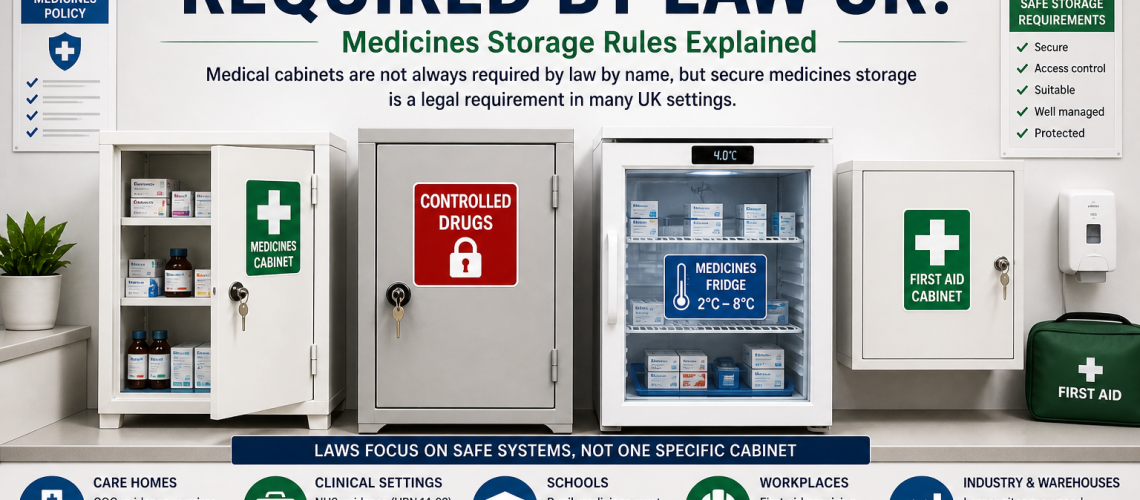
Medical cabinets are not always required by law by name, but secure medicines storage is required in many UK settings. In practice, this often means using a lockable medical cabinet, controlled drug cabinet or locked medicines fridge, depending on the medicines stored and the level of risk.
This guide explains when medical cabinets are required in the UK, how secure storage rules apply to care homes, schools, workplaces and clinical settings, and when specialist storage may be needed for controlled drugs or refrigerated medicines.
Start here: This page forms part of the main Medical Cabinets UK: Medicines Storage, Compliance and Security Guide, which explains how to choose, plan and manage secure medicine storage.
Quick answer: UK guidance usually focuses on secure storage, authorised access, safe procedures and risk assessment rather than naming one universal cabinet type. If medicines are stored on site, a lockable medical cabinet is often the practical way to meet those expectations.
Note: This guide supports product selection and storage planning. Always follow your organisation’s medicines policy, risk assessments and current regulatory guidance.
Are medical cabinets required by law in the UK?
Medical cabinets are not normally required by one single UK law for every site. Instead, different regulations, guidance documents and inspection expectations require medicines and healthcare supplies to be stored safely, securely and appropriately.
This means the legal question is usually not “does the law say medical cabinet?” The better question is “does this site need secure medicine storage?” If the answer is yes, a lockable medical cabinet, controlled drug cabinet or suitable medicines fridge may be needed.
Where medical cabinets are effectively required
| Setting | Why storage is needed | Typical cabinet route |
|---|---|---|
| Care homes | Medicines must be stored securely with authorised access | Lockable medical cabinet, controlled drug cabinet or medicines fridge where required |
| Clinical areas | Medicines storage facilities should follow clinical storage guidance | Medical cabinets, medicine cupboards, controlled drug cupboards and fridges |
| Schools | Pupil medicines and emergency supplies need controlled but practical access | Lockable medicine cabinet plus separate first aid cabinet |
| Workplaces | First aid equipment must be suitable for workplace risk and checked regularly | First aid cabinet, plus lockable medicine storage if medicines are held |
| Factories and warehouses | Large sites may need several first aid points and controlled storage areas | First aid cabinets, medical cabinets and wider storage cabinets |
Need secure storage? View our medical cabinets UK range for lockable medicine storage options.
Care home medical cabinet rules
Care homes have some of the clearest expectations for medicines storage. CQC guidance says medicines must be stored securely, only authorised care home staff should have access, and policies should include how medicine storage keys are securely managed.
For care homes, this normally means medicines should not be left in open cupboards, general office storage or accessible areas. A lockable cabinet, secure medicines room, controlled drug cabinet or locked medicines fridge may be needed depending on the medicines stored.
For a wider setup guide, read the care home medicine storage UK guide.
Are controlled drug cabinets required by law?
Controlled drugs need stricter storage and access control than ordinary medicines. CQC guidance says access to the controlled drugs cupboard should be restricted according to need, spare keys should be stored securely, and the controlled drugs cupboard should not be used for other items such as jewellery or money.
In clinical settings, NHS England HBN 14-02 gives best-practice guidance for medicines storage facilities, including controlled drugs. It also refers to local medicines policies and suitable standards for controlled drug cupboards.
For detailed guidance, read the controlled drug cabinet requirements UK guide.
Do refrigerated medicines need a locked fridge?
Medicines that require refrigeration should not be stored in a standard cabinet. CQC guidance for care homes says medicines fridges should be secure, accessible only to authorised staff, able to maintain the correct temperatures for the medicines stored, and not used for food or biological samples.
Many refrigerated medicines are stored between 2°C and 8°C where required by the product information. The correct storage requirement should always be checked against the packaging, patient information leaflet, medicines policy or professional guidance.
Are first aid cabinets required in workplaces?
Workplaces must provide suitable first aid arrangements. HSE guidance says the contents of a first aid kit should be based on a first aid needs assessment, and first aid kits should be checked regularly because many items have expiry dates.
This does not always mean a workplace needs a medical cabinet for medicines. Many workplaces need a first aid cabinet for emergency supplies, while medicines should only be stored where there is a clear reason, suitable control and a defined responsibility.
Medical cabinet vs first aid cabinet
| Storage type | Used for | Access level |
|---|---|---|
| Medical cabinet | Medicines and healthcare supplies | Restricted to authorised users |
| Controlled drug cabinet | Controlled drugs and higher-risk medicines | Highly restricted with key control and records |
| Medicines fridge | Refrigerated medicines | Restricted, monitored and temperature-controlled |
| First aid cabinet | Dressings, plasters, bandages and emergency supplies | Accessible to responsible or trained staff |
When do you need a medical cabinet?
- You store medicines on site → use lockable, controlled-access storage.
- You store controlled drugs → use specialist controlled drug storage where required.
- You store refrigerated medicines → use a suitable locked medicines fridge.
- You manage medicines in a care home → use secure storage, key control and audit routines.
- You only store first aid supplies → use a first aid cabinet, not a medicine cabinet.
- You store mixed supplies → separate medicines, first aid stock and general healthcare supplies.
What secure medicines storage should include
- A suitable lockable cabinet, cupboard or fridge.
- Access limited to authorised staff.
- Clear key control or digital access procedure.
- Separation of general medicines, controlled drugs and first aid supplies.
- Temperature control where medicines require it.
- Stock checks and expiry-date checks.
- Records for receipt, storage, use, transfer or disposal where required.
- Safe placement away from heat, damp, public access and unsuitable rooms.
For full planning guidance, read the medical storage compliance UK guide.
Common mistakes
- Assuming the law names one cabinet type → the real requirement is usually secure and suitable storage.
- Using a first aid cabinet for medicines → medicine access may be too open.
- Using a general office cupboard → stock may be accessed by unauthorised users.
- Ignoring controlled drug rules → higher-risk medicines may not be properly protected.
- Storing refrigerated medicines in a normal cabinet → medicines may fall outside required storage conditions.
- No key control process → a locked cabinet becomes weak in daily use.
Recommended next step
Start by listing what you store: general medicines, controlled drugs, refrigerated medicines or first aid supplies. Then choose the cabinet type and access level that matches the risk.
Ready to choose? View our secure medical cabinets, or read the full medical storage compliance UK guide for deeper planning.
Related medical storage guides
| If you need help with | Read this guide |
|---|---|
| Choosing the right cabinet | What medical cabinet do I need? |
| Full medical storage planning | Medical storage compliance UK |
| Controlled drug storage | Controlled drug cabinet requirements UK |
| Care home medicines | Care home medicine storage UK |
| Key control | Medical cabinet key management |
| Access records and audits | Medical cabinet access and audit |
Are medical cabinets required by law UK FAQs
Are medical cabinets required by law in the UK?
Medical cabinets are not always required by name, but secure medicines storage is required in many settings. Where medicines are stored, a lockable medical cabinet is often the practical way to restrict access and protect stock.
Do care homes need lockable medicine cabinets?
Care homes need secure medicine storage with access limited to authorised staff. In practice, this usually means lockable cabinets, secure medicines rooms, controlled drug storage or medicines fridges depending on the items stored.
Are controlled drug cabinets legally required?
Controlled drugs need stricter storage controls than ordinary medicines. A controlled drug cabinet or cupboard may be required where safe-custody, access control or local medicines policy requires it.
Can medicines be stored in a first aid cabinet?
Medicines and first aid supplies should usually be separated. First aid supplies often need fast access, while medicines may need restricted access, stock checks and clearer responsibility.
Do refrigerated medicines need a locked fridge?
Where medicines require refrigeration, they should be stored in suitable refrigerated medicines storage. A standard cabinet is not suitable for medicines that must be kept within a controlled temperature range.
Discover more from Blog Total Locker Service
Subscribe to get the latest posts sent to your email.