Locker Room Compliance UK: Safety, Accessibility & Layout Guide
April 13, 2026
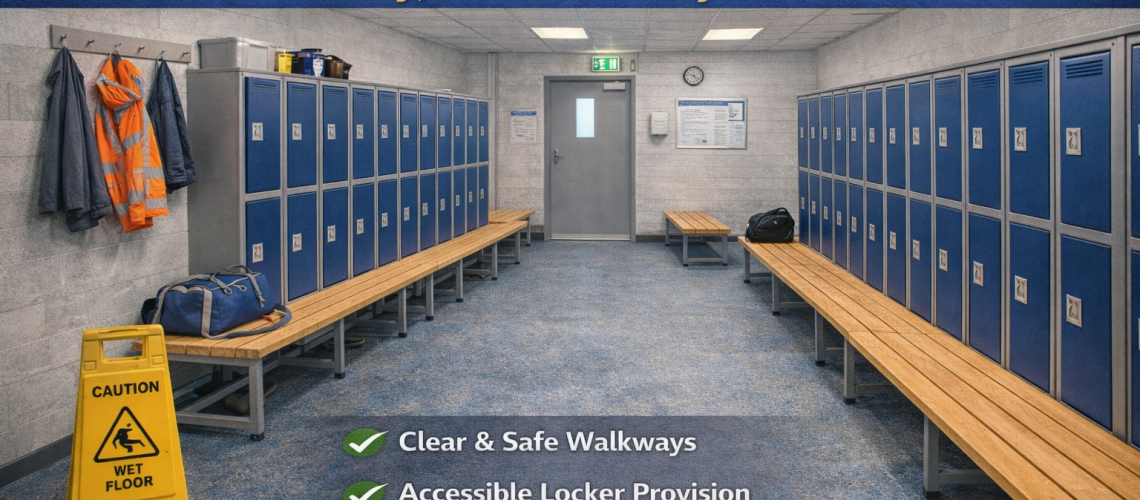
Locker room compliance in the UK is not governed by one single locker-room standard. A compliant and practical changing area is created by considering the legal and operational requirements that apply to the building, the people using it and the activities taking place inside it.
Depending on the site, this can include workplace welfare, safe circulation, fire escape routes, accessibility, wet-area safety, hygiene, changing facilities, clothing storage, cleaning access and the way lockers and benches are positioned.
This guide focuses on locker room compliance UK at room level: safety, accessibility, circulation, welfare and layout planning. For the complete design process, start with our Locker Room Design UK guide. For compliance questions about the lockers themselves, use our Locker Compliance & Regulations UK guide.
This article provides practical planning guidance rather than project-specific legal, architectural, fire-safety or building-control advice. Requirements should be checked against the actual building, intended users and applicable regulations before installation.
Quick answer: what makes a locker room compliant?
A locker room should support the requirements that apply to its use. In practical terms, that can mean providing enough space for safe movement, keeping escape routes clear, offering suitable workplace changing and clothing storage where required, considering disabled users, controlling wet and dry areas, maintaining hygiene and ensuring lockers, benches and other furniture do not create unnecessary hazards.
- Plan the room around the real user group.
- Check the room during peak use, not only when empty.
- Keep circulation and escape routes usable.
- Allow for open locker doors and occupied benches.
- Consider accessibility from the start.
- Provide appropriate workplace changing and clothing storage where required.
- Separate clean, dirty, wet or contaminated items where necessary.
- Choose materials appropriate to the environment.
- Make cleaning and maintenance practical.
- Check the final layout against project-specific fire, building and workplace requirements.
There is no single UK locker room regulation
It is misleading to look for one regulation that defines every locker room. Different rules and guidance apply depending on whether the space is a workplace changing room, school facility, leisure changing room, healthcare staff area, public building or another type of premises.
Relevant areas can include:
- workplace health, safety and welfare;
- changing and clothing accommodation;
- fire-risk assessment and escape routes;
- access to and use of buildings;
- the Equality Act and reasonable adjustments;
- slip, trip and circulation risks;
- cleaning and hygiene;
- wet-area drainage and moisture;
- sector-specific operational requirements; and
- the site’s own risk assessments and procedures.
The room therefore needs to be assessed as a complete working environment rather than judging the lockers, benches or floor independently.
Start with the people who will use the locker room
Compliance planning should begin with the intended users rather than the furniture.
Establish:
- how many people use the facility;
- how many may be present at the busiest time;
- whether they arrive gradually or in groups;
- whether they change clothing or only store possessions;
- whether workwear, uniforms, footwear or PPE are involved;
- whether showers or wet areas are present;
- whether any users require accessible provision;
- whether lockers are assigned or shared; and
- how people enter, use and leave the room.
The complete planning sequence is covered in our Locker Planning UK guide.
Safe circulation is a core locker room requirement
A locker room needs to work while people are actually using it. Locker doors open into the working space, users stand in front of compartments, benches become occupied and bags or clothing may temporarily appear around the room.
A layout that appears spacious when empty can become congested quickly during a school lesson change, factory shift change, sports-team arrival or leisure-session changeover.
Check whether users can:
- enter without immediately meeting a bottleneck;
- reach their locker without crossing an obstructed route;
- open locker doors without striking benches or other users;
- sit and stand without blocking the main circulation path;
- pass other users during peak periods;
- move between storage and wash or changing areas; and
- leave through the intended route without avoidable obstruction.
For detailed positioning of lockers, benches and walkways, see our Locker Room Layout Planning Guide UK.
Plan for peak use, not the empty room
The busiest period is usually the better test of the layout. Thirty employees arriving for a shift can place very different demands on a changing room from three people using the same space in the middle of the day.
Peak periods can create:
- queues at entrances;
- several open locker doors in one aisle;
- incoming and outgoing users crossing;
- fully occupied benches;
- bags temporarily placed on floors;
- congestion beside popular locker banks; and
- conflicting movement around showers or washrooms.
For this specific issue, use our Locker Room Traffic Flow & Congestion Guide UK.
Keep fire escape routes clear
Locker-room furniture must work with the building’s fire-safety arrangements. In workplaces, government guidance requires a clear passageway to escape routes and sufficient routes and exits for people to leave safely.
When reviewing locker and bench positions, check that they do not:
- obstruct an exit;
- reduce a required escape route;
- interfere with fire doors;
- hide emergency signs;
- block access to firefighting equipment;
- create a pinch point immediately beside an exit; or
- encourage bags and equipment to accumulate in the escape route.
Locker placement should be considered within the site’s fire-risk assessment rather than assuming that a particular corridor or wall is automatically suitable. See the current GOV.UK workplace fire-safety guidance for the wider escape-route requirements.
Allow space for locker doors, users and benches
Cabinet dimensions alone do not describe the space a locker bank uses. The working projection also includes the open door, the person standing at the locker and any nearby seating.
A compliant project should therefore avoid treating one generic aisle width as a universal statutory answer. Appropriate space depends on the locker depth, door size, opposing furniture, traffic level, accessibility requirements and the role of the route within the building.
For detailed practical spacing, use our Locker Spacing Guidelines UK. For complete room arrangement, use the Locker Room Layout Planning Guide UK.
Reduce slips, trips and impact risks through layout
Many changing-room problems arise from ordinary daily use rather than one unusual hazard.
Typical risks include:
- bags and shoes left in walkways;
- open doors projecting into busy aisles;
- benches narrowing movement routes;
- water migrating into dry circulation areas;
- users colliding around corners or entrances;
- poorly positioned bins or loose furniture; and
- damaged fittings creating sharp or unstable surfaces.
HSE workplace guidance requires safe movement space, unobstructed traffic routes, appropriate drainage where required and floors that are not unnecessarily slippery. For workplaces, see the HSE workplace health, safety and welfare guidance.
Accessibility must consider the whole user journey
Accessible locker-room design is not achieved simply by providing one low locker compartment. The user needs to be able to enter the room, approach the locker, identify it, operate the lock, open the door, use the internal storage and move between the locker and surrounding facilities.
Planning may need to consider:
- clear approach routes;
- wheelchair manoeuvring space;
- locker reach position;
- lock and handle accessibility;
- bench location;
- door operation;
- visual contrast and numbering;
- dexterity and operating force; and
- avoiding accessible provision being placed in a congested corner.
For the specialist subject, use our Locker Accessibility & DDA Planning UK guide.
For building-level access requirements in England, Approved Document M provides statutory guidance on access to and use of buildings and their facilities.
Workplace changing rooms have specific welfare considerations
Where employees need changing facilities for work, workplace welfare requirements can directly affect locker-room planning.
HSE guidance states that workers must have somewhere to store clothing and somewhere to change where special clothing is worn for work. Where changing facilities are required, the Workplace Regulations and associated guidance also address capacity, seating, access, clothing security and separation where work clothing becomes dirty, damp or contaminated.
Workplace changing-room planning may therefore need to provide for:
- secure personal clothing storage;
- workwear or uniform storage;
- seating;
- footwear and PPE;
- clean and dirty clothing separation;
- drying arrangements where required;
- staff privacy;
- shift-change capacity; and
- access to washing or showering facilities where applicable.
See our Workplace Changing Rooms: Staff Welfare & PPE Layout Guide for the complete workplace workflow.
For official workplace welfare guidance, see HSE workplace facilities and welfare.
Separate personal clothing from dirty or contaminated workwear where required
Some workplaces require more than a bank of general-purpose lockers. Where work clothing or PPE becomes dirty, damp or contaminated, the storage arrangement may need to keep it apart from employees’ personal clothing.
The solution could involve:
- divided lockers;
- separate clean and dirty lockers;
- different changing zones;
- dedicated PPE storage;
- drying facilities; or
- a controlled route between dirty work areas and clean personal storage.
For detailed room organisation, use our Locker Room Zoning Guide UK.
Wet changing rooms need additional planning
Showers, swimming pools, spas and other wet environments introduce regular water, humidity and barefoot traffic. A room layout that performs well in a dry staff changing area may therefore be unsuitable beside a pool.
Wet-area planning should consider:
- floor drainage;
- slip risk;
- water movement through the room;
- wet and dry zoning;
- locker material;
- bench material;
- corrosion resistance;
- cleaning access;
- ventilation; and
- routes between showers, storage and exits.
For this environment, use our Wet Area Changing Room Design guide and our Changing Room Layout Guide: Wet vs Dry Areas.
Use zoning to separate conflicting activities
Zoning means organising the room around the activities taking place rather than treating the entire floor area as one undifferentiated changing space.
Useful zones can include:
- arrival;
- secure storage;
- changing;
- bench seating;
- main circulation;
- accessible provision;
- clean clothing;
- dirty workwear;
- PPE;
- wet activity; and
- exit routes.
These zones do not necessarily need physical partitions. Locker direction, bench position, route planning and clear separation of activities can often create a more understandable room without adding walls.
See our Locker Room Zoning Guide UK for clean/dirty, wet/dry and PPE workflows.
Cleaning access is part of good locker room planning
A locker room that is difficult to clean will become harder to maintain regardless of how good it looked at installation.
Check whether staff can clean:
- beneath and around benches;
- locker bases and stands;
- corners behind furniture;
- floor junctions;
- wet transition areas;
- shelves and open storage; and
- high-use touch points.
Furniture should also remain accessible for inspection so damaged locks, hinges, doors, fixings or seating can be identified before they become larger problems.
For ongoing housekeeping, see our Changing Room Cleaning & Maintenance guide.
Storage design helps keep circulation routes clear
Lockers alone do not necessarily solve every storage problem. If users have nowhere sensible for shoes, bags, coats, helmets or PPE during changing, those items may end up on floors, benches and circulation routes.
A room may need a planned combination of:
- secure lockers;
- hooks;
- shelving;
- boot storage;
- bench storage;
- PPE storage; and
- temporary-use storage.
For the complete supporting-storage system, see our Locker Room Storage Design: Hooks, Shelving & Organisation guide.
Bench positioning affects compliance and usability
Benches should be included in the layout from the beginning rather than added after the lockers have already occupied the available space.
Check that seated users do not:
- block locker doors;
- sit within the main escape route;
- reduce access to neighbouring lockers;
- create a pinch point beside the entrance;
- prevent wheelchair movement; or
- make cleaning unnecessarily difficult.
To compare current products and configurations, browse our changing room bench seating.
Schools need layouts that work during group movement
School changing and locker areas often experience concentrated use when classes arrive or leave together. Circulation, supervision, pupil age, locker-door movement and bags on the floor can therefore become more important than they appear on an empty floor plan.
Planning should consider:
- pupil age and height;
- group movement;
- visibility and supervision;
- clear numbering;
- accessible provision;
- bench capacity;
- PE bags and footwear;
- corridor and exit routes; and
- robust materials suitable for repeated use.
For education-specific storage, use our School Lockers UK guide.
Leisure facilities need to combine throughput, privacy and wet-area control
Gyms, sports centres and swimming facilities may have high user turnover, unfamiliar visitors, wet clothing, showers and periods of concentrated use.
The layout should therefore balance:
- clear navigation;
- privacy;
- locker access;
- bench seating;
- wet and dry routes;
- accessible provision;
- cleaning; and
- peak-time movement.
Material and layout decisions should be based on the actual zone rather than assuming one specification will suit every part of the changing area.
Locker room compliance review checklist
- Who will use the room?
- How many users may be present simultaneously?
- Does the room work during peak occupancy?
- Are entrances and exits clear?
- Do lockers, benches or bags obstruct circulation?
- Have fire escape routes been checked?
- Can locker doors open without creating avoidable conflicts?
- Is accessible provision integrated into the layout?
- Can users approach and operate accessible lockers?
- Are workplace changing and clothing-storage requirements relevant?
- Does dirty or contaminated workwear need separation?
- Are wet and dry zones controlled?
- Are the locker and bench materials suitable for the environment?
- Can floors and furniture be cleaned properly?
- Is there sufficient storage to reduce clutter?
- Can damaged fittings be inspected and maintained?
- Has the final arrangement been checked against project-specific legal and building requirements?
Common locker room compliance mistakes
- Looking for one universal locker-room dimension: requirements depend on the room, route, users and activity.
- Planning from closed locker dimensions: doors and users occupy additional working space.
- Testing the room only when empty: peak use can expose congestion that an empty plan hides.
- Adding benches last: seating changes the usable circulation space.
- Ignoring fire routes: storage furniture must work with the building’s escape strategy.
- Treating accessibility as one low locker: approach, reach, locks and surrounding space all matter.
- Ignoring clean and dirty separation: some workplaces need a structured clothing workflow.
- Allowing wet routes through dry storage areas unnecessarily: zoning can reduce water spread.
- Providing too little supporting storage: bags, shoes and PPE then migrate into walkways.
- Ignoring cleaning access: difficult-to-clean layouts deteriorate operationally over time.
Locker room compliance FAQs
Is there one locker room regulation in the UK?
No. Locker rooms can be affected by different requirements covering workplace welfare, fire safety, accessibility, building use, hygiene and the particular activity taking place. The applicable requirements depend on the site and user group.
Do workplace changing rooms need seating?
Where changing facilities are required under the Workplace Regulations, the facilities must be suitable and sufficient and include seating. The exact changing and welfare requirements depend on the workplace and activity.
Do locker rooms need accessible lockers?
Accessible provision should be considered as part of the building and organisation’s wider accessibility requirements. Good planning considers approach space, reach, locker position, lock operation, benches and circulation rather than only compartment height.
Can lockers be placed on an escape route?
The suitability of lockers near an escape route depends on the building and fire-risk assessment. Escape routes must remain usable and adequately clear, so lockers should not be positioned where they obstruct exits or compromise the required escape arrangement.
How wide should a locker room aisle be?
There is no single aisle width that is appropriate for every locker room. The required space depends on locker depth, door swing, benches, user numbers, accessibility, opposing locker runs and whether the aisle also forms part of a circulation or escape route.
Do dirty work clothes need to be separated from personal clothing?
Where work clothing or PPE becomes dirty, damp or contaminated because of the work, HSE guidance says it should be accommodated separately from the worker’s own clothing where necessary. The appropriate arrangement depends on the workplace and risk.
Treat compliance as part of locker room design, not a final check
The strongest locker rooms do not add compliance after the layout is finished. Safety, accessibility, welfare, circulation, storage, cleaning and environmental conditions are considered while the room is still being planned.
That approach makes it easier to resolve problems before lockers and benches are installed and helps prevent a room that looks efficient on paper but performs badly during daily use.
For the complete design process, continue to our Locker Room Design UK guide. For physical spacing and circulation use the Locker Room Layout Planning Guide UK. For accessible provision use our Locker Accessibility guide, and for products browse our commercial lockers and changing room benches.
Discover more from Blog Total Locker Service
Subscribe to get the latest posts sent to your email.