Rifle Cabinets for Scoped Rifles: UK Gun Safe Guide
June 24, 2026
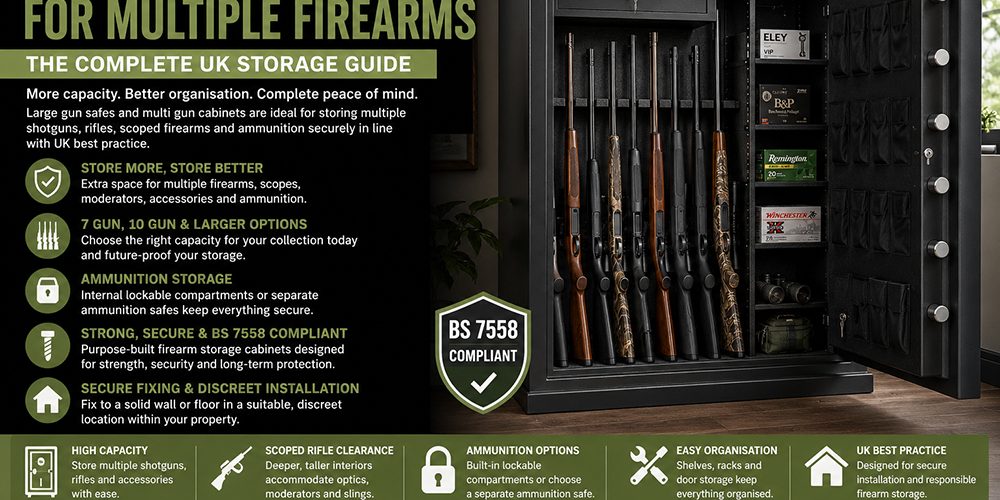
Rifle cabinets for scoped rifles need more careful planning than basic shotgun cabinets. A rifle with a scope, moderator, sling or bipod can need extra usable depth, more internal clearance and better spacing between firearms. If you are comparing secure storage options, start with our range of rifle cabinets and gun safes for scoped rifles, then use this guide to choose the right size, depth, layout and fixing arrangement.
This guide explains how to choose a rifle cabinet for scoped rifles in the UK. It covers internal depth, rifle height, door opening, cabinet capacity, ammunition storage, BS 7558 context, fixing points, installation location and common buying mistakes. It is written for certificate holders comparing rifle safes, gun cabinets, firearm storage cabinets, shotgun cabinets and larger multi-gun safes.
The most important point is simple. A cabinet that technically fits a rifle may still be awkward for a scoped rifle. Scope height changes the storage profile. The rifle may need more depth, more room at the side and more clearance when being removed. A cabinet that looks adequate from the outside can become cramped once optics and accessories are fitted.
Quick Answer: What Cabinet Do You Need for a Scoped Rifle?
A scoped rifle usually needs a deeper and more spacious cabinet than a plain shotgun or unscoped rifle. The cabinet should have enough internal height for the rifle, enough usable depth for the scope, enough width to avoid contact with other firearms and a door opening that allows the rifle to be removed without twisting or forcing it.
When choosing a rifle cabinet for a scoped rifle, check:
- usable internal depth, not just external cabinet depth;
- internal height for the rifle, including moderator if fitted;
- scope clearance so optics do not press against the cabinet door;
- firearm spacing if several rifles or shotguns are stored together;
- door opening width so the rifle can be removed safely;
- rest position and whether the internal layout suits scoped rifles;
- ammunition storage, either internal or separate;
- fixing points and the strength of the chosen installation surface.
If the rifle has a large optic, moderator, night-vision unit or other accessory, choose a cabinet with extra clearance. Buying the smallest possible cabinet often causes problems later.
Why Scoped Rifles Need More Cabinet Depth
A scope changes the shape of the rifle. A plain firearm may sit close to the cabinet back or side without issue. A scoped rifle projects outward. The optic can increase the depth required and may also affect how the rifle sits in the rack or rest.
This is why external depth is not enough. Door thickness, internal lining, shelves, gun rests and lock mechanisms can all reduce usable internal depth. A cabinet may appear deep enough in a catalogue but still press against the scope once the door is closed.
Scope clearance is not only about fitting the rifle inside. It is also about avoiding pressure, knocks and awkward handling. A cramped cabinet can increase the risk of damaging optics or catching the rifle when removing it. For regular users, extra depth can make the cabinet much easier to live with.
Rifle Cabinet vs Shotgun Cabinet
Shotgun cabinets and rifle cabinets are often grouped together, but their practical storage needs can differ. Shotguns usually need height and straightforward vertical storage. Rifles may need height too, but scoped rifles often need more depth, better side clearance and a layout that allows optics to sit safely.
A narrow shotgun cabinet may be fine for plain shotguns but poor for rifles with optics. If you store both shotguns and rifles, choose a cabinet based on the largest and most awkward firearm, not the easiest one. Mixed storage needs more space than a cabinet capacity label may suggest.
If your main storage need is shotgun capacity, read our related Shotgun Cabinet Sizes Guide. If you are storing rifles with scopes, treat depth and internal layout as priority checks.
Understanding Rifle Cabinet Capacity Labels
Gun cabinets are often labelled by capacity. You may see 3 gun, 5 gun, 7 gun or 10 gun models. These labels are useful, but they are usually based on standard firearms stored closely together. They may not reflect practical storage for scoped rifles.
A 5 gun cabinet may not comfortably hold five scoped rifles. A 7 gun cabinet may be better for four or five firearms if several have optics. A 10 gun cabinet may be the right choice for a smaller number of rifles if you want better clearance, accessories and future expansion.
When comparing capacity, ask how the firearms will sit in daily use. Can each rifle be removed without moving everything else? Is there clearance around the scope? Does the door close without contact? Is there room for future changes? For a broader capacity guide, read Gun Safe Sizes Explained: 3 Gun vs 5 Gun vs 10 Gun Models.
Internal Height for Rifles
Internal height is still important for rifle cabinets. A cabinet must be tall enough for the longest firearm stored inside. This is especially important where a moderator is fitted or where the rifle is stored in a way that increases total height.
Do not rely on the external cabinet height. Internal ammunition compartments, shelves, plinths and cabinet construction can reduce usable height. Always check internal dimensions and measure your firearm before ordering.
Allow some extra clearance rather than choosing a cabinet where the rifle only just fits. Tight height clearance can make daily use awkward and may lead to unnecessary knocks or contact with internal fittings.
Usable Depth for Scopes and Optics
Usable depth is the most important dimension for many scoped rifle owners. The cabinet must have enough internal depth for the rifle and optic to sit naturally. It must also allow the door to close without pressing against the scope, mount or bolt area.
Large scopes, high mounts, night-vision optics and thermal equipment can increase the depth needed. Even if the rifle fits, you may not want expensive optics pressed against a door or other firearms. Extra depth gives safer clearance and easier handling.
Where possible, choose a rifle cabinet designed with scoped rifle storage in mind. A deeper cabinet or larger gun safe may cost more than a compact cabinet, but it can prevent early replacement and reduce day-to-day frustration.
Internal Width and Firearm Spacing
Internal width affects how comfortably scoped rifles sit beside each other. A scope can make a rifle wider than expected. If several firearms are stored closely together, scopes, bolts, slings and stocks can catch or rub.
A wider cabinet gives more separation. This is helpful if you store several rifles, a mix of shotguns and rifles, or firearms with different shapes. It also makes it easier to remove one rifle without disturbing the others.
For multi-firearm owners, width can matter as much as depth. A cabinet with generous internal width and depth may be more useful than a taller cabinet with a narrow layout.
Door Opening and Handling Clearance
A rifle cabinet needs enough door opening for safe handling. If the door cannot open fully because of a wall, cupboard side or nearby obstruction, the cabinet may be difficult to use. This matters more for scoped rifles because the rifle may need to be angled carefully during removal.
Before ordering, check the final installation area. Make sure the door can open fully and that there is enough space in front of the cabinet to remove the rifle without twisting awkwardly. A correct cabinet in a poor position can still be frustrating.
For more advice on cabinet placement, read Where Should You Install a Gun Safe in a UK Home?.
Scoped Rifles, Moderators and Accessories
Scoped rifles are often stored with other accessories. Moderators, bipods, slings and specialist optics can all affect how the rifle fits inside the cabinet. Some accessories may increase length, depth or width. Others may catch on internal rests or adjacent firearms.
Think about the rifle as it will actually be stored. A rifle measured without accessories may not represent daily use. If you normally keep a scope fitted, plan cabinet depth around that. If a moderator changes overall length, check internal height. If accessories are removed before storage, make sure they also have a secure and organised place.
Buying for the real storage profile is more reliable than buying for the bare rifle measurement alone.
Rifle Cabinets with Ammunition Compartments
Some rifle cabinets include a lockable internal ammunition compartment. This can be convenient, but it can also reduce usable internal height or storage layout. In a cabinet for scoped rifles, that lost space can matter.
If you need ammunition storage, compare the internal compartment size with your actual ammunition needs. A small compartment may be enough for some users, while others may need a separate ammunition safe. Rifle ammunition, packaging and related items can take up more space than expected.
For more detail, read our Ammunition Safe Storage Guide or view dedicated ammunition safes.
Should You Choose a Larger Gun Safe Instead?
Many scoped rifle owners are better served by a larger gun safe rather than the smallest cabinet that fits. A larger model can provide more depth, better spacing, more room for accessories and greater future capacity.
This does not mean every buyer needs the largest cabinet available. The cabinet still needs to fit the property, reach the installation location and be fixed securely. However, if you are choosing between two sizes and the larger cabinet can be installed properly, the extra space is often useful.
For multi-firearm storage, read our related Large Gun Safes for Multiple Firearms Guide.
BS 7558 and Rifle Cabinets
BS 7558 is commonly associated with gun cabinets and secure firearm storage cabinets in the UK. It helps buyers identify products intended for firearm storage rather than ordinary steel cupboards. When choosing a rifle cabinet, BS 7558 context is useful, but it does not replace the need to check size and layout.
A BS 7558 cabinet can still be unsuitable for a scoped rifle if it lacks depth or clearance. The standard helps with construction expectations, while the cabinet dimensions decide whether the rifle fits properly. You need both suitable construction and suitable layout.
For a fuller explanation, read BS 7558 Gun Cabinets Explained.
Police Assessment and Scoped Rifle Storage
Buyers often search for police approved rifle cabinets or police approved gun safes. This wording should be used carefully. In practice, suitability depends on the full storage arrangement. The cabinet, fixing, property, firearm type and local firearms licensing advice all matter.
A rifle cabinet should be suitable for the number and type of firearms owned. For scoped rifles, that means allowing enough space and avoiding overcrowding. A cabinet that is too small may need to be replaced as storage needs grow.
For more detail on this wording, read Police Approved Gun Safe: What It Really Means in the UK.
Where Should a Rifle Cabinet Be Installed?
A rifle cabinet should be installed in a secure, discreet and structurally suitable location. The chosen wall, floor or fixing surface must be strong enough for the cabinet. The location should also allow proper door opening and safe access to the stored rifle.
Internal locations are often easier to control than outbuildings. A dry, stable environment can help reduce condensation risk and make long-term storage easier. The cabinet should not be obvious to casual visitors or visible from outside the property.
The best location depends on the property and local assessment. If you are unsure, ask for guidance from the local firearms licensing officer before installing the cabinet.
Can a Rifle Cabinet Go in a Garage or Shed?
Garages, sheds and outbuildings require extra care. They can introduce security, condensation and fixing challenges. A cabinet in an outbuilding may be more exposed to damp, temperature change and forced-entry risk than one installed inside the home.
If an outbuilding is being considered, take local firearms licensing advice before relying on it. The structure, location, alarm arrangements, visibility and environmental conditions may all matter. For more detail, read Can You Keep a Gun Safe in a Shed in the UK?.
Fixing a Rifle Cabinet Correctly
Correct fixing is essential. A rifle cabinet must be secured to a suitable structure according to the cabinet design and the installation location. Weight alone should not be treated as security. A cabinet that can be removed, tipped or prised away is not providing the intended protection.
Before installation, check:
- whether the cabinet includes fixing holes;
- whether wall fixing, floor fixing or both are required;
- whether the wall or floor is structurally suitable;
- whether skirting, pipes or cables affect the fixing position;
- whether the cabinet can sit flush and stable;
- whether the door opens fully after fixing;
- whether the location remains discreet and practical.
If the best depth cabinet cannot be fixed properly in the chosen location, choose a different location or a different cabinet. Secure fixing and suitable dimensions must work together.
Rifle Cabinets and Insurance Expectations
Insurance expectations can vary. Some insurers may ask about firearm value, cabinet type, fixing method, property security, alarm arrangements or how ammunition is stored. Scoped rifles and optics may increase the value of the equipment being stored, so records can be useful.
Keep cabinet information, invoices and installation details where possible. If the rifle, scope and accessories are valuable, check policy wording and speak to the insurer if needed. Do not assume that a product label alone satisfies every insurance condition.
For more detail, read Gun Safe Insurance Requirements UK: What Insurers Expect.
Condensation and Rifle Cabinet Care
Rifles, optics and accessories should be stored in a dry and stable environment where possible. Damp or fluctuating conditions can create condensation risk. This can affect metal parts, optics, ammunition packaging and cabinet interiors.
Choose a cabinet location with moisture control in mind. Inspect the cabinet regularly. Keep the interior clean and organised. Avoid storing unnecessary items that reduce airflow or make inspection harder. If the cabinet is in a higher-risk area, consider suitable moisture-control products and check the contents more often.
For wider safe-care advice, read Gun Safe Maintenance and Condensation Control.
Key Lock or Electronic Lock for a Rifle Cabinet?
Rifle cabinets may use key locks or electronic locks depending on the model. Key locks are simple, mechanical and widely used. Electronic locks can be convenient, but they require battery management and careful code control.
For scoped rifle storage, the lock type should support responsible access control. Convenience should not make storage casual. Keys and codes must be controlled carefully, especially where valuable optics and accessories are stored with the rifle.
For a fuller comparison, read Key Lock vs Electronic Gun Safes: Which Is Better in the UK?.
Rifle Cabinet Size Comparison Table
| Cabinet type | Typical use | Main benefit | Key check for scoped rifles |
|---|---|---|---|
| Compact rifle cabinet | One plain rifle or limited storage | Small footprint | May lack scope depth |
| 3 gun cabinet | One or two firearms with spare space | Better than minimum storage | Check usable depth and door clearance |
| 5 gun cabinet | Mixed rifle and shotgun storage | Good all-round flexibility | Capacity may reduce with scopes |
| 7 gun cabinet | Growing collection or multiple scoped rifles | More spacing and clearance | Check width, depth and rest layout |
| 10 gun safe | Multiple firearms and future capacity | Best long-term flexibility | Delivery route and secure fixing |
Common Mistakes When Buying Rifle Cabinets for Scoped Rifles
Most rifle cabinet mistakes come from checking the wrong measurements. Buyers often check height and advertised capacity but forget usable depth, scope clearance and door opening. These details are exactly where scoped rifle storage can fail.
- Buying a cabinet that is too shallow. The rifle fits, but the scope is pressed against the door.
- Trusting the capacity label too literally. Scoped rifles reduce practical capacity.
- Ignoring internal fittings. Shelves, rests and compartments can reduce usable space.
- Forgetting the moderator. A fitted moderator can change height and clearance needs.
- Choosing the cabinet before the location. Installation space and fixing should guide the decision.
- Overlooking ammunition storage. Internal compartments can reduce firearm space.
- Using a damp location. Rifles and optics benefit from stable, dry storage.
Rifle Cabinet Buying Checklist for Scoped Rifles
Use this checklist before ordering a rifle cabinet or gun safe for scoped rifles:
- How many rifles do you need to store now?
- Are any rifles fitted with scopes, night vision or thermal optics?
- Will any rifles be stored with moderators fitted?
- What is the internal height of the cabinet?
- What is the usable internal depth?
- Can the door close without touching the scope?
- Can the rifle be removed without twisting or forcing it?
- Is there enough spacing between firearms?
- Does the cabinet include an ammunition compartment?
- Would a separate ammunition safe be more practical?
- Can the cabinet be fixed to a suitable wall, floor or structure?
- Is the final location discreet, dry and practical?
- Can the cabinet be delivered to the installation area?
- Have you checked local firearms licensing advice?
If you are unsure between two cabinet sizes, the larger practical size is often better for scoped rifles. The exception is where the larger cabinet cannot be delivered, positioned or fixed properly.
How This Guide Fits the Gun Safe Canister
This rifle cabinet guide is part of the wider Total Locker Service gun-safe canister. Each guide answers a different search intent and supports buyers as they move from compliance research to practical product selection.
- Gun Safes UK Legal Requirements and Buying Guide explains the wider secure storage process.
- BS 7558 Gun Cabinets Explained explains the recognised cabinet construction standard.
- Shotgun Cabinet Sizes Guide helps compare shotgun cabinet capacity.
- Ammunition Safe Storage Guide covers internal compartments and separate ammunition safes.
- Large Gun Safes for Multiple Firearms covers larger and mixed-storage cabinets.
- Police Approved Gun Safe clarifies a common search phrase.
- Gun Safe Sizes Explained compares 3 gun, 5 gun and 10 gun options.
- Key Lock vs Electronic Gun Safes compares access options.
- Where Should You Install a Gun Safe? covers location choice.
- Can You Keep a Gun Safe in a Shed? covers outbuilding risks.
- Gun Safe Insurance Requirements UK explains insurer expectations.
- Gun Safe Maintenance and Condensation Control covers long-term care.
Choosing Rifle Cabinets from Total Locker Service
Total Locker Service supplies secure storage products for UK customers, including gun safes, rifle cabinets, shotgun cabinets and ammunition storage options. When choosing a cabinet for scoped rifles, start with the rifle as it is actually stored. Include the scope, moderator, sling and any accessories that affect height, width or depth.
The best rifle cabinet is not always the smallest cabinet that fits the bare rifle. It is the cabinet that gives enough usable depth, sensible scope clearance, safe access, secure fixing and practical long-term capacity. A slightly larger cabinet can often be the better choice where it can be installed properly.
Browse suitable options here: Total Locker Service gun safes, rifle cabinets and shotgun cabinets.
Rifle Cabinet FAQs
Do scoped rifles need a deeper cabinet?
Yes, scoped rifles often need more usable depth than plain rifles or shotguns. The scope can project outward and may need extra clearance so it does not press against the cabinet door or nearby firearms.
Can I store scoped rifles in a shotgun cabinet?
Sometimes, but only if the cabinet has enough internal depth, height and door clearance. Many narrow shotgun cabinets are not ideal for scoped rifles, especially where several firearms are stored together.
What size cabinet is best for scoped rifles?
The best size depends on the number of rifles, scope size, accessories and available fixing location. Many scoped rifle owners benefit from a larger cabinet than the advertised capacity might suggest.
Does a 5 gun cabinet hold five scoped rifles?
Not always. Scoped rifles reduce practical capacity because they need more depth and spacing. A 5 gun cabinet may hold fewer scoped rifles comfortably in daily use.
Should ammunition be stored in the same rifle cabinet?
Some rifle cabinets include a lockable ammunition compartment. In other cases, a separate ammunition safe may be more practical. Certificate conditions and local firearms licensing advice should guide the final arrangement.
Can a rifle cabinet go in a garage?
Garages can create security and condensation concerns. Always take local firearms licensing advice before relying on a garage or outbuilding for rifle storage.
Does a rifle cabinet need to meet BS 7558?
BS 7558 is a recognised construction reference for UK gun cabinets. Buyers should check the product specification and local firearms licensing advice, while also ensuring the cabinet is deep enough for scoped rifles.
Final Thoughts
Rifle cabinets for scoped rifles need more than basic height and capacity checks. Scope clearance, usable depth, door opening, firearm spacing and internal layout all matter. A cabinet that works for plain shotguns may not be suitable for scoped rifles.
Choose a rifle cabinet based on the full storage profile of your firearm, not just the bare rifle. Allow for scopes, moderators, accessories, ammunition storage and future certificate changes. Make sure the cabinet can be fixed securely in a discreet, dry and practical location.
For secure rifle cabinets, scoped rifle storage, shotgun cabinets and related gun safes, visit Total Locker Service gun safes UK.
Discover more from Blog Total Locker Service
Subscribe to get the latest posts sent to your email.