Ammunition Safe Storage Guide: UK Gun Safe Advice
June 24, 2026
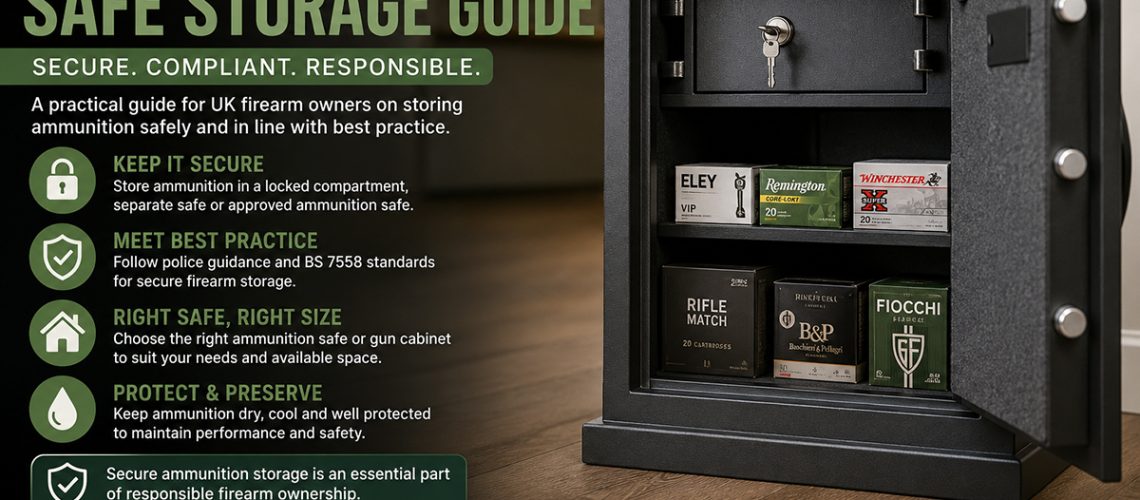
Ammunition safe storage is an important part of responsible firearm and shotgun ownership in the UK. If you are comparing secure storage options for firearms, shotguns, rifles and ammunition, start with our range of gun safes and ammunition storage cabinets UK, then use this guide to decide whether you need a separate ammunition safe, an internal lockable compartment or a larger gun cabinet with better storage capacity.
This guide explains ammunition safes, internal ammunition compartments, separate lockable containers, cabinet size, fixing, location, insurance expectations and common buying mistakes. It is designed for UK buyers who want practical, cautious and useful guidance before choosing a gun safe, shotgun cabinet, rifle cabinet or ammunition safe.
The key point is simple. Ammunition storage should be secure, organised and suitable for the certificate holder, property and firearms stored. A small internal compartment may be enough for some users. Others may need a separate ammunition safe or a larger cabinet arrangement. Final suitability can depend on the storage location, local firearms licensing assessment, certificate conditions and the advice of the local firearms licensing officer.
Quick Answer: Do You Need an Ammunition Safe?
You may need an ammunition safe if you want separate secure storage for cartridges, ammunition or related items rather than storing everything in the main gun cabinet. Some gun safes include a lockable internal ammunition compartment. In other cases, a separate ammunition safe may be more practical, especially where the gun cabinet is already full or where you want more organised storage.
An ammunition safe can be useful when:
- your gun cabinet does not include a lockable internal compartment;
- the internal compartment is too small for your needs;
- you want to keep ammunition separate from firearms;
- you need more flexible storage capacity;
- you want to avoid reducing the firearm space inside your main cabinet;
- your local firearms licensing officer has given specific storage advice;
- your insurance arrangement requires clearer secure storage evidence.
The right answer is not the same for every buyer. A single shotgun owner with limited ammunition may have different needs from a rifle owner, club shooter or certificate holder with several firearms. The safest approach is to match the storage product to the certificate conditions, the property and the actual storage requirement.
What Is an Ammunition Safe?
An ammunition safe is a secure cabinet or lockable container used to store ammunition separately from firearms. It may be a standalone safe, a smaller secure cabinet, or a lockable internal compartment within a larger gun cabinet. The purpose is to restrict unauthorised access and support a more organised firearm storage arrangement.
In product terms, ammunition safes are usually smaller than full-height shotgun cabinets. They are designed for secure storage rather than firearm length. They may be wall fixed, floor fixed, placed within a suitable secure area or used alongside a main gun cabinet depending on the model and storage assessment.
Some buyers use the term ammunition safe. Others search for ammo safe, ammunition cabinet, lockable ammunition box, internal ammunition compartment or secure ammunition storage. These phrases can describe different products, so it is important to check the construction, lock type, size, fixing method and intended use before ordering.
Ammunition Safe, Internal Compartment or Separate Cabinet?
There are three common ways to arrange ammunition storage. The first is a lockable internal compartment inside a gun cabinet. The second is a separate ammunition safe. The third is a smaller secure cabinet or container of suitable construction used separately from the firearms.
A lockable internal compartment is convenient. It keeps ammunition storage within the same cabinet footprint and can be useful where space is limited. However, it reduces the usable internal space for firearms. In a small shotgun cabinet, this can make the cabinet feel cramped.
A separate ammunition safe gives more flexibility. It can help keep the main gun cabinet clear, reduce overcrowding and allow easier organisation. It may also be useful where the gun cabinet has enough firearm capacity but not enough separate storage space.
A smaller cabinet or lockable container may be suitable in some arrangements, depending on construction, fixing and local assessment. Always check the specific product and follow local firearms licensing advice before deciding that a storage arrangement is suitable.
Why Separate Ammunition Storage Can Be Useful
Separate ammunition storage is useful because it supports better organisation and reduces pressure on the main gun cabinet. Many buyers start with a cabinet that seems large enough, then find that cartridges, ammunition boxes, accessories and cleaning items take up more space than expected. A separate ammunition safe can prevent the firearm cabinet from becoming cluttered.
Separate storage can also make daily use clearer. Firearms remain in the main cabinet. Ammunition remains in its own secure area. This can make inspection, access control and inventory checks easier. It can also help where different family members, club members or authorised users have different access needs.
The aim is not simply to add another locked box. The aim is to create a storage arrangement that is secure, practical, easy to inspect and suitable for the property.
UK Firearm Storage Context
UK firearm storage is assessed in context. A cabinet, gun safe or ammunition safe must be considered alongside the property, certificate holder, number of firearms, storage location, fixing method and local risk. Product selection is important, but it is not the only issue.
Firearms and shotguns should be stored securely so that unauthorised access is prevented as far as reasonably practicable. Ammunition storage should support the same responsible approach. Where ammunition or firing mechanisms are kept separately, suitable smaller cabinets, separate lockable containers or internal compartments may be considered depending on the arrangement.
For a wider overview of secure storage expectations, read our related guide: Gun Safes UK Legal Requirements and Buying Guide.
Does Ammunition Need to Be Stored Separately?
Many certificate holders ask whether ammunition must always be stored separately from firearms. The answer depends on the firearm type, certificate conditions, local advice and the specific storage arrangement. Some gun cabinets include a separate lockable compartment. Some users choose a separate ammunition safe for greater capacity or clarity.
It is not sensible to give a single answer for every user. A shotgun certificate holder storing cartridges may have different requirements from a firearm certificate holder storing rifle ammunition. Your certificate conditions and local licensing guidance should always be treated as the controlling factors.
From a buying perspective, it is sensible to plan for secure ammunition storage before choosing a cabinet. If you buy a small gun cabinet without a usable compartment, you may need a separate safe sooner than expected.
Ammunition Safe Size: What Capacity Do You Need?
Ammunition safe size depends on how much ammunition you need to store, the type of ammunition, how it is packaged and whether you want room for future needs. Ammunition boxes can take up more space than expected. Factory packaging, cartridge boxes and accessories can quickly fill a small compartment.
When choosing size, think about:
- the type of ammunition being stored;
- the number of boxes normally kept at home;
- whether storage needs may increase later;
- whether the safe needs shelves or open internal space;
- how often the contents will be accessed;
- whether the safe must fit inside a cupboard or cabinet area;
- whether fixing points and access clearance are suitable.
As with gun cabinets, the smallest option is not always the best option. A slightly larger ammunition safe can make storage easier and reduce the chance of needing to replace it later.
Internal Ammunition Compartments: Pros and Limits
Internal lockable ammunition compartments are popular because they are neat and convenient. They are built into the main gun cabinet and avoid the need for a second separate safe. This can be useful where space is limited or where the ammunition quantity is modest.
The main limitation is lost gun space. A top compartment can reduce internal height. A side or lower compartment can reduce width or usable depth. This matters more in small shotgun cabinets and mixed firearm cabinets where every centimetre of space is useful.
If you are buying a cabinet with an internal compartment, check both the ammunition compartment size and the remaining firearm space. Do not assume that a cabinet described as a 3 gun or 5 gun model will feel the same once the compartment is included.
For more on cabinet size, read our related Shotgun Cabinet Sizes Guide.
Separate Ammunition Safes: Pros and Limits
A separate ammunition safe gives flexibility. It allows the main gun cabinet to be used for firearms only. This can improve access, reduce overcrowding and make it easier to select a gun cabinet based on firearm length and capacity rather than ammunition storage.
Separate ammunition safes can also be positioned where they are easy to fix and discreet to access. They may be wall mounted, floor mounted or placed in a secure internal location depending on the model and fixing requirements.
The limitation is that a separate safe needs its own suitable location and fixing method. It should not be treated as an afterthought. If the safe is poorly fixed, too visible or inconvenient to access, the storage arrangement may be weaker than intended.
You can view suitable product options on our ammunition safes page.
Ammunition Storage and BS 7558 Gun Cabinets
BS 7558 is commonly associated with gun cabinets and secure firearm storage cabinets. It helps buyers identify purpose-made products rather than general cupboards. However, BS 7558 does not remove the need to check ammunition storage layout, fixing points and suitability for the intended use.
If you choose a BS 7558 gun cabinet with an internal compartment, check the compartment size and how it affects the rest of the cabinet. If you choose a separate ammunition safe, check that it is suitable for secure storage and can be fixed or positioned correctly.
For more detail on the standard, read BS 7558 Gun Cabinets Explained.
Where Should You Install an Ammunition Safe?
An ammunition safe should be installed in a secure, discreet and structurally suitable location. It should not be obvious to visitors or visible from outside the property. It should also be fixed to a suitable wall, floor or structure where the product design requires fixing.
Good locations are usually internal, dry and discreet. Poor locations may include visible hallways, damp outbuildings, weak partition walls or areas where the safe cannot be fixed properly. The best location depends on the property and the local firearms licensing assessment.
If the ammunition safe is being installed near the main gun cabinet, check that both units can be accessed safely without drawing attention to the storage area. If the ammunition safe is installed separately, make sure the location still makes sense for secure storage and authorised access.
For wider location advice, read Where Should You Install a Gun Safe in a UK Home?.
Can Ammunition Be Stored in a Shed or Outbuilding?
Outbuildings, sheds and garages need particular care. They can introduce higher security risk, damp, condensation and weaker fixing surfaces. Ammunition packaging and metal components may also be affected by poor environmental conditions. A storage location that seems convenient may not be suitable in practice.
If an outbuilding is being considered, take advice from the local firearms licensing officer before relying on it. You may need stronger physical security, better environmental control or a different internal storage location. Avoid assuming that a locked shed is enough simply because the ammunition is inside a locked safe.
For more detail, read Can You Keep a Gun Safe in a Shed in the UK?.
Fixing an Ammunition Safe Correctly
Fixing matters. A small ammunition safe that can be lifted and removed is not providing the same level of protection as a safe fixed to a suitable building structure. Even if a safe is compact, it should be treated as part of the wider secure storage arrangement.
Before installing, check:
- whether the safe has fixing holes;
- whether the wall or floor is strong enough;
- whether the correct fixing type is being used;
- whether the safe can be accessed without obstruction;
- whether the location is discreet;
- whether moisture or condensation could be a problem;
- whether the installation matches local licensing advice.
Correct fixing is especially important where the ammunition safe is small. Smaller safes can be easier to remove if they are not properly secured.
Key Lock or Electronic Lock for Ammunition Storage?
Ammunition safes and gun cabinets may use key locks or electronic locks depending on the product. Key locks are simple and do not rely on batteries. Electronic locks can offer convenient access, but they require battery management and careful user discipline.
For ammunition storage, reliability and controlled access are more important than novelty. A simple key lock may be ideal for many buyers. An electronic lock may be suitable where convenience is important and the user is careful about maintenance. The lock type should support responsible access control, not make storage casual or insecure.
For a wider comparison, read Key Lock vs Electronic Gun Safes: Which Is Better in the UK?.
Ammunition Storage and Insurance Expectations
Insurance expectations can vary. Some insurers may ask about the value of firearms, secure storage arrangements, property security, alarm systems or the way ammunition is stored. A separate ammunition safe may help demonstrate that storage has been considered carefully, but insurance requirements should be checked directly with the insurer.
Keep product information, invoices, installation notes and photographs where appropriate. Clear records may help if you need to answer questions about your storage arrangement. Do not assume that a product label alone will satisfy every insurance condition.
For more detail, read Gun Safe Insurance Requirements UK: What Insurers Expect.
Ammunition Storage and Condensation Control
Ammunition storage should also consider moisture and condensation. Poor storage conditions can damage packaging and may create wider maintenance issues. Damp areas, unheated spaces and garages can be higher risk than dry internal locations.
Choose a location that is stable, dry and suitable for long-term storage. Check the safe periodically. Keep the inside clean and avoid allowing clutter to build up. Where condensation is a concern, consider appropriate moisture control and inspect the storage area more often.
For wider safe-care advice, read Gun Safe Maintenance and Condensation Control.
Ammunition Storage for Shotgun Owners
Shotgun owners often need practical storage for cartridges. Cartridge boxes can take up space quickly, especially where the user buys in bulk for sport, clay shooting or field use. A small internal compartment may be enough for modest storage, but it may be restrictive for regular users.
If you own one shotgun and keep only a small amount of ammunition at home, a cabinet with an internal compartment may be convenient. If you shoot regularly or need more organised storage, a separate ammunition safe may be better. It allows the shotgun cabinet to remain focused on firearm storage while the ammunition is kept separately and neatly.
If you are also choosing the shotgun cabinet itself, see our Shotgun Cabinet Sizes Guide.
Ammunition Storage for Rifle Owners
Rifle owners may have different storage needs from shotgun owners. Ammunition packaging, quantity, calibre variety and accessories can all affect the amount of space required. If rifles are fitted with scopes or moderators, the main gun cabinet may already need more usable depth and internal clearance. This makes separate ammunition storage more attractive for many buyers.
A separate ammunition safe can help avoid overcrowding the rifle cabinet. It can also support a more organised storage arrangement where different ammunition types are kept clearly separated. As always, the certificate conditions and local firearms licensing advice should guide the final arrangement.
Common Ammunition Safe Buying Mistakes
Most ammunition safe buying mistakes come from treating ammunition storage as an afterthought. Buyers focus on the gun cabinet first, then realise that the internal compartment is too small or that ammunition storage has not been properly planned.
Avoid these common mistakes:
- Buying a gun cabinet without checking the ammunition compartment. Some compartments are smaller than expected.
- Assuming all gun cabinets include ammunition storage. Not all models do.
- Choosing the smallest possible safe. Storage needs often grow.
- Ignoring fixing points. A small safe still needs secure installation.
- Using a damp location. Moisture can damage packaging and create maintenance problems.
- Forgetting access control. Keys and codes must be managed responsibly.
- Assuming product labels guarantee approval. The full storage arrangement matters.
Ammunition Safe Storage Checklist
Use this checklist before choosing an ammunition safe or lockable ammunition compartment:
- Does your current gun cabinet include a lockable compartment?
- Is the compartment large enough for your current ammunition storage?
- Will your storage needs increase in future?
- Would a separate ammunition safe keep the main gun cabinet clearer?
- Can the ammunition safe be fixed securely?
- Is the proposed location discreet?
- Is the location dry and suitable for long-term storage?
- Does the safe use a lock type you can manage responsibly?
- Have you checked certificate conditions and local advice?
- Have you kept product and installation information for records?
If you are unsure, choose the storage arrangement that gives secure fixing, enough capacity, clear organisation and the least chance of needing an early replacement.
How Ammunition Storage Fits the Wider Gun Safe Canister
This ammunition safe storage guide is part of the wider Total Locker Service gun-safe content canister. Each guide answers a different search intent and supports the main commercial gun safes page.
- Gun Safes UK Legal Requirements and Buying Guide explains the wider secure storage process.
- BS 7558 Gun Cabinets Explained explains the recognised cabinet construction standard.
- Shotgun Cabinet Sizes Guide helps buyers choose cabinet capacity.
- Police Approved Gun Safe clarifies a common search phrase.
- Gun Safe Sizes Explained covers broader capacity planning.
- Key Lock vs Electronic Gun Safes compares lock options.
- Where Should You Install a Gun Safe? covers location choice.
- Can You Keep a Gun Safe in a Shed? covers outbuilding risks.
- Gun Safe Insurance Requirements UK explains insurer expectations.
- Gun Safe Maintenance and Condensation Control covers long-term care.
Choosing Ammunition Safes from Total Locker Service
Total Locker Service supplies secure storage products for UK customers, including gun safes, shotgun cabinets, rifle cabinets and ammunition storage options. When choosing ammunition storage, start with your certificate conditions, the amount of ammunition stored, the available fixing location and whether your main gun cabinet already includes a suitable compartment.
For many buyers, the best arrangement is not the smallest possible lockable box. It is the storage setup that gives enough space, secure fixing, responsible access control and a clear separation between firearms and ammunition where required or preferred.
Browse suitable secure storage here: Total Locker Service gun safes and firearm storage cabinets. For dedicated ammunition options, visit our ammunition safes page.
Ammunition Safe Storage FAQs
Do I need a separate ammunition safe?
You may need a separate ammunition safe if your gun cabinet does not include a suitable lockable compartment, if the compartment is too small, or if your certificate conditions or local firearms licensing advice require separate storage.
Can ammunition be stored inside a gun cabinet?
Some gun cabinets include a lockable internal ammunition compartment. This can be suitable for some users, but the compartment size, cabinet layout and local advice should always be checked before relying on it.
Is an internal ammunition compartment better than a separate safe?
Not always. An internal compartment is convenient, but it reduces firearm space. A separate ammunition safe can provide more capacity and keep the main gun cabinet clearer.
Where should an ammunition safe be installed?
Choose a discreet, dry and structurally suitable location where the safe can be fixed securely. Avoid damp outbuildings, weak surfaces and visible areas where possible.
Can ammunition be stored in a shed?
Sheds and outbuildings can create security and condensation risks. Always take advice from the local firearms licensing officer before relying on an outbuilding for ammunition storage.
What size ammunition safe should I buy?
Choose a safe large enough for your current ammunition storage plus some spare capacity. Factory packaging and cartridge boxes can take up more space than expected.
Does an ammunition safe need to be fixed?
Where the product is designed for fixing, it should be fixed to a suitable wall, floor or structure. A small safe that can be easily removed may not provide the intended security benefit.
Final Thoughts
Ammunition safe storage should be planned with the same care as firearm and shotgun storage. The right arrangement may be an internal lockable compartment, a separate ammunition safe or a wider secure storage setup. The choice depends on your firearms, ammunition quantity, cabinet size, property, certificate conditions and local licensing advice.
Check capacity, construction, fixing points, location, lock type and environmental conditions before ordering. Avoid treating ammunition storage as an afterthought. A well-planned storage arrangement is safer, easier to inspect and more practical for long-term use.
For secure firearm cabinets, shotgun cabinets, rifle cabinets and related ammunition storage, visit Total Locker Service gun safes UK.
Discover more from Blog Total Locker Service
Subscribe to get the latest posts sent to your email.