Key Cabinet Sizes and Capacity UK: How Many Keys Do You Need to Store? (2026 Guide)
April 27, 2026
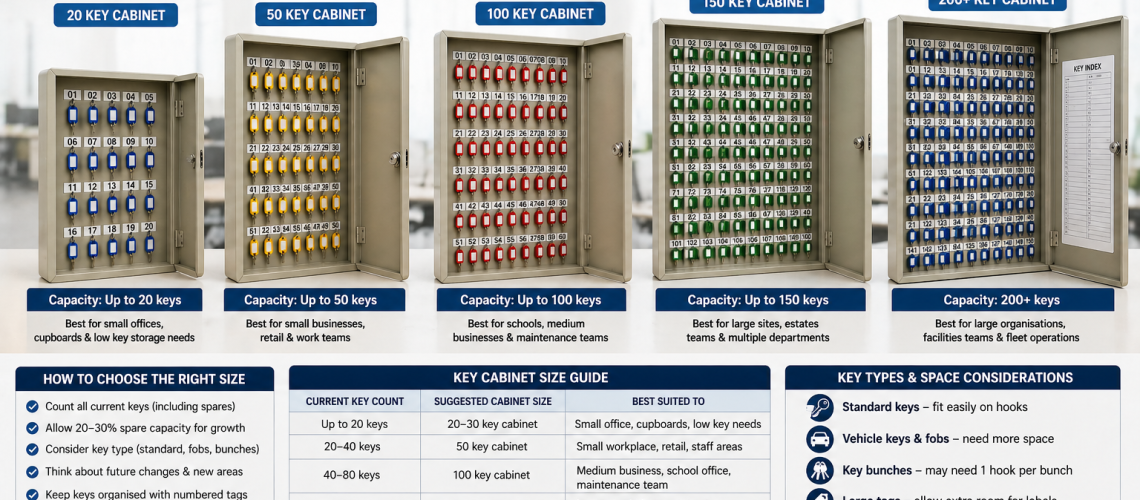
Key cabinet size should be based on the number of keys you need to store now, the type of keys you manage and the extra capacity your site may need in future. Choosing too small can quickly create clutter, while choosing the right size keeps keys organised and easy to control.
A small office may only need a compact cabinet for 20 to 50 keys. Larger workplaces, schools, estates teams, warehouses and fleet sites may need 100, 200 or more key positions, especially where spare keys, master keys and vehicle keys are included.
This guide explains how to choose key cabinet sizes and capacity, so you can specify a cabinet that works now and still has room to grow.
Key cabinet sizes: quick answer
Choose a key cabinet with more hooks than your current key count. As a practical rule, allow at least 20–30% spare capacity for future keys, duplicates, replacement keys and site changes.
| Current key count | Suggested cabinet size | Best suited to |
|---|---|---|
| Up to 20 keys | 20–30 key cabinet | Small office, cupboard keys, spare keys |
| 20–40 keys | 50 key cabinet | Small workplace, retail site, staff areas |
| 40–80 keys | 100 key cabinet | Medium business, school office, maintenance team |
| 80–150 keys | 150–200 key cabinet | Larger workplace, estates team, warehouse |
| 150+ keys | 200+ key cabinet or multiple cabinets | Large sites, multi-department sites, fleet operations |
Takeaway: do not buy a cabinet that only matches today’s exact key count. Spare capacity protects the system from becoming overcrowded too quickly.
Why key cabinet capacity matters
Capacity affects how easy the cabinet is to use. When every hook is full, staff are more likely to place keys on the wrong hook, double up tags or leave keys outside the cabinet.
A properly sized cabinet keeps keys visible, separated and simple to return. It also supports better logging because each key has a clear position and reference number.
For wider selection guidance, see our guide to key storage for businesses.
Count current keys before choosing a cabinet
Start with a full key count. Include active keys, spare keys, duplicates, master keys and keys stored for occasional use.
Many businesses underestimate capacity because they only count the keys used every day. Stored spares, locked cupboards, lockers, cabinets, gates, vehicles and plant rooms can quickly increase the total.
- Office door keys
- Internal room keys
- Locker keys
- Desk and cabinet keys
- Store room keys
- Gate and shutter keys
- Vehicle keys
- Master keys
- Spare and duplicate keys
Allow spare capacity for future keys
Most sites gain extra keys over time. New doors, cabinets, lockers, vehicles, departments and contractors can all increase storage demand.
As a simple guide, add 20–30% spare capacity to your current total. Higher-growth sites may need even more.
If you currently manage 40 keys, a 50-key cabinet may work. If the site is growing, a 100-key cabinet may be the better long-term choice.
Consider key type, not just key count
Not all keys take up the same space. Small single keys are easy to store on standard hooks. Vehicle keys, fobs, bunches and large tags may need more room.
If your site stores bulky keys or key bunches, avoid filling every hook. Extra spacing makes the cabinet easier to use and reduces tangles.
| Key type | Capacity consideration |
|---|---|
| Single door keys | Usually fit standard hook capacity |
| Tagged keys | Need room for labels and colour tags |
| Vehicle keys | Need extra spacing because fobs are bulkier |
| Key bunches | May need one hook per bunch, not per key |
| Master keys | May need separate or restricted storage |
Specification consequence: capacity is not only a hook count. It also depends on key size, tag size and how easily staff can remove and return keys.
Choose by site type
Different sites need different cabinet sizes. A small office may only need a compact cabinet, while a school or warehouse may need larger capacity and stronger organisation.
Small offices
Small offices often need storage for front door keys, internal rooms, cupboards, filing cabinets and spare keys. A 20 to 50 key cabinet is often enough, depending on growth.
Retail and local businesses
Retail sites may store keys for shutters, stock rooms, tills, back offices and display cabinets. A 50 to 100 key cabinet usually gives more useful capacity than a very small unit.
Schools and colleges
Education sites often manage keys for classrooms, offices, gates, stores, lockers, cupboards and contractors. A 100 to 200 key cabinet, or multiple cabinets by department, may be more suitable.
Warehouses and industrial sites
Industrial sites may need storage for offices, stores, plant rooms, vehicles, equipment cages and restricted areas. Larger cabinets or separate cabinets by area can make management easier.
Fleet and vehicle sites
Vehicle keys and fobs need more physical space than standard keys. A cabinet should allow extra room for bulky fobs and clear identification, especially where keys are issued across shifts.
Single large key cabinet or multiple smaller cabinets?
A single large cabinet can be easier to manage when one team controls all keys. Multiple smaller cabinets may be better when departments, buildings or access levels need separation.
| Option | Best for | Main benefit |
|---|---|---|
| Single large cabinet | Central office or facilities team | One controlled key point |
| Multiple smaller cabinets | Departments, buildings or floors | Reduced travel and clearer local control |
| Separate high-risk cabinet | Master keys, vehicle keys, restricted areas | Stronger protection for sensitive keys |
| Digital cabinet | Shared keys and audit requirements | Better access control and tracking |
The best setup depends on who needs access and where keys are used. Central storage gives control, while local storage can improve convenience.
When capacity is not enough
A larger cabinet does not automatically solve every key management problem. If keys are high risk, shared by many users or frequently missing, stronger access control may be needed.
In that case, consider a digital key cabinet or a more structured key control system. These options can help manage user access, issue records and accountability.
For more detail, read our comparison of mechanical vs digital key cabinets.
Key cabinet sizing checklist
- Count all current keys, including spares
- Add at least 20–30% spare capacity
- Allow extra room for fobs and key bunches
- Separate high-risk keys from routine keys
- Decide whether one central cabinet is best
- Consider multiple cabinets for departments or buildings
- Use numbered hooks and matching tags
- Keep an index sheet for quick identification
- Review capacity when the site changes
FAQs about key cabinet sizes and capacity
What size key cabinet do I need?
Choose a cabinet that holds your current keys with spare capacity. A useful guide is to add at least 20–30% extra capacity beyond your current key count.
Is a 20 key cabinet enough for a small office?
A 20 key cabinet may be enough for a very small office, but many sites outgrow it quickly. A 50 key cabinet often gives better spare capacity.
Should I buy a larger key cabinet than I need?
Yes, within reason. Choosing a cabinet with spare hooks helps avoid overcrowding and gives room for new keys, duplicates and future site changes.
Do vehicle keys need more space in a key cabinet?
Vehicle keys and fobs usually need more space than standard keys. Leave extra room so they do not tangle or block nearby hooks.
Is one large key cabinet better than several small ones?
One large cabinet is useful for central control. Several smaller cabinets can work better when keys are managed by different departments, buildings or access levels.
Summary: key cabinet sizes and capacity
The right key cabinet size depends on current key count, future growth, key type and how the site is managed. A cabinet should give every key a clear position without becoming crowded.
For most businesses, the safest approach is to count all keys, allow spare capacity and consider larger or separate cabinets for bulky, shared or higher-risk keys.
Discover more from Blog Total Locker Service
Subscribe to get the latest posts sent to your email.