How Many Lockers Do You Need? Capacity Planning Guide
September 14, 2026
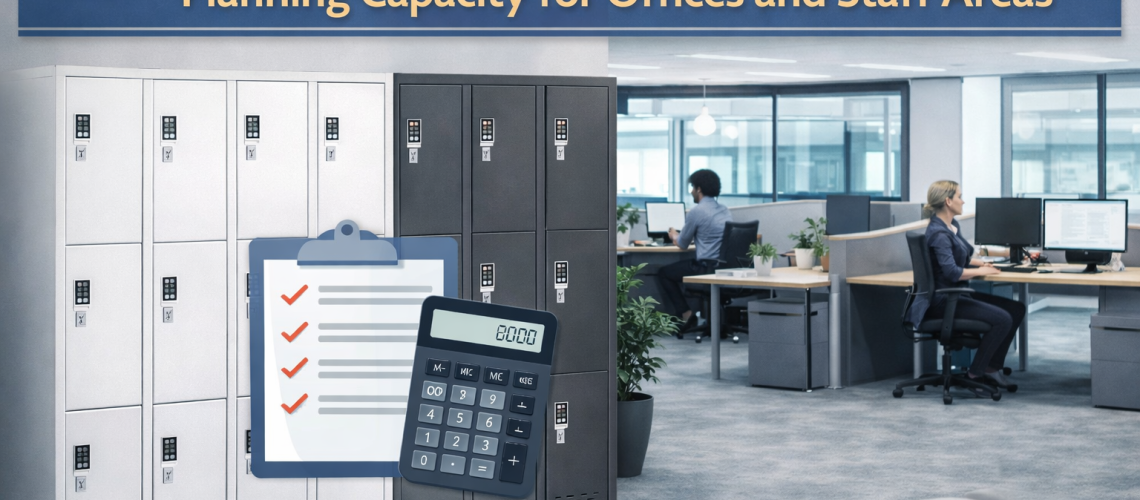
How many lockers you need depends on how many people require storage, when they require it, whether lockers are permanently assigned or shared, and how much spare capacity the site needs. Total headcount alone is rarely enough to calculate the correct locker quantity.
This guide focuses exclusively on locker capacity planning: user numbers, simultaneous demand, assigned and shared locker ratios, shift overlap, hybrid attendance, spare capacity, future growth, compartment count and worked examples. It does not attempt to duplicate the separate guides covering room layout, locker dimensions, aisle widths, locker depth, workplace movement or school congestion.
Quick Answer: How Many Lockers Do You Need?
Start with the number of people who genuinely require secure storage. Then determine the maximum number who need a locker at the same time. If every user has a permanently assigned locker, capacity is usually based on the number of assigned users rather than average daily attendance. If lockers are shared and fully released between different users, capacity can instead be based on peak simultaneous demand.
Then add any justified allowance for visitors, contractors, new starters, future growth and compartments that may temporarily be unavailable. Finally, convert the required number of user compartments into the number of physical locker units required for the chosen configuration.
There is no universal locker-to-user ratio that is correct for every site. A 1:1 ratio may be appropriate for permanently assigned storage, while a managed shared-use system may serve more people than there are lockers if those users are not present at the same time and lockers are reliably released between uses.
What This Capacity Guide Covers, and What It Hands Off
Keeping each planning question on the right page makes the calculation clearer and avoids mixing capacity with room-design decisions.
| Planning question | Use this guide |
|---|---|
| How many locker compartments are required? | This capacity planning guide |
| Where should lockers and benches go in the room? | Locker Room Design UK |
| What locker or compartment size is suitable? | Locker Sizes and Dimensions Guide UK |
| How much clear aisle or working space is required? | Locker Aisle Width Guide UK |
| Should lockers be 300 mm, 450 mm or 600 mm deep? | Locker Depth Guide UK |
| How should staff movement and shift changes affect workplace layout? | Workplace Locker Layout Guide UK |
| How should schools manage pupil access, movement and congestion? | School Lockers UK Guide |
Locker Capacity Terms to Define Before You Calculate
Capacity calculations become unreliable when different people use the word “locker” to mean different things. Before comparing quantities, define the unit being counted.
- User: a person who may require secure storage.
- Assigned user: a person who retains the same compartment between visits or shifts.
- Shared user: a person who uses an available compartment temporarily and releases it afterwards.
- Compartment: one separately secured storage space for one user at a time.
- Locker unit: the physical cabinet. One unit may contain one, two, three, four or more user compartments.
- Peak simultaneous demand: the greatest number of people likely to need a compartment at the same time.
- Operational spare: additional usable capacity held back for temporary demand, faults, visitors or other operational reasons.
- Growth allowance: additional capacity intentionally provided for expected future users.
The distinction between a locker unit and a locker compartment is particularly important. If 120 users each need one secure compartment, the requirement is 120 compartments. That could be 120 single-door units, 60 two-door units, 40 three-door units or another suitable combination. The physical configuration is chosen afterwards according to storage needs and the available product range.
A Practical Locker Capacity Planning Method
A useful calculation separates the demand into components instead of applying one percentage to the total workforce, pupil roll or membership figure.
Planned locker capacity = core locker demand + visitor/contractor demand + operational spare + justified future growth
The important part is how core locker demand is calculated. For permanently assigned lockers, it is normally based on the number of people who require an assigned compartment. For properly managed shared lockers, it is normally based on peak simultaneous use rather than the total number of people who may visit the site over a day, week or term.
1. Count the People Who Actually Need Locker Storage
Do not begin with the headline headcount and assume every person requires the same provision. Separate the population into useful groups.
| User group | Question to answer | Effect on capacity |
|---|---|---|
| Permanent staff | Does every member of staff require storage? | May form the main assigned or shared demand. |
| Shift workers | Are lockers retained between shifts or released? | Can make the difference between total workforce and simultaneous demand. |
| Hybrid staff | How many attend on the busiest realistic days? | Shared lockers may reduce the quantity if allocation is actively managed. |
| Pupils or students | Does every pupil receive an assigned compartment? | Often creates a direct assigned-user requirement. |
| Visitors | How many visitors may need secure storage at once? | May require a separate flexible pool. |
| Contractors | Are regular contractors included in staff capacity? | May create recurring additional demand. |
| Leisure users | How many lockers are occupied at the busiest time? | Daily admissions can greatly exceed simultaneous locker use. |
If only part of the population needs storage, document why. For example, a workplace may have 180 employees but only 135 roles that routinely require locker storage. The capacity calculation should start with those 135 relevant users, not automatically with 180.
2. Establish Peak Simultaneous Locker Demand
Average occupancy can make a locker requirement look smaller than it really is. Capacity should be tested against the busiest realistic period.
- Which day of the week produces the highest attendance?
- Which shift has the greatest number of users?
- Do incoming and outgoing shifts overlap?
- Are there particular classes, teams or departments that arrive together?
- Do temporary staff or contractors increase demand during maintenance, shutdowns or seasonal peaks?
- Does hybrid attendance concentrate on particular days?
- How many lockers are normally still occupied when the next group arrives?
Where reliable attendance or access data exists, use it. Where it does not, capacity should be based on a clearly documented planning assumption and reviewed with the people who understand the site’s operating pattern.
Peak simultaneous demand determines the minimum useful starting point for a shared-use system. It does not automatically determine the quantity for permanently assigned lockers, because an assigned compartment may remain reserved even while its user is absent.
3. Decide Between Assigned, Shared or Mixed Locker Allocation
The allocation model has more effect on locker quantity than almost any other capacity decision.
| Allocation model | Capacity basis | Main planning point |
|---|---|---|
| Fully assigned | Number of users who require a permanent compartment | Absence does not normally release the locker for somebody else. |
| Fully shared/day use | Peak simultaneous users requiring storage | Lockers must be reliably emptied and released between users. |
| Shift sharing | Peak overlapping storage demand | Incoming users may arrive before outgoing users have released lockers. |
| Hybrid office sharing | Credible peak attendance requiring storage | Average attendance is not enough; busy days and team events matter. |
| Mixed system | Assigned pool + shared peak demand | Useful where some roles need permanent storage and others do not. |
Assigned Locker Ratio
If 160 people each require their own permanent compartment, the core requirement is normally 160 assigned compartments. It does not become 120 simply because average daily attendance is 75% if the absent users’ lockers remain allocated to them.
Shared Locker Ratio
If 160 people are eligible to use a shared system but no more than 72 are expected to need storage at the same time, the starting shared capacity is 72 compartments, before adding any justified visitor, operational or growth allowance.
This only works if the operating rules genuinely support sharing. A compartment that remains occupied overnight or contains belongings between visits cannot be counted as available for the next user.
4. Calculate Shift Overlap Instead of Using Shift Headcount Alone
Shift-based workplaces are a common source of capacity errors. Two shifts of 80 people do not automatically mean either 80 lockers or 160 lockers. The answer depends on the allocation method and what happens during the changeover.
For shared lockers, a practical way to test the changeover is:
Peak shift demand = outgoing lockers still occupied + incoming users needing lockers + other users retaining storage during the overlap
Suppose an outgoing shift has 80 users. At the busiest point of changeover, 24 of their lockers are still occupied when 72 incoming staff require storage. If another six day staff also retain shared lockers during that period, the peak simultaneous requirement is:
24 + 72 + 6 = 102 compartments
That 102 is a capacity-planning figure, not a recommendation about how the changing room itself should be arranged. Staff flow, entrances, benches and circulation belong in the Workplace Locker Layout Guide UK.
5. Base Hybrid Workplace Capacity on Credible Peak Attendance
Hybrid working can reduce the number of lockers required, but only when lockers operate as genuinely shared storage. Using average attendance alone creates a risk that the system fails on the busiest office days.
- Review the busiest regular days, not only the weekly average.
- Include team days, training days and company-wide meetings where these are normal operating events.
- Separate staff who require assigned storage from those who can use day lockers.
- Check whether bags, cycle equipment, PPE or work equipment create different storage requirements for some groups.
- Allow for lockers that may be unavailable because of faults, retained belongings or administration.
A mixed model is often easier to calculate than forcing every user into one ratio. For example, 35 staff may require permanently assigned lockers while another 140 hybrid workers use a shared pool. The total planned capacity is then the 35 assigned compartments plus the peak shared requirement and any justified allowances.
6. Convert User Demand Into Locker Compartment Count
Once the number of users requiring storage has been calculated, convert that demand into secure compartments. Do not confuse the number of physical cabinets with the number of people served.
| Locker configuration | User compartments per unit | Units needed for 120 compartments |
|---|---|---|
| Single door | 1 | 120 units |
| Two door | 2 | 60 units |
| Three door | 3 | 40 units |
| Four door | 4 | 30 units |
| Six door | 6 | 20 units |
The arithmetic is simple:
Physical locker units required = required user compartments ÷ compartments per unit
Round up where the result is not a whole number. For example, 125 required compartments using three-door units gives 41.67, so at least 42 three-door units would be required to provide 126 compartments.
Capacity alone should not decide whether a two-door, three-door or six-door configuration is appropriate. More compartments per unit means less storage space per user. Use the Locker Sizes and Dimensions Guide UK to decide what users actually need to store before finalising the configuration.
7. Add Operational Spare Capacity for a Reason, Not by Habit
Providing exactly the calculated minimum can leave no resilience when circumstances change. Additional compartments may be useful for:
- new starters awaiting permanent allocation;
- visitors or temporary staff;
- contractors;
- lockers temporarily unavailable because of repair;
- lost-key or lockout situations;
- belongings left in shared lockers;
- temporary projects or seasonal staffing; and
- short-term fluctuations in attendance.
There is no universal spare-capacity percentage that should be copied into every project. A small stable team may need very little reserve, while a growing site with frequent contractors may need considerably more. Record the reason for the allowance so it can be defended and reviewed.
8. Separate Future Growth From Today’s Operating Spare
Operational spare and future growth are different requirements. Mixing them together makes it difficult to know whether apparently unused lockers are genuinely spare or already reserved for planned expansion.
If a site currently needs 140 compartments and expects 12 additional users during a confirmed expansion, the growth requirement is 12. If it also wants six compartments available for visitors and temporary faults, the planned quantity becomes:
140 core demand + 12 growth + 6 operational spare = 158 compartments
Where future growth is uncertain, model more than one scenario rather than hiding an arbitrary percentage inside the calculation.
Worked Locker Capacity Examples
The examples below illustrate the calculation method. They are not universal design ratios and should not be copied without checking the actual site.
Example 1: School With Assigned Lockers
A secondary school intends to provide an assigned compartment to 720 pupils. The lockers remain allocated to individual pupils throughout the school year. The school also wants 18 additional compartments for new admissions, temporary replacements and changes in pupil allocation.
- Assigned pupil demand: 720
- Additional operational capacity: 18
- Total planned capacity: 738 compartments
If three-door units were suitable for the belongings being stored, 738 ÷ 3 = 246 physical locker units. If a different compartment size is required, the physical unit count changes even though the user capacity requirement remains 738.
Pupil movement, corridor access and congestion are separate planning questions. Use the School Lockers UK Guide for the school-specific specification and planning cluster.
Example 2: Factory With Shared Lockers and Shift Overlap
A factory has two main shifts. The incoming shift has 86 people who need lockers. During the busiest changeover, 28 lockers are still occupied by the outgoing shift. Eight additional day staff retain shared lockers during the same period.
- Incoming shift demand: 86
- Outgoing lockers still occupied: 28
- Other simultaneous users: 8
- Peak shared demand: 122
- Planned operational spare: 8
- Total planned capacity: 130 compartments
The eight spare compartments are an explicit project assumption in this example, not a standard percentage. If the lockers were permanently assigned rather than genuinely shared, the calculation would need to count all people who retain their own compartments.
Example 3: Hybrid Office With Mixed Assigned and Shared Storage
An office has 220 employees. Thirty staff require permanently assigned storage because of their roles. The remaining 190 can use day lockers. Attendance data shows that the busiest realistic day normally brings 108 of those hybrid staff to the office, and around 92 of them require a locker.
- Assigned compartments: 30
- Peak shared demand: 92
- Visitor and contractor allowance: 6
- Operational spare: 6
- Total planned capacity: 134 compartments
The total workforce is 220, but the planned requirement in this example is 134 because most lockers are shared and the attendance evidence supports that model. If the business changed policy and allocated every employee a permanent locker, the requirement would move much closer to the full eligible headcount.
Example 4: Leisure Facility With High Daily Turnover
A leisure site may have 500 visitors over the course of a day, but that does not mean it needs 500 lockers. If the measured busiest period shows 96 lockers occupied simultaneously, the shared-use capacity calculation begins with 96, not daily admissions.
If the operator decides it needs another 12 compartments to absorb visitor peaks and temporarily unavailable lockers, the illustrative planned capacity becomes 108 compartments. The important evidence is simultaneous locker occupation and turnover, not the number of people who entered the building during the whole day.
Compare Capacity Scenarios Before Ordering
Where attendance, growth or sharing behaviour is uncertain, calculate more than one scenario.
| Scenario | Use | Purpose |
|---|---|---|
| Current minimum | Today’s verified demand | Shows the lowest evidence-based requirement. |
| Expected operating case | Normal peak demand plus planned allowances | Usually the most useful procurement figure. |
| Growth case | Expected future users or occupancy | Tests whether expansion should be included now. |
| High-demand case | Credible busy-day or overlap event | Shows how much resilience the proposed capacity has. |
This approach is particularly useful for hybrid workplaces, expanding schools, new facilities and sites where shift patterns are still changing.
Information to Collect Before Calculating Locker Numbers
- Total number of people potentially requiring storage.
- Number who require permanently assigned storage.
- Number who can use shared or day lockers.
- Peak simultaneous users by day, shift or session.
- Shift start and finish times.
- Extent of shift overlap.
- Hybrid attendance by day rather than weekly average alone.
- Visitor and contractor demand.
- Expected new starters or confirmed expansion.
- Number of lockers that may routinely be unavailable.
- Whether shared lockers are actually emptied and released between users.
- Number of secure compartments provided by each proposed locker unit.
Common Locker Capacity Planning Mistakes
- Using total headcount without checking who actually needs storage.
- Using average attendance instead of peak simultaneous demand.
- Reducing locker numbers for hybrid working while still assigning lockers permanently.
- Assuming two non-overlapping shifts share lockers when the changeover actually overlaps.
- Counting physical locker cabinets instead of user compartments.
- Choosing a high-tier configuration only to maximise compartment count.
- Forgetting visitors, contractors or temporary staff.
- Using spare capacity to disguise an uncertain core calculation.
- Adding a generic growth percentage without evidence.
- Assuming a shared locker is available when belongings remain inside it.
- Trying to solve room-layout or congestion problems by changing the capacity figure.
Capacity Is Not the Same as Locker Size
A capacity calculation answers how many secure user compartments are required. It does not answer how large each compartment should be.
For example, a requirement for 180 user compartments could theoretically be met by several different tier configurations. The correct choice depends on whether users need to store coats, bags, books, uniforms, PPE, helmets, footwear or small personal items.
Do not reduce compartment size simply to make the calculated number fit. Establish the required capacity first, then use the Locker Sizes and Dimensions Guide UK to select a useful compartment size.
What If the Required Number of Lockers Does Not Fit?
If the calculated capacity cannot be accommodated comfortably, do not quietly reduce the locker number and assume the problem is solved. Revisit the assumptions.
- Can some users legitimately move from assigned to managed shared storage?
- Is the peak-demand assumption accurate?
- Can different user groups use storage at genuinely separate times?
- Would another suitable compartment configuration serve the same number of users?
- Should storage be split across more than one area?
- Does the proposed room need to be reconsidered?
The physical room solution belongs in the Locker Room Design UK guide. Aisle clearance belongs in the Locker Aisle Width Guide UK, while front-to-back cabinet projection belongs in the Locker Depth Guide UK.
Locker Capacity Planning Checklist
- Count the people who genuinely require locker storage.
- Separate permanently assigned users from shared-use users.
- Establish peak simultaneous demand for the shared group.
- Check shift overlap rather than shift size alone.
- Check busy hybrid-working days rather than average attendance alone.
- Add visitors and contractors where they create real demand.
- Decide how much operational spare is justified and record why.
- Add confirmed or reasonably expected future growth separately.
- Calculate the total number of secure user compartments required.
- Convert the compartment requirement into physical locker units.
- Check that the chosen compartment configuration is large enough for what users store.
- Hand the final capacity figure into the separate room-layout process.
Related Locker Planning Guides
- Locker Room Design UK: Layout, Lockers, Benches and Planning
- Locker Size Guide UK: Standard Dimensions and Buying Advice
- Locker Aisle Width Guide UK
- What Depth Locker Do I Need?
- Workplace Locker Layout Guide UK
- School Lockers UK Guide
Need Help Working Out How Many Lockers You Need?
Total Locker Service supplies commercial lockers for schools, workplaces, factories, warehouses, leisure facilities, healthcare sites and other organisations throughout the UK. If you provide the expected user numbers, allocation method, shift or attendance pattern and what people need to store, we can help identify suitable locker options for the project.
For products, browse our commercial locker range. Workplace projects can also use our workplace lockers range, while education projects can view school lockers.
How Many Lockers Do You Need? FAQs
How do I calculate how many lockers I need?
Start with the number of people who require storage. Separate permanently assigned users from shared users, calculate peak simultaneous demand for the shared group, then add justified visitor, operational and future-growth allowances. The result is the number of secure user compartments required.
Do I need one locker for every employee?
Not always. If lockers are permanently assigned, a one-compartment-per-user model may be appropriate. If lockers operate as genuine shared or day-use storage, the quantity can instead be based on peak simultaneous demand, provided lockers are reliably released between users.
How many lockers are needed for shift workers?
For assigned lockers, count the workers who retain their own compartments. For shared lockers, calculate the busiest overlap between outgoing users, incoming users and any other people whose lockers remain occupied during the changeover.
How do hybrid workplaces calculate locker numbers?
Use credible peak attendance rather than average attendance, then identify how many people on those busy days actually require storage. Keep permanently assigned users separate from the shared locker pool and add any justified visitor, operational and growth allowance.
Should spare lockers be included in the calculation?
Spare capacity can be useful for visitors, new starters, temporary faults, contractors or unexpected demand, but there is no universal spare percentage. The allowance should reflect the way the particular site operates and should be documented separately from future growth.
Is locker capacity the same as the number of locker cabinets?
No. Capacity should normally be counted in secure user compartments. A two-door locker unit provides two compartments, a three-door unit provides three, and so on. The required number of physical cabinets therefore depends on the selected configuration.
What if the calculated locker quantity will not fit in the room?
Do not reduce the capacity figure without reviewing the assumptions. Check whether the allocation model, peak demand, locker configuration or room choice can change. Room layout, aisle width and locker depth should then be assessed using the relevant specialist planning guides.
How many lockers does a school need?
A school should base locker quantity on the pupils or staff who require storage and on whether compartments are assigned or shared. Where each pupil receives a permanent locker, the starting capacity is normally the number of pupils receiving an allocation, plus any justified spare or future capacity.
Discover more from Blog Total Locker Service
Subscribe to get the latest posts sent to your email.