Business Documents, Contracts and Digital Backups Organised for Fire Protection Planning
April 26, 2026
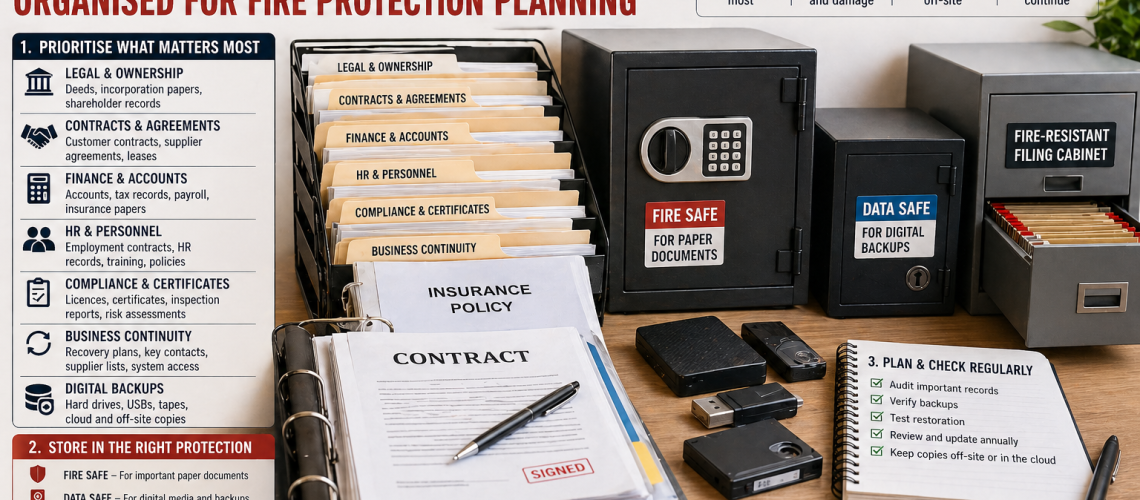
Business fire protection planning starts with knowing which documents, contracts and digital backups matter most. The aim is not to protect every file equally, but to organise critical records so the business can recover quickly after a fire.
Fires can destroy paper documents, damage digital media and disrupt access to essential business information. Contracts, insurance papers, accounts, HR records, compliance documents and backup drives all need to be reviewed by risk and recovery value.
This guide explains how to organise business records for fire protection, what to prioritise and how to choose between a fire safe, data safe and fire-resistant filing cabinet.
Why document organisation matters for fire protection
Good fire protection is not only about buying a safe. It also depends on knowing what belongs inside it. If important records are scattered across desks, drawers, cabinets and old folders, they may be missed when protection is needed most.
Organised records are easier to protect, easier to review and easier to recover after an incident. This reduces delays during insurance claims, legal checks, audits and business continuity planning.
Specification consequence: sort records by importance before choosing fire-rated storage.
Which business documents should be prioritised?
The highest priority documents are usually the ones that prove ownership, support recovery, confirm legal duties or keep the business operating.
- Contracts: customer agreements, supplier contracts, leases and service agreements.
- Insurance papers: policy documents, claim details, valuations and key contact information.
- Financial records: accounts, tax records, payroll files, audit evidence and banking information.
- Company records: incorporation documents, shareholder records and ownership papers.
- HR records: employment contracts, training records, disciplinary files and sensitive personnel information.
- Compliance records: inspection reports, licences, certificates, risk assessments and statutory documents.
- Business continuity documents: recovery plans, supplier lists, emergency contacts and system access procedures.
Key takeaway: prioritise documents that would be hard to replace, legally important or needed quickly after a fire.
How to organise contracts for fire protection
Contracts should be easy to identify and retrieve. Start by separating active contracts from expired agreements, drafts and duplicates. Current documents usually need stronger protection because they affect live obligations.
Use labelled folders for customer contracts, supplier agreements, property leases, finance agreements and service documents. Keep signed originals or certified copies in fire-rated storage where they are still required in paper form.
Digital contract copies should also be backed up securely. A paper fire safe protects physical documents, but digital records need suitable backup and data protection planning.
How to organise digital backups
Digital backups should be treated as recovery assets, not general office accessories. Hard drives, USB drives, memory cards and tapes can be damaged by heat, humidity and smoke, so they need different protection from paper records.
Label backup media clearly with the system, date, version and owner. Remove outdated or unverified backups, because they can create confusion during recovery.
- Keep current backups separate from old archive copies.
- Record what each backup contains.
- Check that backups can be restored.
- Store local backup media in a data safe.
- Keep an additional copy off-site or in secure cloud storage.
Specification consequence: do not store backup drives in a standard document fire safe unless it is specifically rated for data media.
Fire safe, data safe or filing cabinet?
The correct storage depends on what is being protected. Paper documents, digital media and large filing systems have different fire protection needs.
| Storage type | Best for | Typical contents |
|---|---|---|
| Document fire safe | Critical paper documents | Contracts, certificates, deeds, insurance papers and accounts |
| Data safe | Digital backup media | Hard drives, USB drives, tapes, memory cards and recovery media |
| Fire-resistant filing cabinet | Large volumes of paper files | Client files, HR records, active office paperwork and archive folders |
Key takeaway: choose fire protection by content type, access need and recovery importance.
Simple fire protection planning checklist
- List critical business documents.
- Separate originals, copies and duplicates.
- Identify records needed for insurance claims.
- Group contracts by active use and legal importance.
- Check which digital backups are current and restorable.
- Store paper documents in a fire safe or fire-resistant cabinet.
- Store digital backup media in a data safe.
- Keep additional backups away from the main premises.
- Review the plan at least once a year.
What does not need high-level protection?
Fire-rated storage space should be used carefully. Duplicate printouts, outdated drafts, old marketing material, replaceable supplier brochures and files already backed up elsewhere may not need high-level fire protection.
This does not mean these items have no value. It means they should not displace records that are harder to replace or more important to recovery.
Final thoughts
Business documents, contracts and digital backups should be organised before fire protection is specified. Once records are sorted by value, risk and recovery importance, choosing the right storage becomes much easier.
Use a document fire safe for critical paper records, a data safe for backup media and a fire-resistant filing cabinet for larger paper filing systems. Good organisation helps protect what matters most and supports faster recovery after a fire.
FAQs
Which business documents need fire protection?
Contracts, insurance papers, accounts, HR records, company records, compliance documents and business continuity plans should usually be prioritised for fire protection.
Should digital backups be stored in a fire safe?
Digital backups should usually be stored in a data safe rather than a standard document fire safe. Digital media can be damaged by heat and humidity at lower levels than paper.
How should contracts be organised for fire protection?
Contracts should be separated into active agreements, expired agreements, originals, copies and duplicates. Signed originals and important active contracts should be stored in fire-rated protection.
What is the best storage for large volumes of business records?
Large volumes of active paper records are usually better suited to a fire-resistant filing cabinet than a small fire safe.
Discover more from Blog Total Locker Service
Subscribe to get the latest posts sent to your email.