Fire Safe for Home vs Business: What’s the Difference?
April 26, 2026
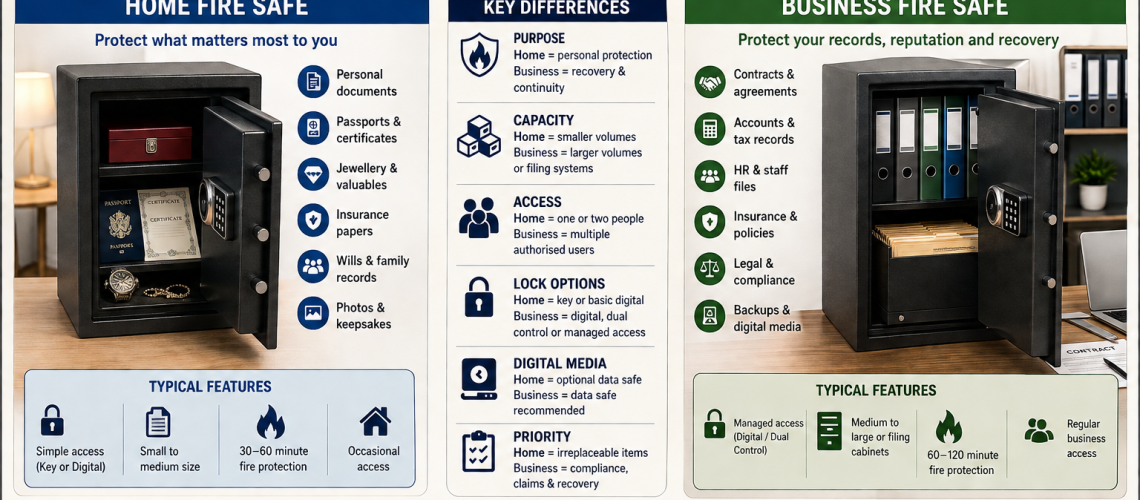
A fire safe does not become a different technical product simply because it is used in a business rather than a home. The difference is usually the requirement placed on it: the type and volume of records, how often they are accessed, how many authorised users need access, how long records must be retained and how important they are to business continuity.
This guide focuses on the home-use vs business-use distinction. It explains what changes when fire-protected storage moves from a household setting into a workplace and when a compact home-style safe is still perfectly suitable for a small office.
For fire-rating interpretation, use Fire Safe Ratings UK. For size and capacity, use Fire Safe Sizes Explained.
Fire Safe for Home vs Business: Quick Answer
The same model can sometimes be suitable for either environment. What changes in business use is usually the record volume, access frequency, number of authorised users, retention requirements, operational importance and the need to manage the safe as part of the organisation’s wider asset and records system.
| Factor | Home use | Business use |
|---|---|---|
| Typical records | Personal certificates, deeds, wills, insurance papers | Contracts, HR records, accounts, licences, compliance records |
| Access pattern | Usually occasional | Can be regular or daily |
| Users | One household or very small group | Several authorised staff or changing users |
| Record volume | Usually limited | Can range from compact records to full filing systems |
| Retention | Personal long-term storage | Formal retention periods may apply |
| Operational importance | Personal loss and inconvenience | Can affect recovery, compliance and normal operations |
| Asset management | Usually informal | Model, location, specification and inspection history may need recording |
Can the Same Fire Safe Be Used at Home and in a Business?
Yes. A fire safe that is suitable for a household can also be suitable for a business if its tested protection, usable capacity and day-to-day practicality match the business requirement.
A small company with a few contracts, certificates and insurance records may have no need for a physically large commercial unit. Conversely, a home with a substantial archive of important papers may need a larger product than some small offices.
The label “home” or “business” is therefore less important than the way the safe will actually be used.
1. The Type of Records Changes
Home safes are often used for personal records such as:
- passports and birth certificates;
- wills and deeds;
- insurance documents;
- personal certificates and ownership papers.
Business use is more likely to involve records such as:
- signed contracts and agreements;
- HR and personnel files;
- accounts and finance records;
- licences and certificates;
- compliance and inspection records;
- business-continuity paperwork.
The difference matters because business records may have formal retention periods, operational value and a more direct impact on recovery after an incident.
2. Business Record Volume Is Often Higher
A household may only need to protect a relatively small set of important documents. A business can accumulate records continuously as staff numbers, contracts, customers and compliance requirements grow.
This does not automatically mean every business needs a large safe. It means the expected record volume should be considered more deliberately.
- Small office: a compact document safe may still be enough.
- Growing business: a larger document safe may become more practical.
- Large active paper filing system: a fire-resistant filing cabinet may be a better fit.
Use the Fire Safe Sizes Explained guide for the detailed capacity decision.
3. Business Records May Be Accessed More Often
Home fire-safe contents are often accessed occasionally. Business records may be retrieved weekly or even daily.
Higher access frequency changes the practicality of the storage format. Staff need to be able to retrieve and return documents without disrupting normal work or leaving records outside the protected storage because the system is inconvenient.
This is one reason large active filing systems often move from shelf storage in a safe to drawer-based fire-resistant filing.
4. Shared Staff Access Is Different From Household Access
A household may have one or two regular users. A business may have several authorised staff, changing roles and staff turnover.
The important issue is not which lock technology is “best”, but whether the organisation has a clear access process.
- Who is authorised to access the safe?
- Who controls keys or codes?
- What happens when a staff member leaves?
- Who is responsible for restoring access if a key or code is lost?
Detailed lock-type comparison belongs elsewhere. For this page, the distinction is that business use normally requires more formal access administration than household use.
5. Record Retention Is Usually More Formal in a Business
Household records may be kept because they are personally important. Business records may also need to be retained for operational, contractual, legal or administrative reasons.
This affects the storage requirement because records can accumulate over several years rather than remaining a fixed set of documents.
- Retention periods can increase long-term capacity needs.
- Archived records still need to remain identifiable and organised.
- Older records should not block access to active documents.
6. Business Records Can Be Operationally Important
For a household, the loss of documents can cause serious inconvenience and personal disruption. In a business, record loss can also interfere directly with normal operations.
- Contracts may be needed to confirm obligations.
- Insurance documents may be needed during recovery.
- Accounts records may be needed for ongoing administration.
- Licences and certificates may support continued operation.
- HR records may be needed by management and administration teams.
This is why business use often benefits from a clearer specification and documented ownership of the safe.
7. Workplace Location and Practicality Matter More
In a home, the safe may only need to fit a convenient private location. In a workplace, location has to work with staff access, document workflow and the available floor space.
- Is the safe near the staff who use the records?
- Can authorised staff access it without disrupting other work?
- Can the unit be delivered to the intended position?
- Does the door have enough clearance to open fully?
- Will the chosen location remain suitable if record volumes increase?
The detailed delivery and dimension question belongs in the size guide. Here, the key distinction is that a workplace safe needs to fit the operational environment as well as the room.
8. Businesses Benefit From Clearer Asset Control
A home safe is often managed informally. A business may benefit from treating the safe as a managed asset.
- Record the manufacturer and model.
- Record the stated fire specification.
- Record the installation location.
- Record the acquisition or installation date.
- Record inspection, repair or relocation history.
- Define who is responsible for the unit.
This becomes particularly useful across larger estates or where several safes and cabinets are in use.
When Is a Compact Home-Style Fire Safe Still Suitable for a Small Office?
A compact document fire safe can still be entirely appropriate for a small office where:
- only a limited number of important paper records need protection;
- access is occasional rather than constant;
- the folders and documents fit comfortably inside;
- only a small number of authorised staff need access;
- record growth is modest.
In that situation, buying a much larger commercial unit purely because the premises are a business may add cost and take up space without solving a real problem.
When Should a Business Move to a Larger Safe or Filing Cabinet?
The stronger trigger is not the size of the company. It is the volume and workflow of the records.
- Folders no longer fit comfortably.
- Protected records are being stored outside the safe because capacity is full.
- Several departments need protected storage.
- Staff access is frequent enough that shelf storage becomes inefficient.
- Records need to remain organised by employee, client, account or case.
At that point, a larger document safe or fire-resistant filing cabinet may be more practical. The detailed product comparison belongs in Fire Safe vs Fire-Resistant Filing Cabinet.
Commercial Fire Safes and Fire-Resistant Cabinets
Total Locker Service supplies fire-protected storage for small offices, larger businesses and public-sector environments, including compact document safes and fire-resistant filing cabinets.
- Fireproof Safes and Cabinets – browse the wider commercial range.
- 4-Drawer Fire-Resistant Filing Cabinet – for larger active paper filing systems.
Fire Safe for Home vs Business FAQs
Is a business fire safe different from a home fire safe?
Not necessarily. The same model can sometimes suit either environment. Business use usually introduces higher record volumes, more authorised users, more frequent access and greater operational importance.
Can a small business use a compact home-style fire safe?
Yes. A compact document fire safe can be suitable where the business only needs to protect a small number of important paper records and access is occasional.
Why do businesses often need larger fire-protected storage?
Businesses often accumulate contracts, personnel records, accounts and compliance documents over time. Larger record volumes and more frequent access can make a larger safe or fire-resistant filing cabinet more practical.
Why is staff access different from household access?
A household usually has very few users. A business may need to manage access for several authorised staff, changing roles and staff turnover, so access administration becomes more formal.
When should a business move from a safe to a fire-resistant filing cabinet?
A fire-resistant filing cabinet becomes more practical when protected paper records are numerous, actively used and need organised drawer-based access rather than compact shelf storage.
Conclusion: Business Use Changes the Requirement, Not Necessarily the Product
The most important difference between home and business fire-safe use is the way the records are managed. Businesses are more likely to have higher volumes, more frequent access, several authorised users, formal retention requirements and records that affect operational recovery.
A compact home-style document safe can still be suitable for a small office. Move to a larger document safe or fire-resistant filing cabinet when record volume and workflow justify it, rather than simply because the premises are commercial.
Related Guides
Discover more from Blog Total Locker Service
Subscribe to get the latest posts sent to your email.