Retrofit Locker Locks UK: How to Upgrade Existing Lockers Without Full Replacement
May 8, 2026
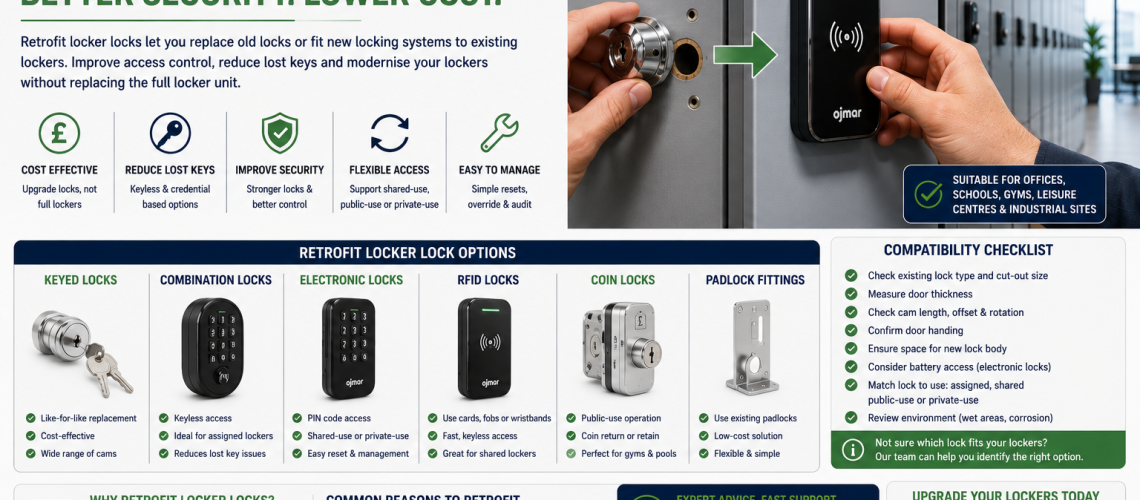
Retrofit locker locks allow existing lockers to be upgraded with new locking systems without replacing the complete locker body. Where the doors, frames and hinges remain sound, changing the locks can be a cost-effective way to reduce lost keys, introduce combination or electronic access, modernise shared lockers and extend the useful life of an existing locker installation.
Possible upgrades include like-for-like keyed locks, mechanical combination locks, electronic PIN locks, RFID access, replacement coin locks and padlock fittings. Locker locks are not universally interchangeable. Door thickness, lock cut-out, fixing method, cam position, rear clearance and operating mode all need to be checked before replacement locks are ordered.
This guide explains how to assess an existing locker bank, choose a suitable replacement lock, check physical compatibility and decide whether retrofitting or replacing the lockers is the better option.
Quick Answer: Can Existing Locker Locks Be Replaced?
Often, yes. Existing locker locks can frequently be replaced or upgraded if the locker door, frame and hinges are still in good condition and the proposed lock is compatible with the existing door preparation.
The main checks are:
- existing lock type;
- door material;
- door thickness;
- lock cut-out size and shape;
- fixing-hole positions;
- cam length and offset;
- cam rotation;
- door handing;
- space behind the lock;
- battery access for electronic locks;
- and whether the locker is assigned, shared, public-use or private-use.
Do not order a complete batch of replacement locks until one lock has been physically checked and tested on the existing locker.
Why Retrofit Locker Locks Instead of Replacing the Lockers?
Locker cabinets can remain serviceable for many years even when the original locking system is no longer suitable.
Common reasons for upgrading the locks include:
- large numbers of lost locker keys;
- obsolete lock types;
- poor availability of replacement keys;
- changing from assigned to shared locker use;
- removing coin operation;
- introducing combination locks;
- introducing electronic PIN access;
- introducing RFID access;
- improving master-key control;
- standardising several different lock types;
- and extending the useful life of the existing lockers.
If the locker bodies, doors and hinges remain sound, replacing only the locks can avoid unnecessary disruption and the cost of removing and replacing a complete locker installation.
When Should the Complete Locker Be Replaced Instead?
A new lock does not repair a structurally poor locker.
Replacement of the complete locker may be more appropriate where there is:
- severe corrosion;
- damaged or distorted doors;
- failed hinges;
- significant cabinet distortion;
- repeated door-alignment problems;
- extensive damage around the lock opening;
- unsuitable compartment sizes;
- or a wider requirement to change the locker configuration.
The condition of the cabinet should therefore be assessed before investing in a large retrofit programme.
Step 1: Identify the Existing Locker Lock
Start by identifying what is currently installed.
- Keyed cam lock
- Master-keyed cam lock
- Padlock fitting
- Mechanical combination lock
- Electronic combination lock
- RFID lock
- Coin-return lock
- Coin-retain lock
- Token lock
- Hasp fitting
- Manufacturer-specific locking system
If the lock cannot be identified, photographs of the front, rear, cam, fixing and any visible markings can help determine the available replacement options.
Total Locker Service can help identify unknown locker locks and replacement parts. Use our locker lock and part identification service.
Step 2: Record the Existing Door Preparation
The existing door preparation often determines how simple the conversion will be.
Record:
- the size of the lock opening;
- the shape of the cut-out;
- fixing-hole positions;
- door thickness;
- door material;
- existing reinforcement plates;
- rear clearance;
- and the position of the locker frame relative to the lock.
A replacement lock that fits through the visible front opening may still be unsuitable if the rear fixing, lock body or cam does not fit the existing door.
Door Thickness
Door thickness is one of the most important retrofit measurements.
Metal locker doors are generally thinner than laminate or timber locker doors. Electronic locks may also have different fixing requirements from conventional cam locks.
Measure the complete material through which the lock must be fitted, including any:
- metal skin;
- laminate;
- timber;
- reinforcement plate;
- mounting bracket;
- or adaptor plate.
Lock Cut-Out Size and Shape
Locker locks use different hole and cut-out arrangements.
A replacement may require:
- the existing hole to be reused;
- a small amount of additional drilling;
- an adaptor plate;
- a conversion plate;
- or a completely different door preparation.
Where a large number of lockers are involved, modifying every door can add substantial installation time. Lock compatibility should therefore be considered before the product is selected.
Door Reinforcement and Condition
The area around the existing lock should be inspected before fitting a new lock.
Look for:
- distortion around the lock hole;
- cracking around laminate or timber doors;
- oversized previous drillings;
- loose reinforcement plates;
- corrosion;
- and evidence that the old lock has been forced.
Where the door remains fundamentally sound, an adaptor or reinforcement plate may sometimes provide a suitable mounting surface for the replacement lock.
A badly damaged door should be repaired or replaced rather than relying on the new lock to compensate for structural damage.
Step 3: Check the Existing Cam or Latch Arrangement
The lock does not simply need to fit the hole. It must also engage correctly with the locker frame.
Check:
- cam length;
- cam offset;
- cam shape;
- cam rotation;
- locking direction;
- frame position;
- and the amount of engagement required.
Cam Length
A cam that is too short may not engage with the locker frame. A cam that is too long can interfere with the cabinet or fail to rotate correctly.
Do not assume the cam supplied with a new lock automatically matches the old one.
Cam Offset
Some locker doors require a straight cam while others use an offset or cranked cam.
The offset controls how the cam aligns with the locker frame once the door is closed.
Cam Rotation
Check whether the existing lock rotates clockwise or anticlockwise to secure the door and whether the proposed replacement can be configured appropriately.
Door Handing
Some lock installations depend on whether the locker door is left-hand or right-hand hung.
Where several locker configurations exist on the same site, check whether the proposed lock and cam can accommodate both arrangements.
Step 4: Check Rear Clearance
Electronic and combination locks can have a much larger body behind the locker door than a conventional keyed cam lock.
Check for interference with:
- shelves;
- internal dividers;
- door stiffeners;
- locker frame sections;
- stored items;
- hinges;
- and adjacent lock components.
Open and close the test door fully after installing the replacement lock.
Step 5: Decide What You Want the New Lock to Achieve
Do not change lock technology without identifying the operational problem first.
| Existing problem | Possible retrofit direction |
|---|---|
| Too many lost keys | Mechanical combination, PIN or RFID |
| Difficult master-key control | New keyed suite or controlled electronic access |
| Coin locks no longer wanted | Hasp, padlock, key, combination or electronic conversion |
| Lockers changing from assigned to shared use | Public-use combination, PIN or RFID system |
| Staff already carry access cards | Compatible RFID system |
| Existing lock model obsolete | Compatible modern replacement |
| Several different lock types across the site | Standardised replacement programme where practical |
Replacing Keyed Locker Locks Like for Like
The simplest retrofit may be replacing a worn or obsolete keyed lock with another keyed cam lock.
This can be appropriate where:
- users are permanently assigned;
- key administration works adequately;
- electronic access provides little benefit;
- the existing locker condition is good;
- and a compatible modern lock is available.
A new keyed system can also provide an opportunity to standardise key series or master-key arrangements.
See our locker lock range for current replacement options.
Converting Keyed Lockers to Mechanical Combination Locks
Mechanical combination locks can remove ordinary user keys without introducing batteries or electronic administration.
They can suit:
- staff lockers;
- schools;
- universities;
- changing rooms;
- and other assigned or shared applications depending on the lock.
Check whether the proposed lock is intended for private use, where one user keeps the same code, or public use, where the locker is released for different users.
Retrofitting Electronic PIN Locker Locks
Electronic PIN locks can provide keyless access with more flexibility than many traditional mechanical systems.
They may support:
- assigned users;
- shared users;
- temporary users;
- management override;
- code reset;
- and different operating modes depending on the product.
Before retrofitting, check the lock dimensions, door thickness, rear clearance, battery access and cam or latch arrangement.
Battery-Powered Electronic Locker Locks
Many retrofit electronic locker locks are battery powered.
This can be an advantage when upgrading existing locker banks because electrical cabling may not be required to every door.
- Less disruption to existing locker banks
- No requirement to route power cables through every locker
- Simpler phased installation
- Practical conversion of isolated locker banks
Battery-powered locks do, however, require a maintenance plan.
- Identify the battery type.
- Establish expected service intervals.
- Check whether low-battery warnings are provided.
- Make sure batteries can be reached easily.
- Define who is responsible for changing them.
- Confirm how authorised access is obtained if a battery is exhausted.
Hardwired Electronic Locker Locks
Some electronic and smart locker systems use wired power and communication instead of relying solely on batteries at each door.
This may suit installations where:
- a new locker installation is already being wired;
- central management is required;
- live locker status is required;
- high-frequency use would create excessive battery servicing;
- or the wider smart locker platform requires networked hardware.
Hardwired retrofit work can be more disruptive because power, controllers and communication routes may need to be incorporated into an existing locker installation.
Battery-Powered vs Hardwired Retrofit
| Factor | Battery-powered | Hardwired |
|---|---|---|
| Installation disruption | Usually lower | Usually higher |
| Electrical cabling | Usually not required to each lock | Normally required |
| Routine maintenance | Battery replacement | Electrical and system maintenance |
| Central connectivity | Depends on system | Often easier to incorporate |
| Existing locker retrofit | Often practical | May require greater modification |
Retrofitting RFID Locker Locks
RFID locker locks allow compatible cards, fobs or wristbands to operate the locker.
They can be particularly useful where users already carry staff access cards, student cards, membership cards, key fobs or leisure wristbands.
Before converting a large locker bank to RFID, confirm both physical lock compatibility and credential compatibility.
For detailed RFID guidance, see RFID Locker Locks UK.
Can Existing Staff Cards Be Used?
Possibly, but compatibility should never be assumed.
Existing cards may use different RFID technologies and formats. Identify the current credential and confirm compatibility with the proposed locker lock before purchasing equipment.
Converting Coin Locks
Older leisure and changing-room lockers may still use coin-operated locks even where the organisation no longer wants to manage coins or tokens.
Possible conversions include:
- hasp and padlock fittings;
- key locks;
- mechanical combination locks;
- electronic PIN locks;
- and RFID systems.
Total Locker Service also manufactures conversion components where required. Given a suitable existing lock and locker arrangement, we can assess whether a conversion plate or fitting can be produced to install a different locking system.
See our locker lock conversion products for examples.
Converting to Padlock Operation
A padlock conversion can be a straightforward option where users are expected to provide or manage their own padlocks.
Procedures are still needed for:
- abandoned padlocks;
- lost padlock keys;
- forgotten combinations;
- locker clearance;
- and authorised management access.
Public-Use vs Private-Use Locks
| Mode | How it works | Typical application |
|---|---|---|
| Private use | One person retains access to the same locker | Staff, pupils and assigned storage |
| Public use | Different people use the locker at different times | Gyms, leisure centres and shared storage |
A private-use electronic or combination lock is not automatically suitable for a high-turnover public locker simply because the hardware fits the door.
Wet-Area Locker Lock Retrofits
Swimming pools, leisure centres and wet changing rooms require additional checks.
- Confirm the proposed lock is suitable for the environment.
- Check manufacturer guidance for moisture exposure.
- Consider corrosion-resistant components.
- Check whether gaskets or additional protection are required.
- Review battery and electronic component access.
- Inspect the existing locker door for corrosion before retrofitting.
Do not assume every electronic or RFID locker lock is suitable for a wet area.
Standardising Locker Locks Across a Site
Locker estates often accumulate several different lock types over time as products are replaced individually.
A planned retrofit programme provides an opportunity to reduce unnecessary variation.
- Reduce the number of spare lock models required.
- Reduce the number of different master keys.
- Reduce the range of batteries held.
- Simplify staff training.
- Reduce the number of programming tools required.
- Simplify replacement-parts identification.
Standardisation should not be forced where different applications genuinely require different locking systems.
Test One Locker Before Converting the Whole Bank
- Select a representative locker.
- Remove the existing lock.
- Measure the door preparation.
- Fit the proposed replacement.
- Check the front mounting.
- Check rear clearance.
- Check cam or latch engagement.
- Open and close the door repeatedly.
- Test management override.
- Check battery access where applicable.
- Confirm the user operating mode.
- Only then approve the lock for wider rollout.
A small dimensional problem repeated across 100 or 500 locker doors can become a major installation problem.
Maintaining Locker Access During the Retrofit
Large retrofit projects should be planned so users retain access to essential storage while work is taking place.
- Work one locker bank at a time.
- Work one department or changing area at a time.
- Provide temporary lockers where necessary.
- Issue temporary keys or credentials where appropriate.
- Work outside peak use periods where practical.
- Clearly identify lockers that are temporarily unavailable.
- Maintain authorised management access throughout the work.
Phased Locker Lock Upgrades
A complete estate does not necessarily need to be converted at once.
- Target the areas causing the greatest administration first.
- Reduce initial capital cost.
- Limit disruption.
- Test the new system under real conditions.
- Identify maintenance requirements.
- Use the first phase to improve later phases.
Existing keyed, combination and electronic locks can operate alongside newer systems while the estate is upgraded gradually.
For mixed-estate planning, see Hybrid Locker Estates UK.
Maintenance After an Electronic Retrofit
The retrofit project is not complete when the final lock has been installed. The new system needs an ongoing maintenance process.
- battery replacement;
- code reset;
- credential replacement;
- management-key control;
- software administration where applicable;
- spare locks;
- replacement cams;
- replacement fixing components;
- and staff training.
Where a large number of identical locks is being installed, identify the likely spare-parts requirement at the same time.
Whole-Life Cost of a Locker Lock Retrofit
Compare retrofit systems using more than the purchase price of the individual lock.
- locks;
- cams or latches;
- conversion plates;
- door modification;
- installation labour;
- replacement keys;
- programming cards or tools;
- batteries;
- software where applicable;
- maintenance;
- replacement parts;
- and user administration.
A more expensive lock can sometimes reduce administrative work, while a simple keyed or mechanical lock may remain more economical where users rarely change.
Retrofit vs Complete Locker Replacement
| Existing condition | Likely direction |
|---|---|
| Good cabinets, obsolete locks | Retrofit strongly worth considering |
| Good cabinets, high key-management workload | Consider new lock technology |
| Good lockers, coin system no longer required | Consider conversion |
| Mixed old locks, good cabinets | Consider standardisation |
| Damaged doors but sound cabinets | Assess replacement doors and locks |
| Extensive corrosion and structural damage | Complete replacement likely stronger |
| Locker sizes no longer meet user requirements | Complete replacement may be preferable |
Common Locker Lock Retrofit Mistakes
- Ordering locks before measuring the existing door.
- Checking only the front hole and ignoring the rear mechanism.
- Ignoring door thickness.
- Ignoring cam length.
- Ignoring cam offset.
- Ignoring rotation direction.
- Ignoring door handing.
- Ignoring rear clearance.
- Choosing private-use locks for shared lockers.
- Choosing public-use locks without understanding reset operation.
- Assuming existing RFID cards will automatically work.
- Installing electronic locks without planning battery changes.
- Ignoring door reinforcement and existing damage.
- Replacing locks on locker bodies that are beyond economical repair.
- Ordering a large batch before testing one lock.
- Failing to plan user access during the conversion.
- Introducing unnecessary additional lock models across one site.
Locker Lock Retrofit Checklist
- What locker make or range is installed?
- What lock is currently fitted?
- What problem is the retrofit intended to solve?
- Are the locker cabinets structurally sound?
- Are the doors in good condition?
- Is reinforcement required?
- What is the door material?
- What is the door thickness?
- What size is the existing lock cut-out?
- Where are the fixing holes?
- What cam length is required?
- Is a cam offset required?
- Which way does the cam rotate?
- Are doors left or right handed?
- How much clearance exists behind the lock?
- Are lockers assigned or shared?
- Is private or public-use operation required?
- Is master or management override required?
- Are existing access cards to be retained?
- Has RFID compatibility been confirmed?
- Is battery power acceptable?
- Would hardwired access provide a genuine advantage?
- Who will change batteries?
- Is the environment wet, humid or corrosive?
- Has one test lock been fitted?
- How will locker access be maintained during installation?
- Can replacement lock models be standardised?
- Are spare parts available?
- Would complete locker replacement actually be more economical?
Step-by-Step Locker Lock Retrofit Process
- Identify the existing lockers.
- Identify the existing locks.
- Inspect cabinet and door condition.
- Define the reason for changing the lock.
- Determine assigned or shared operation.
- Measure door thickness.
- Measure the existing lock opening.
- Record fixing-hole positions.
- Measure the existing cam.
- Record cam rotation and door handing.
- Check rear clearance.
- Assess any door reinforcement requirement.
- Compare suitable replacement lock types.
- Check environmental suitability.
- Check battery or power requirements.
- Confirm credential compatibility where RFID is involved.
- Select one representative locker.
- Fit one test lock.
- Test the door repeatedly.
- Test user access.
- Test management override.
- Check servicing and battery access.
- Review installation time.
- Plan user access during the wider conversion.
- Standardise the lock model where practical.
- Roll out in controlled phases.
- Keep suitable spare locks and components.
- Review the new system after installation.
Related Locker Lock Guides
- Locker Locks
- Replacement Locker Keys
- How to Choose the Right Locker Locking System
- RFID Locker Locks UK
- Locker Access Control Systems UK
- Smart Locker Systems UK
- Hybrid Locker Estates UK
- Electronic Locker Locks UK
- Locker Lock Conversion Products
- Identify a Locker Lock or Part
Retrofit Locker Locks FAQs
Can I replace the locks on existing lockers?
Often, yes. Replacement is normally possible where the locker door and cabinet remain sound and a compatible lock or conversion method is available.
Can keyed lockers be converted to combination locks?
Many keyed lockers can be converted to mechanical or electronic combination locks, but door thickness, lock cut-out, fixing method, cam position and rear clearance should be checked first.
Can keyed lockers be converted to RFID access?
Many existing lockers can accept RFID locks, but both the physical door compatibility and the RFID credential technology should be confirmed before the locks are ordered.
Are battery-powered electronic locks easier to retrofit than hardwired locks?
They often can be because power cabling may not need to be routed to every locker. Battery-powered locks do, however, require a planned battery replacement and emergency-access procedure.
Can coin-operated lockers be converted to another lock type?
Often, yes. Depending on the existing locker and coin-lock arrangement, possible conversions include hasp fittings, keyed locks, combination locks and electronic access systems.
Why is door thickness important when replacing locker locks?
The replacement lock fixing must accommodate the complete door thickness. A lock designed for a thin metal door may not fit a thicker laminate or timber locker door without a different fixing arrangement.
Why does cam length matter?
The cam needs to engage correctly with the locker frame. A cam that is too short may not lock the door, while an excessively long or incorrectly offset cam may interfere with the cabinet.
Should one lock be tested before replacing a complete locker bank?
Yes. Fitting and testing one representative lock can confirm the door preparation, cam engagement, rear clearance, operating mode and servicing access before a larger quantity is ordered.
Can different lock types be used in the same locker estate?
Yes. Keyed, combination, RFID and electronic locks can operate within the same organisation. Where practical, reducing unnecessary variation can make spare parts, maintenance and administration easier.
When should lockers be replaced instead of retrofitted?
Complete replacement may be more appropriate where cabinets or doors are severely corroded, structurally damaged, badly distorted or no longer provide suitable storage dimensions for the users.
Upgrade the Lockers You Already Have
Replacing locker locks can be a practical way to modernise an existing installation without unnecessarily replacing sound locker cabinets.
The key is to treat the project as a compatibility exercise rather than simply choosing a preferred lock. Measure the existing door, identify the cam or latch arrangement, check rear clearance and understand whether the lockers need assigned, shared, keyed, combination, electronic or RFID access.
For larger electronic upgrades, compare battery-powered and hardwired options, plan how users will retain locker access during installation and standardise replacement lock models where doing so genuinely simplifies maintenance.
For replacement products, browse our locker locks. If the existing lock is difficult to identify, use our locker lock and part identification service.
For help identifying an existing locker lock, checking retrofit compatibility or designing a lock conversion, call Total Locker Service on 01284 749211 or email sales@totallocker.co.uk.
Discover more from Blog Total Locker Service
Subscribe to get the latest posts sent to your email.