Locker Lock Cost UK: Purchase, Maintenance and Lifecycle Comparison
May 8, 2026
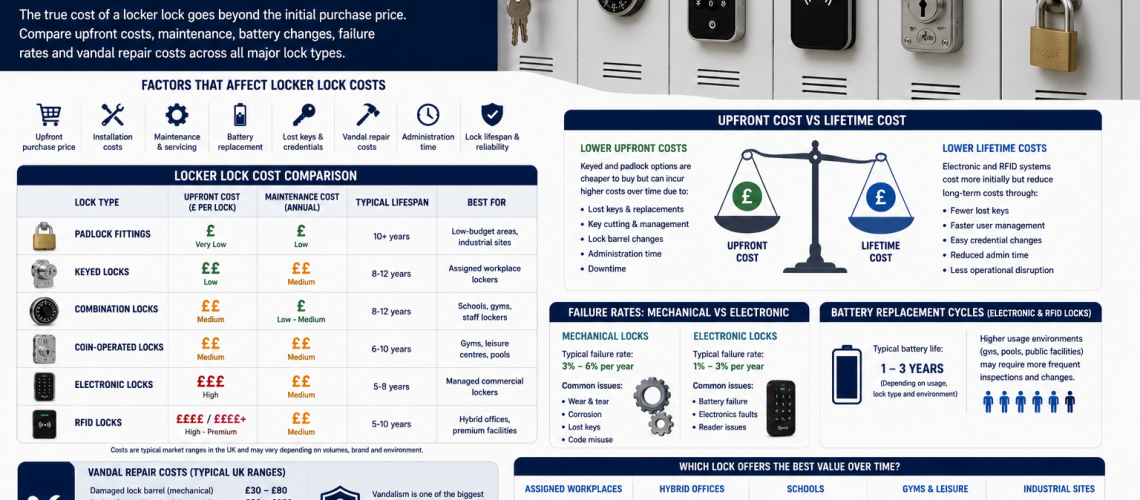
Locker lock cost should focus on the physical locking hardware and the cost of keeping that hardware serviceable. That includes the lock itself, keys or credentials where they are part of the lock, barrels, cams, batteries, fitting labour, replacement parts, damage repair and lock-level maintenance.
This guide does not decide which access technology is best, whether RFID or smart lockers justify their additional cost, or what a complete connected access system costs. Those questions belong in separate guides so the lock-cost page can remain a clear hardware-cost reference.
For complete system cost including software, integrations, administration and support, use Locker Access System Cost Guide UK. For choosing the access technology itself, use Locker Access Control Systems UK.
Locker Lock Cost = physical lock ownership cost. Access System Cost = complete operational and system cost.
Quick Answer: What Does a Locker Lock Cost Comparison Include?
A useful locker lock cost comparison should include the purchase price of the lock and the physical costs required to keep it working over the chosen comparison period.
| Cost area | Examples |
|---|---|
| Lock hardware | Keyed lock, hasp, combination lock, coin lock, electronic lock or RFID lock |
| Fitting | Lock removal, fitting, drilling, cam adjustment or door modification |
| Keys / physical credentials | User keys, master keys, replacement keys, cards or fobs where supplied with the lock |
| Replacement parts | Barrels, cams, fixings, battery covers, readers or lock bodies |
| Battery materials | Batteries required by electronic or RFID locks |
| Maintenance labour | Servicing, adjustment, reset and physical replacement work |
| Damage repair | Forced-entry, misuse, vandal damage or worn components |
What This Page Owns, and What It Hands Off
- Physical locker-lock purchase, fitting, batteries, parts, repair and replacement cost: this page
- Complete system cost including software and administration: Locker Access System Cost Guide UK
- Which lock or credential technology to choose: Locker Access Control Systems UK
- Whether smart access justifies extra investment: Smart Lockers UK: Investment Guide
- Physical lock compatibility and retrofit checks: Locker Lock Compatibility Guide UK
- Key issue, replacement and master-key processes: Locker Key Management Systems UK
- RFID lock technology: RFID Locker Locks UK
- Lock maintenance procedure: Locker Lock Maintenance Guide UK
Use Supplier Pricing, Not Generic Price Bands
Locker lock prices vary by manufacturer, model, quantity, lock function, finish, environment and installation requirement. Generic “low”, “medium” and “high” price labels can be useful only as rough relative categories and should not replace current supplier quotations.
For an actual project, compare quoted prices on the same basis:
- Same quantity
- Same lock mode
- Same credential requirement
- Same level of override capability
- Same installation scope
- Same spare-parts allowance
- Same maintenance period
Keyed Locker Lock Costs
Keyed cam locks are usually simple to purchase, fit and replace. Physical cost items can include:
- Lock barrel
- Cam
- Fixing nut or clip
- User keys
- Spare keys
- Master key where the system supports one
- Replacement barrel
- Replacement key cutting
- Fitting labour
The lock-level cost page should record those hardware and replacement costs. The wider administrative burden of issuing, collecting and controlling keys belongs in Locker Key Management Systems UK.
Hasp and Padlock Fitting Costs
A hasp fitting can be one of the simplest locker-locking options because the locker itself only needs the hasp hardware. The padlock may be supplied by the organisation or by the user.
- Hasp fitting
- Fixing hardware
- Installation labour
- Organisation-supplied padlock where applicable
- Replacement hasp after damage
- Authorised padlock removal where a lock is lost or abandoned
The cost model should state clearly whether padlocks are included or user supplied.
Mechanical Combination Lock Costs
Mechanical combination locks remove the ordinary user key but introduce their own physical and servicing costs.
- Combination lock body
- Cam and fixing hardware
- Installation
- Manager key where supported
- Reset tool where required
- Replacement lock after wear or misuse
- Physical reset / servicing labour
Do not assume a combination lock automatically has lower whole-life cost than a keyed lock. Lost-key cost may fall, but reset, misuse or replacement workload can still be material.
Coin and Token Locker Lock Costs
Coin and token locks include more mechanical components than a basic keyed cam lock and may require additional servicing depending on use.
- Coin / token lock mechanism
- User key
- Management key
- Coin tray or collection component where applicable
- Replacement barrels or cams
- Jam clearance
- Mechanical servicing
- Replacement lock mechanism
For public-use sites, frequency of use and environmental exposure can materially affect physical maintenance cost.
Electronic PIN Lock Costs
Electronic PIN locks usually have a higher hardware cost than basic keyed or mechanical combination locks because the lock contains electronics, keypad components and a power source.
- Electronic lock body
- Keypad
- Battery compartment
- Batteries
- Manager key or programming tool where supported
- Replacement keypad or lock body
- Battery-cover components
- Fitting and setup labour
Software or connected-management cost should not be included here unless it is inseparable from the physical lock supply. Complete system cost belongs in the Locker Access System Cost Guide UK.
RFID Locker Lock Costs
RFID lock cost can include the lock body, reader, battery and physical credentials used with the lock.
- RFID lock hardware
- Reader
- Battery
- Card, fob or wristband where supplied as part of the lock package
- Management credential
- Programming or setup tool
- Replacement reader or lock
- Installation labour
Do not assume RFID automatically lowers administration or produces a lower lifetime cost. That depends on the operating model and belongs in the smart / access-system business case. For the technology itself, use RFID Locker Locks UK.
Battery Cost for Electronic and RFID Locks
Battery cost should be modelled from the actual manufacturer specification and local maintenance plan rather than a universal replacement interval.
- Battery chemistry and size
- Number of batteries per lock
- Expected service interval under the intended use
- Labour to open and replace batteries
- Travel or access time
- Out-of-hours working where required
- Emergency replacement
- Disposal requirements
Usage frequency, lock design, battery quality, temperature and environment can all affect actual battery life. Use supplier evidence and local operating data where available.
Fitting and Replacement Labour
The same lock can have very different installed cost depending on the locker door.
- Direct replacement into an existing opening
- Cam adjustment
- Spindle adjustment
- New fixing holes
- Enlarged lock cut-out
- Door reinforcement
- Removal of obsolete fittings
- Making good around old holes
Before assuming a lock can be fitted directly, use Locker Lock Compatibility Guide UK.
Replacement Barrel and Cam Costs
On many keyed locker locks, the entire locking system does not need replacing when a component wears or becomes unsuitable.
- Replacement barrel
- Replacement cam
- Replacement fixing nut
- Replacement retaining clip
- Replacement key
- Fitting labour
Availability depends on the lock family and manufacturer, so spare-part references should be retained where practical.
Replacement Key Costs
Keyed locks can generate recurring physical replacement cost where keys are lost or damaged.
- Cut-to-code replacement key
- Copied key where appropriate
- Replacement master key
- Carriage where keys are ordered remotely
- Replacement barrel where the existing key code cannot be retained
For replacement keys, use Locker Keys.
Physical Damage and Vandal Repair Costs
Damage cost should be based on the actual site rather than assumptions that one sector or lock technology will always suffer more damage.
- Forced lock barrel
- Broken keypad
- Damaged hasp
- Bent cam
- Broken reader
- Coin-lock jam
- Damaged door around the lock opening
If the locker door, frame or carcass is damaged as well as the lock, the cost may move beyond the scope of this lock-cost page and into the wider repair or lifecycle decision.
Lock Maintenance Cost
Physical lock maintenance can include inspection, adjustment, cleaning, lubrication where appropriate, battery replacement, reset and component replacement.
| Lock type | Typical physical maintenance items |
|---|---|
| Keyed | Barrel wear, cam adjustment, key replacement |
| Hasp | Hasp damage, fixing wear, padlock removal |
| Mechanical combination | Reset mechanism, wear, fixing and cam checks |
| Coin / token | Jam clearance, barrel, cam and mechanism wear |
| Electronic PIN | Battery, keypad, lock body and physical override components |
| RFID | Battery, reader, lock body and management credential hardware |
For maintenance procedure rather than cost, use Locker Lock Maintenance Guide UK.
Lock-Level Whole-Life Cost
A simple lock-level whole-life cost model can be expressed as:
Lock ownership cost = purchase + fitting + physical credentials + batteries + replacement parts + maintenance labour + damage repair + eventual lock replacement
This formula intentionally excludes software licences, central administration, integration and organisation-wide helpdesk cost. Those belong in the wider access-system cost model.
Cost per Lock
For projects with several locker banks, cost per lock can make physical options easier to compare.
Cost per lock = total physical lock ownership cost ÷ number of locks in scope
Use the same period and the same inclusions for every option.
Do Not Rank Lock Types by Generic Lifetime Cost
There is no universal “lowest lifetime cost” lock for workplaces, schools, gyms or industrial sites. The result depends on purchase price, actual use, damage, maintenance, fitting and replacement history.
A keyed lock may be inexpensive at one site and expensive at another. The same is true of combination, electronic and RFID locks. Use local evidence and quoted costs.
Do Not Assume Electronic Locks Reduce Administration
Electronic and RFID locks remove some physical key tasks but may introduce code resets, credential support, battery servicing or software administration.
Whether that results in a net saving is an access-system or investment question, not a lock-hardware conclusion. Use Locker Access System Cost Guide UK and Smart Lockers UK: Investment Guide.
Retrofit vs New Locker Lock Cost
Retrofitting a new lock onto an existing locker may be cheaper than replacing the locker, but the comparison depends on compatibility and labour.
- Direct-fit replacement
- Minor drilling
- Major door modification
- New power or cable route
- Reader positioning
- Replacement door or locker bank
The physical repair/refurbish/replace decision belongs in Locker Lifecycle Management Systems UK. This page should only provide the lock-cost input once the viable options are known.
Environment and Lock Cost
Environment can influence both purchase and maintenance cost.
- Wet or humid areas may require more suitable materials or lock constructions.
- Industrial dust may increase cleaning and servicing requirements.
- High public turnover may increase wear.
- Cold or hot conditions can affect batteries and electronic components.
- Frequent cleaning can affect exposed components.
Use the manufacturer’s stated environmental suitability rather than assuming all locks of one technology behave the same way.
Locker Lock Cost Comparison Template
| Cost field | Option A | Option B |
|---|---|---|
| Lock purchase | Enter quote | Enter quote |
| Fitting labour | Enter quote | Enter quote |
| Door modification | Enter quote | Enter quote |
| Initial keys / credentials | Enter quote | Enter quote |
| Battery materials | Enter assumption | Enter assumption |
| Replacement parts | Enter local / supplier assumption | Enter local / supplier assumption |
| Maintenance labour | Enter local assumption | Enter local assumption |
| Damage repair | Enter local evidence if available | Enter local evidence if available |
| Replacement lock allowance | Enter assumption | Enter assumption |
This table deliberately avoids invented prices. Populate it with current supplier quotations and local maintenance evidence.
Common Locker Lock Costing Mistakes
- Comparing purchase price only. Include fitting, parts and maintenance.
- Using generic price bands as project quotes. Obtain current supplier pricing.
- Assuming RFID or electronic automatically saves administration.
- Using one universal battery replacement interval. Use manufacturer and local evidence.
- Ignoring door modification. Retrofit labour can materially change cost.
- Ignoring replacement key or credential hardware.
- Mixing software licence cost into a lock-only comparison. Use the system cost guide instead.
- Ranking one lock type as the cheapest for an entire sector.
- Assuming a direct retrofit without checking compatibility.
- Using lock cost alone to decide whether the locker itself should be replaced.
- Including speculative savings as if they were proven cost reductions.
Locker Lock Cost Checklist
- What exact lock model is being priced?
- How many locks are required?
- Is the price supply-only or installed?
- Does the door need modification?
- Are cams and fixings included?
- Are initial keys or credentials included?
- Are master / manager keys included?
- Does the lock require batteries?
- What battery type and quantity are required?
- What physical spare parts are recommended?
- What maintenance labour should be allowed?
- What local damage / failure evidence exists?
- What replacement lock allowance is reasonable?
- Is software being costed separately?
- Are administration costs being kept in the wider system cost model?
- Has physical compatibility been verified?
Where Locker Lock Cost Questions Go Next
| Question | Next guide |
|---|---|
| What does the complete access system cost? | Locker Access System Cost Guide UK |
| Which lock technology should be selected? | Locker Access Control Systems UK |
| Is smart access worth paying more for? | Smart Lockers UK: Investment Guide |
| Will the lock fit the existing locker? | Locker Lock Compatibility Guide UK |
| How should physical keys be controlled? | Locker Key Management Systems UK |
| How does RFID lock technology work? | RFID Locker Locks UK |
| How should locks be maintained? | Locker Lock Maintenance Guide UK |
| Should the physical locker be repaired, refurbished or replaced? | Locker Lifecycle Management Systems UK |
Locker Lock Cost UK FAQs
What costs should be included when comparing locker locks?
Include lock purchase, fitting, door modification, keys or physical credentials, batteries, replacement parts, maintenance labour, damage repair and eventual lock replacement.
Are keyed locker locks always the cheapest option?
Not necessarily. They may have a low purchase price, but fitting, replacement keys, barrels, maintenance and local damage history all affect physical ownership cost.
Do electronic locker locks always cost more to maintain?
Not always. Electronic locks may require batteries and electronic replacement parts, while mechanical locks have their own wear, key and component costs. Compare the actual products and maintenance assumptions.
How often should electronic locker lock batteries be replaced?
There is no universal replacement interval. Use the manufacturer’s guidance and adjust the maintenance plan for actual usage, battery type and environmental conditions.
Should software licences be included in locker lock cost?
Software belongs in the wider access-system cost model rather than a physical lock-only comparison unless the charge is inseparable from the lock supply.
Can existing lockers be fitted with new locks?
Many can, but compatibility must be checked. Door material, thickness, cut-out, fixing points, cam geometry, body depth and internal clearance can all affect fitting cost.
Which locker lock has the lowest lifetime cost?
There is no universal winner. The result depends on current supplier price, fitting, actual use, maintenance, damage, batteries, parts and replacement history at the site.
Summary
Locker lock costing should remain focused on the physical locking hardware and the cost of keeping that hardware serviceable.
Keep software, central administration, integrations and organisation-wide support in the Access System Cost Guide. Keep technology selection in Access Control Systems, smart-investment justification in the Smart Locker Investment Guide and repair/refurbish/replace decisions in Lifecycle Management.
The strongest lock-cost comparison uses current supplier quotations, the same comparison period and local maintenance evidence rather than assuming one lock technology is always the cheapest.
Discover more from Blog Total Locker Service
Subscribe to get the latest posts sent to your email.