Locker Locks for High-Traffic Areas UK: Offices, Warehouses and Staff Areas
May 8, 2026
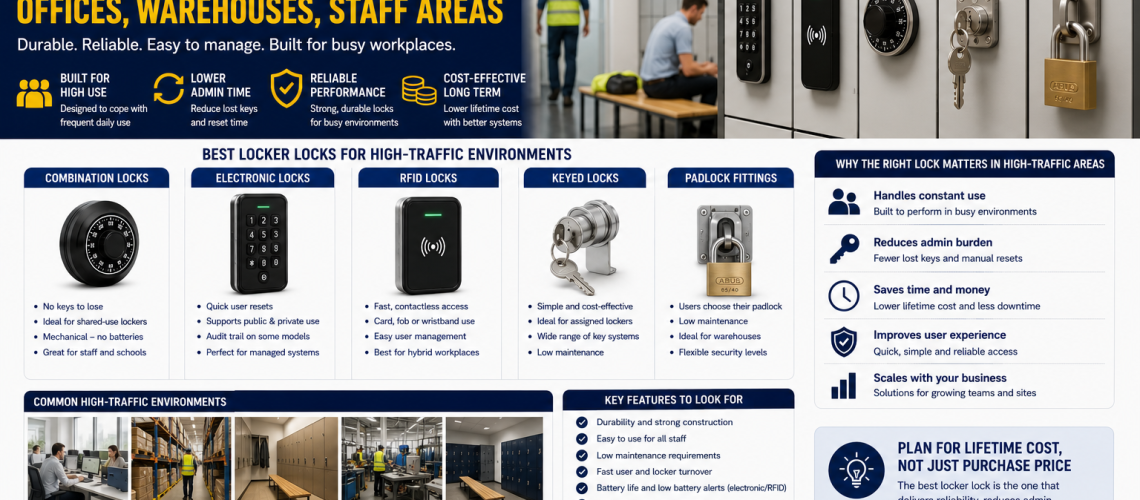
Locker locks in high-traffic areas are exposed to repeated opening cycles, frequent user turnover and sustained daily handling. The important question is not simply which lock technology is “best”, but whether the selected lock, locker door and maintenance plan are suitable for the actual duty cycle.
This guide focuses on what high usage changes: wear patterns, inspection pressure, battery demand, loose fixings, cam and latch wear, door alignment, recurring faults, spare-parts planning and the signs that a lock is no longer suitable for the level of use.
For choosing between keyed, hasp, combination, coin, PIN, RFID and other access technologies, use Locker Access Control Systems UK.
Access Control = which lock technology. High-Traffic Planning = what repeated use does to that lock and how the site should respond.
Quick Answer: What Makes a Locker Lock Suitable for High-Traffic Use?
A high-traffic locker lock should tolerate the expected frequency of use, remain serviceable in the installation environment, allow practical maintenance and use parts that can be supported over time. Suitability depends on the complete installation, not only the lock mechanism.
| High-use factor | What it can affect |
|---|---|
| Frequent opening cycles | Lock mechanism, cam, latch and fixings |
| Repeated door movement | Door alignment, hinge wear and latch engagement |
| Changing users | Handling consistency, misuse and support demand |
| Battery-powered operation | Battery consumption and service workload |
| Peak-time use | Fault impact and urgency of repair |
| Public or shared use | Wear variability and reset / release workload |
| Dirty or wet environment | Contamination, corrosion and component life |
What This Page Owns, and What It Hands Off
- Duty cycle, repeated-use wear, high-use inspection pressure and serviceability: this page
- Which access technology should be selected: Locker Access Control Systems UK
- Detailed maintenance procedure: Locker Lock Maintenance Guide UK
- Physical replacement procedure: Locker Lock Replacement Guide UK
- Physical lock ownership cost: Locker Lock Cost UK
- Compatibility before retrofit or replacement: Locker Lock Compatibility Guide UK
- Repeated-fault and maintenance-risk signals: Locker Predictive Maintenance UK
- Repair, refurbish or replace decision: Locker Lifecycle Management Systems UK
High Traffic Is a Duty-Cycle Question
“High traffic” should describe how intensively the locker is actually used, not simply the sector where it is installed.
A small staff changing room can generate more lock cycles than a much larger locker area if several shifts use the same lockers every day. Conversely, a large bank of permanently assigned lockers may experience relatively modest use.
- How many times is a typical lock opened each day?
- How concentrated is use around shift changes or peak periods?
- Are lockers assigned or repeatedly turned over?
- Do many different users operate the same lock?
- How often are locks reset, overridden or released?
- How quickly must faults be resolved?
Opening Cycles and Mechanical Wear
Repeated operation creates wear at the points that move or carry load.
- Key barrel or cylinder
- Combination mechanism
- Keypad buttons
- RFID reader surface
- Cam
- Latch
- Spindle
- Fixing nut or retaining clip
- Handle where the lock incorporates one
The lock should therefore be assessed as a mechanism with several wear points rather than as one replaceable part.
Door Alignment Matters as Much as Lock Wear
A lock can appear to be failing when the real problem is the locker door or frame.
- Door sag
- Loose hinges
- Distorted door edge
- Frame movement
- Cam striking the frame
- Latch not clearing correctly
- Users having to lift or push the door to operate the lock
High-use doors should therefore be checked together with the lock. Replacing a lock without correcting poor alignment can leave the original loading problem in place.
Cam and Latch Wear
The cam or latch transfers the lock movement into actual door retention. Repeated use can expose wear or poor adjustment.
- Bent cams
- Loose cam fixings
- Incorrect cam length
- Excessive rubbing against the frame
- Incomplete engagement
- Wear marks showing misalignment
- Latch return becoming unreliable
Where a replacement lock or cam is required, use Locker Lock Compatibility Guide UK before ordering.
Loose Fixings in Frequently Used Lockers
Repeated operation can expose weak or loosening fixings.
- Lock retaining nuts
- Clips
- Cam screws
- Handle screws
- Hinge fixings
- Reader or keypad fixings
Early movement should be investigated before the lock begins rotating in the door, the cam changes position or surrounding door material becomes damaged.
Keyed Locks Under High Use
High use does not automatically make a keyed lock unsuitable. The important factors are the quality of the lock, condition of the keys, alignment and how the locker is operated.
- Key insertion becoming rough
- Key difficult to turn
- Worn or bent keys
- Barrel movement
- Cam movement
- Increasing number of replacement-key requests
Key administration is a separate management issue. This page only treats repeated key or barrel problems as evidence relevant to the duty cycle.
Mechanical Combination Locks Under High Use
Mechanical combination locks remove ordinary user keys but still contain moving components that can wear or be misused.
- Dial or button wear
- Stiff operation
- Reset mechanism problems
- Loose lock body
- Cam or latch wear
- Repeated forgotten-code interventions
Forgotten codes are not physical wear, but frequent reset demand can increase the operational pressure on a high-turnover locker area.
Electronic PIN Locks Under High Use
Electronic keypad locks add button surfaces, electronics and batteries to the physical wear picture.
- Keypad wear
- Damaged or unresponsive buttons
- Battery warnings
- Battery-cover damage
- Lock-body movement
- Repeated reset or override events
The correct inspection plan should reflect actual use and manufacturer guidance rather than assuming all electronic locks require the same maintenance interval.
RFID Locks Under High Use
RFID removes some physical interaction with keys or keypads, but the lock still has mechanical and electronic components.
- Reader surface damage
- Credential-read problems
- Battery demand
- Door and cam wear
- Lock-body movement
- Management credential issues
Whether RFID is appropriate for the operating model belongs in Locker Access Control Systems UK. This page only considers how repeated use affects serviceability once that technology has been selected.
Coin and Token Locks Under High Use
Coin and token systems can experience repeated mechanical operation and contamination from high public turnover.
- Coin or token jams
- Key wear
- Return-mechanism wear
- Cam wear
- Debris in the mechanism
- Loose or damaged components
Where the site relies on rapid public turnover, a small number of recurring faults can create disproportionate operational disruption.
Battery Demand in High-Use Electronic Locks
Battery planning should use the actual lock specification and local usage pattern. High use can increase energy demand on some products, but there is no universal replacement interval that applies to every locker lock.
- Record battery type.
- Record replacement date where practical.
- Record low-battery warnings.
- Track premature battery replacements.
- Compare similar locks in similar locations.
- Investigate recurring early battery failure rather than simply shortening every interval.
Physical battery cost belongs in Locker Lock Cost UK.
Inspection Frequency Should Follow Evidence
High-use areas usually justify more attention than rarely used lockers, but inspection frequency should be based on actual operating evidence rather than a universal timetable copied across every site.
- Usage intensity
- Fault frequency
- Previous maintenance history
- Environmental exposure
- Criticality of access
- Availability of spare lockers
- Manufacturer recommendations
For detailed inspection and maintenance tasks, use Locker Lock Maintenance Guide UK.
High Traffic vs High Risk
High traffic and high security are different requirements.
A lock can be operated frequently without protecting particularly high-value contents. Equally, a low-use locker can require a higher security level. Do not use usage intensity as a substitute for a security assessment.
High Traffic vs Harsh Environment
Repeated use is also different from environmental exposure.
| Pressure | Examples |
|---|---|
| High traffic | Repeated opening, many users, shift turnover |
| Wet environment | Humidity, splashing, cleaning chemicals |
| Industrial environment | Dust, dirt, impact, gloves |
| High security | Greater consequence of unauthorised access |
A site can have more than one of these pressures at once. The specification should record them separately.
Peak-Time Fault Impact
The same lock fault can have a different operational impact depending on when and where it occurs.
- A single failed staff locker in a quiet office may have limited wider impact.
- A failed shared-use locker bank at a shift change can affect many users.
- A jammed public-use lock may require immediate staff intervention.
- A battery failure in a critical staff-changing area may need a rapid fallback route.
High-traffic planning should therefore consider both failure frequency and operational consequence.
Representative Testing Before a Large Installation
Where a lock is being introduced into a demanding high-use environment, a representative trial can reduce risk.
- Fit the proposed lock to the actual locker door.
- Confirm cam or latch engagement.
- Check user operation.
- Check manager or override operation.
- Observe behaviour during peak use.
- Record support interventions.
- Inspect fixings and alignment after repeated use.
- Review battery behaviour where applicable.
For the technical replacement sequence, use Locker Lock Replacement Guide UK.
Keep Critical Spare Parts Where Failure Has High Impact
High-traffic areas can justify holding a small stock of known-compatible parts where downtime is operationally disruptive.
- Replacement lock bodies
- Cams
- Fixings
- Keys or management keys
- Batteries
- Battery covers
- Reader or keypad components where separately replaceable
The correct quantity should follow local fault history, lead times and the number of installed locks rather than an arbitrary percentage.
Record Recurring Faults
A one-off fault and a repeated pattern should not be treated the same way.
- Locker or lock ID
- Location
- Fault type
- Date
- Repair action
- Part replaced
- Previous occurrence
- Observed environmental or usage context
Where repeated evidence begins to show a maintenance-risk pattern, hand the interpretation to Locker Predictive Maintenance UK.
Signs a Lock May Be Unsuitable for the Duty Cycle
- Repeated failure of the same component
- Frequent loose fixings
- Recurring cam or latch problems
- Premature battery replacement compared with similar installations
- Repeated keypad or reader damage
- Users regularly needing abnormal force to operate the lock
- Repeated reset or release interventions
- Repair frequency increasing over time
- Spare parts becoming difficult to obtain
- Maintenance workload becoming disproportionate to the number of lockers
These are investigation triggers, not automatic proof that the technology should be replaced.
Do Not Turn High-Traffic Evidence Into an Automatic Upgrade Decision
High usage can reveal that a lock is wearing quickly, but this page should not decide whether the correct response is maintenance, like-for-like replacement, retrofit, refurbishment or full locker replacement.
Use Locker Lifecycle Management Systems UK for the intervention decision.
Do Not Assume Electronic Access Solves High-Traffic Problems
Electronic access can remove some key-related tasks, but it can introduce batteries, credentials, electronics, software or different support requirements.
Whether the trade-off is worthwhile depends on the operating model. Use Locker Access Control Systems UK for technology selection and Smart Lockers UK: Investment Guide where the question is whether additional smart capability is worth buying.
High-Traffic Workplaces and Offices
Busy workplaces can create concentrated locker use at arrival, departure and shift-change periods. The important evidence is how frequently lockers are used, how many users share them and how quickly faults need to be resolved.
A workplace does not automatically require RFID or electronic locks simply because attendance is flexible. The selected access method should follow the operating requirement.
High-Traffic Warehouses and Industrial Sites
Industrial sites can combine high opening frequency with dust, impact, gloves and shift turnover. These pressures should be documented separately so a lock is not chosen only for access convenience while environmental suitability is overlooked.
High-Traffic Staff Changing Rooms
Changing rooms can create short periods of very intense use. Door alignment, lock operation and rapid fault resolution can matter as much as headline lock features.
High-Traffic Leisure and Public-Use Areas
Leisure and public-use areas may combine repeated use with wet conditions and changing users. Separate the duty-cycle requirement from moisture resistance, public-use operating mode and access technology so each can be specified properly.
High-Traffic Locker Maintenance Checklist
- Is actual usage intensity understood?
- Are peak-use periods known?
- Are recurring lock faults recorded?
- Are door alignment and hinges checked with the lock?
- Are cams and latches checked for wear?
- Are loose fixings identified early?
- Are batteries tracked where applicable?
- Are premature battery failures investigated?
- Are high-impact spare parts available?
- Are maintenance intervals based on evidence and manufacturer guidance?
- Are representative locks tested before large-scale changes?
- Are repeated faults handed to predictive-maintenance analysis?
- Are technology-selection decisions kept with Access Control?
- Are repair/refurbish/replace decisions kept with Lifecycle?
Common High-Traffic Locker Lock Mistakes
- Calling one lock technology “best” for every busy site.
- Treating sector as a substitute for actual duty cycle.
- Looking only at the lock and ignoring door alignment.
- Using a universal battery-change interval.
- Assuming high traffic means high security.
- Assuming high traffic means harsh environment.
- Replacing repeated-failure locks without checking the root cause.
- Failing to record recurrence.
- Keeping no compatible spares where faults have high operational impact.
- Assuming RFID or electronic access will automatically reduce administration.
- Using this page to decide the lifecycle intervention.
Where High-Traffic Locker Lock Questions Go Next
| Question | Next guide |
|---|---|
| Which lock technology should be used? | Locker Access Control Systems UK |
| How should the lock be maintained? | Locker Lock Maintenance Guide UK |
| How is a worn or failed lock replaced? | Locker Lock Replacement Guide UK |
| Will a replacement lock fit? | Locker Lock Compatibility Guide UK |
| What does the physical lock cost to own? | Locker Lock Cost UK |
| Do repeated faults indicate increasing maintenance risk? | Locker Predictive Maintenance UK |
| Should the locker be maintained, repaired, refurbished or replaced? | Locker Lifecycle Management Systems UK |
| Is additional smart capability worth the investment? | Smart Lockers UK: Investment Guide |
High-Traffic Locker Locks UK FAQs
What makes a locker lock suitable for high-traffic use?
It should be suitable for the expected opening frequency, user behaviour, environment and maintenance capability, with compatible parts and practical servicing available.
Are RFID locks always better for high-traffic areas?
No. RFID can suit some operating models, but high traffic alone does not determine the correct access technology. The lock must also suit the users, environment, administration and support model.
What causes locker locks to wear in busy areas?
Repeated opening cycles can wear lock mechanisms, cams, latches and fixings. Door misalignment, dirt, misuse and environmental exposure can add further loading.
Should high-traffic locker locks be inspected more often?
Often yes, but the interval should reflect actual usage, fault history, environment, operational impact and manufacturer guidance rather than a universal timetable.
How often should batteries be replaced in high-use electronic locker locks?
There is no universal interval. Use manufacturer guidance and local evidence such as usage level, low-battery warnings and previous replacement history.
Does repeated lock failure mean the locker should be replaced?
Not automatically. Repeated faults should trigger investigation into the lock, door alignment, compatibility, environment and maintenance history. The repair, refurbish or replace decision belongs in the lifecycle process.
Should spare locker locks be held for busy sites?
Compatible spares can be useful where failures have a high operational impact. Stock levels should reflect fault history, installed quantity and replacement lead time.
Summary
High-traffic locker lock planning should focus on actual duty cycle, repeated-use wear, door alignment, cams, latches, fixings, battery demand, recurring faults and the maintenance capability needed to keep the installation usable.
Keep technology selection with Access Control Systems, detailed servicing with Locker Lock Maintenance, physical replacement with the Replacement Guide, compatibility with the Compatibility Guide, cost with Locker Lock Cost and repeated-fault interpretation with Predictive Maintenance.
The strongest high-traffic specification is not “use the most advanced lock”. It is “use a lock and maintenance model that can reliably tolerate the actual level of use”.
Discover more from Blog Total Locker Service
Subscribe to get the latest posts sent to your email.