Break-Time Flow Management in Schools: Reducing Corridor Congestion
May 11, 2026
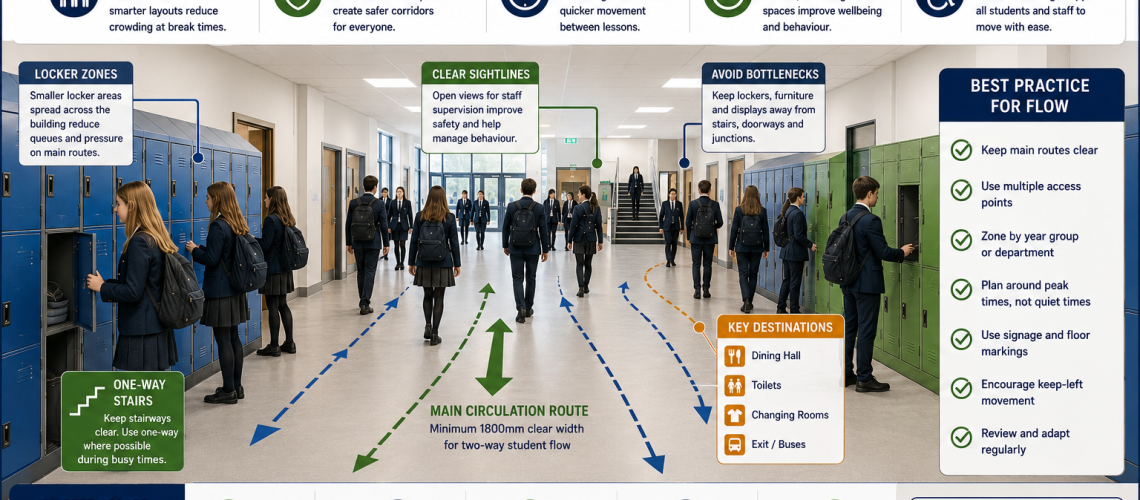
Break-time flow management helps schools organise pupil movement during lesson changes, morning breaks, lunch periods and the end of the school day. Effective planning identifies where congestion develops, why pupils stop or queue, and which changes can improve movement without compromising safety, accessibility or supervision.
This UK guide explains how schools can assess peak-time movement, manage corridor bottlenecks, organise dining and toilet access, coordinate locker use, deploy supervision staff and measure whether changes have improved daily circulation.
For the wider management of student storage, see our School Locker Systems UK guide. This article concentrates on pupil movement and congestion rather than choosing or specifying lockers.
What is break-time flow management in schools?
Break-time flow management is the organisation of pupil movement through corridors, stairs, entrances, dining facilities, toilets, changing rooms and other shared areas during busy periods.
The objective is to reduce unnecessary crowding while maintaining safe access, appropriate supervision and reasonable journey times between school activities.
Good flow management does not necessarily require a building redesign. Schools can sometimes improve movement by adjusting timetables, changing the use of entrances, reviewing supervision positions or separating activities that generate queues.
When are school corridors busiest?
Congestion is often concentrated into short periods rather than spread evenly across the school day. The busiest locations and times should be identified before changes are proposed.
| Time of day | Typical movement | Potential issue |
|---|---|---|
| Morning arrival | Pupils entering, storing belongings and moving to registration | Queues at entrances and locker areas |
| Lesson changeover | Large groups moving between teaching rooms | Conflicting movement at stairs and junctions |
| Morning break | Pupils travelling to toilets, lockers, outdoor spaces and food outlets | Stopping and queuing along main corridors |
| Lunch period | Movement towards dining halls, seating, toilets and recreation spaces | Queues and cross-traffic near dining entrances |
| PE changeover | Groups entering and leaving changing rooms | Congestion around entrances and bag storage |
| End of day | Pupils collecting belongings and leaving the site | Heavy demand around exits, lockers and transport routes |
The actual pattern depends on school size, timetable, building layout, age groups and how pupils use the available facilities.
1. Identify where corridor congestion develops
The first step is to observe movement when the school is occupied. A corridor that appears spacious during lessons may become difficult to use when several classes arrive at the same time.
Look for recurring problems such as:
- Pupils stopping immediately outside classroom doors.
- Two-way movement slowing at narrow sections.
- Queues extending from dining areas into circulation routes.
- Groups gathering around locker banks during changeovers.
- Crowding at stairwell entrances and landings.
- Students waiting outside toilets or changing rooms.
- Crossing movements where several routes meet.
Record the time, location, duration and apparent cause of each problem. This helps distinguish a recurring capacity issue from an isolated incident.
2. Map pupil movement during peak periods
A simple circulation map can help schools understand how different groups use the building.
Start with a floor plan showing classrooms, corridors, stairs, entrances, dining facilities, toilets, locker areas and other locations pupils regularly visit.
Then identify:
- The principal routes between teaching areas.
- Routes used by pupils accessing dining facilities or outdoor spaces.
- Locations where pupils regularly stop.
- Junctions where opposing groups meet.
- Routes used by pupils with mobility or accessibility requirements.
- Areas where staff supervision is limited.
Review the map against the timetable. Several classes changing rooms simultaneously may create a temporary bottleneck even where the route is otherwise adequate.
The purpose of this exercise is to identify movement patterns, not simply to calculate how many pupils can fit into a corridor.
3. Reduce congestion at stairs, doors and junctions
Stairs, doorways and corridor junctions often carry movement from several directions. Congestion at these locations can affect other parts of the building as queues extend into adjoining routes.
Useful management measures may include adjusting the timing of class changes, identifying alternative routes where suitable, repositioning supervision staff and preventing unnecessary stopping in the immediate approach to these areas.
Schools should not introduce informal one-way systems, barriers or access restrictions that conflict with their fire strategy, accessibility provisions or emergency procedures.
Any significant alteration to circulation arrangements should be reviewed with the school’s responsible facilities and safety personnel.
4. Manage lesson changeover movement
Lesson changes are predictable periods of concentrated activity. Where several year groups use the same corridor or staircase, relatively small differences in timing can affect congestion.
Possible measures include:
- Reviewing whether multiple large groups are released into the same junction simultaneously.
- Adjusting classroom changeover arrangements where operationally practical.
- Using established routes consistently so pupils know where to travel.
- Positioning staff at recurring bottlenecks.
- Reviewing unnecessary journeys between distant teaching areas.
- Keeping doorways clear of waiting groups.
Changes should be trialled and evaluated before becoming permanent. A route that works for one year group may not suit another, particularly where pupil numbers or accessibility needs differ.
5. Consider staggered break and lunch arrangements
Staggering can reduce the number of pupils attempting to use the same facilities simultaneously. However, it should be considered as an operational option rather than an automatic solution.
Schools might investigate separate dining sittings, different break-time arrangements for year groups or adjusted access windows for particularly busy facilities.
| Approach | Possible benefit | Consideration |
|---|---|---|
| Staggered break periods | Reduces simultaneous corridor demand | Staffing and timetable implications |
| Separate dining sittings | Reduces peak dining entrance queues | Food-service capacity and available time |
| Year-group movement arrangements | Reduces conflicting flows at selected locations | Fairness, supervision and route availability |
| Adjusted locker-access periods | Reduces stopping at congested locker banks | Access to essential belongings |
| Alternative routes | Distributes demand across suitable circulation routes | Fire safety, accessibility and supervision |
Evaluate the effects on the complete school day. A change that reduces congestion in one corridor should not simply transfer the same problem to another location.
6. Control dining hall and food-service queues
Dining facilities can create concentrated movement because pupils arrive, queue, collect food, find seating and leave within a limited period.
A dining queue becomes a wider circulation problem when it extends into a main corridor, staircase approach or entrance route.
Schools should review where the queue begins, how it progresses, whether pupils can pass safely and whether the entrance and exit arrangements create unnecessary cross-traffic.
Possible improvements include better queue supervision, clearer waiting arrangements, adjusted release times or changes to the use of existing entry and exit points, subject to the building’s safety arrangements.
7. Account for toilets and changing-room movement
Toilets and changing rooms generate stopping and waiting activity. Pupils may arrive in groups while others are leaving, creating congestion around entrances.
Where this occurs, consider whether waiting areas obstruct circulation, whether groups are scheduled too closely together and whether supervision arrangements are appropriate for the location.
PE changeovers may require additional coordination because pupils carry bags and kit, enter changing rooms in groups and move on to sports facilities.
Physical changing-room layout and locker selection are separate design subjects. This guide focuses on managing the timing and movement of pupils entering and leaving those spaces.
8. Manage the effect of locker access on corridor flow
Locker use introduces stopping activity into school circulation. Pupils may need time to unlock a door, change books, collect bags or speak with other pupils.
Where several pupils reach the same locker bank simultaneously, the available walking route can become restricted.
Operational measures may include reviewing which year groups use particular locker areas, avoiding unnecessary concentration of locker visits and assessing whether access times contribute to recurring congestion.
Physical changes to locker positions, door-opening clearances, fixing arrangements or compartment specifications require separate layout and installation planning.
For the complete student locker management process, including allocation, access and maintenance, read our School Locker Systems UK guide.
For school locker products and configurations, see the Total Locker Service school lockers range.
9. Improve supervision during busy periods
Staff supervision can help schools identify congestion before it develops into a persistent problem. It can also support orderly movement and respond to incidents that interrupt circulation.
Supervision positions should be selected around actual movement patterns, particularly where pupils converge, queue or change direction.
- Identify locations with repeated congestion or incidents.
- Review visibility at junctions, entrances and waiting areas.
- Assign clear responsibilities to supervising staff.
- Use consistent instructions for managing temporary queues.
- Provide a clear process for reporting emerging problems.
- Review supervision coverage when timetables or room allocations change.
Supervision arrangements should complement the school’s safeguarding and behaviour policies. Visibility alone is not a substitute for appropriate staffing, reporting or incident procedures.
10. Support accessible and inclusive pupil movement
Break-time planning must consider pupils with mobility impairments, wheelchair users, pupils using walking aids and those who may find crowded or noisy spaces difficult to navigate.
A circulation plan should not assume that every pupil travels at the same speed, uses the same entrance or can comfortably manage a crowded route.
Schools should consider:
- Keeping designated accessible routes unobstructed.
- Ensuring queuing arrangements do not obstruct access.
- Allowing sufficient time for pupils who need it.
- Reviewing routes to accessible toilets and other facilities.
- Providing suitable alternatives where particular routes become overcrowded.
- Consulting relevant staff and pupils when assessing practical difficulties.
Actual circulation dimensions and accessibility provisions should be checked against the applicable building requirements and the school’s circumstances. A single suggested corridor width is not a reliable substitute for a site-specific assessment.
11. Measure corridor congestion before and after changes
Schools can assess whether a proposed improvement works by observing the same location during comparable peak periods before and after the change.
It is useful to record several observations rather than relying on a single break time, as attendance, weather, timetable changes and special events may affect movement.
| Measure | How to record it | What it indicates |
|---|---|---|
| Queue duration | Time a queue persists at a named location | Whether waiting is becoming prolonged |
| Journey time | Time taken to travel between selected points | Whether routes are delayed |
| Queue extent | Where the end of the queue reaches | Whether queues obstruct adjoining routes |
| Peak crowding | Consistent observation of congestion during the busiest minutes | Whether pressure is concentrated at particular times |
| Supervision incidents | Relevant incidents reported by staff | Whether operational problems persist |
| Accessibility problems | Reported obstructions or difficulties using routes | Whether circulation is inclusive in practice |
Results should be interpreted carefully. A shorter journey time is useful, but it is not a successful outcome if a change makes access less safe or more difficult for particular pupils.
12. Example: reviewing a congested school corridor
The following is an illustrative planning example, not a completed Total Locker Service project.
A secondary school identifies recurring congestion at a junction between two teaching corridors. During morning break, pupils travelling to the dining area cross the route used by another group collecting belongings from nearby lockers.
Rather than immediately moving the lockers, the school could first observe the junction across several break periods and record where queues form.
- Observe: record when the two groups arrive and how long the congestion lasts.
- Identify: determine whether stopping at lockers or crossing movement creates the greater problem.
- Trial: consider a timetable adjustment, supervised movement arrangement or revised locker-access period.
- Measure: repeat the observations under comparable conditions.
- Review: confirm that any improvement does not create congestion elsewhere or obstruct accessible routes.
If operational changes are insufficient, a more detailed building and locker-layout review may be justified. The appropriate response should follow the evidence gathered on site.
Break-time flow management checklist
Schools can use this checklist when reviewing busy circulation areas.
- Have the busiest movement periods been identified?
- Have recurring congestion points been recorded?
- Are stairs, exits and required access routes kept clear?
- Do queues extend into corridors or junctions?
- Have simultaneous class changeovers been reviewed?
- Could alternative timing arrangements reduce peak demand?
- Are dining and toilet queues properly managed?
- Does locker access create avoidable stopping or crowding?
- Are staff supervision responsibilities clear?
- Are accessible routes suitable during busy periods?
- Have proposed changes been checked against fire-safety procedures?
- Will results be measured after any changes?
Related school locker and planning guidance
Break-time circulation should be considered alongside the school’s wider building, timetable and storage arrangements. For related locker-specific information, see:
- School Locker Systems UK for student allocation, administration, supervision and maintenance.
- School Lockers UK Guide for choosing locker sizes, materials and configurations.
- Locker Layout Planning UK for arranging lockers, benches and circulation within storage areas.
- School Lockers for available commercial locker ranges and specifications.
Frequently asked questions
What is break-time flow management in schools?
Break-time flow management is the planning and organisation of pupil movement during busy periods. It includes identifying congestion points, managing queues, coordinating movement times and providing appropriate supervision.
Why do school corridors become congested?
Congestion can develop when large groups use the same route simultaneously, particularly near stairwells, classroom entrances, dining facilities, toilets and locker areas. Stopping and crossing movements can increase delays.
Can staggered break times reduce corridor congestion?
Staggered break times may reduce simultaneous demand on busy routes and facilities. Schools should assess staffing, timetables, accessibility and the effects on other areas before making permanent changes.
How can schools manage dining hall queues?
Schools can review queue locations, entry arrangements, dining sittings and staff supervision. The aim is to prevent queues from obstructing corridors, stairs, entrances or other essential circulation routes.
How does locker use affect break-time movement?
Pupils stop at lockers to collect belongings, open doors and change equipment. When several pupils use the same locker area simultaneously, this activity can restrict passing space and contribute to congestion.
What corridor width is required for school break-time movement?
There is no single corridor width that can be recommended for every school. Requirements depend on the building, occupancy, access arrangements, fire-safety provisions and accessibility needs. Relevant requirements should be confirmed through a site-specific assessment.
How can schools measure whether movement has improved?
Schools can compare journey times, queue duration, queue extent, congestion observations and reported accessibility problems before and after a change. Observations should be made under comparable conditions.
Summary: reducing break-time congestion
Effective break-time flow management begins with understanding how pupils actually move through the building. The most useful improvements address identified congestion points, unnecessary stopping, conflicting routes and concentrated demand during busy periods.
Schools should review timing, queue management, supervision, accessibility and the effects of locker access together. Trialling changes and measuring the results helps establish whether an intervention has improved movement without creating problems elsewhere.
Where locker allocation or physical storage arrangements contribute to congestion, our School Locker Systems UK guide provides the next level of planning detail.
Discover more from Blog Total Locker Service
Subscribe to get the latest posts sent to your email.