Mesh Lockers UK: Secure Ventilated Storage for Workplaces, Schools and Gyms
April 22, 2026
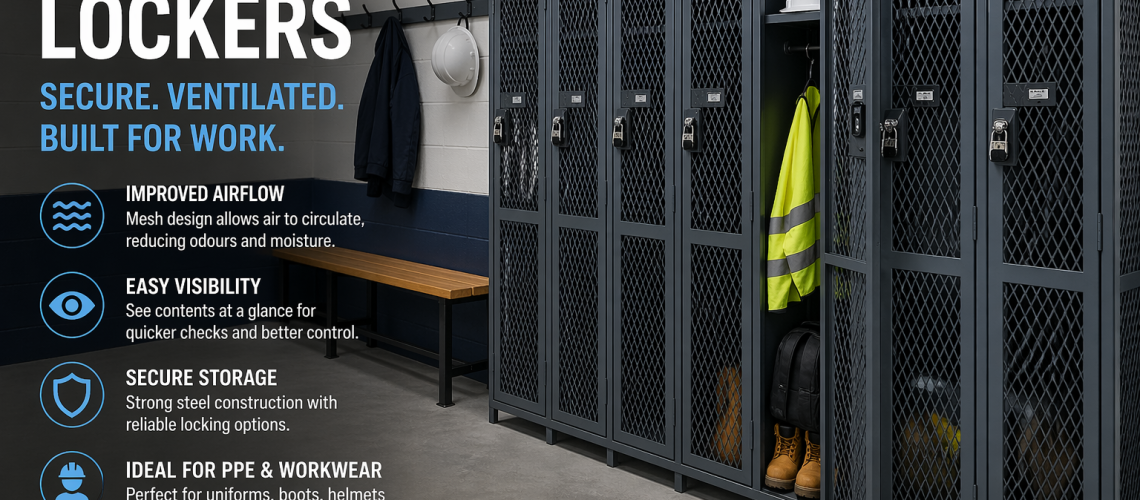
Mesh lockers are secure ventilated storage units built from steel mesh rather than fully enclosed panels. They are best suited to workplaces, industrial sites, sports facilities and other operational environments where airflow, visibility and robust construction matter as much as privacy.
This guide explains when to choose mesh lockers in the UK, what they are used for, how they compare with solid lockers, what to check when specifying them and when another locker type may be more appropriate.
If you are deciding between several specialist locker types, start with our specialist locker applications guide. For general locker dimensions, materials and buying decisions, use the UK locker buying guide.
Quick Answer: When Should You Choose Mesh Lockers?
Choose mesh lockers when the storage requirement is driven by airflow, visibility or operational practicality. They are especially useful for workwear, PPE, boots, sports kit, uniforms and equipment that is used frequently or may be stored damp.
- Choose mesh when ventilation is more important than complete enclosure.
- Choose mesh when supervisors need to see whether compartments are occupied or what is stored inside.
- Choose mesh for robust back-of-house, industrial and welfare environments.
- Choose solid lockers instead where privacy, appearance or concealment of contents is more important.
What Are Mesh Lockers?
Mesh lockers use steel mesh panels in place of fully enclosed doors and sides. The open construction allows air to move through the compartment and makes the contents easier to see from outside.
They are usually selected for practical environments rather than decorative ones. The design can make them particularly useful where clothing, footwear or equipment needs to air between uses, or where staff need quick visual confirmation of occupancy or contents.
Mesh construction does not make every locker identical. Compartment height, width, depth, mesh aperture, internal fittings, door design, frame strength, finish and lock type can all vary by product.
Main Benefits of Mesh Lockers
| Benefit | Why it matters |
|---|---|
| Airflow | Helps reduce stale air around clothing, footwear, PPE and regularly used equipment. |
| Visibility | Makes it easier to check occupancy, identify obvious misuse and inspect storage without opening every compartment. |
| Robust construction | Steel mesh can suit hard-working operational and industrial environments. |
| Practical storage | Useful for bulky, damp or frequently used items that may be less suitable for sealed compartments. |
| Operational control | Can support managed issue areas, welfare spaces and supervised storage zones. |
Mesh lockers are not automatically the best choice simply because ventilation is desirable. The full storage requirement still needs to account for security, privacy, environment, room layout and the size of the items being stored.
Where Do Mesh Lockers Work Best?
Workplaces and Staff Areas
Mesh lockers are commonly used in warehouses, factories, depots, transport sites and staff changing areas for uniforms, boots, workwear, bags and PPE. They are especially useful where items are used daily and need somewhere practical to air between shifts.
For broader staff-storage planning, see our workplace lockers guide.
Industrial and PPE Storage
Industrial and PPE storage is one of the strongest use cases for mesh lockers. Helmets, gloves, boots, uniforms and protective equipment may all benefit from airflow and quick visual checking.
If the main requirement is separating personal clothing from workwear or managing clean and dirty garments, use the dedicated PPE and uniform locker guide. This page owns the mesh-locker product decision; the PPE guide owns the workflow.
Gyms, Sports and Leisure
Mesh lockers can work well in team rooms, staff areas, equipment zones and practical sports-storage spaces where kit, shoes or clothing may be damp or used frequently. In customer-facing changing rooms, appearance and privacy may make a solid locker more appropriate.
Schools, Colleges and Training Centres
Education sites may use mesh lockers in sports departments, technical areas, vocational training spaces, staff facilities or equipment issue points. They are usually a specialist choice rather than the default option for general pupil corridor storage.
Mesh Lockers vs Solid Lockers
Mesh and solid lockers solve different problems. A solid locker usually provides more privacy and a more enclosed appearance. A mesh locker prioritises airflow, visibility and practical use in operational environments.
| Locker type | Best suited to | Main strength | Main limitation |
|---|---|---|---|
| Mesh locker | PPE, uniforms, boots, sports kit and ventilated storage | Airflow and visibility | Less privacy |
| Solid steel locker | General personal storage in dry internal spaces | Privacy and versatility | Less airflow |
| Garment locker | Uniforms, coats and longer workwear | Hanging space | May use more floor area per user |
| Wet-area locker | Humid or splash-prone environments | Material suited to wet conditions | May not provide the same visibility as mesh |
| Heated locker | Drying damp clothing, PPE or cycling kit | Active drying support | Requires a more specialised installation |
If privacy is the priority, choose a more enclosed locker. If airflow and visual checking are more important, mesh may be the better fit. If stored items need active drying rather than passive ventilation, consider a heated locker.
Mesh Lockers vs General Locker Ventilation
Mesh lockers are one way of achieving high levels of airflow, but they are not the same subject as locker ventilation generally. Solid lockers may also use perforations, vents or other airflow features.
Use this page when deciding whether mesh construction itself is the right locker type. For the broader principles of moisture, odour, airflow and locker design, use our locker ventilation and airflow guide.
How to Choose Mesh Lockers
1. Start With the Items Being Stored
Measure the largest regular items before choosing the locker. Boots, helmets, PPE and bulky sports equipment may need substantially more usable compartment space than bags, coats or personal items.
2. Decide How Much Privacy Is Required
Mesh construction makes contents more visible. That can be useful operationally but inappropriate where personal belongings need to remain concealed. Privacy should therefore be treated as a specification requirement rather than an afterthought.
3. Check Compartment Size and Layout
Single-door, multi-compartment and specialist mesh layouts can serve different storage models. Choose the number and size of compartments around the users and stored items rather than simply maximising door count.
For general locker dimensions and room planning, see our locker sizes guide and locker planning guide.
4. Review the Locking Method
The lock should reflect whether lockers are assigned, shared, supervised or used temporarily. Key and hasp arrangements may suit many workplace applications, while other access methods may be appropriate depending on the product and operating model.
For general lock selection, use our locker locking systems guide.
5. Check the Environment and Finish
Mesh lockers are commonly used in demanding internal environments, but that does not mean every steel mesh locker is suitable for outdoor, corrosive or constantly wet locations. Check the manufacturer’s environmental specification, finish and component suitability for the proposed site.
For external storage, use the dedicated outdoor lockers guide.
Are Mesh Lockers Secure?
Mesh lockers can provide secure storage, but security depends on the complete specification: frame strength, mesh construction, hinges, door design, locking method, installation and the surrounding environment.
The visible construction also changes the security model. Seeing the contents can help with supervision and inspection, but it also means stored items are not concealed. Where high-value personal belongings are the main concern, a solid locker may offer a more appropriate balance of privacy and security.
When Mesh Lockers Are Not the Right Choice
- Where users require strong visual privacy for personal belongings.
- Where a design-led office or front-of-house appearance is more important than operational visibility.
- Where stored items need protection from dust or environmental contamination.
- Where the site is exposed to rain or corrosive conditions and the product is not specified for that environment.
- Where damp items need active drying rather than passive airflow.
- Where clean and dirty garments need controlled separation rather than simple ventilated storage.
In those cases, compare solid lockers, wet-area lockers, heated lockers or dedicated PPE and uniform storage instead.
Mesh Locker Installation and Maintenance
Mesh lockers should be installed on a suitable level surface with enough space for doors, users and circulation. Banks may need to be joined, secured or fixed according to the product and site conditions.
- Check door alignment and hinges.
- Inspect locks, hasps and keys.
- Look for damage or distortion to mesh panels.
- Keep the floor and base area clear.
- Check joining points and any fixings.
- Replace damaged labels or locker numbers.
- Review whether stored items or working practices have changed since installation.
For wider servicing and repair guidance, see our locker parts, repairs and servicing guide.
Mesh Lockers from Total Locker Service
Total Locker Service supplies commercial locker solutions for workplaces, industrial sites, schools, sports facilities and other organisations throughout the UK. Where mesh construction is the right fit, the specification should be based on the stored items, required compartment size, privacy, lock type, environment and room layout.
Browse our commercial locker ranges, or use the specialist locker applications guide if you are still comparing mesh, outdoor, PPE, heated or other specialist locker types.
Mesh Locker FAQs
What are mesh lockers?
Mesh lockers are steel storage lockers made with open mesh panels rather than fully enclosed sides and doors. The construction allows greater airflow and makes the contents easier to see from outside.
What are mesh lockers used for?
They are commonly used for PPE, uniforms, boots, sports kit, workwear and operational equipment in workplaces, industrial sites, sports facilities and other areas where ventilation and visibility are useful.
Are mesh lockers better than solid lockers?
Not always. Mesh lockers are usually stronger where airflow and visibility are priorities, while solid lockers are often better where privacy, concealment and a more enclosed appearance matter.
Are mesh lockers suitable for PPE?
They can be suitable for PPE where secure ventilated storage is required. If the site needs controlled separation between personal clothing, clean workwear and dirty garments, a dedicated PPE or clean-and-dirty locker arrangement may be more appropriate.
Can mesh lockers be used outdoors?
Only where the specific locker is designed and specified for the proposed external conditions. Standard steel mesh lockers should not automatically be assumed to be suitable for rain, corrosion or prolonged outdoor exposure.
Discover more from Blog Total Locker Service
Subscribe to get the latest posts sent to your email.