Small Business Key Storage UK: Simple Key Management for Offices and Small Workplaces
April 28, 2026
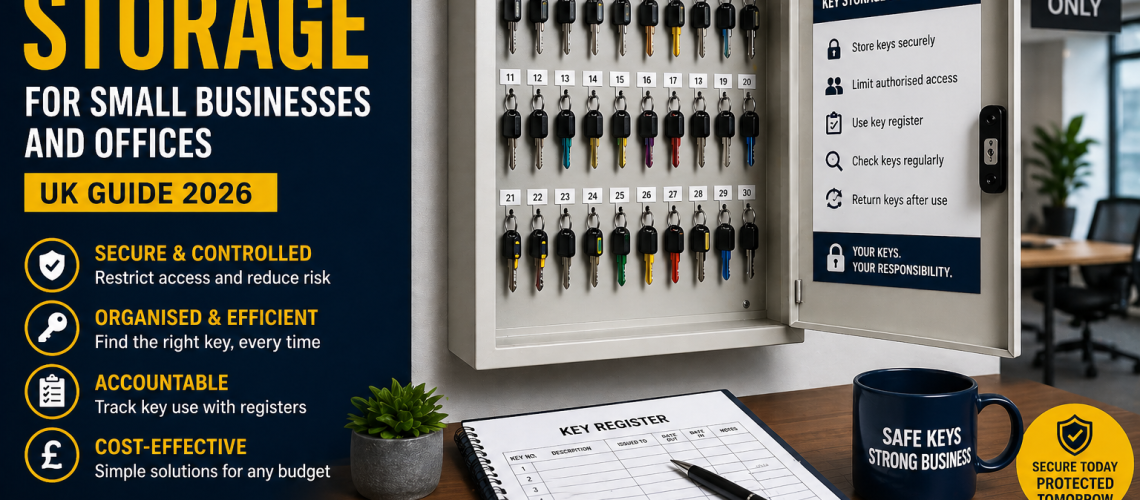
Most small businesses do not need a complicated key-management system. They usually need one secure storage point, a clear way to identify keys, a simple record of what exists and tighter control only for keys that create greater risk.
A small office with a few entrance, cupboard and filing-cabinet keys should not be managed in the same way as a hospital estate, vehicle depot or organisation controlling hundreds of keys across several sites.
This guide explains what a small business actually needs for key storage, when one wall-mounted cabinet is enough, how to organise 10, 20 or 50-key estates, how to handle spare and vehicle keys, when a simple paper register is sufficient and when the business has outgrown a basic manual system.
For detailed cabinet types, see Key Cabinets Explained. For detailed capacity planning, use Commercial Key Cabinet Sizes UK. For installation position and fixing, see Where to Install Key Cabinets.
Quick Answer: What Key Storage Does a Small Business Need?
For many small businesses, a straightforward manual system is enough.
A practical setup normally consists of:
- one lockable wall-mounted key cabinet;
- clear numbered or coded key references;
- a simple register showing what each key controls;
- restricted cabinet access;
- basic sign-out records only for shared or higher-risk keys;
- clear identification of spare and duplicate keys;
- and some unused cabinet capacity for future growth.
The aim is not to create unnecessary administration. It is to stop important keys becoming scattered between desks, drawers, pockets, cupboards and informal hiding places.
Why Small Businesses Need Proper Key Storage
Small businesses often begin with informal key arrangements because everybody knows each other and there are relatively few keys to control.
One person may know where the spare entrance key is kept, another keeps the van key in a desk drawer, while cupboard and filing-cabinet keys stay close to the furniture they open.
That can work while the business is very small, but it becomes fragile as staff, premises and responsibilities change.
- keys become harder to find;
- duplicate copies are forgotten;
- leavers may retain keys;
- vehicle keys may be left unsecured;
- contractor keys may remain in circulation;
- nobody is certain how many copies exist;
- and the business becomes dependent on one person’s memory.
A simple central storage system removes much of that uncertainty without introducing unnecessary complexity.
How Many Keys Can a Small Business Manage With a Simple System?
The number of keys is only one part of the decision, but many small businesses operate relatively modest key estates.
| Approximate key estate | Typical small-business approach |
|---|---|
| Up to around 10 keys | A compact lockable cabinet with straightforward references may be all that is required. |
| Around 20 keys | One small commercial key cabinet, numbered positions and a basic register usually provide a simple structured system. |
| Around 50 keys | One larger cabinet can still work well, but references, spare capacity and clear responsibility become more important. |
| Beyond this | Review whether increasing numbers of users, sites, vehicles or higher-risk keys are making the system operationally more complex. |
These are examples rather than fixed thresholds. A business managing 15 frequently shared vehicle and master keys may need stronger control than another business storing 50 low-risk cupboard and office keys.
For detailed calculations based on hook positions, key bunches and future growth, see Commercial Key Cabinet Sizes UK.
A Simple Small-Business Key Storage Setup
A practical starting point is one central cabinet controlled by a small number of authorised staff.
- Count the important keys the business currently manages.
- Identify which are routine and which create greater risk.
- Give each controlled key a clear reference.
- Store the keys in one secure cabinet where practical.
- Keep a simple register showing what each reference means.
- Record spare and duplicate copies.
- Use sign-out records only where sharing or risk justifies them.
- Review the arrangement when the business changes.
This is usually enough for a small workplace with a limited number of users and a manageable key estate.
When Is One Wall-Mounted Key Cabinet Enough?
One central wall-mounted cabinet is often the simplest arrangement for a small office, workshop or workplace.
It is particularly suitable where:
- the business mainly operates from one location;
- the number of keys is manageable;
- only a small number of people need cabinet access;
- most keys are returned to the same location;
- there are relatively few master, vehicle or other higher-risk keys;
- and the cabinet can be installed in a staff-only area.
Keeping the system centralised also makes missing keys easier to notice and prevents spare keys being distributed between desks and individual staff members.
For detailed guidance on cabinet position, wall suitability, working height and fixing, see Where to Install Key Cabinets.
Which Small-Business Keys Need More Control?
Not every key needs the same level of control. The useful distinction is between routine keys and keys that create greater operational, security or asset risk.
| Key type | Typical small-business approach |
|---|---|
| Low-value cupboard keys | Basic cabinet storage may be sufficient. |
| Internal office keys | Store centrally and restrict cabinet access sensibly. |
| External door keys | Keep clearer holder records and restrict access. |
| Filing or records keys | Limit access to staff who genuinely require them. |
| Vehicle keys | Use secure storage and evidence of issue where several staff share vehicles. |
| Master or override keys | Restrict access to named authorised staff. |
| Safe or high-value asset keys | Separate or stronger control may be appropriate. |
| Contractor keys | Use a clear temporary issue and return point. |
The detailed operating rules for these keys belong in the wider Managing Keys in the Workplace UK guide.
How Simple Can Small-Business Key Control Be?
Small businesses benefit from keeping key control proportionate.
A five-person office with a modest collection of low-risk keys does not necessarily need electronic tracking, multiple permission levels or detailed transaction reports.
A simple manual system can work perfectly well where:
- the number of keys is limited;
- the number of authorised users is small;
- the cabinet is easy to supervise;
- staff responsibilities are relatively stable;
- high-risk keys are limited;
- and the register is easy to keep current.
The important test is whether the business can still answer three basic questions quickly: what keys exist, where should they be and who is responsible for them?
Keep a Simple Key Register
A small-business key register does not need to be elaborate. Its purpose is simply to stop the system depending on memory.
A basic register might contain:
- key reference;
- what the key opens or controls;
- normal storage position;
- authorised holder or user group where relevant;
- number of duplicate or spare copies;
- and current issue status where necessary.
This can be maintained on paper, in a spreadsheet or within an existing facilities record. The format matters less than keeping the information current.
For detailed log formats, transaction records and audit trails, see Key Tracking Methods UK.
When Is a Paper Key Register Enough?
A paper register can be entirely sufficient for a small business where key movements are infrequent and only a few authorised people use the system.
It is most practical where:
- keys are not being issued continuously throughout the day;
- there are only a few shared keys;
- records are easy to maintain;
- the organisation does not require automatic audit data;
- and staff reliably follow the agreed process.
A small business should not introduce electronic key management simply because digital technology exists. Technology becomes useful when it solves a real operational problem.
Who Should Be Responsible for Small-Business Keys?
Even a simple key system needs somebody to take responsibility for keeping it accurate.
In a small business this does not usually require a dedicated key-control role. Responsibility may sit with:
- the business owner;
- an office manager;
- a facilities or operations manager;
- the person responsible for the premises;
- or another clearly nominated member of staff.
The important point is that responsibility is explicit. If everybody assumes somebody else maintains the system, small inaccuracies gradually accumulate.
The responsible person should normally make sure that:
- new keys are recorded;
- obsolete keys are removed from the active system;
- spare copies remain identifiable;
- staff changes are reflected where relevant;
- and changes to the premises or vehicles are incorporated into the register.
Use Clear Key References
Numbered or coded references make a small key system easier to maintain and reduce dependence on handwritten descriptions.
- match cabinet positions to the register;
- avoid duplicate reference numbers;
- replace damaged tags promptly;
- avoid putting unnecessary sensitive information directly on keys;
- and keep the reference system simple enough for staff to understand.
A ten-key office does not need an elaborate coding structure. Simple references such as K01, K02 and K03 may be entirely adequate if the register explains what each one controls.
How Should a Small Business Manage Spare and Duplicate Keys?
Spare keys are useful, but they are also one of the easiest ways for a small key system to become unclear.
If several copies of the same key exist, the business should be able to identify how many authorised copies there are and where they are normally stored.
- keep duplicate copies associated with the same key reference;
- record how many authorised copies exist;
- avoid keeping emergency spares in informal hiding places;
- separate rarely used reserve keys from everyday working keys where useful;
- remove obsolete duplicates when locks are changed;
- and update the register when replacement copies are produced.
A small business does not need a complicated inventory system for a handful of spares. It simply needs enough information to prevent forgotten duplicate keys remaining in circulation.
Allow for Growth Without Over-Specifying
A small business should avoid buying a cabinet that is already full on the day it is installed.
New doors, storage areas, vehicles and duplicate sets can increase the number of keys over time.
That does not mean buying an unnecessarily large cabinet. It simply means allowing enough spare positions for realistic growth.
This guide deliberately does not set a universal spare-capacity percentage because requirements vary. The dedicated Commercial Key Cabinet Sizes UK guide covers physical capacity planning in more detail.
Small Businesses With Company Vehicles
Vehicle keys are one of the clearest reasons for a small business to strengthen an otherwise simple key-storage system.
If several staff use company cars, vans, minibuses, forklifts or plant, the business should normally be able to identify who has the relevant key and whether it has been returned.
Vehicle keys can also be physically larger than normal door keys, particularly where remote fobs and labelled bunches are involved.
- store vehicle keys in the cabinet rather than on open desks;
- use an obvious internal reference such as fleet or registration number;
- record issue where several people share the vehicle;
- keep spare vehicle keys separately identifiable;
- and reconsider the system if vehicle movements become frequent enough to make manual records unreliable.
Detailed tracking methods belong in Key Tracking Methods UK, while broader operational control belongs in Key Control Systems UK.
Master and Override Keys in a Small Business
A small business may have only one or two master or override keys, but those keys can provide substantially more access than ordinary keys.
They should therefore not automatically be treated in the same way as low-risk cupboard or internal-office keys.
- limit access to people who genuinely need the key;
- keep spare master keys clearly identified;
- avoid leaving master keys in open or unsupervised areas;
- and record who has permanent possession where the key does not normally stay in the cabinet.
If the business operates a formal master-key hierarchy, use the specialist guide to Master Key Systems and Controlled Key Access.
Keys for Confidential Records and Restricted Areas
Keys that provide access to HR files, finance records, archives, server cupboards or other restricted areas should not simply be treated as general office keys.
A small business may still use the same central cabinet, but access to those particular keys should be limited to staff who genuinely require them.
This does not necessarily require a separate electronic system. In many small workplaces, clear responsibility and sensible restriction are enough.
For the wider governance and evidence layer, see Key Storage Compliance UK.
Contractor and Cleaner Keys
Small businesses frequently provide temporary or continuing access to cleaners, maintenance contractors, IT support, landlords or alarm engineers.
At minimum, the business should know:
- which key was issued;
- who received it;
- whether access is temporary or ongoing;
- when the key should be returned;
- and what happens when the work or contract ends.
A simple paper or spreadsheet record may be sufficient when contractor key movement is infrequent.
Detailed contractor procedures belong in Managing Keys in the Workplace UK.
Where Should a Small Business Put the Key Cabinet?
A small business will usually want the cabinet in a staff-only area that is convenient for the people responsible for it and not directly exposed to customers or visitors.
Possible locations include:
- an office manager’s room;
- a secure administration office;
- a facilities or maintenance room;
- a supervised staff area;
- or another controlled back-office location.
Avoid choosing a location purely because there is spare wall space. The cabinet should be practical to use and appropriate for the sensitivity of the keys.
Detailed guidance on wall construction, fixing, visibility, access and working height belongs in Where to Install Key Cabinets.
Do Small Businesses Need Electronic Key Management?
Usually not by default.
A business with a small key estate, limited staff and infrequent key movement may gain little from an electronic system compared with a well-managed mechanical cabinet.
Electronic key control becomes more relevant when:
- many people regularly share keys;
- keys change hands throughout the working day;
- individual users need different permissions;
- manual records are repeatedly incomplete;
- managers need reliable audit information;
- or missing keys are becoming an operational problem.
The decision should therefore be based on the problem the business is trying to solve, not on the assumption that electronic technology is automatically better.
For the detailed comparison, see Mechanical vs Digital Key Cabinets UK.
When Has a Small Business Outgrown Simple Key Storage?
The point at which a small business needs a more formal key-control system is determined more by complexity than by staff numbers.
A basic cabinet-and-register arrangement should be reviewed when:
- many staff regularly take and return shared keys;
- vehicle, plant or master keys are frequently issued;
- the business begins operating from several locations;
- manual records are repeatedly incomplete;
- nobody can quickly establish who has a missing key;
- different staff require different key permissions;
- contractors or temporary users regularly require access;
- the cabinet has become difficult to organise;
- higher-risk assets are involved;
- or managers increasingly need reliable evidence of key use.
At this stage, the first response does not necessarily need to be electronic key management. A clearer manual process, better cabinet organisation or tighter responsibility may solve the problem.
If the underlying problem is now permissions, frequent key movement or audit information, compare the alternatives in Key Control Systems UK and Mechanical vs Digital Key Cabinets UK.
If the organisation has instead grown into hundreds of keys across multiple buildings, fleets or sites, move to our guide to Managing Large Key Estates UK.
Common Small-Business Key Storage Mistakes
- keeping spare keys in desk drawers;
- leaving frequently used keys on open hooks;
- depending on one person’s memory;
- not recording duplicate copies;
- using obvious descriptions on sensitive keys;
- sharing cabinet access more widely than necessary;
- allowing contractor keys to remain in circulation indefinitely;
- storing vehicle keys in open offices;
- failing to remove obsolete keys;
- buying a cabinet with no room for growth;
- and continuing with an informal system after the business has clearly outgrown it.
Small-Business Key Storage Checklist
- Count the keys that need controlled storage.
- Identify which keys create greater risk.
- Use one secure storage point where practical.
- Give keys clear references.
- Keep a simple key register.
- Record spare and duplicate copies.
- Restrict cabinet access to the people who need it.
- Use sign-out records only where sharing or risk justifies them.
- Control vehicle, master and contractor keys more carefully.
- Allow sensible capacity for future growth.
- Nominate somebody to keep the system accurate.
- Review the arrangement when staff, premises, vehicles or responsibilities change.
- Upgrade the process if the current system becomes unreliable.
Related Key Storage Guides
| Question | Guide |
|---|---|
| What type of key cabinet should I buy? | Key Cabinets Explained |
| What cabinet capacity do I need? | Commercial Key Cabinet Sizes UK |
| Where should the cabinet be installed? | Where to Install Key Cabinets |
| How should workplace key procedures work? | Managing Keys in the Workplace UK |
| How should key movement be recorded? | Key Tracking Methods UK |
| Should control be manual or digital? | Key Control Systems UK |
| Mechanical or digital cabinet? | Mechanical vs Digital Key Cabinets UK |
| What governance and evidence are needed? | Key Storage Compliance UK |
| How should hundreds of keys be organised? | Managing Large Key Estates UK |
Small Business Key Storage FAQs
What is the best key storage for a small business?
For many small businesses, a lockable wall-mounted key cabinet with clear key references, a simple register and restricted access is sufficient. Shared or higher-risk keys may also need issue and return records.
How many keys can a small business keep in one cabinet?
There is no fixed limit. Estates of around 10, 20 or 50 keys can often be managed in one cabinet where the number of users and key movements remains modest. Complexity matters as much as the number of keys.
Does a small business need electronic key management?
Not necessarily. A manual cabinet and register can work well where the number of keys and authorised users is limited. Electronic control becomes more useful when keys are frequently shared, permissions vary or reliable audit information is required.
Does every office key need to be signed out?
No. Low-risk keys may only need controlled storage. Sign-out records are more useful for shared, vehicle, master, contractor or other higher-risk keys.
Should a small business keep a key register?
Yes. A simple register reduces dependence on memory by recording what keys exist, what they control, where they belong and how many authorised copies exist.
How should spare business keys be stored?
Spare keys should remain identifiable and associated with the same reference as the working key. Avoid informal hiding places and record how many authorised copies exist.
When should a small business upgrade its key-control system?
Consider an upgrade when many users share keys, records become unreliable, the business operates from several locations, higher-risk keys are involved or managers need stronger evidence of key use.
Small Business Key Storage: Keep It Simple and Structured
Small-business key storage should be simple, structured and proportionate.
For many small offices and workplaces, one lockable cabinet, clear key references, a basic register and sensible control of higher-risk keys are all that is required.
The system only needs to become more formal when the business itself becomes harder to manage: more users, more locations, more vehicles, more valuable assets or more frequent movement of shared keys.
For commercial storage options, view our key cabinet range. If your organisation has developed into hundreds of keys across several buildings or sites, continue to Managing Large Key Estates UK.
Discover more from Blog Total Locker Service
Subscribe to get the latest posts sent to your email.