Key Storage for Schools, Hospitals and Facilities Management (UK Guide 2026)
April 28, 2026
Key storage for schools, hospitals and facilities management teams must be secure, organised and easy to audit. These environments often manage many keys across buildings, departments, restricted rooms, vehicles, cupboards, lockers, plant areas and contractor access points. A simple drawer or informal handover is not enough.
The best key storage system depends on the risk. Schools need safe access control for classrooms, gates, offices, medical rooms and safeguarding areas. Hospitals and healthcare settings need stricter control for clinical rooms, records, medicines, plant areas and staff-only spaces. Facilities management teams need reliable key tracking across sites, contractors, maintenance zones and emergency access routes.
This guide explains how schools, hospitals and facilities teams can choose secure key cabinets, organise key registers, manage sign-out records and reduce the risk of missing or uncontrolled keys.
Why key storage matters in managed sites
Large and managed sites often hold far more keys than people realise. Keys may open teaching spaces, staff rooms, medicine cupboards, maintenance areas, archive rooms, electrical rooms, lockers, offices, external gates, stores, server cupboards and vehicles.
When keys are not controlled, daily management becomes harder. Staff waste time looking for keys. Contractors are delayed. Restricted areas may be accessed without approval. Missing keys may not be noticed until there is a security issue.
A proper key storage system gives the organisation one controlled process. Keys are stored in a secure cabinet, recorded in a register, issued only to authorised people and checked regularly. This improves security, accountability and operational reliability.
Practical answer: schools, hospitals and facilities teams should use secure key cabinets with numbered hooks, coded tags, controlled access, sign-out records and regular audits. Higher-risk keys need stricter control than general-use keys.
Common key storage risks
The same key storage problems appear across education, healthcare and facilities management. The scale may differ, but the risks are similar.
- Keys stored in unlocked drawers or open offices
- No complete key register
- Duplicate keys not recorded
- Master keys mixed with low-risk keys
- Contractor keys issued without return checks
- Shared codes not changed when staff leave
- Keys labelled with obvious room names
- Vehicle keys left unsecured
- No clear lost key procedure
- Key audits completed too rarely
- Restricted areas accessible to too many people
These risks can lead to theft, unauthorised access, safety issues, data exposure, safeguarding concerns, service disruption and costly lock replacement.
Best key storage system for schools, hospitals and facilities teams
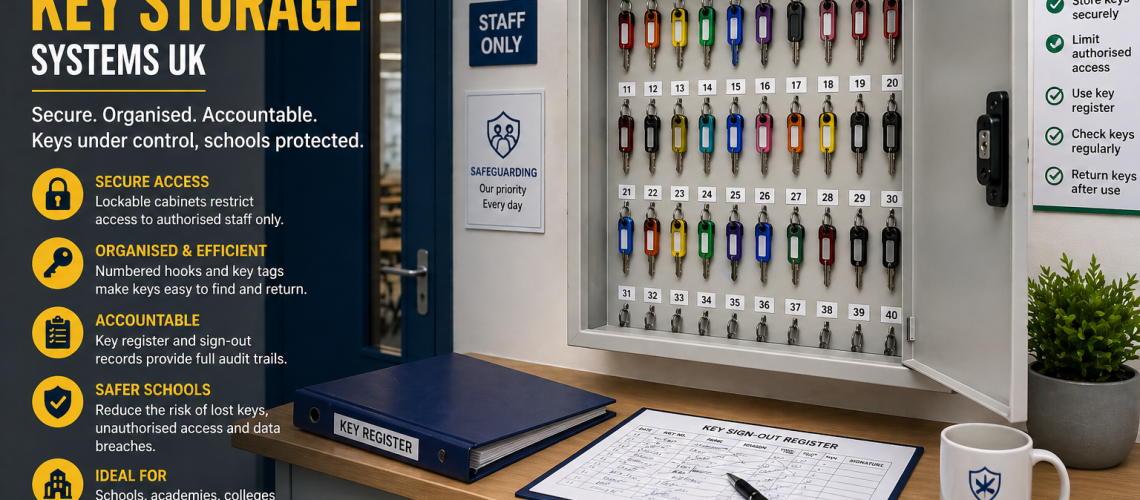
The best system is usually a secure key cabinet or key control cabinet supported by a clear process. The cabinet provides physical storage. The register explains what each key opens. The sign-out process records who used the key. The audit routine checks that the system is working.
For smaller sites, a wall-mounted key cabinet with a paper or digital register may be enough. Larger schools, hospitals, estates departments and facilities teams may need high-capacity cabinets or electronic key control systems with stronger audit records.
- Use numbered hooks and coded key tags.
- Keep a complete key register.
- Separate high-risk keys from general keys.
- Restrict cabinet access to authorised people.
- Record sign-outs for shared or high-risk keys.
- Check keys regularly.
- Review access when staff or contractors change.
The system should be simple enough to use every day. A complicated process that staff bypass will not provide reliable control.
Key storage for schools
Schools need key storage that supports security, safeguarding, staff access and daily site management. A school may manage keys for classrooms, offices, halls, gates, cupboards, lockers, medical rooms, IT rooms, stores, kitchens, sports areas and external buildings.
The system must balance control with practicality. Teachers, site managers, administrators, cleaners and contractors may all need access to different areas. However, not everyone should be able to access every key.
School key storage should usually include a secure cabinet in a staff-only area, numbered tags, a key register and clear access rules. Site keys, master keys, safeguarding record keys, medical room keys and IT room keys should be controlled more tightly than low-risk classroom or cupboard keys.
School keys that need control
- External door and gate keys
- Classroom keys
- Master keys
- Medical room keys
- Safeguarding and confidential record keys
- IT room and server cupboard keys
- Sports hall and equipment store keys
- Kitchen and catering area keys
- Cleaning cupboard keys
- Locker override keys
- Contractor and maintenance keys
Master keys and safeguarding-related keys should not be treated like ordinary cupboard keys. They should have restricted access and a clear record of use.
Key storage for hospitals and healthcare settings
Hospitals, clinics, care settings and healthcare departments often need stricter key control because keys may protect clinical areas, medicines, records, staff-only spaces, storage rooms, plant areas and controlled access zones.
Healthcare key storage should support confidentiality, patient safety, medicine control and operational access. Keys should be stored securely, issued only to authorised staff and handed over clearly between shifts where needed.
General facility keys should be separated from high-risk keys. Keys for medicines, clinical rooms, controlled storage, records, plant rooms and high-value equipment should be restricted and audited more often.
Healthcare keys that need control
- Medicines cabinet keys
- Clinical room keys
- Patient record storage keys
- Controlled storage keys
- Staff-only area keys
- Plant room and maintenance keys
- Medical equipment store keys
- Office and archive keys
- External access keys
- Emergency access keys
Where keys are transferred during shift handover, the process should be clear and recorded. Staff should know which keys they are responsible for and what to do if a key is missing.
Key storage for facilities management teams
Facilities management teams often control the widest range of keys. They may manage access across several buildings, departments, floors, service zones, plant rooms, cleaning areas, stores, external compounds, vehicles and contractor access points.
Because facilities teams support daily operations and emergency response, the key system must be fast, accurate and reliable. Staff need to find the right key quickly, but access still needs to be controlled.
Facilities key storage should use coded tags, a structured register and clear sign-out rules. For larger estates, electronic key control may be worth considering because it can provide stronger user records and reduce manual administration.
Facilities management keys that need control
- Plant room keys
- Roof access keys
- Electrical and mechanical service keys
- Store room keys
- Cleaning cupboard keys
- External gate and compound keys
- Vehicle and equipment keys
- Lift motor room keys
- Contractor access keys
- Emergency access keys
- Master and sub-master keys
Facilities teams should pay close attention to contractor access. Temporary keys should be issued for a defined purpose and returned at the end of the job or working day unless a formal exception is approved.
Choosing the right key cabinet capacity
Schools, hospitals and facilities teams should choose key cabinets with spare capacity. These environments tend to gain keys over time as rooms change, departments move, buildings expand and new contractors are added.
Do not choose a cabinet based only on the number of keys currently in use. Allow room for future growth, duplicate keys, contractor sets, vehicle keys and separate high-risk sections.
| Environment | Typical need | Suggested approach |
|---|---|---|
| Small school or clinic | Moderate number of internal keys | Wall-mounted cabinet with spare capacity |
| Large school or healthcare site | Many departments and restricted areas | High-capacity cabinet or multiple controlled cabinets |
| Facilities team | Large range of building and contractor keys | Structured cabinet system with coded sections |
| Multi-site estate | Keys across several locations | Electronic control or site-by-site cabinet system |
Takeaway: extra capacity helps keep the system organised. A full cabinet quickly becomes a messy cabinet.
Key cabinet lock options
The lock type should match the number of users and the risk level. A simple key lock may suit a small controlled office. A combination or digital lock can work better where several authorised staff need access. Electronic systems may be suitable for larger teams or high-risk sites.
| Lock type | Best suited to | Main control point |
|---|---|---|
| Key lock | Small teams with limited access | Cabinet key must be controlled |
| Mechanical combination lock | Shared manager access | Code must be changed when needed |
| Digital keypad lock | Regular authorised staff access | Code control and battery checks |
| Electronic key control | Large or high-risk environments | User permissions and audit reporting |
A lock is only secure if the access process is managed. Shared codes should not be passed around casually. Cabinet keys should not be left in drawers. Access should be reviewed when staff leave or change roles.
Key registers and coded tags
A key register is essential for managed sites. It links each key to a reference number, location, authorised user group and storage position. Without a register, a cabinet may look organised but still provide weak control.
Coded key tags are safer than obvious labels. A tag that says “science lab”, “medicine cupboard”, “server room” or “master key” can create risk if the key is lost. A coded number linked to a secure register is usually safer.
A good register should include:
- Key reference number
- Cabinet and hook position
- Building, department or area
- What the key opens
- Risk level
- Authorised users
- Duplicate key record
- Issue and return status
- Notes on lost, damaged or replaced keys
The register should be reviewed regularly. A key system is only reliable if the register matches the cabinet.
Sign-out records for shared and high-risk keys
Sign-out records are important when keys are shared, removed from the storage area or used for restricted spaces. They show who took a key, why it was needed and when it was returned.
Schools may use sign-out records for master keys, contractor keys, medical room keys and external access keys. Healthcare sites may use them for medicine storage, records, clinical rooms and controlled areas. Facilities teams may use them for plant rooms, roof access, vehicles and contractor works.
A simple sign-out record should include:
- Date and time issued
- Key reference
- Name of person taking the key
- Department or company
- Reason for use
- Expected return time
- Actual return time
- Authorising person where needed
Where manual sign-out sheets are often missed, an electronic key control system may be more reliable.
Master key control
Master keys need strict control because one key may open many areas. A lost master key can create serious security, cost and operational problems.
Schools may use master keys for classrooms or site access. Hospitals may have master or sub-master systems across wards, departments and offices. Facilities teams may hold master keys for maintenance and emergency access.
Master keys should be limited to authorised staff, stored separately where appropriate and signed out when used. They should also be audited more frequently than low-risk keys.
Specification consequence: master keys should never be treated as ordinary keys. Their storage, access and audit routine should reflect the wider access they provide.
Contractor key control
Contractor key control is vital in schools, hospitals and facilities management. Contractors may need access to service cupboards, plant rooms, roofs, gates, external compounds, classrooms, offices or clinical support areas.
Temporary access should be recorded. The organisation should know who has the key, which company they represent, what area they are accessing and when the key is due back.
Keys should not be handed over informally. If a contractor leaves site with a key, the organisation may not notice until the next person needs it. For high-risk keys, the return should be checked before the contractor leaves the site.
Long-term contractor access should be reviewed. If a cleaning contractor, maintenance provider or service partner holds keys permanently, the arrangement should be documented and checked when contracts change.
Lost key procedure
Every managed site should have a lost key procedure. The procedure should explain how missing keys are reported, who investigates them and what action is needed.
The response should be based on risk. A missing low-risk cupboard key may only need replacement. A missing master key, medicine storage key, plant room key, vehicle key or external access key may require urgent action.
A lost key record should include the key reference, date found missing, last known user, area affected, risk assessment, action taken and whether locks or access permissions were changed.
Good key registers make lost key decisions faster. If managers know what the key opens and who last used it, they can respond more accurately.
Key audit routines
Key audits confirm that the system is working. They should check the cabinet, register, sign-out records, high-risk keys and missing key reports.
Audit frequency depends on risk. High-risk keys may need daily, weekly or monthly checks. General keys may need periodic checks. Large sites should use a formal schedule so checks are not forgotten.
An audit should confirm:
- Keys are present in the correct positions.
- Sign-out records are complete.
- High-risk keys are accounted for.
- Duplicate keys are recorded.
- Lost keys have been investigated.
- Authorised user lists are current.
- Cabinet codes or access permissions are up to date.
Audits should be recorded with a date and named person. This provides evidence that key control is active rather than assumed.
Single key cabinet or multiple cabinets?
Some organisations can manage keys through one central cabinet. Others may need multiple cabinets by department, building or risk level.
A single cabinet can be easier to manage because all keys are in one place. However, it may become too busy if many staff need access. It can also create too much exposure if low-risk and high-risk keys are mixed together.
Multiple cabinets can work well where departments have different access needs. For example, a school may keep general keys in the site office and medical room keys under a stricter process. A hospital may separate facilities keys from clinical storage keys. A facilities team may use one cabinet per site or building.
The best structure is the one that keeps access clear, controlled and auditable.
When to consider electronic key control
Electronic key control can be useful where key use is frequent, high risk or difficult to track manually. These systems can restrict access by user and record activity automatically.
Schools may consider electronic systems for large campuses or multi-academy trusts. Healthcare sites may consider them for restricted departments, estates teams or high-risk stores. Facilities teams may consider them for multi-site operations, vehicle keys, plant rooms and contractor access.
Electronic systems can help when manual logs are not completed, keys are often missing, managers need audit reports or several teams share one key pool.
They are not always necessary for smaller sites. However, where accountability matters, electronic control can reduce gaps in the process.
Sector comparison: school, healthcare and facilities key storage
| Sector | Main key risks | Recommended controls |
|---|---|---|
| Schools | Safeguarding, site access, medical rooms, IT rooms, master keys | Secure cabinet, restricted access, coded tags, sign-out for high-risk keys |
| Hospitals and healthcare | Medicines, clinical rooms, records, plant rooms, staff-only areas | Separate high-risk keys, authorised access, handover records, regular audits |
| Facilities management | Contractors, plant rooms, multi-site access, vehicles, emergency keys | Structured register, contractor sign-out, master key control, electronic control where needed |
Takeaway: each sector needs the same foundation: secure storage, controlled access, clear records and regular checks. The difference is how strict the controls need to be.
Key storage checklist for managed sites
Use this checklist to review your current key storage system.
- Are all keys listed in a current register?
- Are keys stored in a secure cabinet or controlled system?
- Is cabinet access limited to authorised staff?
- Are key tags coded rather than obviously labelled?
- Are high-risk keys identified separately?
- Are master keys controlled more tightly?
- Are contractor keys signed out and returned?
- Are vehicle and equipment keys controlled?
- Are lost keys recorded and risk assessed?
- Are cabinet codes changed when staff leave?
- Are audits completed and recorded?
- Is emergency access covered without weakening security?
- Is the cabinet capacity enough for future growth?
If several answers are “no”, the key storage system needs improvement. Start with the register, then review cabinet access, high-risk keys and audit routines.
FAQs about key storage for schools, hospitals and facilities management
What is the best key storage for schools?
The best key storage for schools is usually a secure key cabinet with numbered hooks, coded tags, a key register and restricted access. Master keys, medical room keys, safeguarding record keys and contractor keys should have stronger controls than ordinary classroom keys.
How should hospitals store keys?
Hospitals should store keys in secure cabinets or controlled key systems. Keys linked to medicines, clinical rooms, records, plant areas and restricted spaces should be limited to authorised staff and audited regularly.
Why is key control important for facilities management?
Facilities management teams often manage keys for plant rooms, service areas, contractors, vehicles and multiple buildings. Good key control helps them find keys quickly while keeping access secure and auditable.
Should contractor keys be signed out?
Yes, contractor keys should be signed out and returned through a clear process. The record should show who took the key, which company they represent, why they needed access and when the key was returned.
Should master keys be stored separately?
Master keys should usually have stricter controls and may need separate storage depending on risk. Access should be limited and use should be recorded because master keys can open several areas.
Are electronic key cabinets worth it for large sites?
Electronic key cabinets can be worthwhile for large schools, hospitals, estates departments and facilities teams. They help control user access, reduce missed sign-outs and provide stronger audit records.
How often should keys be audited?
Audit frequency should match risk. High-risk keys may need frequent checks, while general keys may need periodic audits. Each audit should be recorded with the date and the person completing the check.
Final thoughts
Schools, hospitals and facilities management teams need key storage that is secure, organised and practical. These sites often manage many keys, multiple users and areas with different levels of risk.
A strong system starts with a secure cabinet, coded tags and a complete register. It becomes more effective when high-risk keys are separated, shared keys are signed out and audits are completed regularly.
The right key storage system should make daily access easier while reducing risk. For smaller sites, a well-managed cabinet may be enough. For larger or higher-risk environments, electronic key control may provide the extra accountability needed.
School key storage systems UK: FAQs
What is the best key storage system for schools in the UK?
The best system is usually a secure wall-mounted key cabinet with numbered hooks, coded tags and a clear key register. Larger schools or multi-site academies may benefit from high-capacity or electronic key control systems for stronger tracking.
How should school keys be organised?
School keys should be organised using numbered hooks and coded tags rather than obvious labels. A key register should link each code to the room or area it opens, helping maintain security if a key is lost.
Who should have access to school key cabinets?
Access should be limited to authorised staff such as site managers, senior leadership, administrators and facilities staff. Not all staff should have access to all keys, especially master keys or safeguarding-related keys.
Should school keys be signed out?
Yes, shared or high-risk keys should be signed out. This includes master keys, gate keys, contractor keys and keys to medical rooms or sensitive areas. A sign-out record helps track who used the key and when it was returned.
What keys in schools need the most control?
Keys that need the most control include master keys, external door and gate keys, safeguarding record keys, medical room keys, IT/server room keys and contractor access keys. These should have restricted access and regular audits.
Where should a school key cabinet be installed?
A school key cabinet should be installed in a secure staff-only area such as the main office, site office or administration room. It should be fixed securely to a solid wall and kept away from public access.
How often should school keys be checked?
Keys should be checked regularly based on risk. High-risk keys may require frequent checks, while general classroom keys may be audited periodically. All checks should be recorded.
Are electronic key cabinets worth it for schools?
Electronic key cabinets can be useful for larger schools or multi-site trusts. They improve accountability by tracking who accessed keys and when, reducing reliance on manual sign-out logs.
What should schools do if a key is lost?
If a key is lost, it should be reported immediately and recorded. The school should assess the risk based on what the key opens and decide whether locks, access permissions or procedures need to be updated.
Do schools need a key register?
Yes, every school should maintain a key register. It should list all keys, their reference numbers, what they open, who can access them and whether they are currently issued or stored.
Discover more from Blog Total Locker Service
Subscribe to get the latest posts sent to your email.