Are Key Cabinets Secure? What Protection Do They Actually Provide?
April 28, 2026
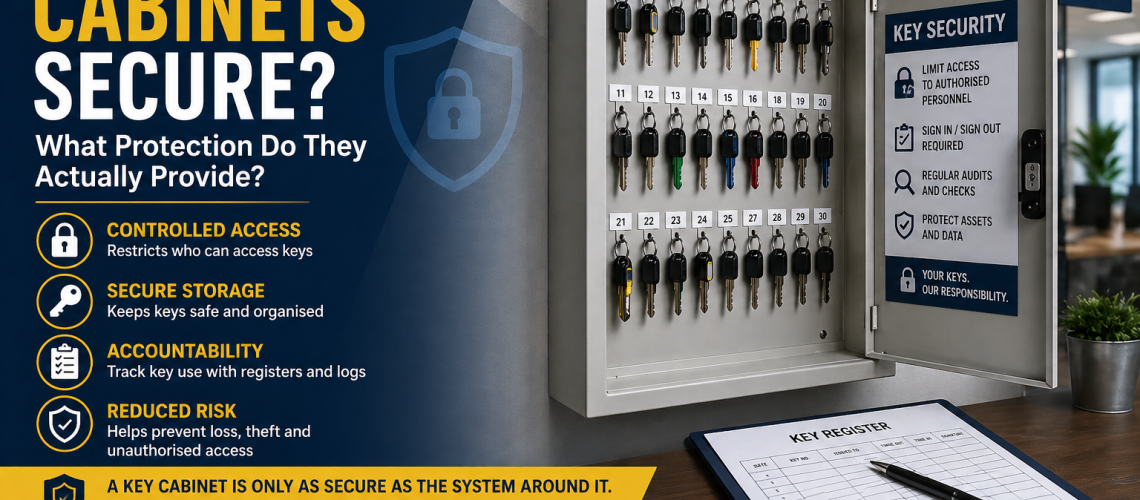
Key cabinets are secure when they are used for the right purpose, installed correctly and managed with clear key control procedures. They protect keys from casual access, poor organisation, unauthorised handling and daily misplacement. However, a standard key cabinet is not the same as a safe. Its real value is controlled storage, accountability and better key management.
A key cabinet helps a business know where keys are, who can access them and whether important keys have been returned. This makes it much stronger than keeping keys in drawers, open hooks, desk trays, cupboards or reception areas.
The level of protection depends on the cabinet type, lock option, wall fixing, installation location and the process around it. A small office key cabinet may be suitable for low-risk internal keys. Master keys, vehicle keys, safe keys, medicines cabinet keys and high-value site keys may need stronger controls.
Are key cabinets secure?
Yes, key cabinets are secure for everyday business key control when they are matched to the risk. They provide a lockable, organised and controlled place to store keys. This reduces the chance of keys being lost, borrowed without permission or left where unauthorised people can reach them.
A key cabinet is most effective against casual access and poor internal control. It stops keys being left loose around the workplace and makes it easier to see when a key is missing. In many offices, schools, workshops, care settings, property offices and facilities departments, that is the main daily risk.
However, not all key cabinets offer the same level of protection. A light-duty key cabinet with a basic lock should not be treated like a high-security safe. It may be fine for low-risk keys, but it is not suitable as the only protection for keys that could expose expensive assets or restricted areas.
Practical answer: a key cabinet is secure when it prevents the most likely misuse in your environment. For low-risk keys, that may mean simple locked storage. For high-risk keys, it may mean stronger construction, restricted access, audit records and a more controlled location.
What protection does a key cabinet provide?
A key cabinet provides four main types of protection: physical storage, access control, organisation and accountability. These work together to reduce risk.
- Physical storage: keys are kept inside a locked cabinet rather than left loose.
- Access control: only authorised people should be able to open the cabinet.
- Organisation: hooks, numbers and tags show where each key belongs.
- Accountability: registers and sign-out systems show who used a key and when.
This protection is often enough to fix the biggest workplace problem: nobody knows where the key is. Once keys are numbered, stored and checked, missing keys become visible much faster.
For stronger environments, a key cabinet can also support compliance, insurance evidence, staff procedures and audit trails. The cabinet itself is only one part of the system. The process around it is just as important.
What key cabinets do not provide
A key cabinet does not automatically provide high-security protection against determined attack. Many standard cabinets are designed for organisation and controlled access, not prolonged forced entry resistance.
A basic key cabinet will not solve every security issue. It will not stop poor staff procedures, shared codes, unrecorded duplicate keys, weak wall fixing or keys being signed out and never returned. It also cannot protect keys properly if the cabinet is installed in a public or unlocked area.
For high-risk keys, businesses should not rely on the cabinet alone. Master keys, vehicle keys, safe keys, external building keys and restricted-area keys may need additional controls such as a stronger cabinet, restricted room access, sign-out logs, electronic tracking or management approval.
Important distinction: a key cabinet improves key control. A safe provides stronger physical protection. Some sites may need both.
Key cabinet vs safe: what is the difference?
A key cabinet is designed to store, organise and control keys. A safe is designed to resist physical attack and protect higher-value contents. They are not the same product.
| Feature | Key cabinet | Safe |
|---|---|---|
| Main purpose | Organised key storage and access control | Physical protection of valuables |
| Typical contents | Business keys, vehicle keys, locker keys, contractor keys | Cash, documents, valuables, data media, high-risk keys |
| Daily access | Often used frequently | Usually accessed less often |
| Organisation | Hooks, tags and numbering | Internal shelves or compartments |
| Attack resistance | Varies by model; often moderate | Usually stronger, depending on safe grade |
| Best use | Key control and accountability | Higher-value physical security |
Takeaway: use a key cabinet when the main need is organised key control. Use a safe or higher-security solution when the keys themselves create serious asset, insurance or site security exposure.
How secure is a wall-mounted key cabinet?
A wall-mounted key cabinet can be secure when it is fixed properly to a suitable wall and installed in a controlled area. The fixing is important because a cabinet is weaker if it can be removed from the wall.
For most workplaces, wall-mounted key cabinets work well in staff-only offices, admin rooms, security rooms, maintenance offices and back-office areas. They keep keys organised and away from casual public access.
Security is reduced when the cabinet is fitted to a weak surface, fixed with unsuitable screws, placed near a public entrance or left visible to visitors. A strong cabinet in the wrong place can still be a weak control.
Best practice is to fit the cabinet to a solid wall, restrict who can enter the room, avoid public-facing placement and keep the cabinet closed when not in use.
Key cabinet lock options and security
The lock type affects how secure and manageable the key cabinet is. Different locks suit different workplaces.
| Lock type | Security benefit | Main weakness | Best suited to |
|---|---|---|---|
| Key lock | Simple and familiar | The cabinet key must also be controlled | Small offices and low-risk keys |
| Mechanical combination lock | No cabinet key to lose | Code may be shared too widely | Manager-controlled access |
| Digital keypad lock | Easy code access and changeable permissions | Needs code discipline and battery checks | Regular staff access |
| Electronic access control | Better user accountability and audit records | Higher cost and setup | High-risk or multi-user sites |
A keyed cabinet is not automatically weaker, but it creates another access item to manage. If the cabinet key is left in a drawer, the cabinet loses much of its value.
Combination and digital locks remove the need for a cabinet key, but codes must be controlled. Codes should be changed when staff leave, when access changes or when the code has been shared too widely.
Do key cabinets stop theft?
Key cabinets can reduce theft risk, but they should not be viewed as a complete theft-prevention system. Their main role is to prevent easy, unnoticed access to keys.
For internal theft or opportunistic misuse, a key cabinet can be very useful. It reduces access, shows when keys are missing and makes it harder for someone to take keys without being noticed.
Against a determined intruder, the level of protection depends on the cabinet strength, lock quality, fixing method and room security. If high-value vehicle keys or master keys are stored on site, the cabinet should sit within a wider security plan.
Businesses should consider alarms, CCTV, restricted rooms, stronger cabinets, safes or electronic key control where the theft risk is high. A key cabinet is strongest when it forms part of layered security.
Do key cabinets improve accountability?
Yes. Accountability is one of the biggest benefits of a key cabinet. When every key has a numbered hook and every movement is recorded, managers can see what is missing and who last used it.
This is especially useful for shared keys. Vehicle keys, plant keys, master keys, contractor keys and office keys may pass between several people. Without a system, it becomes difficult to know who had the key last.
A basic cabinet can support accountability through numbered hooks, key tags and a paper sign-out log. An electronic system can improve this further by recording access automatically.
Accountability protects both the business and staff. It reduces uncertainty, supports investigations and makes key return part of normal procedure rather than an informal habit.
When is a basic key cabinet secure enough?
A basic key cabinet is usually secure enough for low to medium-risk business keys where the main concern is organisation and restricted access.
- Small office keys
- Internal cupboard keys
- Staff locker override keys
- Low-risk storage room keys
- Spare desk or cabinet keys
- General maintenance keys
In these cases, the cabinet should still be lockable, fixed securely and kept in a staff-only area. A key register is also recommended so the business knows which keys exist.
A basic cabinet becomes less suitable when keys provide access to high-value assets, confidential records, vehicles, medicines, safes or master-key systems. Those keys need stronger control.
When do you need a stronger key control system?
A stronger key control system is needed when missing keys could cause serious loss, safety risk, data exposure or operational disruption.
- Master keys that open several areas
- Vehicle keys for fleets or valuable vehicles
- Safe keys or cash office keys
- Keys to medicines cabinets or controlled storage
- Plant room and machinery keys
- Keys to confidential records or server rooms
- Keys used by contractors or temporary staff
- Keys shared across several departments or shifts
For these keys, consider restricted cabinet access, a sign-out process, frequent audits, electronic access control or separate storage. The higher the risk, the more evidence the system should produce.
Specification consequence: do not choose by hook count alone. Choose by risk, user numbers, key value, audit requirement and the consequence of a missing key.
Can key cabinets support compliance?
Yes. Key cabinets can support compliance by helping businesses restrict access, organise keys, record use and prove that key control procedures exist. They are often part of a wider access control and security process.
For example, a key cabinet may support data protection where keys open rooms or cabinets containing personal records. It may support health and safety where keys control plant rooms, machinery or hazardous storage. It may support insurance evidence where keys protect vehicles, buildings or high-value assets.
The cabinet itself is not enough. Compliance also depends on the surrounding records and procedures. A business should be able to show which keys exist, where they are stored, who can use them and how missing keys are handled.
For stronger compliance, combine the cabinet with a key register, sign-out log, authorised user list, audit routine and lost key procedure.
How to make a key cabinet more secure
The security of a key cabinet depends on how it is used. A modest cabinet with a strong process can outperform a better cabinet with poor control.
- Install the cabinet in a staff-only area.
- Fix it securely to a suitable wall.
- Keep the cabinet closed and locked when not in use.
- Limit access to authorised people only.
- Use numbered hooks and coded key tags.
- Avoid obvious labels such as “safe” or “front door”.
- Keep a key register.
- Use a sign-out log for shared or high-risk keys.
- Audit keys regularly.
- Change codes when staff leave.
- Separate high-risk keys from general keys.
- Act quickly when keys are missing.
These steps improve both security and accountability. They also make the system easier to manage because staff know exactly what is expected.
Common key cabinet security mistakes
Most key cabinet failures come from poor use rather than the cabinet itself. The following mistakes reduce protection.
- Leaving the cabinet unlocked during the day
- Sharing the code with too many people
- Not changing the code when staff leave
- Installing the cabinet in a public area
- Using weak fixings or a poor mounting surface
- Labelling keys with obvious room names
- Keeping master keys with low-risk keys
- Not recording who has taken keys
- Allowing contractors to keep keys overnight without approval
- Failing to check whether keys have been returned
Correcting these issues can improve security quickly. In many workplaces, the first upgrade should be procedure, not product.
Key cabinets for different business types
Different organisations need different levels of key cabinet security. The right solution depends on how many keys are used and what they control.
Offices
Offices usually need organised storage for internal keys, filing cabinets, cupboards, post rooms, meeting rooms and staff areas. A wall-mounted cabinet with a register is often suitable. Keys for HR, finance or confidential records should have stricter access.
Schools
Schools often manage keys for classrooms, offices, gates, stores, medical rooms, lockers and restricted areas. They usually benefit from a larger cabinet, numbered hooks and clear staff access rules. Site keys and master keys should be controlled carefully.
Care homes and healthcare sites
Care and healthcare settings may have keys linked to medicines, records, clinical rooms and staff-only areas. These keys need restricted access and clear handover procedures. General keys should not be mixed casually with high-risk medicine or record storage keys.
Vehicle fleets
Fleet operators should store vehicle keys in a controlled cabinet with sign-out records. The system should show which person took which vehicle key and when it was returned. Spare keys should be controlled with the same care as main keys.
Property managers
Property managers often handle many keys for different sites. Coded key tags, a secure register and careful sign-out records are important. Full addresses should not be visible on key tags because this increases risk if a key is lost.
Key cabinet security checklist
Use this checklist to assess whether your current key cabinet gives enough protection.
- Is the cabinet fitted in a staff-only area?
- Is it securely fixed to a suitable wall?
- Is it locked whenever keys are not being accessed?
- Is access limited to authorised people?
- Are cabinet keys or codes properly controlled?
- Are keys numbered or coded?
- Is there a complete key register?
- Are high-risk keys stored separately or controlled more tightly?
- Are vehicle, master and safe keys signed out?
- Are keys audited regularly?
- Are lost keys reported and recorded?
- Are codes changed when staff leave?
- Are contractors required to return keys?
- Is the cabinet capacity large enough for future keys?
If several answers are “no”, the cabinet may not be providing enough protection. The solution may be better procedure, better placement, a stronger cabinet or a move to electronic key control.
Are key cabinets worth it?
Yes, key cabinets are worth it for most businesses that manage more than a few keys. They are a simple way to improve security, reduce lost keys, organise access and create basic accountability.
The cost of a key cabinet is usually small compared with the disruption caused by lost keys, lock changes, stolen vehicles, missing master keys or uncontrolled contractor access. Even a basic cabinet can create a major improvement over loose keys or informal storage.
For higher-risk environments, a stronger or electronic key control system may be worth the additional cost because it provides better audit evidence and user accountability.
The most important point is to choose the correct level. A small cabinet may be enough for ordinary office keys. Critical keys need stronger storage and stronger procedure.
Final thoughts
Key cabinets are secure when they are used as part of a proper key control system. They protect keys from casual access, reduce misplacement, improve organisation and create accountability. For many businesses, that is exactly the protection needed.
However, a key cabinet should not be mistaken for a safe. Standard cabinets are designed mainly for controlled storage, not maximum attack resistance. High-risk keys may need stronger cabinets, restricted locations, electronic tracking or additional security measures.
The best approach is to match the cabinet to the risk. Store low-risk keys securely, control high-risk keys more tightly and support the whole system with a register, sign-out process and regular audits.
Here’s a **clean FAQ section** (Gutenberg-ready, no schema—just on-page content for UX + SEO): “`htmlKey cabinet security FAQs
Are key cabinets actually secure?
Key cabinets are secure for everyday business use when they are installed correctly and used with proper procedures. They protect keys from casual access, improve organisation and make missing keys visible. However, they are not designed to replace high-security safes for very high-risk keys.
Can a key cabinet be broken into?
Like most physical security products, a key cabinet can be forced open if attacked with enough time and tools. Standard cabinets are designed to reduce everyday risk rather than resist prolonged attack. For higher-risk keys, stronger cabinets or additional security measures may be required.
Are key cabinets safer than leaving keys in a drawer?
Yes. A lockable key cabinet is significantly safer than storing keys in drawers, trays or open areas. It restricts access, keeps keys organised and allows businesses to track which keys are present or missing.
Should key cabinets be locked at all times?
Key cabinets should be kept locked whenever keys are not being accessed. Leaving the cabinet open reduces its effectiveness and allows unauthorised access, especially in shared or busy environments.
Where is the safest place to install a key cabinet?
The safest place is a staff-only area such as an office, admin room or security room. The cabinet should be fixed securely to a solid wall and kept away from public view or unauthorised access.
Are digital key cabinets more secure?
Digital or electronic key cabinets can be more secure in multi-user environments because they control access by user and record activity automatically. This improves accountability and reduces reliance on manual logs.
Do key cabinets prevent theft?
Key cabinets help reduce theft risk by limiting access and making key use visible. However, they should be part of a wider security system that may include restricted rooms, alarms or CCTV where risk is higher.
Should master keys be stored in a key cabinet?
Master keys can be stored in a key cabinet, but they should have stricter control. Access should be limited, use should be recorded and the keys may need to be stored separately from general keys depending on risk.
Do small businesses need a key cabinet?
Most small businesses benefit from a key cabinet if they manage more than a few keys. It improves organisation, reduces lost keys and helps create a simple but effective control system.
What makes a key cabinet more secure?
A key cabinet becomes more secure when it is fixed properly, installed in a controlled area, used with restricted access, supported by a key register and checked regularly. The process around the cabinet is just as important as the cabinet itself.
“`Discover more from Blog Total Locker Service
Subscribe to get the latest posts sent to your email.