Key Storage Compliance UK: Policies, Records and Key-Control Evidence
April 27, 2026
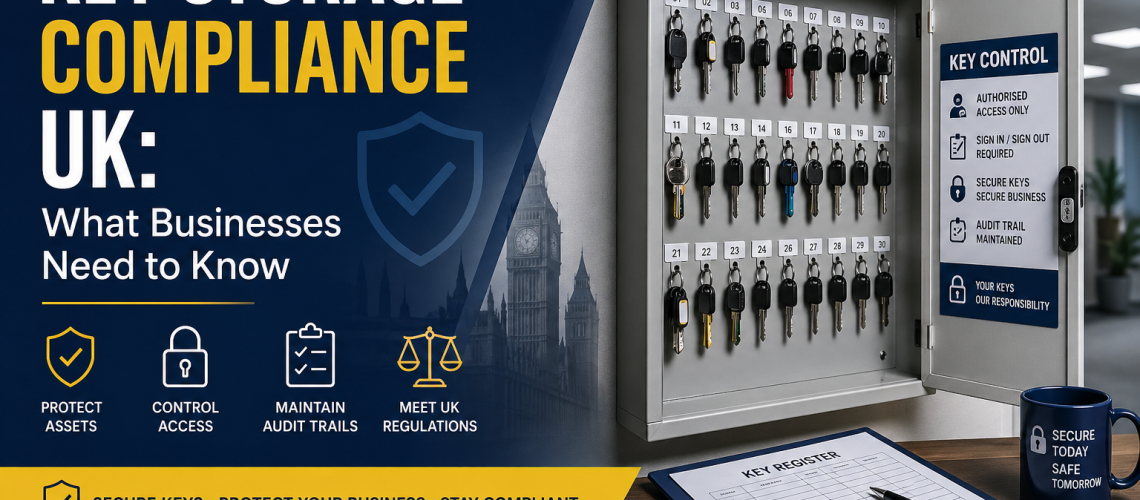
Key storage compliance is primarily about governance, accountability and evidence. A business should be able to explain which important keys it controls, who is responsible for them, which users or roles are authorised, what happens when circumstances change and what evidence shows that the control process is actually being maintained.
The key cabinet itself is only one component. A strong cabinet cannot compensate for unclear responsibility, outdated access, missing records or a process that nobody reviews.
This guide focuses specifically on the governance and evidence layer: documented responsibility, access approval, key inventories, review evidence, contractor governance, leavers and role changes, exception records, proportionate retention and evidence that may be required for internal assurance, contracts, insurers or sector-specific requirements.
For the day-to-day workplace procedure, use Managing Keys in the Workplace UK. For recording individual key movements, use Key Tracking Methods UK. For choosing the overall manual, electronic, centralised or departmental control model, use Key Control Systems UK.
Quick Answer: What Does Good Key-Control Governance Need?
A proportionate key-control framework should normally be able to demonstrate:
- which important keys are controlled;
- who owns the key-control process;
- which roles are authorised to access higher-risk keys;
- how access decisions are approved where necessary;
- what evidence is retained;
- how contractors and temporary access are governed;
- how access is reviewed when staff roles change;
- how lost, unreturned or otherwise exceptional keys are handled;
- when the framework was last reviewed;
- and whether any contractual, insurer or sector-specific requirements also apply.
The level of governance should be proportionate to the consequence of loss, misuse or unauthorised access. A routine cupboard key does not necessarily need the same evidence and oversight as a master key, vehicle key, safe key or key controlling access to sensitive information.
What Does Key Storage Compliance Mean?
In practical terms, key storage compliance means being able to show that important physical keys are subject to appropriate control rather than relying on informal knowledge or habit.
That normally involves four layers:
| Layer | Governance question |
|---|---|
| Responsibility | Who owns the key-control framework? |
| Authorisation | Who is supposed to have access? |
| Evidence | What records show that the control exists and is being followed? |
| Review | How does the organisation check that the control remains appropriate? |
Compliance does not automatically require electronic key management. A well-controlled manual process may provide suitable evidence in one organisation, while another may need more structured or electronic control because its users, risks or contractual requirements are different.
Does UK Law Require a Specific Type of Key Cabinet?
There is no universal key-cabinet specification that applies to every UK business. The appropriate control depends on what the key protects, the risk associated with unauthorised access and any legal, contractual, insurer or sector-specific requirements that apply.
Physical keys may form part of the controls surrounding:
- personal or confidential records;
- restricted staff areas;
- valuable assets;
- vehicles;
- plant or equipment;
- customer or tenant property;
- safe or secure storage;
- or locations governed by contractual or sector-specific requirements.
The organisation should therefore identify the obligations that actually apply to the protected area or asset rather than assuming that buying a particular cabinet automatically creates compliance.
Where legal, regulatory, insurer, contractual or sector requirements apply, those requirements should take precedence over generic guidance.
Governance Starts With Clear Responsibility
A key-control framework should have a defined owner.
Depending on the organisation, responsibility may sit with facilities, security, administration, property management, fleet management, a site manager or another designated role.
That role may be responsible for:
- overseeing the controlled-key inventory;
- making sure higher-risk access has an appropriate approval route;
- reviewing missing or exceptional keys;
- checking that leavers and role changes are reflected;
- overseeing contractor and temporary access governance;
- reviewing whether the existing controls remain appropriate;
- and retaining evidence of significant reviews or corrective actions.
Responsibility should be attached to a role or documented function rather than existing only as informal knowledge held by one employee.
Classify Important Keys by Risk
Different keys can justify different levels of governance.
| Key category | Possible governance approach |
|---|---|
| Routine low-risk keys | Basic ownership and storage control may be sufficient |
| Frequently shared operational keys | Clear responsibility and movement evidence may be appropriate |
| Vehicle or asset keys | Stronger accountability may be justified |
| Master keys | Restricted authorisation and stronger review |
| Keys to confidential or restricted areas | Access should support the underlying security requirement |
| Safe or high-value asset keys | Separate or stronger governance may be justified |
The point is not to create arbitrary categories. It is to apply greater oversight where loss or misuse would have greater consequences.
Maintain a Controlled-Key Inventory
An organisation should be able to identify the important keys that fall within its control framework.
A key inventory is different from a detailed movement log. Its purpose is to establish what controlled keys exist and how they fit into the governance structure.
At a high level, the inventory may identify:
- a unique reference;
- the key or key group being controlled;
- the relevant area, asset or function;
- its broad risk classification;
- the responsible role;
- the authorised role or group;
- known spare or duplicate keys where relevant;
- and the current review status.
The exact transaction fields used when a key moves belong in Key Tracking Methods UK.
Document Key Access Governance
For important keys, the organisation should be able to explain why particular people or roles have access.
- define which roles may use higher-risk keys;
- identify who can approve exceptional access where necessary;
- avoid granting broad access simply because it is convenient;
- review access after role changes;
- remove access where there is no longer an operational need;
- and record significant exceptions to normal access rules.
This page owns the governance requirement that authorisation should be defined and reviewable. The practical control model used to deliver that authorisation belongs in Key Control Systems UK.
What Key-Control Evidence Should Be Retained?
The purpose of retaining evidence is to demonstrate that the control framework exists and that important exceptions and reviews have been dealt with.
Depending on the organisation and risk, evidence may include:
- a current controlled-key inventory;
- documented responsibility;
- access approvals for higher-risk keys where required;
- issue and return evidence where appropriate;
- contractor or temporary-access evidence;
- leaver or role-change checks;
- missing-key and exception records;
- corrective actions;
- and dated reviews of the key-control framework.
Not every organisation needs every record. Evidence should reflect the actual risk and the legal, contractual, insurer or internal requirements that apply.
How Long Should Key-Control Records Be Kept?
There is no useful universal retention period for every type of key-control record.
Retention should be based on why the record exists.
- What operational purpose does the record serve?
- Does it contain personal information?
- Is it required by an internal policy?
- Does a contract or insurer require evidence for a particular period?
- Is the information still needed to investigate unresolved incidents?
- Does keeping it longer provide any legitimate benefit?
Organisations should avoid retaining personal information indefinitely simply because it is easy to keep.
A defined retention approach also makes the control framework easier to review because staff understand which records should remain active and which can be securely removed when no longer needed.
Personal Data in Key-Control Records
Key-control records can contain personal information where they identify employees, contractors, visitors or other individuals who have been authorised to use or have received particular keys.
Where personal information is recorded, the organisation should consider whether each item of information is actually necessary for the control purpose.
- collect only the information needed for the purpose;
- restrict access to the records appropriately;
- keep records accurate enough to remain useful;
- define a proportionate retention approach;
- and dispose of information securely when it is no longer required.
The key-management record should not become a repository for unnecessary personal information.
Physical Keys and Data Protection
Physical key control can form part of wider information-security arrangements where keys provide access to filing rooms, archives, HR records, server rooms, locked cabinets or other locations containing personal or confidential information.
The relevant question is not whether a particular cabinet is labelled as compliant. It is whether the physical access controls are appropriate to the risk and support the organisation’s wider security arrangements.
Key management by itself does not establish data-protection compliance, but weak physical access control can undermine otherwise sensible organisational and technical security measures.
Insurance and Key-Control Evidence
Insurance requirements vary by insurer, policy, property and risk. Businesses should check the wording that actually applies to them rather than assuming that one cabinet type or generic key procedure satisfies every policy.
Where keys protect insured assets, useful governance evidence may include:
- a maintained controlled-key inventory;
- defined responsibility;
- restricted access to important keys;
- issue and return evidence where relevant;
- documented missing-key incidents;
- evidence of corrective action;
- and dated reviews of the control framework.
If an insurer or broker specifies particular physical or procedural requirements, those requirements should be checked against the actual policy and followed where applicable.
Contractor and Visitor Governance
Temporary key access should be governed rather than treated as an undocumented exception.
For higher-risk access, the organisation may need to be able to establish:
- why temporary access was required;
- which role approved it;
- which key or area was involved;
- when the access started;
- when it should have ended;
- whether the key was returned or access otherwise closed;
- and whether any exception occurred.
The practical process for handing keys to contractors belongs in Managing Keys in the Workplace UK.
Governance for Leavers and Role Changes
Access should be reviewed when somebody leaves the organisation or changes responsibilities.
The governance requirement is that historic access should not simply continue by default.
- identify physical keys associated with the person or role;
- confirm appropriate recovery or reassignment;
- remove relevant electronic permissions where applicable;
- review shared codes where relevant;
- update the controlled-key inventory;
- record any unresolved missing keys;
- and assess whether further security action is required.
The operational steps for recovering keys from leavers belong in Managing Keys in the Workplace UK. This page owns the requirement that the change should be governed, reviewable and evidenced where appropriate.
Exception Handling and Missing Keys
A useful control framework needs a defined response when the normal process fails.
Examples include:
- missing or stolen keys;
- unreturned contractor keys;
- unknown duplicate keys;
- unauthorised copying;
- access granted outside normal policy;
- shared codes that remain active after staff changes;
- and repeated failures to follow the normal control process.
Significant exceptions should be recorded clearly enough to establish what happened, who assessed the issue and what corrective action was taken.
The detailed physical response to a lost workplace key belongs in Managing Keys in the Workplace UK.
What Should a Key-Control Incident Record Show?
The purpose of an incident record is not to reproduce the normal sign-out log. It should document an important exception and the response to it.
Depending on the incident, useful evidence may include:
- which key or key group was affected;
- when the problem was identified;
- the nature of the exception;
- the responsible manager or reviewer;
- the risk assessment or decision made;
- the corrective action;
- whether locks, permissions or procedures were changed;
- and when the incident was considered closed.
Keep the record proportionate. A minor late return does not necessarily need the same level of documentation as the loss of a master key or key to a high-risk area.
How Often Should Key Controls Be Reviewed?
There is no single daily, weekly, monthly or quarterly review interval that is appropriate for every organisation.
Review frequency should be proportionate to factors such as:
- the risk associated with the keys;
- the number of controlled keys;
- the number of authorised users;
- how frequently key access changes;
- contractor and temporary access;
- staff turnover;
- site complexity;
- the consequence of losing an important key;
- previous control failures;
- and any internal, insurer, contractual or sector-specific requirements.
The important governance point is that the organisation can explain why its review approach is appropriate and can demonstrate that significant reviews actually took place.
What Should a Key-Control Review Check?
- the controlled-key inventory is still current;
- key classifications remain appropriate;
- responsibility for the framework is still clear;
- authorised roles remain appropriate;
- leaver and role-change access has been removed;
- contractor access has been closed correctly;
- important spare and duplicate keys remain accounted for;
- missing or unresolved keys have been addressed;
- exception records are complete where required;
- retention rules are still appropriate;
- corrective actions have been completed;
- and the control framework still reflects the actual organisation and site.
Detailed daily key counts and transaction records belong in the operating and tracking processes. Governance review should focus on whether the overall framework remains effective and evidenced.
Key Control and Internal Audit
An internal audit or assurance review should be able to test whether the organisation’s stated key-control framework matches what is actually happening.
Potential evidence may include:
- documented ownership;
- current key inventories;
- access approvals where required;
- sample movement records;
- leaver checks;
- contractor-access records;
- incident records;
- review dates;
- and evidence that identified problems were corrected.
The purpose is not simply to prove that records exist. It is to establish whether the controls described by the organisation are actually operating.
Review the Policy After Significant Incidents
A significant missing-key incident, unauthorised duplication, repeated contractor failure or other control breakdown can reveal weaknesses that routine reviews have missed.
After a significant incident, consider whether:
- the affected key was classified appropriately;
- access was too broad;
- responsibility was unclear;
- movement evidence was inadequate;
- the escalation route worked;
- staff understood the procedure;
- the existing control model remains suitable;
- or stronger physical storage is now justified.
The objective is to improve the control framework rather than simply close the incident record.
Sector-Specific Key Governance
Different sectors may have different reasons for applying stronger key controls, but the underlying governance principles remain similar: identify what is being protected, define appropriate access, retain useful evidence and review the controls.
| Environment | Typical governance concern |
|---|---|
| Schools | Site access, safeguarding considerations, confidential records and contractor access |
| Healthcare and care | Restricted areas, confidential information and controlled storage |
| Property management | Property traceability, contractor access and large numbers of controlled keys |
| Retail and hospitality | Cash, stock, opening and closing access, and shared management responsibility |
| Industrial and warehouse sites | Plant, equipment, restricted areas and shift-based access |
| Vehicle fleets | Asset accountability and evidence of authorised vehicle-key access |
Where a sector has specific statutory, contractual, insurer or organisational requirements, those requirements should be incorporated into the organisation’s own governance framework.
What Belongs on the Other Key-Management Guides
Discover more from Blog Total Locker Service
Subscribe to get the latest posts sent to your email.
Discover more from Blog Total Locker Service
Subscribe to get the latest posts sent to your email.