BS 7558 Gun Cabinets Explained: UK Firearm Storage Guide
June 24, 2026
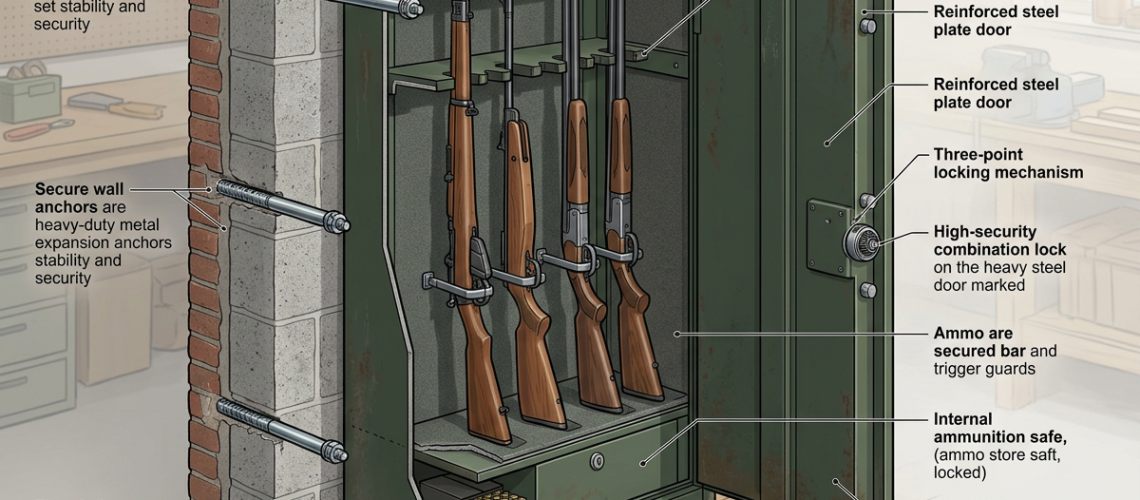
BS 7558 is one of the most important terms to understand when choosing a gun cabinet, gun safe or firearm storage cabinet in the UK. It is commonly referenced in firearms security guidance, police storage assessments and product specifications for shotgun cabinets, rifle cabinets and ammunition storage. If you are comparing suitable storage options, you can browse our BS 7558 gun safes and firearm cabinets before using this guide to understand the key checks.
This article explains what BS 7558 means in practical buying terms. It also explains what the standard does not do. A cabinet being described as BS 7558 does not remove the need for correct installation, suitable fixing, sensible location choice and responsible day-to-day use. Firearm storage is always assessed in context. The property, certificate holder, number of firearms, local risk level and advice from the local firearms licensing officer can all matter.
The aim is simple. By the end of this guide, you should understand why BS 7558 matters, what to check on a cabinet before ordering, how it relates to secure fixing, and how to link the standard with wider choices such as cabinet size, lock type, ammunition storage and installation location.
What Is BS 7558?
BS 7558 is a British Standard associated with gun cabinets and secure firearm storage cabinets. In practical terms, it is used to identify cabinets that are built for the secure storage of firearms, shotguns and related equipment. It is especially relevant when comparing gun cabinets for UK certificate holders because it gives a recognised construction benchmark rather than leaving the buyer to judge security from appearance alone.
Many product descriptions refer to BS 7558 gun cabinets, BS 7558 shotgun cabinets or BS 7558 firearm safes. These terms are often used by buyers searching for suitable storage before or after a firearms licensing inspection. The wording can vary between suppliers, but the intent is usually the same: the buyer wants a cabinet designed for recognised secure firearm storage rather than a general domestic safe or light metal cupboard.
That distinction matters. A general safe may be strong, but it may not have the internal layout, firearm rests, cabinet height or fixing arrangement required for practical firearm storage. A light metal cupboard may provide enclosure, but it is not the same thing as a purpose-made gun cabinet. BS 7558 helps buyers focus on products that are designed for this specific security role.
Why BS 7558 Matters for UK Firearm Storage
UK firearm storage is not only about owning a locked box. It is about preventing unauthorised access. A cabinet needs to resist casual interference, be fixed in a suitable way and be located where it is not unnecessarily visible or vulnerable. BS 7558 matters because it gives a recognised benchmark for cabinet construction, but it is only one part of the full storage picture.
In many domestic and sporting settings, a BS 7558 gun cabinet is the standard starting point. It gives the certificate holder a purpose-made storage product to discuss with the local firearms licensing officer. It also gives the buyer a clearer way to compare cabinets than simply looking at colour, price or capacity.
For most buyers, the standard helps answer three questions:
- Is this cabinet designed for firearm storage? A BS 7558 cabinet is intended for this type of security use.
- Is it likely to be taken seriously during a storage assessment? BS 7558 is a recognised reference point in UK firearm storage guidance.
- Can I compare it properly against other gun cabinets? The standard helps buyers avoid comparing proper gun cabinets with ordinary steel cupboards.
However, BS 7558 should not be treated as a magic label. Final suitability can still depend on cabinet placement, wall or floor fixing, the number and type of firearms stored, and the risk assessment made by the local police firearms licensing team.
BS 7558 Does Not Automatically Mean “Approved in Every Situation”
One common mistake is to assume that a BS 7558 gun cabinet is automatically approved for every certificate holder, every property and every collection. That is too simple. A suitable cabinet can still be installed badly. A good cabinet can still be placed in a poor location. A cabinet that works well for one shotgun may be unsuitable for several firearms, scoped rifles or additional ammunition storage.
This is why phrases such as “police approved gun safe” need care. In everyday search language, buyers often use that phrase to mean a cabinet that is likely to meet police expectations. In practice, approval is not just a product label. The storage arrangement is assessed in context. For more detail on this wording, read our related guide: Police Approved Gun Safe: What It Really Means in the UK.
A better way to think about BS 7558 is this: it is a strong product selection signal, not the whole compliance process. It helps you choose the right type of cabinet, but correct fixing, suitable location and responsible use are still essential.
Gun Cabinet, Gun Safe or Firearm Cabinet?
The terms gun cabinet, gun safe, firearm cabinet and shotgun cabinet are often used interchangeably in the UK. There are differences in how suppliers present products, but buyers often use these terms to describe the same basic requirement: secure storage for firearms, shotguns, rifles or ammunition.
A gun cabinet is usually a steel cabinet designed specifically for firearms. A gun safe may be used as a broader term, especially where the product is heavier, more secure or marketed alongside other safes. A shotgun cabinet is usually tall enough for shotguns and may be available in different capacities. A rifle cabinet may need extra usable depth or height, especially if scopes, moderators or accessories are fitted.
For SEO and buyer clarity, it is useful to recognise all these terms. A customer may search for “BS 7558 gun cabinet”, “gun safes UK”, “shotgun cabinet”, “rifle cabinet” or “firearm storage cabinet” while looking for the same general product family. The safest buying approach is to focus on the specification rather than the name alone.
What to Check on a BS 7558 Gun Cabinet Before Buying
Before ordering a gun cabinet, check more than the headline capacity. The phrase “5 gun cabinet” can be useful, but it does not tell the full story. Real capacity depends on the internal layout, whether firearms have scopes fitted, how the rests are arranged and whether there is a lockable ammunition compartment taking up internal space.
Use the following checks before choosing a cabinet:
- Cabinet capacity: Check whether the cabinet is intended for one firearm, several shotguns or multiple rifles.
- Internal height: Make sure the cabinet is tall enough for the firearms you need to store.
- Usable depth: Scoped rifles may need more depth than plain shotguns.
- Door opening: A tight door opening can make access awkward even when the internal space looks adequate.
- Fixing points: Check whether the cabinet has wall fixing, floor fixing or both.
- Lock type: Decide whether you prefer key locking or an electronic lock, where available.
- Ammunition storage: Check whether there is a separate lockable compartment or whether a separate ammunition safe is better.
- Delivery and placement: Larger cabinets may need more planning for safe delivery and positioning.
If you are unsure about capacity, it is often sensible to choose slightly more space than your immediate need. A cabinet that is full on day one may become frustrating if your certificate changes, you add another shotgun, or you start storing accessories alongside the firearm.
Gun Cabinet Capacity: Why the Number Is Only a Guide
Gun cabinet capacity is often shown as 1 gun, 3 gun, 5 gun, 7 gun or 10 gun. This is useful, but it can be optimistic. Capacity labels usually assume standard firearm shapes and close spacing. Once scopes, moderators, slings or accessories are involved, the practical number may be lower.
A 3 gun cabinet may be suitable for a single shotgun owner who wants spare room. A 5 gun cabinet can be a better long-term choice for buyers who want more flexibility. Larger cabinets suit certificate holders who need room for multiple firearms or who want to avoid upgrading later. For a deeper size comparison, see our related guide: Gun Safe Sizes Explained: 3 Gun vs 5 Gun vs 10 Gun Models.
The best size is not always the smallest compliant size. It is the cabinet that fits the firearms, fits the property and can be fixed securely in a sensible location.
Shotgun Cabinets and Rifle Cabinets: Different Practical Needs
Shotguns and rifles can place different demands on a cabinet. Shotguns often require height, but may not need as much depth as scoped rifles. Rifles with optics can need more usable depth, more careful spacing and better clearance around the door opening. If the cabinet is too narrow or shallow, firearms may rub together or become awkward to remove.
When comparing BS 7558 gun cabinets, check the internal measurements rather than relying only on the advertised capacity. For rifles, think about scope height. For shotguns, think about length and number of guns. For mixed storage, allow spare room. A cabinet that works for several plain shotguns may not work as well for a mixed collection of shotguns and scoped rifles.
Ammunition Storage and Lockable Compartments
Some gun cabinets include a separate lockable internal compartment for ammunition. This can be convenient because it keeps ammunition storage within the same cabinet footprint. However, internal compartments reduce the space available for firearms, and not every buyer wants the same arrangement.
In other cases, a separate ammunition safe may be the better option. This can give more flexibility, especially where the gun cabinet is already close to capacity. If you are comparing ammunition storage options, view our dedicated ammunition safes page or read the wider secure storage guidance in our Gun Safes UK Legal Requirements and Buying Guide.
The important point is to check the exact arrangement before buying. Do not assume that every gun cabinet includes a lockable ammunition compartment. Do not assume that a compartment will be large enough for your future needs. Look at the product specification, internal layout and certificate conditions before making a final choice.
Fixing a BS 7558 Gun Cabinet Correctly
A good cabinet still needs correct fixing. A gun cabinet that can be lifted, tipped, prised or removed is not providing the same level of security as one fixed to a suitable building structure. Fixing should be considered before ordering because the available wall, floor or structural position may influence the cabinet size and type you choose.
Most domestic gun cabinets are fixed to a solid wall, floor or structural surface. The correct method depends on the building fabric. Brick, block, concrete, timber and stud wall situations are not all the same. If the fixing point is weak, the cabinet security can be compromised even if the cabinet itself is well made.
Before installation, consider:
- whether the wall or floor is strong enough for secure fixing;
- whether the cabinet can be fixed through the provided fixing points;
- whether the cabinet can be positioned discreetly;
- whether there is enough space to open the door fully;
- whether the location avoids unnecessary damp or condensation risk;
- whether the cabinet can be delivered safely to the chosen location.
For location planning, read our related article: Where Should You Install a Gun Safe in a UK Home?.
Where Should a Gun Cabinet Be Installed?
The best cabinet location is normally secure, discreet, structurally suitable and practical for the certificate holder. A visible or easily accessible location can increase risk. A damp or unheated location can create maintenance problems. A difficult location may make correct fixing harder.
Bedrooms, cupboards, utility areas and other internal locations may be considered depending on the property. The right location depends on the building and the advice of the local firearms licensing officer. Avoid assuming that the same location will be suitable for every home.
Outbuildings and sheds require particular care. They may introduce higher security risk, moisture risk and fixing challenges. In some cases they may be unsuitable. In other cases, additional security and environmental control may be required. For more detail, read Can You Keep a Gun Safe in a Shed in the UK?.
Key Lock or Electronic Lock?
BS 7558 gun cabinets may be supplied with different lock options depending on the model. Key locks are simple, mechanical and widely used. They do not need batteries and can be very dependable when looked after properly. Electronic locks can offer convenient access, but require battery management and careful use.
The best lock type depends on the certificate holder’s routine, preference and risk tolerance. A key lock may be ideal for someone who wants simple long-term reliability. An electronic lock may suit someone who wants keypad access and is disciplined about battery checks. The cabinet construction, installation and responsible access control still matter whichever lock type is chosen.
For a fuller comparison, read Key Lock vs Electronic Gun Safes: Which Is Better in the UK?.
BS 7558 and Insurance Expectations
Insurance requirements can vary. Some insurers may ask about secure storage, fixing, the value of firearms or the security arrangements at the property. A BS 7558 gun cabinet can help demonstrate that you have selected a purpose-made firearm storage product, but insurers may still have their own requirements.
If you hold higher value firearms, multiple firearms or specialist equipment, you may need to check your policy wording carefully. Keep product information, invoices and installation details where possible. If an insurer asks for proof of secure storage, clear documentation can be useful.
For more detail, read Gun Safe Insurance Requirements UK: What Insurers Expect.
Maintenance and Condensation Control
A gun cabinet is not a fit-and-forget product. Long-term secure storage also depends on basic maintenance. Check the lock operation, hinges, fixings and cabinet condition at sensible intervals. Keep the inside dry and clean. If the cabinet is in a location with changing temperature or humidity, consider condensation control.
Condensation can create corrosion risk, especially in unheated or poorly ventilated areas. Silica gel, dehumidifier rods or other moisture-control products may help depending on the location and cabinet type. The main point is to inspect the cabinet and stored items rather than assuming that a locked cabinet alone solves every storage issue.
For practical maintenance guidance, read Gun Safe Maintenance and Condensation Control.
Common Mistakes When Buying a Gun Cabinet
Many gun cabinet problems begin before installation. A buyer chooses the smallest cabinet, does not check internal dimensions, ignores fixing requirements or assumes that every cabinet described as a gun safe is suitable for their exact situation. These mistakes can lead to awkward use, early replacement or a storage arrangement that needs further work.
Avoid these common mistakes:
- Buying too small. Allow for future needs, accessories and realistic spacing.
- Ignoring internal depth. Scoped rifles may need more space than expected.
- Choosing a poor fixing location. The cabinet must be fixed to a suitable structure.
- Overusing “police approved” language. Suitability depends on the full storage arrangement.
- Forgetting ammunition storage. Check whether an internal compartment is included and large enough.
- Installing in a damp area. Moisture can create long-term maintenance problems.
- Not checking access. Make sure the door can open fully and firearms can be removed safely.
BS 7558 Gun Cabinet Buying Checklist
Use this checklist before buying a BS 7558 gun cabinet or firearm safe:
- Does the product state BS 7558 or an equivalent recognised construction standard?
- Is the cabinet suitable for firearms, shotguns, rifles or ammunition as required?
- Is the internal height suitable for your longest firearm?
- Is the usable depth suitable for scopes, moderators or accessories?
- Is the advertised capacity realistic for your collection?
- Does the cabinet include a separate ammunition compartment if you need one?
- Are the fixing points suitable for the intended wall or floor?
- Can the cabinet be positioned discreetly?
- Can the cabinet be delivered safely to the installation area?
- Have you checked any specific advice from your local firearms licensing officer?
If several of these answers are uncertain, pause before ordering. It is usually easier to choose correctly at the start than to replace a cabinet after installation.
How BS 7558 Fits Within the Wider Gun Safe Canister
This article focuses on BS 7558, but it should sit alongside the wider gun-safe content canister. Each guide answers a different search intent. Together, they help buyers move from general compliance research to choosing a suitable product.
- Gun Safes UK: Legal Requirements, Insurance Rules and Buying Guide explains the wider buying process.
- Police Approved Gun Safe: What It Really Means in the UK clarifies a common search phrase.
- Gun Safe Sizes Explained helps buyers choose cabinet capacity.
- Key Lock vs Electronic Gun Safes compares lock types.
- Gun Safe Insurance Requirements UK covers insurer expectations.
- Gun Safe Maintenance and Condensation Control supports long-term ownership.
- Where Should You Install a Gun Safe in a UK Home? covers location choice.
- Can You Keep a Gun Safe in a Shed in the UK? answers a high-risk long-tail query.
- What Size Gun Safe Do Police Expect in the UK? covers storage-size expectations.
Choosing a BS 7558 Gun Cabinet from Total Locker Service
Total Locker Service supplies secure storage products for UK customers, including gun safes, shotgun cabinets, rifle cabinets and ammunition storage options. When choosing a cabinet, start with the number and type of firearms you need to store. Then check the internal height, capacity, fixing points, lock type and ammunition storage arrangement.
For many buyers, the best cabinet is not the cheapest or the smallest. It is the product that provides enough internal space, can be installed securely and gives a practical storage arrangement for daily use. A slightly larger cabinet can often be a better long-term choice, especially where a certificate holder expects future changes.
Browse the available range here: Gun Safes UK: BS 7558 Firearm and Shotgun Cabinets.
BS 7558 Gun Cabinet FAQs
Is a BS 7558 gun cabinet required by law?
BS 7558 is a recognised standard used in UK firearm storage guidance, but storage suitability is assessed in context. Always follow your certificate conditions and the advice of your local firearms licensing officer.
Does a BS 7558 cabinet guarantee police approval?
No. A BS 7558 cabinet is a strong product-selection signal, but approval depends on the full arrangement. Correct fixing, suitable location, firearm type, property risk and local assessment all matter.
Can ammunition be stored in the same gun cabinet?
Some gun cabinets include a separate lockable internal compartment for ammunition. In other cases, a separate ammunition safe may be more suitable. Check the product layout and any certificate or licensing advice that applies to you.
What size BS 7558 gun cabinet should I buy?
Choose a cabinet with enough internal height, depth and capacity for your firearms, plus spare space for future changes. Scoped rifles and accessories can reduce practical capacity, so do not rely only on the advertised gun count.
Where should I install a BS 7558 gun cabinet?
Choose a discreet, structurally suitable location where the cabinet can be fixed securely. Avoid obvious visibility, weak fixing surfaces and damp areas where possible. Local firearms licensing advice should guide the final arrangement.
Final Thoughts
BS 7558 is an important standard for UK gun cabinets, but it should be understood properly. It helps buyers identify purpose-made firearm storage cabinets and compare products more intelligently. It does not replace correct installation, sensible location choice or local firearms licensing assessment.
The best buying decision combines product specification with practical use. Check the cabinet standard, internal size, lock type, ammunition storage, fixing points and installation location before ordering. If you need a secure cabinet for firearms, shotguns, rifles or ammunition, start with a suitable BS 7558 gun safe and then make sure it is installed and used correctly.
Discover more from Blog Total Locker Service
Subscribe to get the latest posts sent to your email.