Locker Regulations UK: What Employers Must Provide
February 18, 2026
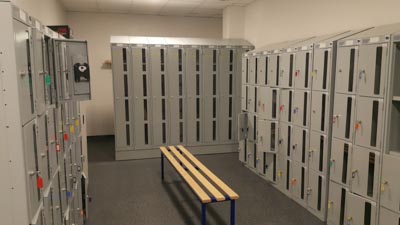
Locker regulations in the UK are not always straightforward. While there is no single law titled “locker legislation”, multiple workplace and safety regulations require employers to provide appropriate storage facilities. In schools, factories and leisure centres, lockers often form part of compliance infrastructure.
This guide explains what UK employers must provide in relation to lockers. It covers Workplace Welfare Regulations, HSE guidance, education obligations, leisure facility standards and fire escape planning.
For a broader overview of locker types and applications, see our complete lockers guide.
Workplace (Health, Safety and Welfare) Regulations
The Workplace (Health, Safety and Welfare) Regulations 1992 require employers to provide suitable and sufficient facilities for storing clothing where workers change into special workwear.
This typically applies in industries where:
- Protective clothing is required
- Workwear may become contaminated
- Uniforms must not be worn outside the workplace
Where there is a risk of contamination, employers must ensure that personal clothing can be kept separate from work clothing. This often means providing twin-compartment or clean/dirty lockers.
HSE Guidance on Storage Facilities
The Health and Safety Executive (HSE) provides guidance supporting the Workplace Regulations. Employers must ensure that welfare facilities are appropriate for the number of employees and the nature of work undertaken.
HSE guidance indicates that:
- Storage must be secure.
- Facilities must be adequate for the workforce size.
- Clean and contaminated clothing should not mix.
- Lockers should be suitably ventilated where necessary.
Failure to provide adequate storage facilities can be considered a breach of welfare obligations.
Education Sector Obligations
In schools and colleges, locker provision is not mandated by a single statute. However, schools have safeguarding, supervision and duty-of-care responsibilities that often make lockers appropriate or necessary.
Considerations include:
- Safe storage of personal belongings
- Reduction of corridor congestion
- Minimising trip hazards from bags
- Supporting structured behaviour policies
Where physical education or specialist subjects require kit storage, lockers help meet organisational and safety standards.
Leisure and Changing Facility Standards
Leisure centres, gyms and swimming pools operate under broader health and safety obligations. Lockers in these environments support hygiene, security and safe changing arrangements.
Operators must ensure:
- Safe circulation space around locker banks
- Appropriate ventilation in humid areas
- Durable materials resistant to moisture
- Secure locking mechanisms
Although not always specified by law in detail, locker provision forms part of risk assessments and facility management standards.
Fire Safety and Escape Routes
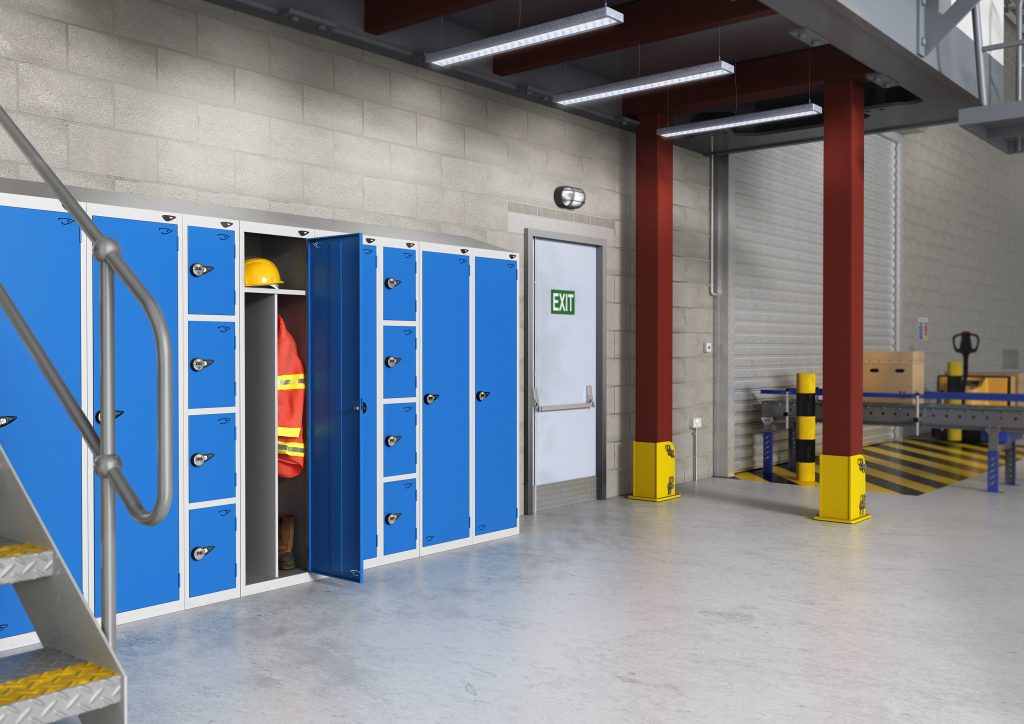
Fire safety legislation, including the Regulatory Reform (Fire Safety) Order 2005, requires that escape routes remain clear and unobstructed. Locker installations must not reduce corridor widths below required minimums.
Employers must consider:
- Minimum aisle widths (often 900mm or more)
- Unobstructed access to fire exits
- Door swing clearance
- Maintaining escape route capacity
Installing lockers without accounting for fire planning can create compliance risks.
Accessibility and Equality Considerations
Under the Equality Act 2010, employers must ensure that facilities are accessible to disabled employees and service users. Locker provision should consider accessibility requirements.
- Accessible locker heights
- Sufficient turning space for wheelchair users
- Clear circulation routes
Accessible lockers should be integrated into main locker banks rather than positioned in isolated locations.
Security Requirements
Employers have a duty of care to provide reasonably secure storage for personal belongings where lockers are offered. Poor-quality locks or flimsy construction may undermine this responsibility.
Security considerations include:
- Quality cam or digital locks
- Reinforced door frames
- Master key systems for management oversight
In higher-risk environments, enhanced locking systems may be appropriate.
What Employers Should Review
- Number of employees requiring lockers
- Whether special clothing is required
- Risk of contamination
- Ventilation needs
- Fire escape planning
- Accessibility compliance
A documented risk assessment should guide locker specification rather than price alone.
Common Compliance Mistakes
- Providing insufficient lockers for workforce size
- Failing to separate clean and contaminated clothing
- Blocking escape routes with locker banks
- Ignoring accessibility requirements
- Using low-grade lockers in high-impact environments
Final Thoughts
Locker regulations in the UK are embedded within broader workplace welfare, safety and equality legislation. While there may not be a single “locker law”, employers have clear obligations to provide appropriate storage where required.
Compliance is achieved through proper risk assessment, suitable materials, adequate spacing and secure locking systems. Lockers are not just storage units. In many environments, they are a core component of workplace welfare and safety planning.
Discover more from Blog Total Locker Service
Subscribe to get the latest posts sent to your email.