Locker Compliance and Regulations UK: What You Need to Know for Safe and Suitable Storage
April 11, 2026
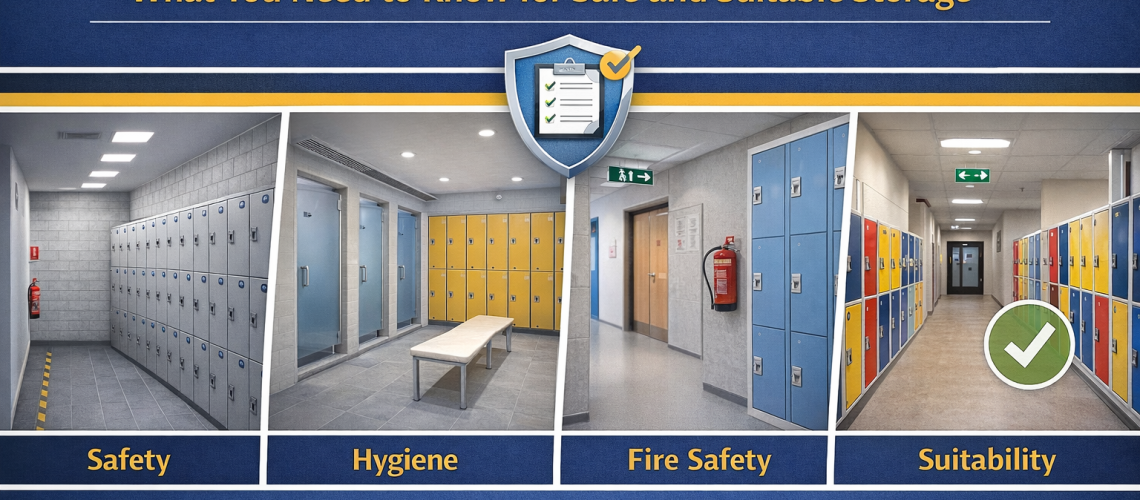
Locker compliance in the UK is not governed by one single “locker regulation”. Instead, locker installations can be affected by wider requirements covering workplace welfare, health and safety, fire risk, accessibility, hygiene, storage of workwear and the specific environment in which the lockers are used.
That means a locker can be perfectly suitable in one setting but inappropriate in another. The correct specification depends on who will use it, what will be stored, where the lockers will be positioned and which legal or operational requirements apply to the site.
This guide explains the main locker compliance and regulatory considerations in the UK. For the complete project-planning process, including dimensions, aisle space, access and installation, see our Locker Planning UK guide.
Quick answer: what regulations apply to lockers in the UK?
There is no single UK law setting one universal specification for commercial lockers. Instead, the relevant requirements depend on the application.
- Workplaces: welfare rules may require suitable and sufficient accommodation for workers’ clothing and, in some circumstances, secure or separate storage.
- Fire safety: locker positioning must be considered within the site’s fire-risk assessment and should not compromise escape routes or emergency access.
- Accessibility: locker position, reach, approach space, locks and surrounding circulation may need to form part of the building’s wider accessible-design provision.
- Healthcare, food production and specialist workplaces: hygiene, contamination control and separation requirements may affect locker material and configuration.
- Schools and public facilities: durability, safe positioning, congestion, supervision and accessibility should be considered alongside any building or organisational requirements.
The locker should therefore be specified as part of the wider building and operational environment rather than treated as an isolated item of furniture.
Why locker compliance matters
Good compliance planning helps ensure that the storage system supports rather than conflicts with the way the building needs to operate.
This can include:
- providing suitable storage for personal clothing and workwear;
- maintaining clear access and escape routes;
- supporting cleaning and hygiene procedures;
- reducing avoidable congestion around locker banks;
- providing appropriate storage for PPE, uniforms or specialist equipment;
- supporting accessible use; and
- making ongoing inspection and maintenance easier.
The strongest approach is to identify the site’s actual requirements before choosing the locker range, configuration or lock type.
Workplace locker regulations and clothing storage
The Workplace (Health, Safety and Welfare) Regulations 1992 require suitable and sufficient accommodation for clothing that workers do not wear while working and for special work clothing that is not taken home.
Where changing facilities are required, the clothing accommodation must provide suitable security. Separate accommodation may also be required where necessary to avoid risks to health or damage to clothing.
HSE guidance explains that secure clothing storage can, for example, be provided through a lockable locker for each worker. Where work clothing or PPE becomes dirty, damp or contaminated, it should be stored separately from personal clothing where necessary.
For workplace projects, see our workplace lockers and our detailed Workplace Lockers UK guide.
When do staff need changing facilities?
Workplace changing facilities may be required where employees have to wear special clothing for work and cannot reasonably be expected to change elsewhere for reasons of health or propriety.
Where changing facilities are required, the Workplace Regulations state that they should be easily accessible, of sufficient capacity and provided with seating. HSE guidance also expects clothing accommodation to be associated appropriately with changing and washing facilities.
This is why lockers, benches and changing-room circulation should normally be planned together rather than as unrelated purchases. For staff-changing layouts, see our workplace changing room guide.
Separate personal clothing from contaminated workwear where required
Some workplaces need more than a simple personal locker. Where work clothing becomes contaminated, dirty or wet as part of the job, storing it together with clean personal clothing may be inappropriate.
Depending on the risk and process, the solution may involve:
- separate compartments within one locker;
- separate clean and dirty lockers;
- dedicated workwear storage;
- drying arrangements where clothing becomes wet; or
- a wider changing-room zoning system.
For detailed planning of clean, dirty, wet and dry areas, see our Locker Room Zoning Guide UK.
Locker stability, fixing and safe installation
Locker safety depends partly on the way the units are installed. Tall or lightweight storage equipment can become unstable if it is incorrectly positioned, loaded or restrained.
There is no universal rule that every locker must be fixed to a wall in exactly the same way. The correct installation method depends on the locker range, bank arrangement, supporting structure, manufacturer’s guidance and site risk assessment.
Installation planning should consider:
- manufacturer installation instructions;
- locker height, depth and configuration;
- wall and floor construction;
- whether lockers are linked into banks;
- stands, plinths or supporting frames;
- expected loading; and
- the behaviour and age of the user group.
For installation and space planning, use our Locker Planning UK guide.
Locker doors must not compromise circulation
A locker bank occupies more space when it is being used than when every door is closed. Users need room to stand, open the door, retrieve belongings and move away while other people may be passing behind them.
Planning should therefore account for:
- locker-door projection;
- users standing in front of open lockers;
- bench seating opposite locker banks;
- main pedestrian routes;
- entrances and doorways; and
- access for cleaning and maintenance.
For detailed working clearances, see our Locker Aisle Width Guide UK.
Fire safety and locker placement
Locker installations should be considered as part of the building’s fire-risk assessment. Fire-safety duties apply to the premises as a whole, so locker placement should not create an obstruction or undermine the escape strategy.
In practical terms, check that locker banks do not:
- reduce required escape-route widths;
- obstruct fire doors or final exits;
- block access to firefighting equipment;
- hide essential emergency signage;
- create trip or collision hazards within an escape route; or
- conflict with the findings of the site’s fire-risk assessment.
UK fire-safety guidance specifically requires escape routes to remain usable and unobstructed. Where lockers are proposed within corridors or circulation spaces, their suitability should therefore be assessed as part of the fire-risk process rather than assumed.
Can lockers be placed in corridors?
There is no simple rule saying that lockers are either always permitted or always prohibited in corridors. The answer depends on the building layout, escape strategy, available route width, locker construction and the findings of the fire-risk assessment.
Government fire-safety guidance notes that some relatively low-risk items, including non-combustible lockers, may be acceptable in certain escape-route situations where minimum exit widths are maintained and the fire-risk assessment supports the arrangement.
That should not be interpreted as automatic approval. The responsible person or competent fire-safety adviser should assess the actual installation.
Locker materials should suit the environment
Compliance is not simply a question of whether a locker is metal, plastic or laminate. The material and construction should be suitable for the environmental conditions and operational requirements of the site.
Factors can include:
- humidity and water exposure;
- frequency and type of cleaning;
- risk of corrosion;
- expected physical abuse;
- hygiene requirements;
- stored chemicals or equipment; and
- fire-risk considerations within the particular building.
For general dry environments, compare our metal lockers. For the complete selection of commercial locker materials and applications, see our locker range.
Hygiene and cleaning requirements
Locker hygiene becomes particularly important in healthcare, food production, leisure centres and workplaces where employees change out of work clothing.
The storage system should support the site’s cleaning and contamination-control process. Relevant considerations may include:
- materials that tolerate the required cleaning regime;
- surfaces and details that can be cleaned effectively;
- clear access beneath or around lockers;
- ventilation where appropriate for the stored items;
- separation of personal and contaminated workwear where required; and
- avoiding inaccessible areas where dirt or moisture can accumulate.
For routine housekeeping considerations, see our changing room cleaning and maintenance guide.
Healthcare locker compliance
Healthcare staff storage needs to be considered alongside local infection-control procedures, uniforms, PPE, shift patterns and the division between clinical and non-clinical activities.
Depending on the department and role, planning may need to consider:
- personal clothing and uniform separation;
- clean and used workwear;
- PPE storage;
- cleaning access;
- staff access control; and
- shift-change demand.
For sector-specific planning, see our Healthcare Staff Lockers UK guide.
Food-industry lockers and contamination control
Food-production sites may need stricter separation between personal clothing and work clothing, together with materials and layouts that support the site’s hygiene procedures.
The correct arrangement depends on the food-safety system, production process and local hygiene controls. Lockers should therefore be specified alongside those procedures rather than from a generic workplace template.
Where clean and dirty separation is required, use our locker-room zoning guide as the planning starting point.
School locker safety and compliance
Schools need locker installations that work safely within busy corridors, changing rooms and communal areas. The main issues are often less about a special “school locker regulation” and more about safe layout, durability, supervision and suitability for the pupil group.
Planning should consider:
- age and height of pupils;
- door opening into busy circulation areas;
- congestion during lesson changes;
- appropriate locking arrangements;
- clear numbering;
- robust construction;
- accessibility; and
- the building’s fire and safeguarding arrangements.
For education-specific specification, see our School Lockers UK guide.
Leisure, gym and wet-area lockers
Gyms, swimming pools and leisure centres add moisture, frequent cleaning and high user turnover to the normal locker specification.
Relevant considerations can include:
- materials suitable for humidity or direct water exposure;
- corrosion resistance;
- easy-clean construction;
- appropriate shared-use or assigned-use locks;
- clear circulation and changing space; and
- regular inspection and maintenance.
The correct lock should be selected separately from the locker material. Compare key, hasp, coin, combination, keypad and RFID options on our locker locks page.
Accessibility and inclusive locker design
Locker accessibility is not achieved simply by providing one low-level compartment. The user must be able to approach the locker, identify it, operate the lock, open the door and reach the usable storage space.
Inclusive locker planning should consider:
- approach and wheelchair manoeuvring space;
- usable reach positions;
- lock and handle height;
- door opening;
- contrast and identification;
- bench positioning; and
- dexterity and operating force.
For detailed guidance, use our Locker Accessibility & DDA Planning UK guide.
Locker locks and compliance
The correct lock depends on how the locker is used rather than on compliance alone. An assigned workplace locker, a leisure-centre day-use locker and a school locker can all require different access arrangements.
When selecting a lock, consider:
- assigned or shared use;
- user age and dexterity;
- wet or dry environment;
- management override;
- replacement-key administration;
- temporary users;
- security level; and
- compatibility with the locker door.
Compare the main options using our Locker Access Control Systems UK guide or browse our locker lock range.
Electronic lockers, access logs and data protection
Mechanical lockers generally create little or no personal access data. Connected or electronically managed systems can be different.
RFID credentials, user accounts, booking records, administrator activity and access logs may contain personal data. Where they do, the organisation should consider data-protection requirements including purpose, access, retention and deletion.
This is separate from the physical compliance of the locker itself. For the data-handling layer, see our Locker Access Compliance UK guide.
Maintenance is part of keeping an installation suitable
A compliant or suitable installation can deteriorate if damaged lockers are ignored. Doors, hinges, locks, stands and other fittings should be inspected and repaired where necessary.
Common problems include:
- damaged or misaligned doors;
- loose lockers or fixings;
- failed locks;
- sharp or damaged components;
- corrosion in unsuitable environments; and
- stored items obstructing routes or cleaning access.
For ongoing support, see our locker parts and servicing guide.
Common locker compliance mistakes
- Looking for one universal locker regulation: the relevant requirements depend on the building and use.
- Buying lockers before assessing the site: layout, hygiene and user requirements should influence the product choice.
- Assuming every locker must be wall fixed: installation should follow the relevant product guidance and site conditions.
- Blocking or narrowing escape routes: the locker installation must work with the building’s fire-safety arrangements.
- Ignoring clean and contaminated clothing separation: some workplaces need more than general personal storage.
- Using unsuitable materials: wet and hygiene-sensitive environments can require different construction.
- Ignoring accessibility: the locker, lock and surrounding space all affect usability.
- Treating digital access as only a hardware issue: electronic systems may introduce data-protection considerations.
- Ignoring maintenance: damaged equipment can undermine an otherwise well-planned installation.
Locker compliance planning checklist
- What type of building and user group is involved?
- What belongings, workwear or PPE will be stored?
- Are changing facilities required?
- Does clothing need secure storage?
- Do personal and contaminated items need separating?
- Are drying facilities needed?
- Does the locker layout affect fire escape routes?
- Is the locker material suitable for the environment?
- Can cleaning and inspection be carried out effectively?
- Is the installation accessible to the intended users?
- Is the lock appropriate for assigned or shared use?
- Does electronic access create personal-data records?
- Has the installation method been checked against manufacturer guidance?
- Is there a plan for maintenance and replacement parts?
Locker compliance starts with the environment
There is no one-size-fits-all UK locker regulation. A suitable installation is created by identifying the requirements that apply to the building and activity, then choosing lockers, locks and a layout that support those requirements.
For workplace clothing storage, that may mean secure lockers and clean/dirty separation. In a school it may mean robust products and careful corridor planning. In a leisure centre it may mean moisture-resistant materials and shared-use locks. In every case, the locker should support the wider safety, welfare, accessibility and operational requirements of the site.
For complete project planning, start with our Locker Planning UK guide. To compare products, browse our commercial lockers. For locking options, see our locker locks, and for accessible layouts use our locker accessibility guide.
Locker compliance FAQs
Are there specific locker regulations in the UK?
There is no single universal UK regulation that sets one specification for all lockers. Relevant requirements depend on the environment and can include workplace welfare, health and safety, fire safety, accessibility, hygiene and sector-specific rules.
Do employers have to provide lockers for staff?
Workplace regulations require suitable and sufficient accommodation for workers’ clothing in relevant circumstances. Where changing facilities are required, that accommodation must provide suitable security. A lockable locker is one method identified in HSE guidance for providing that security.
Do work clothes need to be stored separately from personal clothing?
Separate accommodation is required where necessary to avoid risks to health or damage to clothing. HSE guidance also states that work clothing or PPE that becomes dirty, damp or contaminated should be accommodated separately from the worker’s own clothing.
Can lockers be installed in fire escape corridors?
It depends on the building and fire-risk assessment. Escape routes must remain usable and unobstructed. Government guidance indicates that some non-combustible lockers may be acceptable in certain circumstances where route widths remain adequate and the risk assessment supports the arrangement.
Do all lockers need to be fixed to a wall?
No single fixing method applies to every locker installation. The appropriate method depends on the locker design, bank arrangement, supporting structure, manufacturer guidance and site conditions.
Do electronic locker systems create GDPR considerations?
They can. User accounts, RFID credentials, booking records and access logs may contain personal data, so organisations should consider why the data is collected, who can access it, how long it is retained and when it should be deleted.
Discover more from Blog Total Locker Service
Subscribe to get the latest posts sent to your email.